
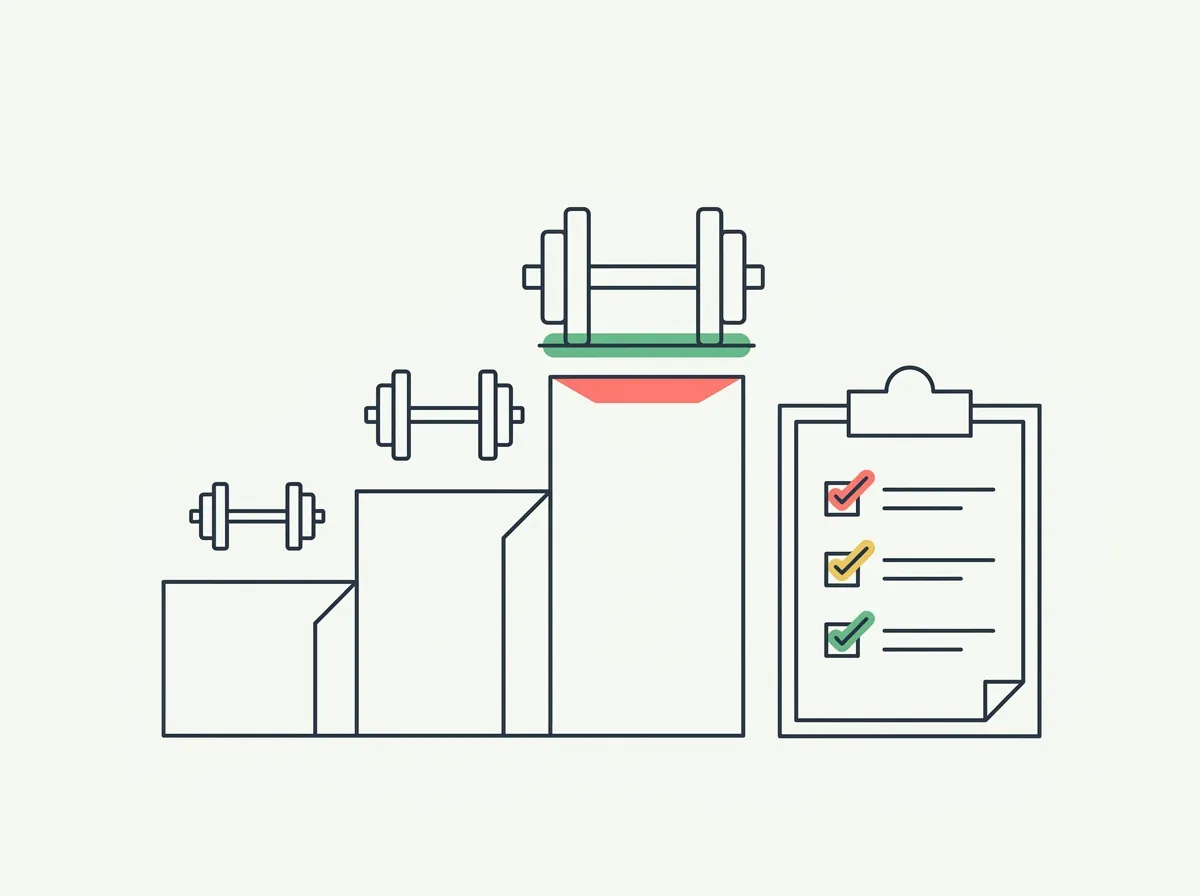
Quick answer: Your level is set by rate of progress, not calendar years: beginners add weight to the bar roughly weekly, intermediates monthly, advanced lifters quarterly at best. Commonly cited strength landmarks - around a bodyweight bench, 1.5× squat, 2× deadlift for men - mark intermediate territory, but standards vary. Most consistent lifters are intermediate.
Ask a room of lifters their level and you get two failure modes. The guy three months in who just discovered programming calls himself intermediate because beginner sounds insulting. The guy five years in benching the same 185 he benched in year two also says intermediate, because the calendar says he can't possibly still be a beginner.
The calendar is the wrong instrument. Training level is a description of how your body currently responds to training - and that's assessable in about two minutes if you look at the right three things. This page is the self-assessment: three axes, one honest scoring rule, and the reason your answer changes what program you should be running.
Why don't calendar years decide your level?
Because training level describes adaptation, not attendance. What commonly gets emphasized by coaches is that training age counts consistent, progressive months - months where you trained regularly and the weights moved. Five calendar years containing two real years of progression is two years of training age. Five years of showing up without progression is closer to zero.
This cuts in a direction people don't expect: it's mostly good news. The lifter who's "been lifting forever" without progressing hasn't spent his fast adaptations - he still has most of his newbie gains available the moment he starts training progressively. Meanwhile the lifter who ran hard, consistent programming for 18 straight months may genuinely be intermediate despite a shorter membership history.
So the assessment below never asks when you joined a gym. It asks three things: how long you've actually progressed, how strong you are for your size, and how fast progress is arriving right now.
How long have you actually been progressing?
Axis one: consistent training age. Count only the stretches where you trained multiple times a week, followed some form of progression, and the weights or reps actually climbed. Be ruthless about it - deload the number for every program-hopping phase, every three-month disappearance, every year of casually repeating the same workout.
Commonly cited descriptions map roughly like this: under a year of consistent progression reads beginner, one to three years reads intermediate, and four-plus reads advanced. Hedge the boundaries; they blur, and they're spent at different speeds by different people.
If your honest count came in way under your calendar years, that's the finding, not a failure. It means the fast part of the curve is still ahead of you.
How strong are you relative to your bodyweight?
Axis two: relative strength. Rough landmarks commonly cited for men put intermediate territory around a bench press of 1× bodyweight, a squat of 1.5×, and a deadlift of 2× - with beginner territory below roughly 0.75× / 1.25× / 1.5×, and advanced commonly gated around 1.5× / 2× / 2.5× or more.
Now hedge all of it, hard. Published standards disagree with each other by wide margins. Heavier lifters hit lower multipliers at the same training quality; lighter lifters hit higher ones. Limb lengths skew individual lifts - long arms tax the bench and help the deadlift. Women's commonly cited multipliers run lower on upper-body lifts and closer to men's on lower-body. Treat the landmarks as orientation for one axis out of three, never as a verdict. For numbers adjusted to your sex, bodyweight, and each lift, our strength standards calculator does the personalized version of this axis. The companion strength standards by bodyweight guide explains where the common bench, squat, deadlift, and overhead press landmarks come from. If your best recent performance was a hard set rather than a true max, use the one-rep max calculator to estimate the number first.
One more caution: strength alone misclassifies people constantly. A genetically strong novice can hit intermediate numbers in months while still progressing weekly like a beginner - which is why the third axis carries the most weight.
How fast are you still progressing?
Axis three, and the one commonly described as the truest test: rate of progress. Beginners can add weight to the bar roughly every session or every week. Intermediates fight for monthly progress and need real programming to get it. Advanced lifters measure progress in quarters and training blocks, and a good year might move a lift by amounts a beginner adds in a month.
This axis works because it measures the thing the labels are actually about - how close you are to your genetic ceiling. The further away you are, the faster your body adapts; the curve is the same one behind the muscle-rate table in how much muscle you can gain in a month.
It's also self-correcting where the other axes lie. The strong novice progressing weekly gets correctly read as a beginner. The stalled veteran gets asked the useful question: is the stall because you're near your ceiling, or because nothing in your training has demanded progress in years? Only one of those makes you advanced.
You can track estimated one-rep max over time using consistent exercises and set conditions. Keep the formula and repetition range comparable, and interpret changes alongside your technique and training log.
Which column describes you most?
The assessment. Read each row, mark the column that honestly matches, and note there's no JavaScript here on purpose - a static table you can't game beats a quiz that tells you what you hoped.
| Axis | Beginner | Intermediate | Advanced |
|---|---|---|---|
| Consistent training age | Under ~1 year of real, progressive training | ~1-3 years consistent | ~4+ years consistent |
| Relative strength (men, commonly cited) | Below ~0.75× BW bench / 1.25× squat / 1.5× deadlift | Around ~1× bench / 1.5× squat / 2× deadlift | Around ~1.5× bench / 2× squat / 2.5× deadlift or beyond |
| Rate of progress | Weights climb weekly, almost automatically | Progress arrives monthly, and needs programming | Progress arrives quarterly at best, even with good programming |
Scoring: your level is the column holding two or more of your three marks. When all three disagree, weight rate of progress most, training age second, strength last - that ordering follows what each axis actually measures.
Split verdicts are diagnoses in themselves. Strength says intermediate but progress says weekly? You're a beginner with a head start - keep riding the fast curve. Training age says advanced but you've stalled at intermediate strength? You most likely have an intermediate body with an advanced calendar, and a programming problem rather than a ceiling problem.
Why does your level actually matter?
Two practical reasons, or this would just be a vanity label.
Programming. Beginners progress fastest on simple linear programs - adding weight every session - and genuinely waste their fastest months running complex periodization built for people who need it. Intermediates need weekly-to-monthly progression structures. Advanced lifters need long, planned blocks. Running the wrong tier's program either leaves free progress on the table or drives you into a wall. The 2025 ACSM resistance training guidelines provide a practical minimum for sets, effort, and weekly frequency before level-specific programming becomes useful.
Expectations. The commonly cited muscle rates fall by level - roughly 1-2 pounds a month for beginners, 0.5-1 for intermediates, 0.25 or less for advanced men. An intermediate expecting beginner-speed results will conclude his working program is broken and hop to a new one, which is one of the classic ways lifters waste their newbie gains and stall the years after them.
Level-appropriate expectations are also why tracking has to get better as you advance. Weekly progress is visible in the gym log; quarterly progress isn't visible anywhere except long-window comparisons. GainFrame covers the visual half of that - progress photos become body fat estimates, per-muscle ratings, and a 1-100 physique score, so an intermediate's monthly grind shows up as a trend instead of a feeling. Estimates from photos rather than clinical measurement, and iOS only - but the slower your progress gets, the more you need an instrument that can see it.
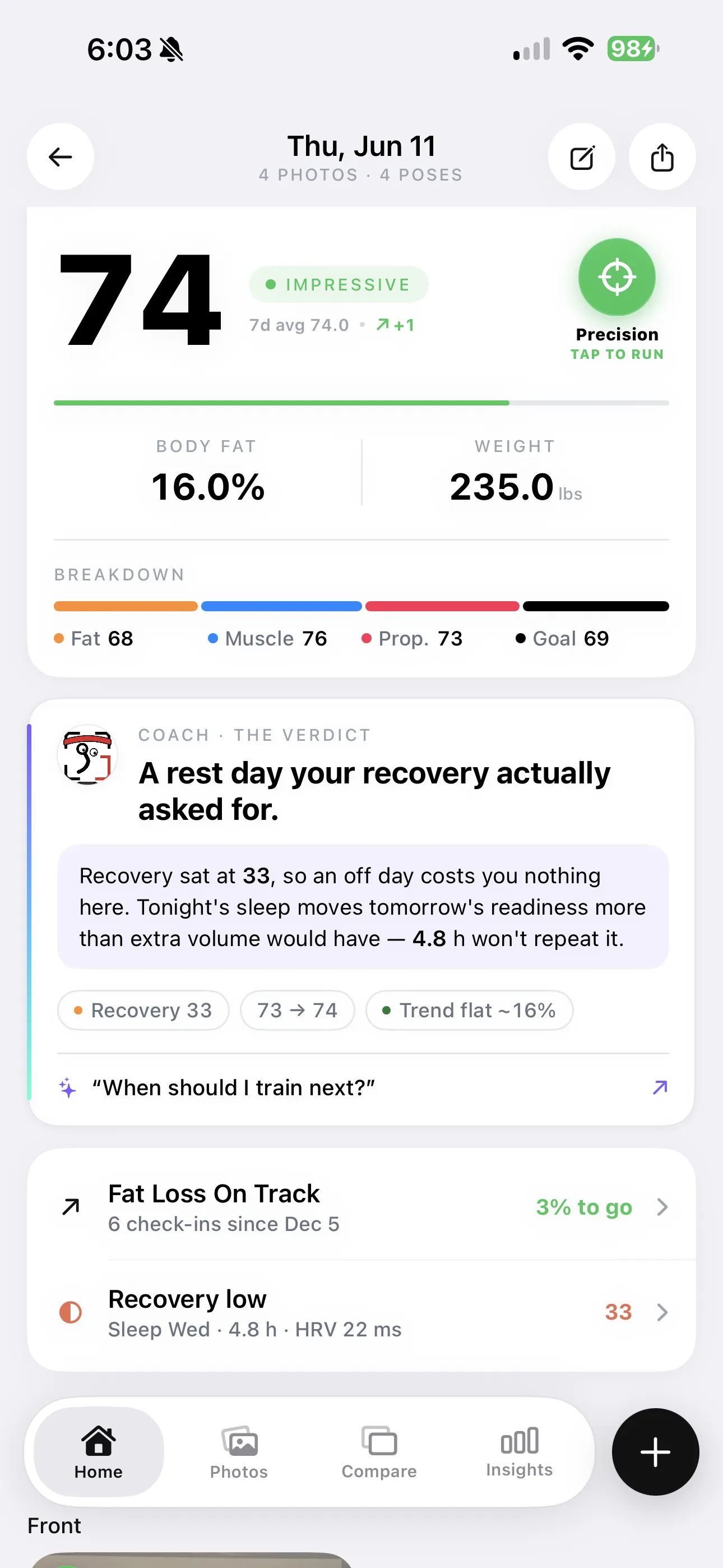
At intermediate speed and beyond, progress hides between months - a scored photo trend is how it stays visible.
Is it bad to still be intermediate?
No - it's the normal condition of nearly everyone who lifts seriously, and it's worth saying kindly because gym culture implies otherwise. By the rate-of-progress definition, intermediate commonly spans years of a training career. The advanced column describes lifters near their genetic ceiling after four-plus consistent years, and that population is far smaller than social media suggests - most impressive physiques you scroll past belong to longtime intermediates on a good day of lighting.
The label also isn't a rank. It's a dosing instruction: it tells you which program tier fits and which progress rate is realistic. A self-assessed intermediate running intermediate programming with intermediate expectations will out-progress a self-assessed "advanced" lifter running a pro's program on a second-year body. If you want to see how far the whole road goes, the FFMI percentiles breakdown shows where lifters actually land across a training lifetime - and the middle of that curve is a crowded, respectable place to be.
Frequently asked questions
What qualifies as an intermediate lifter?
Commonly used markers: roughly 1 to 3 years of consistent progressive training, progress arriving monthly rather than weekly, and strength somewhere around the commonly cited landmarks of a bodyweight bench, 1.5-times-bodyweight squat, and 2-times-bodyweight deadlift for men. Standards vary widely by source and body size - treat the numbers as orientation, and weigh rate of progress most heavily.
Am I a beginner if I've lifted for years but never progressed?
Functionally, mostly yes - and that's good news. Training age is commonly counted in consistent, progressive months, not calendar membership years. Years of sporadic or unstructured lifting build some skill and base, but a lifter whose weights haven't moved retains most of the fast beginner-rate progress. Run a progressive beginner program and you'll likely progress at close to beginner speed.
How long does it take to become an advanced lifter?
Commonly cited descriptions put it around 4 or more years of consistent, progressive training - with the emphasis on consistent and progressive, which is why far fewer lifters get there than gym culture implies. The defining feature isn't a date; it's that progress now arrives over quarters or training blocks, near your genetic ceiling, even with good programming.
What strength standards make you an intermediate lifter?
Rough landmarks commonly cited for men: bench around 1 times bodyweight, squat around 1.5 times, deadlift around 2 times. Hedge these hard - sources disagree, bodyweight and limb lengths skew them, and women's multipliers run lower on upper-body lifts. Strength is also only one of three axes; a lifter can hit the numbers and still progress like a beginner.
Why does my lifter level matter?
Because programming and expectations both key off it. Beginners progress fastest on simple linear programs and waste potential on complex periodization; intermediates need weekly-to-monthly progression structures; advanced lifters need long planned blocks. Expectations follow the same curve - commonly cited muscle rates fall from roughly 1 to 2 pounds monthly for beginners to 0.25 or less for advanced lifters.
Make slow progress visible
GainFrame turns progress photos into body fat estimates, per-muscle ratings, and a physique score - so intermediate-speed progress shows up as a trend line instead of a doubt. Free to start on iOS.
Download GainFrame Free