
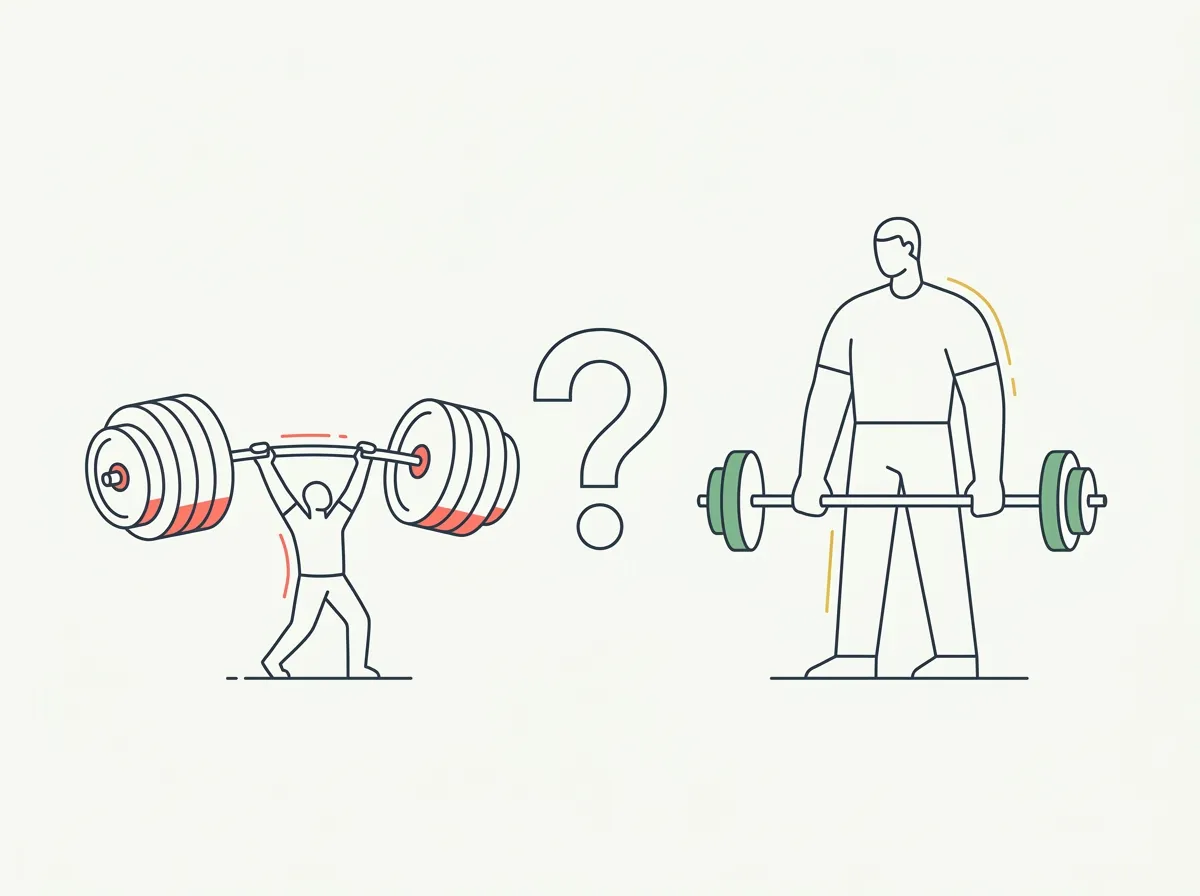
Quick answer: Strength and size are related but separate adaptations. Early strength gains are commonly driven by neural efficiency — recruitment, coordination, skill — which adds weight to the bar without adding visible muscle. Low-rep training, body fat blurring your definition, and expectations calibrated to enhanced physiques explain most of the rest.
You bench 275. The guy two racks over benches 185, and if a stranger had to guess which of you lifts, he wins. You mentioned your numbers exactly once outside the gym, watched someone's eyes flick to your arms, and never brought it up again.
This gap is common enough to have its own genre of forum thread, and the explanations are mostly knowable. Strength and size travel together over a career, but they're driven by different adaptations on different timelines — and several things about your training, your body fat, and your reference points can stretch the gap wide. Here's each mechanism, honestly hedged, and what to change if you want the mirror to catch up.
Why can you be strong without looking big?
Because a meaningful share of strength lives in your nervous system, and nervous systems don't show in a t-shirt.
Training research commonly reports that early strength gains outpace muscle growth by a wide margin: in your first months on a lift, your brain learns to recruit more motor units, fire them faster, coordinate the movement, and stop braking the effort. All of that adds pounds to the bar while adding almost no tissue. Strength is partly a skill, and skills improve without your sleeves getting tighter.
Anatomy stacks on top. Tendon insertions, limb lengths, and segment proportions give some people mechanical leverage that's worth a lot of weight on specific lifts — short arms are a bench-press gift, long arms a deadlift one. Weight-class strength sports are the standing proof: there are 148-pound lifters pulling triple bodyweight who look like fit, normal people, because their sport rewards force per pound rather than circumference.
Is your training built for strength instead of size?
Look at your log. If it's heavy singles, triples, and fives with long rests — powerlifting-shaped training — you've been practicing the skill of strength, and you got what you trained for.
Hypertrophy research commonly favors a different recipe: moderate rep ranges, more total sets per muscle, taken close to failure. Muscle grows in response to accumulated tension and volume; maximal-load work delivers tension but caps how much volume you can recover from, since a heavy triple taxes the whole system for a handful of working reps. This is the practical difference between how powerlifters and bodybuilders train, and it's why the two sports produce different bodies at the same strength level.
None of this means your heavy work was wasted — it built a strength base most physique-first lifters never get. It means the adaptation you bought matches the receipt. Change the stimulus and the tissue commonly follows.
Is body fat hiding the muscle you already have?
Here's the mechanism almost everyone underrates: you may be bigger than you look. At around 20 percent body fat and above, muscle detail disappears under a smoothing layer — delts round off, arms lose their lines, and the waist thickens enough to shrink your shoulder-to-waist contrast. The mass is there; the light just has nothing to catch.
This runs the other way too, and it's why a cut commonly makes a strong lifter look bigger at a lower body weight. Same muscle, more visible edges, better proportions. Our body fat percentage chart shows what each range actually looks like on a body, and the abs timeline guide covers how much fat has to go before definition shows — usually less than people fear, and more than they hope.
If you lift heavy and read as "solid" rather than "muscular," check this box before blaming your genetics.
Are clothes, height, and frame playing tricks on you?
Several purely visual effects widen the gap between what you lift and what people see:
- Height dilutes mass. The same 16-inch arm looks thick at 5'8" and unremarkable at 6'4", because circumference reads against limb length. Tall lifters commonly need substantially more total muscle to look equally big.
- Clothes flatten everyone. A regular-fit t-shirt hides the chest-back thickness that's most of a lifter's mass. Gym mirrors flatter; office lighting and a button-down erase.
- Big frames absorb muscle. Wide-set bones and a thick natural build spread new tissue where it reads as "built like that" rather than "built that."
Photos deserve their own line, because the camera adds a shrink factor on top of everything above — lens distance, focal length, and flat lighting all compress you. If your specific complaint is looking smaller in pictures than in the mirror, that has its own explanation.
Are you comparing yourself to enhanced physiques?
Your calibration for "looks like he lifts" was likely set by social media, and social media over-samples enhanced, dehydrated, pumped, and well-lit bodies. Against that reference set, nearly every natural lifter reads as small — including ones carrying decades of work.
The honest anchor is what natural muscle actually tops out at, and it's less than the feed implies. Our natty limit breakdown puts real numbers on it; the short version is that a natural lifter near his ceiling looks athletic and dense in person and merely "fit" on camera. If your strength is well above average and your size looks merely good, you may simply be calibrated to bodies that aren't playing your game.
How should you track strength and size together?
The reframe that kills the frustration: strength is the input signal, and physique is a lagging output. The bar tells you this week whether training is working; the mirror confirms it a few months later. Judging monthly progress by the slow gauge is how strong lifters convince themselves nothing is happening.
So track both gauges deliberately. Your log already covers strength. For size, two measures beat mirror-squinting: FFMI, which scores muscle mass adjusted for height and body fat, and consistent progress photos, which catch the visual change your daily mirror check adapts away. GainFrame reads both from a photo — estimated body fat, FFMI, and 12 individual muscle group ratings per check-in. Estimates rather than lab numbers, but consistent shot-to-shot, which is exactly what a lagging output needs.
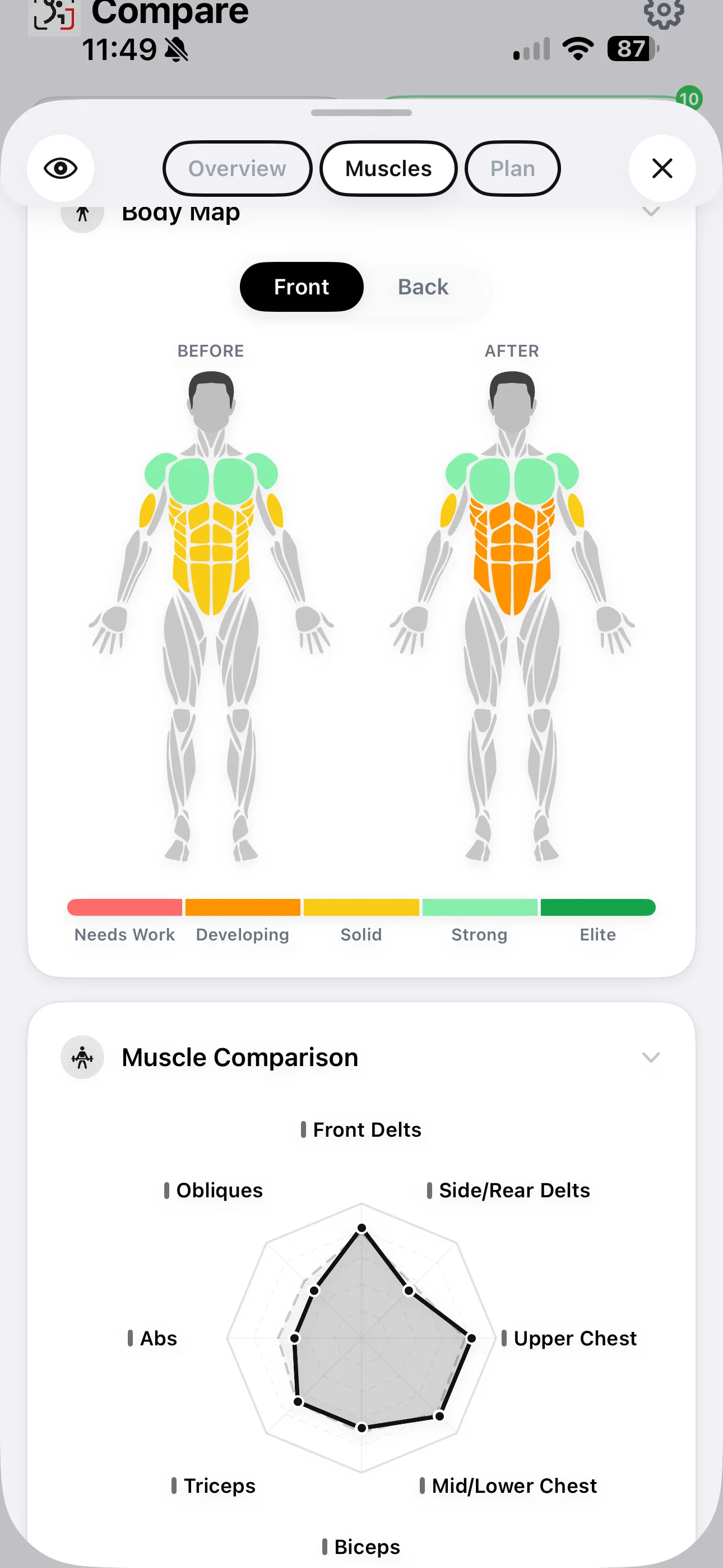
GainFrame's muscle map rates 12 muscle groups per check-in — a size gauge that moves independently of your training log.
What should you change if size is the goal?
Three levers, in order of likely impact:
- Add volume in moderate rep ranges. Keep a heavy top set for the strength you've earned, then build the session around sets of 6–15 taken close to failure. More weekly sets per lagging muscle, added gradually.
- Eat for growth. A small consistent surplus with adequate protein. Years of maintenance-calorie strength training is a common and under-diagnosed reason strong lifters stay small.
- Recalibrate the timeline. Muscle arrives in monthly increments — here's what a realistic month of gains looks like — so judge the change in photos taken weeks apart, never in the mirror tonight.
Your strength base makes all of this faster: you'll do your hypertrophy volume with loads that would be someone else's top sets. The gap between what you lift and what you look like is real, explainable, and — with the stimulus pointed at size — the most closable gap in the gym.
Frequently asked questions
Why am I strong but look small?
Most commonly: your strength gains so far have been substantially neural — better recruitment, coordination, and skill with the lifts — which adds weight to the bar without adding much tissue. Low-rep training, body fat softening your definition, and comparing yourself to enhanced physiques all widen the gap between what you lift and what you look like.
Can you be strong without big muscles?
Yes, within limits. Strength depends on muscle size plus factors that don't show: nervous system efficiency, tendon and leverage advantages, limb lengths, and pure technical skill. Weight-class strength sports prove it constantly — lifters at 148 pounds pull triple bodyweight while looking like fit, normal people. Size sets the ceiling; the other factors decide how close you get.
Do low reps build muscle?
Some, especially early on and when total volume is high. But hypertrophy research commonly favors moderate rep ranges with more total sets, taken close to failure, because they accumulate volume with less systemic fatigue. Heavy singles and triples are primarily a strength-skill tool. If size is the goal, most of your work is commonly better spent around 6 to 15 reps.
Will losing fat make me look bigger?
At moderate body fat levels, commonly yes. Definition returning to the shoulders, arms, and midsection makes the same muscle mass read dramatically larger, and the shoulder-to-waist contrast improves as the waist shrinks. It has limits — very lean with little muscle just looks thin — but for a strong lifter above roughly 20 percent body fat, a cut usually reveals more than another bulk adds.
How long until strength gains show up as size?
Commonly reported patterns put neural adaptation in charge for the first weeks to months of any new lift, with measurable size arriving over months of consistent volume and eating. Expect the bar to move well before the mirror does. Photos and FFMI tracked monthly catch the lag closing; day-to-day mirror checks mostly show you noise.
Track the gauge that lags
Your log tracks strength. GainFrame tracks size — estimated body fat, FFMI, and 12 muscle group ratings from a progress photo, so you can watch the mirror catch up to the bar. Free to start on iOS.
Download GainFrame Free