
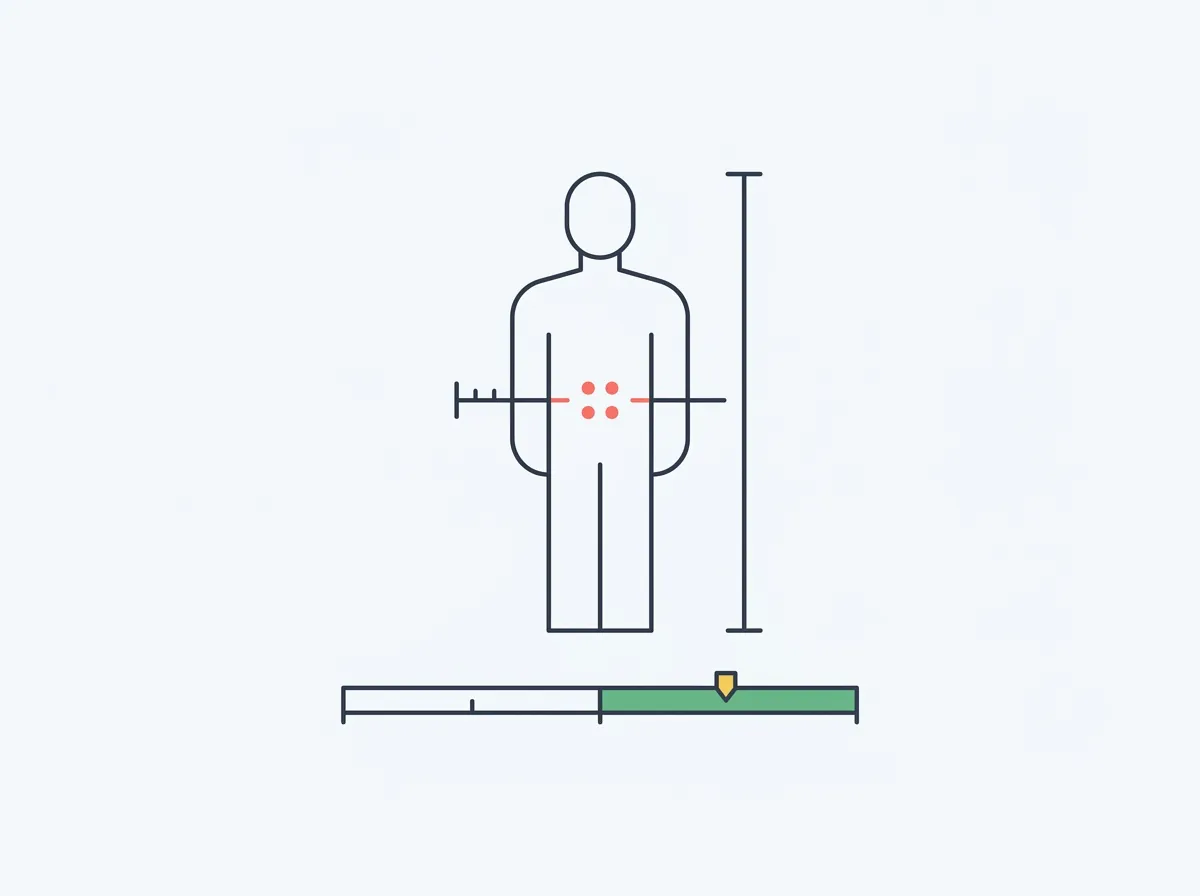
Quick answer: Divide your waist circumference by your height, using the same units. This calculator works in centimeters or inches. A waist below half your height gives a ratio below 0.5, the commonly used screening guide. The result adds context alongside BMI; it does not measure body-fat percentage or diagnose your health.
Calculate your waist-to-height ratio
For adult screening alongside BMI when BMI is below 35. This is not a diagnosis or a body-fat measurement. See the guidance below for who should use a different assessment.
A 35-inch waist at 70 inches tall gives a ratio of 0.50. A 34-inch waist at the same height gives 0.49. Enter your measurements above to see the calculation and where your waist sits relative to half your height.
Waist-to-height ratio adds information about abdominal size that weight alone misses. The NHS waist-to-height guidance presents it alongside BMI, not as a diagnosis. This page includes the chart by height, the measurement method, and the limits that matter when you read the result.
What is the waist-to-height ratio?
Waist-to-height ratio (WHtR) is exactly what it sounds like: your waist circumference divided by your height, in the same units. A 34-inch waist on a 5'10" (70-inch) frame is 34 ÷ 70 = 0.49.
The rule of thumb built on it is even simpler, keep your waist under half your height. For adults with BMI below 35, NICE guidance uses the following bands to help interpret central adiposity alongside BMI:
| Waist-to-height ratio | Commonly cited interpretation |
|---|---|
| Under 0.4 | Low ratio; this alone does not establish underweight |
| 0.4 to below 0.5 | Healthy central-adiposity reference band |
| 0.5 to below 0.6 | Increased central adiposity |
| 0.6 and above | High central adiposity |
Treat the boundaries as screening lines, not diagnoses. Different bodies of research draw them slightly differently, and a ratio of 0.51 versus 0.49 is a nudge to pay attention, not a medical event. The ratio scales the waist measurement to height: a 36-inch waist is below 0.5 at 6'4" and above it at 5'6". Neither result alone establishes whether someone is healthy.
How do you read the waist-to-height ratio chart by height?
Find your height below. The second column shows the 0.5 screening line; it is a threshold, not a personal target weight or a diagnosis. Use the rib-to-hip midpoint measurement described below.
| Height | Below the 0.5 line | 0.5 to below 0.6 | 0.6 and above |
|---|---|---|---|
| 5'4" (64 in) | under 32 in | 32 to under 38.4 in | 38.4 in or more |
| 5'5" (65 in) | under 32.5 in | 32.5 to under 39 in | 39 in or more |
| 5'6" (66 in) | under 33 in | 33 to under 39.6 in | 39.6 in or more |
| 5'7" (67 in) | under 33.5 in | 33.5 to under 40.2 in | 40.2 in or more |
| 5'8" (68 in) | under 34 in | 34 to under 40.8 in | 40.8 in or more |
| 5'9" (69 in) | under 34.5 in | 34.5 to under 41.4 in | 41.4 in or more |
| 5'10" (70 in) | under 35 in | 35 to under 42 in | 42 in or more |
| 5'11" (71 in) | under 35.5 in | 35.5 to under 42.6 in | 42.6 in or more |
| 6'0" (72 in) | under 36 in | 36 to under 43.2 in | 43.2 in or more |
| 6'1" (73 in) | under 36.5 in | 36.5 to under 43.8 in | 43.8 in or more |
| 6'2" (74 in) | under 37 in | 37 to under 44.4 in | 44.4 in or more |
| 6'3" (75 in) | under 37.5 in | 37.5 to under 45 in | 45 in or more |
| 6'4" (76 in) | under 38 in | 38 to under 45.6 in | 45.6 in or more |
At 70 inches tall, the 0.5 line is 35 inches and the 0.6 line is 42 inches. The average waist size guide provides population context, but its survey measurements use a different anatomical landmark. Use a consistent measurement method for your own ratio rather than comparing unlike tape positions.
How do you calculate your ratio?
The calculation takes one division:
WHtR = waist circumference ÷ height (same units for both).
A 38-inch waist at 6'1" (73 inches): 38 ÷ 73 = 0.52, in the increased band. An 84-cm waist at 178 cm: 84 ÷ 178 = 0.47, within the reference band. Inches or centimeters both work because the units cancel. You can also compare twice your waist measurement with your height to see which side of 0.5 you fall on. Avoid rounding before interpreting a result close to a boundary.
How does waist-to-height ratio complement BMI?
BMI relates total mass to height. It cannot distinguish muscle from fat or show where fat is carried. Waist-to-height ratio adds a separate measurement, which helps explain two common situations:
A muscular person can have a higher BMI and a smaller waist. A 5'10" lifter at 195 lbs with a 33-inch waist has a BMI around 28 and a WHtR around 0.47. The measurements describe different things; neither resolves overall health by itself. Our body fat % vs BMI breakdown explains that distinction.
A normal-range BMI can coexist with a larger waist. A 5'10" person at 167 lbs with a 40-inch waist has a BMI around 24 and a WHtR around 0.57. That additional waist measurement can be useful in a broader assessment.
Waist circumference reflects abdominal size, including muscle and several fat compartments. It does not isolate or directly measure visceral fat. NICE's rationale for using the two measures together explains why waist-to-height ratio can add useful context for adults with high muscle mass. It is not immune to measurement error or changes in abdominal muscle.
How do you measure your waist for WHtR?
The ratio is only as good as the tape work, and the failure mode is always the same: measuring where the pants sit and flattering yourself by an inch of breath. The protocol:
- Find the midpoint between your lowest ribs and the top of your hips. Position the tape there, rather than using your pants waistband or assuming your navel is the correct landmark.
- Stand relaxed, no flexing, no sucking in. You're screening your body, not auditioning it.
- Exhale normally and read the tape at the end of the breath. Not forced empty, not held full.
- Keep the tape parallel to the floor, snug against the skin without compressing it.
- Repeat under the same conditions, morning, before food, is least noisy.
This is the self-measurement method in the NICE guidance linked above. Health surveys can use other landmarks, so record your tape position and keep it consistent. Measure height without shoes; overstating height or tightening the tape lowers the ratio without changing your body.
What does the ratio look like on a body?
These standardized, photorealistic AI renders from our body fat visualizer illustrate different body-fat levels with the same reference build, pose and lighting. They are not measured subjects. You cannot infer a specific waist-to-height ratio or health classification from the renders; that requires a tape measurement.
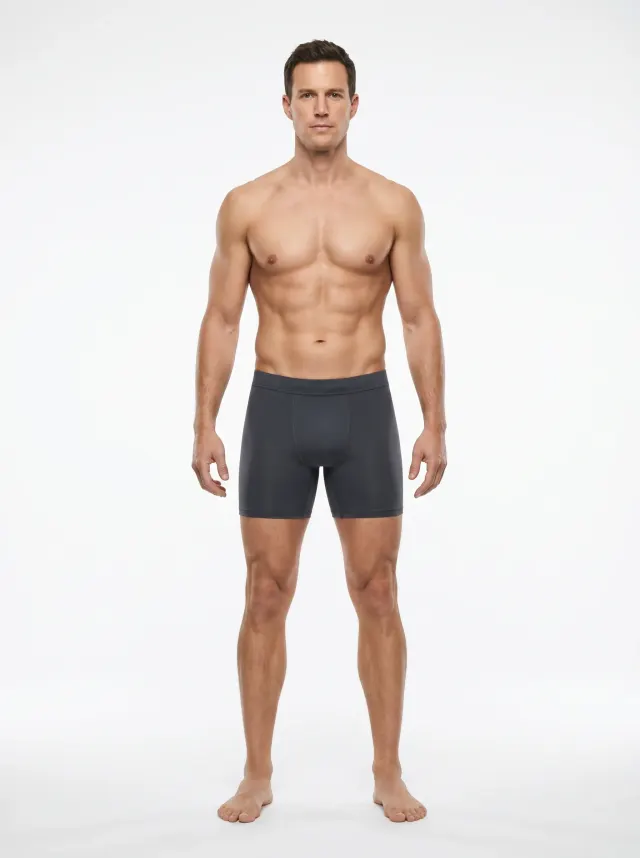
Illustrative 18% reference. The appearance does not establish a waist measurement or a health category.
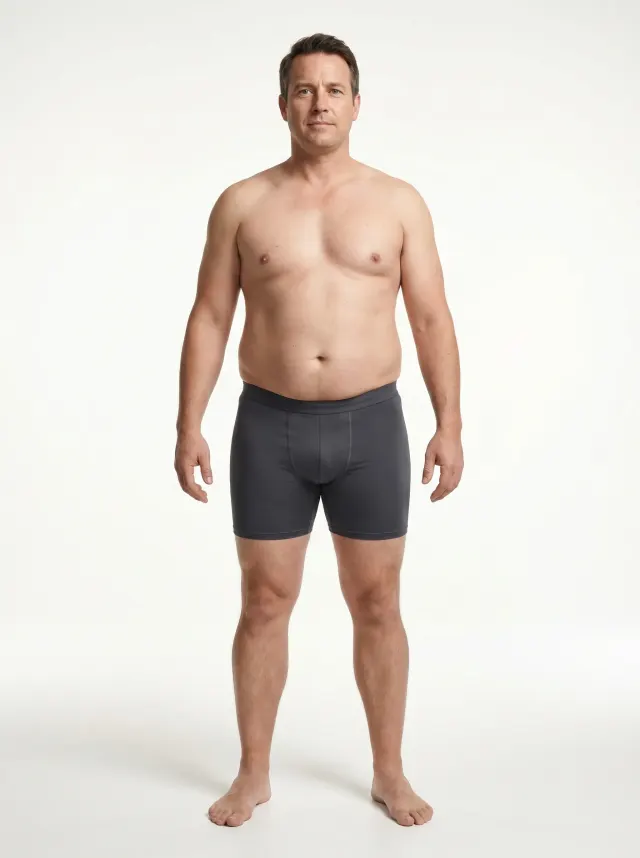
Illustrative 28% reference. Measure your own waist and height instead of assigning yourself a ratio from a picture.
For tracking, use actual measurements alongside consistent photos. Changes in waist circumference, posture, measurement technique or height can change the ratio. Record the conditions so a difference between check-ins is easier to interpret.
What can the ratio tell you, and where are its limits?
Honesty about limits, because this is where the rule gets oversold:
It is one part of a health assessment. A ratio below 0.5 does not rule out illness or establish body composition. Two people with the same ratio can have different muscle mass, fat distribution and medical histories. For aesthetics, the ratio that matters puts the waist in the denominator against your shoulders; our shoulder-to-waist ratio guide covers that math.
It's one number with screening-grade precision. It doesn't know your fat distribution beyond the waistline, your training history, your bloodwork, or your genetics. Use it alongside other information rather than treating a band label as a complete assessment.
Use the right guidance for your circumstances. This page's calculator is for adult screening alongside BMI when BMI is below 35. The NHS eligibility guidance excludes pregnancy, eating disorders and conditions affecting height; children need age-appropriate guidance.
It moves slowly. A waist changes by fractions of an inch per week even on a well-run cut, so the ratio is a monthly signal, not a daily one. For week-to-week feedback, photos catch what the tape misses, GainFrame estimates body fat percentage and physique scores from progress photos, so the waist trend and the visual change live in one place. Photo estimates, not clinical measurement, but consistent week to week, which is what a trend needs.
Frequently asked questions
What is a healthy waist-to-height ratio?
For adults with BMI below 35, the commonly used reference band is 0.4 to below 0.5. Ratios from 0.5 to below 0.6 indicate increased central adiposity; 0.6 or higher is the high band. These are screening categories, not a diagnosis or a measure of body-fat percentage.
How do I calculate my waist-to-height ratio?
Measure your waist midway between your lowest ribs and the top of your hips after a normal exhale. Divide that circumference by your height, using the same units. For example, a 36-inch waist at 70 inches tall gives 36 divided by 70, or about 0.51. Centimeters work the same way.
Is waist-to-height ratio better than BMI?
It adds information that BMI does not provide. BMI relates total mass to height, while waist-to-height ratio adds abdominal size. NICE recommends using both for adults with BMI below 35, including people with high muscle mass. Neither measure alone diagnoses health, directly measures visceral fat or distinguishes every source of abdominal size.
Does the 0.5 rule apply to everyone?
No. This page uses adult screening guidance and is not a substitute for an individual assessment. Pregnancy, eating disorders and conditions affecting height need different guidance, and children require age-appropriate advice. For adults with BMI of 35 or above, the reference bands on this page are not the recommended assessment method.
Can a waist-to-height ratio be too low?
A ratio below 0.4 means the waist is small relative to height, but it does not establish underweight, adequate nutrition or muscle mass. Interpret it together with weight history, body composition and clinical context. A smaller number is not automatically a better result, and the ratio should not become a target in isolation.
Track the ratio you can see
GainFrame estimates body fat percentage and physique scores from your progress photos, so the waist coming off shows up as visible, tracked change, not just a smaller decimal. Free to start on iOS.
Download GainFrame Free