
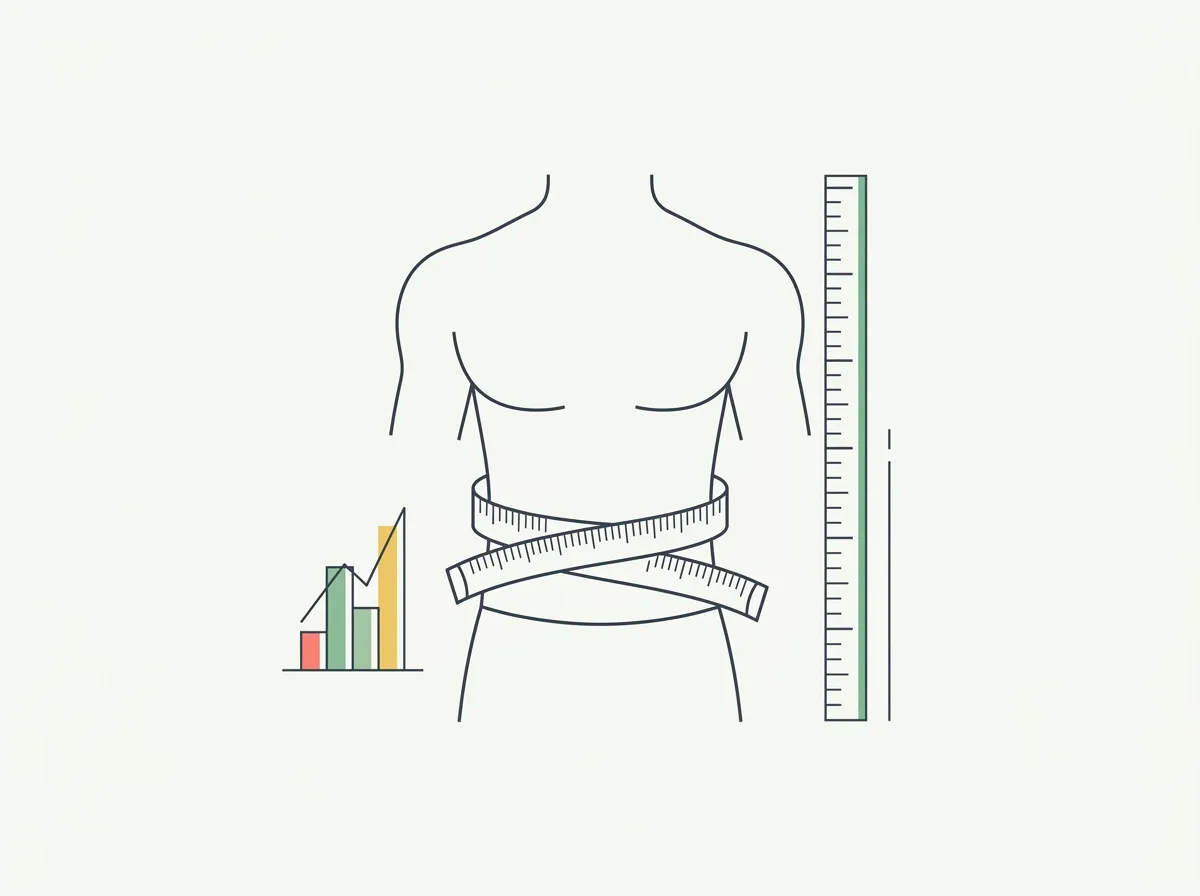
Quick answer: NHANES 2015-2018 measurement data puts the average American man's waist at 40.5 inches, measured at the iliac crest. That's also roughly the threshold where health risk rises - most guidance flags waists over 40 inches in men. A better personal target: keep your waist under half your height.
Where does your waist actually sit?
The median man aged 30–39 measures 39.3". Enter yours to compare.
Percentiles from NHANES 2015–2018 · NCHS Vital and Health Statistics, Series 3, No. 46 (Tables 19–20). Measured at the iliac crest, not at your pants label — the two differ by several inches on most people.
You wear 34-inch pants. Then you wrap a tape measure around your actual waist - at the navel, where every health guideline says to measure - and it reads 39. Five inches appeared out of nowhere, and your first instinct is that you measured wrong.
You didn't. Pants size and waist size are two different measurements of two different places, and the gap between them is why most men have no idea what their real waist is. This page covers what's average, what's healthy for your height, why the pants label lies, and what a few inches of waist actually looks like on a body.
What is the average waist size for men?
The most recent US national measurement data - NHANES 2015-2018, published by the National Center for Health Statistics - puts the average adult male waist at 102.9 cm, or 40.5 inches, measured at the iliac crest. Read that against the clothing rack, where 32 to 36 dominates the shelf space, and the disconnect is obvious. The survey tape and the pants label are not measuring the same thing. Our guide to average body fat percentage for men adds the composition context that a waist measurement alone cannot provide.
The average also climbs with age. These are the actual measured figures, not estimates:
| Age | Average (mean) | Typical (median) |
|---|---|---|
| 20-29 | 37.1 in | 35.7 in |
| 30-39 | 40.4 in | 39.3 in |
| 40-49 | 41.0 in | 40.5 in |
| 50-59 | 41.4 in | 40.7 in |
| 60-69 | 42.2 in | 41.8 in |
| 70-79 | 42.3 in | 42.0 in |
| 80+ | 41.1 in | 41.0 in |
Two columns because they answer different questions. The mean is the arithmetic average, and it gets dragged upward by the heaviest men in each group. The median is the middle man - half of his age group is smaller, half larger - which is the number most people actually mean when they ask what's normal. The gap between them, widest in the 20s, is the shape of the distribution: a long right tail.
The pattern is what matters. The average man gains roughly an inch of waist per decade through his 60s, and by his 40s the average sits past the 40-inch mark that health guidance commonly flags as elevated risk.
Which leads to an uncomfortable arithmetic: the average American man's waist is approximately equal to the risk threshold. Average and fine are not the same thing.
What is a normal waist size by height?
A 38-inch waist means something different at 6'4" than at 5'7", which is why the flat 40-inch cutoff is a blunt tool. The refinement most commonly used is the waist-to-height ratio: keep your navel waist under half your height.
| Height | Waist target (under 0.5 × height) |
|---|---|
| 5'6" | under 33 in |
| 5'8" | under 34 in |
| 5'10" | under 35 in |
| 6'0" | under 36 in |
| 6'2" | under 37 in |
| 6'4" | under 38 in |
Two thresholds are worth keeping in your head together. Waist-to-height under 0.5 is the commonly cited general target. And a waist over 40 inches in men is commonly flagged as elevated risk regardless of height. If you clear both, your waist is unlikely to be your limiting health factor.
Why does a beltline measurement predict anything? Because waist circumference is a rough proxy for abdominal fat - including the visceral fat packed around your organs, which is the metabolically nasty kind. Our visceral fat guide goes deeper on that. It's also part of why waist tells you things BMI can't - BMI counts total mass and has no idea where you keep it.
Why is your pants size smaller than your real waist?
Two mechanisms stack, and both push the same direction.
Location. Fashion waistbands sit at the hips, typically 2-3 inches below the navel. For most men - especially anyone carrying belly fat - the navel line is the widest point and the hip line is narrower. Health guidelines measure the navel; your jeans skip it entirely.
Vanity sizing. A pair labeled 34 commonly measures 35-36 inches of actual fabric. Brands learned decades ago that men buy the smaller number, so the label drifted from the tape.
Add them up and a man in "34s" often carries a 38-40 inch navel waist. This is why the survey average of ~40 inches sounds impossible to men who've never put a tape at their navel - the number they know is the label, and the label is measuring somewhere else, generously.
How do you measure your waist correctly?
The protocol takes thirty seconds and removes the guesswork:
- Stand relaxed, feet together, arms at your sides. No flexing, no sucking in.
- Wrap the tape at navel level, parallel to the floor all the way around. Check it in a mirror - a tape that dips at the back reads low.
- Exhale normally and measure at the end of the breath. Not forced empty, not held full.
- Snug, not compressing. The tape should sit on the skin without denting it.
- Same conditions every time - morning, before food, is the least noisy. Waists swing an inch-plus through a day of meals and water.
Measure weekly under those conditions and the trend is one of the most reliable fat-loss signals you can get for free - often more responsive than the scale, because it can move even during a recomp when weight holds still.
What does a 4-inch waist difference look like?
Numbers on a tape are abstract. Here's the same man at two body fat levels - these are standardized, photorealistic AI renders from our body fat visualizer - same build, pose, and lighting, so only body fat changes between images. The jump from 18% to 28% body fat on the same frame corresponds to several inches of navel waist, on the order of the 4-inch gap between a 35 and a 39.
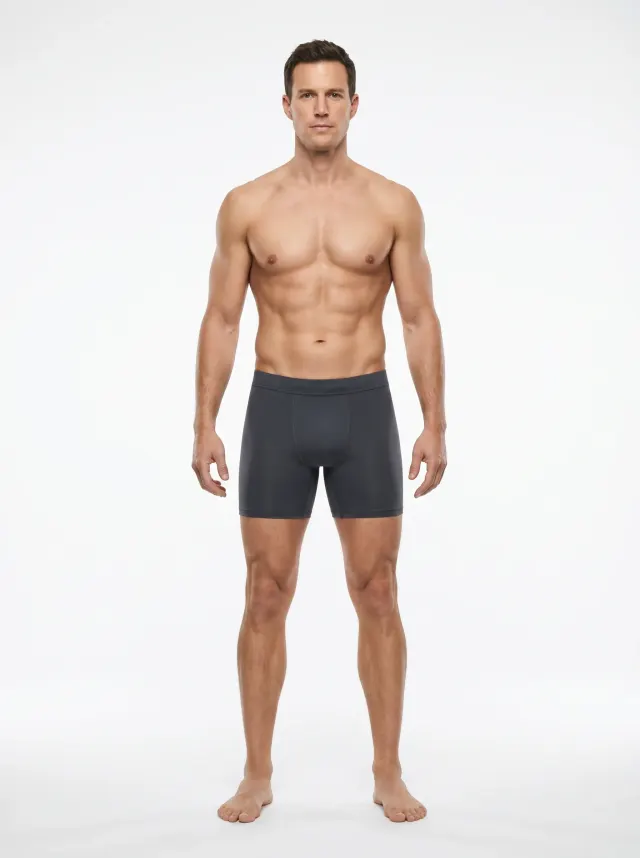
18% body fat - a waist comfortably under half of height. Some softness, but the waistline is clearly narrower than the shoulders.
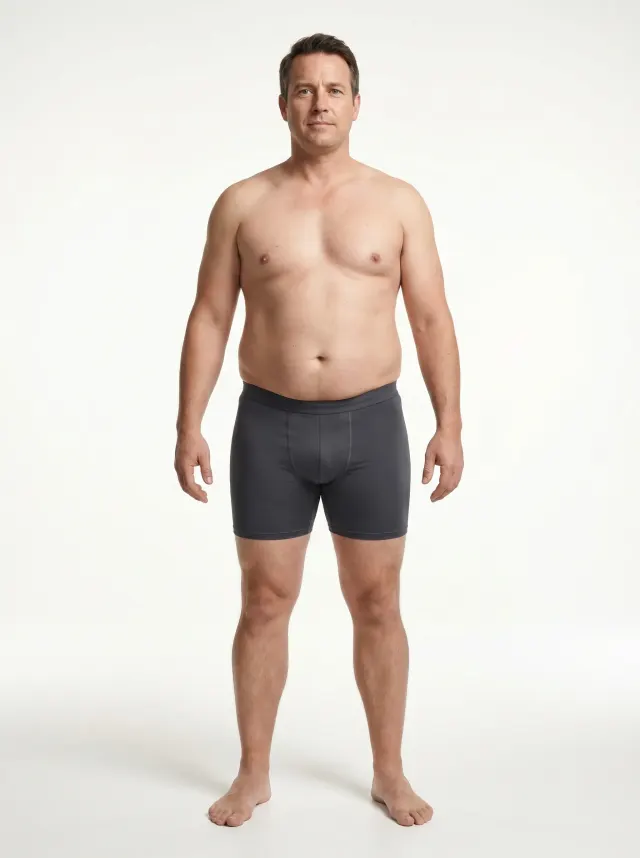
The same frame at 28% - several inches more waist, and the shoulder-to-waist contrast has mostly disappeared.
Notice what changed and what didn't. Shoulders, arms, and legs are close to identical. Nearly the entire visual difference lives at the waistline - which is exactly why the tape at your navel is such an efficient measurement.
Why does waist size matter for how you look?
Everything above is the health case. The aesthetics case is arguably stronger, because the waist sits in the denominator of the ratio that drives how a male physique reads: shoulders divided by waist.
Commonly cited ideals put that ratio around 1.6 - the V-taper. And the math is brutally asymmetric: adding an inch of shoulder circumference takes months of pressing and lateral work, while dropping an inch of waist happens in weeks of a modest cut. The waist is the fast lever. Our shoulder-to-waist ratio guide includes a worked table showing exactly how much ratio improvement each inch of waist is worth at different shoulder sizes.
The tape tracks the number, but photos catch what the tape misses - posture, proportion, where the inches came off. GainFrame reads body fat percentage and physique scores from progress photos, so the waist trend and the visual verdict live in one place. Estimates from photos, not clinical measurement - but consistent week to week, which is what a trend needs. If you just want a one-off number today, the free browser body fat estimator does a single scan a day with no download or signup.
Frequently asked questions
What is the average waist size for a man in the US?
National health survey data commonly cited puts the average American man's waist around 40 inches, measured at the navel. That's notably larger than the average pants size sold, because pants are measured lower on the hips and vanity sizing shaves the label. Averages climb with age, from the high 30s in men's 20s to the low 40s past 50.
Is a 36-inch waist big for a man?
It depends on height. At 6'4", a 36-inch waist is exactly half of height - right at the commonly used waist-to-height target. At 5'8", the same waist is above 0.5 and worth addressing. As a navel measurement, 36 inches is smaller than the commonly cited US average of about 40 inches.
What waist size is healthy for my height?
The most commonly used rule of thumb is a waist-to-height ratio under 0.5 - keep your navel waist below half your height. That's roughly 34 inches at 5'8", 35 at 5'10", 36 at 6'0". Guidance also commonly flags waists over 40 inches in men as elevated risk regardless of height.
Why is my waist size bigger than my pants size?
Two reasons. Pants sit at your hips, several inches below the navel, where most men are narrower. And vanity sizing means a labeled 34 often measures 35-36 inches of actual fabric. Together, the gap between labeled pants size and true navel waist commonly runs 2-5 inches - occasionally more.
Does waist size matter if my BMI is normal?
Yes - arguably more. Waist circumference is a proxy for abdominal fat, including visceral fat around the organs, which BMI can't see. A man with a normal BMI and a waist creeping past half his height is carrying fat in the riskiest place while the headline number says he's fine.
See the waist change, not just measure it
GainFrame estimates body fat percentage and physique scores from your progress photos - so the inches coming off your waist show up as visible, tracked change. Free to start on iOS.
Download GainFrame Free