
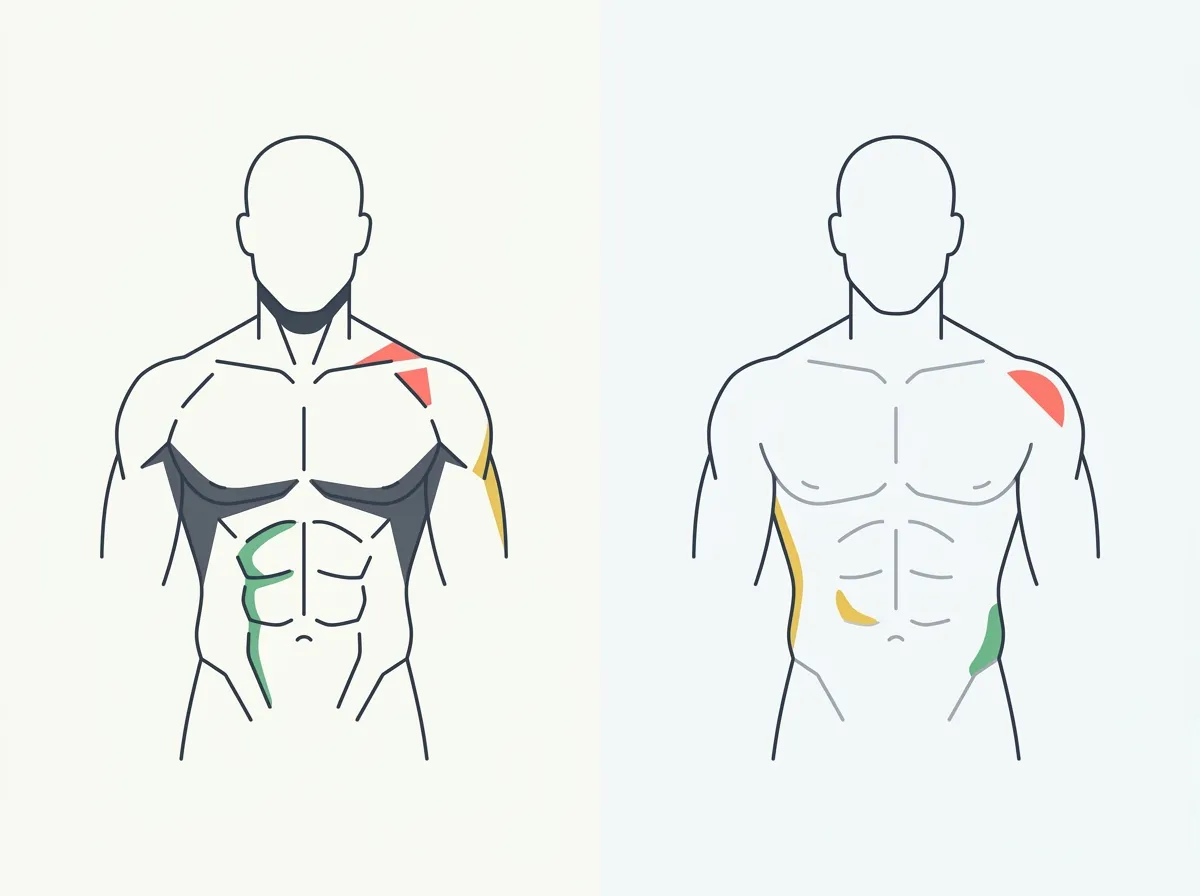
Quick answer: Overhead, directional light casts shadows into the grooves between muscles, which is why gym mirrors flatter you. Diffuse bathroom light fills those shadows and flattens everything. Lighting alone can swing apparent definition by what looks like several body fat points — your body didn't change, the shadows did.
You finish a pump-heavy session, catch yourself in the gym mirror, and there they are: four abs, maybe six, obliques cutting in at the sides. Twenty minutes later you're home, shirt off in the bathroom, and it's gone. Smooth. Like someone deflated you at a red light.
Your body fat did not change on the drive home. Nothing about your body changed except the room it's standing in. What you're seeing is physics, and it's worth two minutes to understand — because it's quietly ruining how you track your progress.
Why do your abs show in the gym mirror?
Muscle definition isn't a thing your eyes see directly. What you actually see is shadow — small pockets of darkness sitting in the grooves where one muscle ends and another begins. No shadow in the groove, no visible definition, regardless of what's under the skin.
Gym lighting is nearly perfect shadow-making equipment. It's bright, it's directional, and it comes from above. Light raking down your torso from overhead hits the high points — the bellies of your abs, the ridge of your chest — and skips the valleys between them. Every valley goes dark. Dark valleys read as "shredded."
The steeper the angle of the light, the deeper the shadows, the more separated everything looks. That's the whole trick. Bodybuilders have posed under harsh top-down stage lighting for decades for exactly this reason.
Why does bathroom light erase them?
Your bathroom does the opposite of everything the gym does. The light is usually softer, warmer, and — this is the killer — diffuse. A frosted fixture, a white ceiling bouncing light everywhere, maybe a mirror-side bulb hitting you from the front.
Diffuse light arrives from many directions at once. Whatever shadow one ray casts into a groove, another ray coming from a different angle fills back in. No surviving shadows, no visible separation. The same abs that popped an hour ago are still there, doing structural work, completely unlit.
Front-facing light is the harshest flattener of all. Light hitting you straight-on fills every groove by definition — which is why flash selfies make almost everyone look smoother than they are.
How much can lighting change how lean you look?
More than most people believe until they test it. Walk the same body from flat bathroom light to hard overhead light and the apparent change can look like several body fat points — the difference between "barely any definition" and "clearly visible abs" without a gram of fat moving.
For context on what those points mean: the visual difference between roughly 18% and 13% body fat on a man is substantial — our body fat percentage chart with photos shows it level by level. Lighting can fake a swing of that magnitude in either direction. A month of disciplined dieting might move you 1–2 real points; one bad light source can visually erase all of it, and one great light source can fake it.
This is also why physiques on stage and physiques in airport light look like different people, and why the aesthetic physiques you see online are partly a lighting decision. And it's half the answer to a related mystery — why you look smaller in photos than in the mirror — where lens and angle pile on top of the lighting problem.
The honest conclusion follows directly: an unstandardized selfie is a lighting measurement, not a body measurement. A gym-light photo this week will beat a bathroom-light photo from last week even if you gained fat in between. Comparing them tells you nothing.
What's the right photo setup for actually tracking progress?
Once the setup is consistent, a scored baseline helps: the free AI ab analyzer rates ab visibility from one photo under whatever light you standardize on, so next month's photo has a number to beat.
You don't need photography gear. You need repeatability — pick one configuration and never change it:
- One location. Same room, same wall, feet on the same spot. Mark the floor with tape if you have to.
- One light source, overhead and slightly in front. A single ceiling light a bit ahead of you shows definition honestly — enough shadow to see separation, not so much that it's a stage pose. Kill every other light. Skip window light entirely; it changes hour to hour.
- One time of day. Morning, before food, is the standard — it removes the day's food-and-water fullness from the comparison too.
- One distance, one pose. Prop the phone at the same height and distance, relaxed pose first, every time.
Do that, and lighting drops out of the equation. Whatever changes between this week's photo and last month's is you. The full checklist — angles, poses, timing — is in our complete guide to progress photos.
Why does consistency matter even more for AI body-fat estimates?
Everything above about your eyes applies to software too. Any tool estimating body composition from a photo is reading the same visual evidence — shading, contour, separation. Feed it a shadow-carved gym photo one week and a flat bathroom photo the next, and you've handed it two different-looking bodies. Garbage in, noise out.
That's exactly why standardized photos are the price of admission for photo-based tracking. GainFrame estimates body fat percent and rates 12 muscle groups from your check-in photos, then lines up any two check-ins side by side, auto-aligned, with the deltas computed. The comparison is only as honest as the photo conditions — same light, same spot, same time — which is why the setup above isn't fussiness. It's what makes week 1 versus week 12 a real measurement instead of a lighting contest. Worth knowing: it's iOS only, and the numbers are estimates from photos, not a clinical scan.
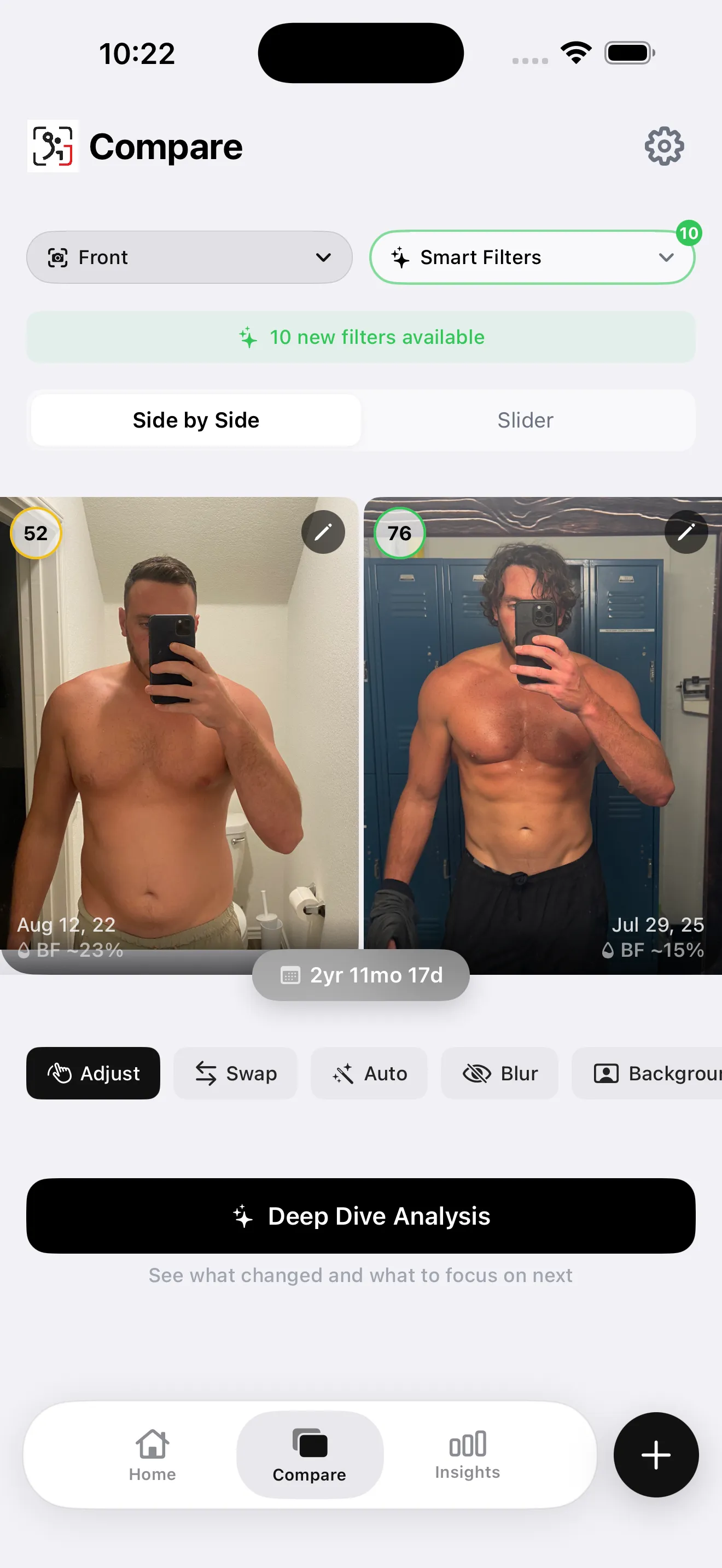
Two check-ins, same conditions: when the lighting is constant, the delta is actually you.
Frequently asked questions
Why do my abs look better in the gym mirror?
Gym lighting is usually bright, overhead, and directional. Light hitting your torso from above casts small shadows into every groove between muscles — the separation lines of your abs, the cut of your obliques. Those shadows read as definition. Your bathroom likely has softer, more diffuse light that fills the same grooves in, so the identical body looks smoother.
Can lighting really make you look leaner than you are?
Yes, dramatically. Move from flat diffuse light to hard overhead light and the same physique can look like it dropped what appears to be several body fat points — visible abs versus barely-there abs, purely from shadow depth. Physique competitors and fitness photographers exploit this deliberately. It changes nothing about your actual body composition, only what the surface shows.
What is the best lighting for progress photos?
The best lighting is the one you can repeat exactly. A single overhead light slightly in front of you shows definition honestly without competition-stage exaggeration. Avoid window light, which changes with weather and time of day. Same room, same fixture, same spot on the floor, same time of day — consistency beats flattery for tracking purposes every time.
Why do my abs disappear at night?
Two things stack in the evening. Physically, a day of food, fluid, and sodium adds genuine abdominal fullness that softens definition. Optically, evening home lighting tends to be warm, dim, and diffuse — the exact conditions that fill in muscle shadows. Morning you, fasted under a hard overhead light, is the leanest-looking version of the same body.
Do unstandardized selfies work for tracking progress?
Not really. If lighting alone can swing apparent definition more than a month of honest dieting changes it, random selfies mostly measure your lighting, not your body. A photo in gym light will beat last week's bathroom photo even if you gained fat. Standardize location, light, time, distance, and pose, and photos become one of the best tracking tools available.
Make your photos mean something
GainFrame turns standardized check-in photos into numbers you can compare — estimated body fat, muscle-group ratings, and auto-aligned side-by-side deltas across weeks. Free to start on iOS.
Download GainFrame Free