
Quick answer: Arms can look small because of muscle size, proportions, body fat or the way you compare photos and measurements. Review your training consistency, progression, nutrition and measurement setup before blaming genetics. A cause-and-next-step checklist can identify what to investigate; appearance alone cannot diagnose why your arms have changed.
If you are early in training, the newbie-gains guide explains how to evaluate progress without a fixed deadline. For proportions, our hand-size guide distinguishes length and span from the size of your arm.
What should you check first if your arms look skinny?
| What you notice | Possible explanation to investigate | Next step |
|---|---|---|
| Measurements vary between checks | Tape placement, flexing or a post-workout pump | Repeat under the same conditions |
| Other lifts progress but arm work is inconsistent | The program may not match your arm-growth goal | Review the actual logged biceps and triceps work |
| Training and recovery are inconsistent | The routine may be hard to sustain | Review attendance, food intake and recovery together |
| Arms look different in photos but the tape is similar | Lighting, camera distance and posing | Compare matched views |
| A small-looking upper arm is being called “short” | Length and circumference may be confused | Use the bicep-length guide to identify the dimension |
Use average bicep size for circumference context, while remembering that a population average is not an individual growth target. Sudden size loss, pain or new weakness deserves medical assessment rather than a programming guess.
A year of lifting. Your bench is up 50 pounds, your shirts fit tighter across the chest and shoulders, and people have started to notice. Then you wrap a tape around your upper arm and it reads the same 12.5 inches it did last summer.
Arms are the body part most likely to produce this exact story, and it's rarely random bad luck. There are five mechanisms that keep arms skinny while everything else grows, most people are running two or three of them at once, and every one of them has a known fix. Here's the honest breakdown.
Why do arms show neglect louder than any other muscle?
Biceps and triceps are small muscles, and small muscles are unforgiving in both directions. A few weekly sets of direct work moves them noticeably; skipping direct work parks them for years. There's simply less tissue to hide programming gaps in , a lagging upper chest disappears into a big torso, while a lagging arm hangs there in every T-shirt.
Genetics also speak louder in the arms than almost anywhere else. Bicep insertion points vary widely , a high insertion leaves a visible gap at the elbow that reads as thinness no matter how the muscle is developed. And the visual ratio between forearm and upper arm changes how the whole limb reads: a thin forearm makes the bicep above it look smaller than its measurement, which is part of why average forearm size matters more for appearance than most lifters assume.
Neither of those is a diagnosis of doom. They set the shape of your arms; the next three sections decide the size.
Are compound lifts enough to grow your arms?
This is a genuine debate, and both sides have a real point. Rows and pull-ups load the biceps; presses and dips load the triceps. Some lifters build respectable arms on compounds alone, and any program built purely around isolation curls would be worse, so the "big lifts are enough" camp isn't wrong about everything.
But for many lifters , commonly those with long arms, or leverages that let chest and back do most of the work , compounds under-stimulate the arms relative to what those muscles need to grow. The arm's contribution to a row is real but submaximal, taken through partial ranges, and never pushed close to failure for the arm itself. Torso muscles get a growth stimulus; arms get an assist credit.
The practical test cuts through the debate: if your compound lifts have progressed for months and your arm measurement hasn't moved, your arms are telling you the compounds aren't reaching them. That's data, and the response is direct work, covered below.
Are you eating enough to grow anything?
Here's the mechanism nobody wants to hear: skinny arms are often just the most visible symptom of skinny everything. If you're 6 feet tall at 150 pounds, the problem isn't your curl selection , no arm specialization program can outrun a body that has no building material.
Muscle gain is slow even when eating is dialed. Commonly cited natural rates land around 0.5-2 pounds of total muscle per month depending on training age , our honest muscle gain numbers breaks that down , and your arms receive only a small fraction of any month's total. Eat at maintenance or below while underweight and that trickle rounds to zero.
The check is blunt: if your bodyweight hasn't moved in 3 months, you're not in a surplus, whatever it feels like. A modest surplus of roughly 200-300 calories over maintenance is commonly enough, paired with adequate protein. Whole-body weight gain is the tide; arms are one of the boats.
Do your wrists make your arms look smaller than they are?
Sometimes the tape says your arms are fine and the mirror disagrees. Frame size is usually the explanation. Wrist circumference is mostly bone, essentially untrainable, and it sets the visual baseline the whole arm is judged against , the same 14-inch bicep looks full above a 7.5-inch wrist and stringy above a 6.3-inch one. Our average wrist size guide covers what's typical and what your wrist actually predicts.
The tapering effect is strongest in clothes: sleeves are cut for average proportions, so a lean, small-jointed arm swims in fabric that a same-measurement thicker-jointed arm fills. This is a close cousin of the strong but look small problem , real strength and real muscle that reads modestly because of where and how it sits.
If this is your mechanism, the good news is that it's a rendering issue rather than a muscle issue, and it fades as absolute size increases. Small-framed lifters commonly end up looking more impressive per pound of muscle at the destination , thin joints exaggerate the peaks , even though the early miles feel unrewarding.
Are you measuring your arms wrong?
A surprising number of skinny-arm crises are measurement artifacts. The classic version: you measure flexed and pumped after a gym arm session once, anchor on that number, then later measure cold and unflexed at home and conclude you've shrunk. A pump commonly adds a genuinely meaningful amount of temporary circumference; it was never your real size.
The fix is a protocol. Same arm, same spot (commonly the peak of the flexed bicep, elbow at 90 degrees), cold , meaning no training that day , and the same time of day. Flexed versus relaxed both work, but pick one, because they're commonly an inch or more apart. Then compare against real reference points: our average bicep size charts put commonly cited adult male averages around 13-13.5 inches flexed, which is smaller than gym culture has convinced most lifters.
Photos catch what the tape misses , insertion shape, forearm balance, whether the arm reads fuller even when the number barely moved. GainFrame rates 12 individual muscle groups from your progress photos, including biceps and triceps, so a lagging arm shows up as a specific low rating you can track instead of a vague feeling in the mirror. Estimates from photos rather than a lab measurement, but consistent across weeks, which is what a lagging-part experiment needs.
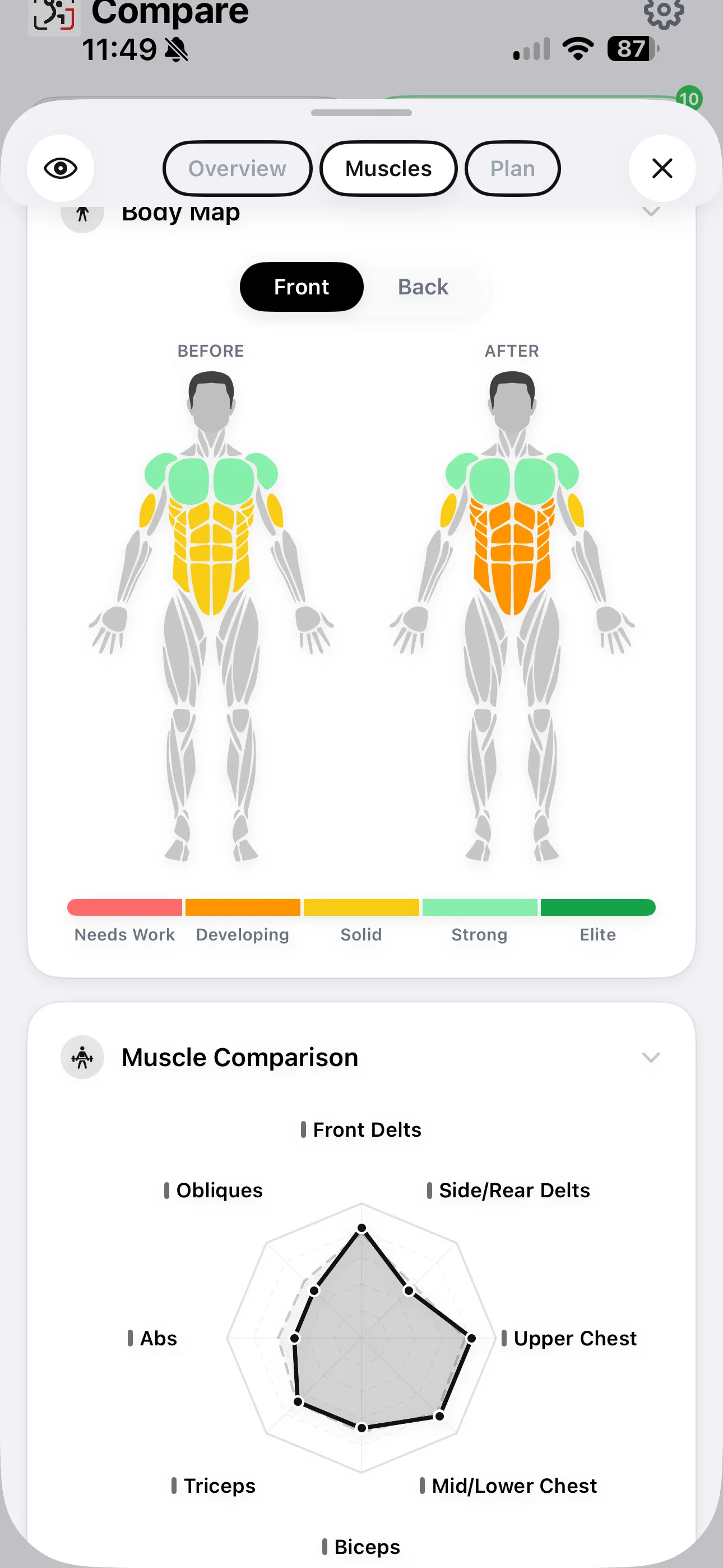
GainFrame's muscle map rates 12 muscle groups from a progress photo , a lagging arm shows up as a number, and so does its progress.
What actually fixes skinny arms?
The fix is boring and it works. Four parts:
- Keep the compounds, add direct arm work. Commonly effective starting range: 6-10 direct sets per week for biceps and the same for triceps, spread over 2 sessions. Curls, extensions, dips , the exercise menu matters far less than the sets existing.
- Progress the direct work like a main lift. The failure mode of most arm training is curling the same weight for the same sets for a year. Add reps, then weight, and log it , arms respond to progressive overload exactly like everything else.
- Eat for growth if you're underweight. A modest surplus and adequate protein. This is the highest-leverage fix on the list for lifters whose arms are skinny because all of them is skinny.
- Give it 6-12 months, measured properly. Cold, same conditions, every 4-6 weeks. Half an inch in 6 months is a solid outcome; an inch in a year is excellent. Anyone promising visible arm transformation in 4 weeks is selling something.
And the thing that doesn't work, for symmetry: endless curl volume on top of a maintenance diet. Twenty weekly sets of arms cannot out-train a body with no surplus to build from , that combination just produces impressive pumps that deflate by dinner.
What else should you know?
Why are my arms so skinny even though I work out?
Most commonly some mix of: your program leans on compound lifts that under-stimulate arms for your leverages, you're not eating enough to grow anything, and your genetics , bicep insertions, wrist and forearm size , make your arms read smaller than their measurement. Adding direct arm volume and a small surplus fixes the first two; the third stops mattering as the tape moves.
Are compound lifts enough to grow arms?
For some lifters, yes , rows and presses deliver meaningful arm stimulus. For many others, commonly those with long arms or pressing-dominant leverages, compounds leave biceps and triceps well short of the volume they need. The practical test: if your compounds have progressed for months and your arms haven't moved, add 6-10 direct sets per week and watch what happens.
How long does it take to fix skinny arms?
Expect visible change over months. Commonly cited natural rates put total muscle gain around 0.5-2 pounds per month for most lifters past the beginner stage, and arms get a small share of that. Half an inch on the arms in 6 months of consistent direct work and adequate eating is a solid result; an inch in a year is excellent.
Do wrist size and genetics really matter for how arms look?
Yes, more than most lifters expect. A slim wrist and long forearm make the same bicep measurement read visibly smaller, and high bicep insertions leave a gap at the elbow that photographs as thinness. You can't change any of that. You can out-train it , genetics set where you start and how the muscle sits, and volume decides the size.
Should I measure my arms flexed or unflexed?
Either works as long as you pick one and keep conditions identical: same arm, same spot, cold (not pumped), same time of day. Commonly cited averages are usually flexed measurements, so compare flexed to flexed. A post-workout pump adds temporary size, which is why measuring after curls always flatters and always lies.
Put a number on the lagging arm
GainFrame rates 12 muscle groups from your progress photos , including biceps and triceps , so six months of direct arm work shows up as a tracked rating instead of a guess. Free to start on iOS.
Download GainFrame Free