
Quick answer: Commonly cited coaching heuristics put natural muscle gain around 1 to 2 pounds per month for beginners, 0.5 to 1 for intermediates, and 0.25 or less for advanced lifters. Women commonly gain about half those absolute amounts. Daily water weight swings run larger than a month of muscle, so the scale alone can't confirm any of it.
One month into a bulk, you've gained 6 pounds, and some corner of your brain is whispering that it's all muscle. Meanwhile someone else is one month into training, up half a pound, and convinced nothing is happening. Both readings are wrong, in opposite directions, for the same reason: a month of muscle is a smaller number than almost anything else your body weight does.
This page gives you the honest rates by training age, explains why the first months feel faster than the tissue actually grows, and covers the part most rate articles skip — why you can't verify any of these numbers with a scale on a 30-day window.
How much muscle can you gain in a month?
The numbers below are commonly cited coaching heuristics — the kind popularized by evidence-based coaches over the past couple of decades. They describe actual contractile tissue under good conditions: consistent progressive training, adequate protein, enough calories, and reasonable sleep.
| Training age | Commonly cited monthly gain (men) | Commonly cited monthly gain (women) |
|---|---|---|
| Beginner (year 1) | ~1–2 lb | ~0.5–1 lb |
| Intermediate (years 2–3) | ~0.5–1 lb | ~0.25–0.5 lb |
| Advanced (year 4+) | ~0.25 lb or less | ~0.1–0.25 lb |
Read the table twice, because both readings matter. Reading one: the ceiling is low. Even a genetically fortunate male beginner doing everything right adds roughly the weight of a large water bottle in muscle per month, and the rate falls every year after. Reading two: the ceiling compounds. Twelve beginner months at the commonly cited rate is 12 to 24 pounds of muscle in a year — a visibly different human being.
Women's absolute numbers run at roughly half the male figures, mostly because the starting muscle mass and hormonal environment differ. Relative to existing muscle, commonly cited research finds the sexes gain at similar percentage rates. The whole trajectory — from these monthly rates out to your multi-year ceiling — is mapped in our natty limit guide, and you can see where your current build sits against the population in the FFMI percentiles breakdown.
Why do the first months feel so much faster?
Because in the first months, three things arrive at once and only one of them is muscle.
Glycogen and water land immediately. New training drives your muscles to store more glycogen, and glycogen binds several times its weight in water. That's a fast several-pound jump with a visual bonus — fuller-looking muscles within weeks. It's real weight and real fullness, and it's a one-time stocking of the shelves rather than tissue growth. Our guide to why weight goes up when you start lifting itemizes the whole early-scale-jump anatomy.
Newbie gains are real, and front-loaded. The commonly cited 1 to 2 pounds per month is the fastest muscle grows for most natural lifters, and it happens in year one. Strength climbs even faster during this window because your nervous system is learning the lifts, which makes the muscle feel like it's arriving faster than it is.
A calorie surplus adds its own pounds. Eat 500 over maintenance daily and the month adds roughly 4 pounds of scale weight regardless of what your muscles do. Put all three together and a first-month gain of 5 to 7 pounds is completely normal — containing perhaps 1 to 2 pounds of actual muscle.
Why can't the scale confirm your monthly gain?
Here's the measurement problem stated plainly: your target signal is about 1 pound per month, and commonly cited figures put normal day-to-day weight fluctuation at 2 to 5 pounds — water, sodium, carbs, gut contents, training status. Your daily noise is bigger than your monthly signal. A morning weigh-in after a salty dinner erases three months of muscle; a dehydrated one fabricates two.
The scale becomes usable only with statistics. Weigh daily under matched conditions, average each week, and compare weekly averages across the month — the noise mostly cancels, and a 1-pound monthly trend becomes visible. A single weigh-in on day 1 versus day 30 is a coin flip wearing a number.
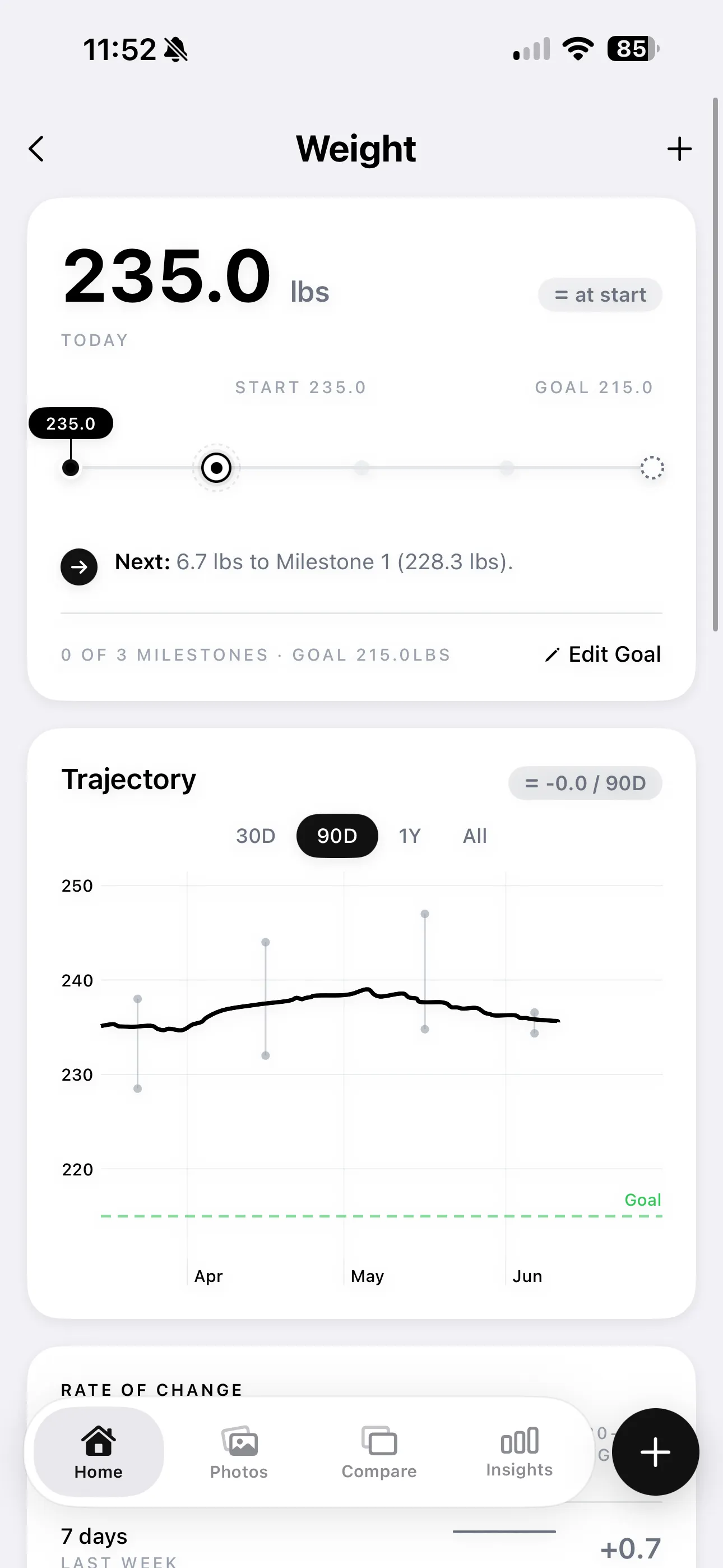
Daily weigh-ins scatter; the trend line is the only part that means anything at muscle-gain speed.
And even a clean weight trend answers the wrong question. The scale reports mass, and the question is composition — a 2-pound monthly trend could be 1 pound muscle and 1 pound fat, or almost all fat with the muscle rounding error. That's why every serious approach adds a second instrument: waist measurements, photos, or body fat estimates alongside the trend line.
What does a month of real progress actually look like?
Mostly invisible, and it helps to accept that up front. Here's the honest expectations table:
| Training age | Realistic monthly gain | What's actually visible after one month |
|---|---|---|
| Beginner | ~1–2 lb muscle | Fuller muscles from glycogen; strength up noticeably; body shape essentially unchanged |
| Intermediate | ~0.5–1 lb | Nothing reliable to the eye; visible in photo comparisons over 2–3 months |
| Advanced | ~0.25 lb or less | Nothing month to month; visible in 6–12 month comparisons, if at all |
A pound of muscle spread across your whole body moves any single body part by a few millimeters. Clothing fit, pump status, and lighting each move the visual more than that — which is why the mirror keeps lying in both directions. Commonly cited timelines put self-noticeable change around 8 to 12 weeks and other-people-noticeable change around 3 to 6 months; the full breakdown is in how long it takes to see results from lifting.
The practical rule: judge muscle gain on 3-month windows, minimum. A month is a data point. Three months is a trend. Checking daily is how lifters convince themselves that working programs are broken.
How do you verify muscle gain month to month?
Stack signals that fail differently, and let agreement be your evidence. Strength logs climbing while your weekly weight average drifts up slowly is the classic pair. Add the early-warning signs — sleeve tightness, veins surfacing, gym lighting hitting differently — covered in signs you're building muscle.
Photos under matched conditions are the strongest monthly instrument, because they capture the composition change the scale can't see — but only if the comparison is honest, meaning same pose, same light, same time of day. GainFrame structures exactly that: progress photos become body fat estimates, per-muscle-group ratings, and a physique score, so a month of "did anything happen?" gets an answer with numbers attached. These are estimates from photos rather than clinical measurement, and it's iOS only — but at muscle-gain speed, a consistent estimator beats a precise scale reading that measures the wrong thing.
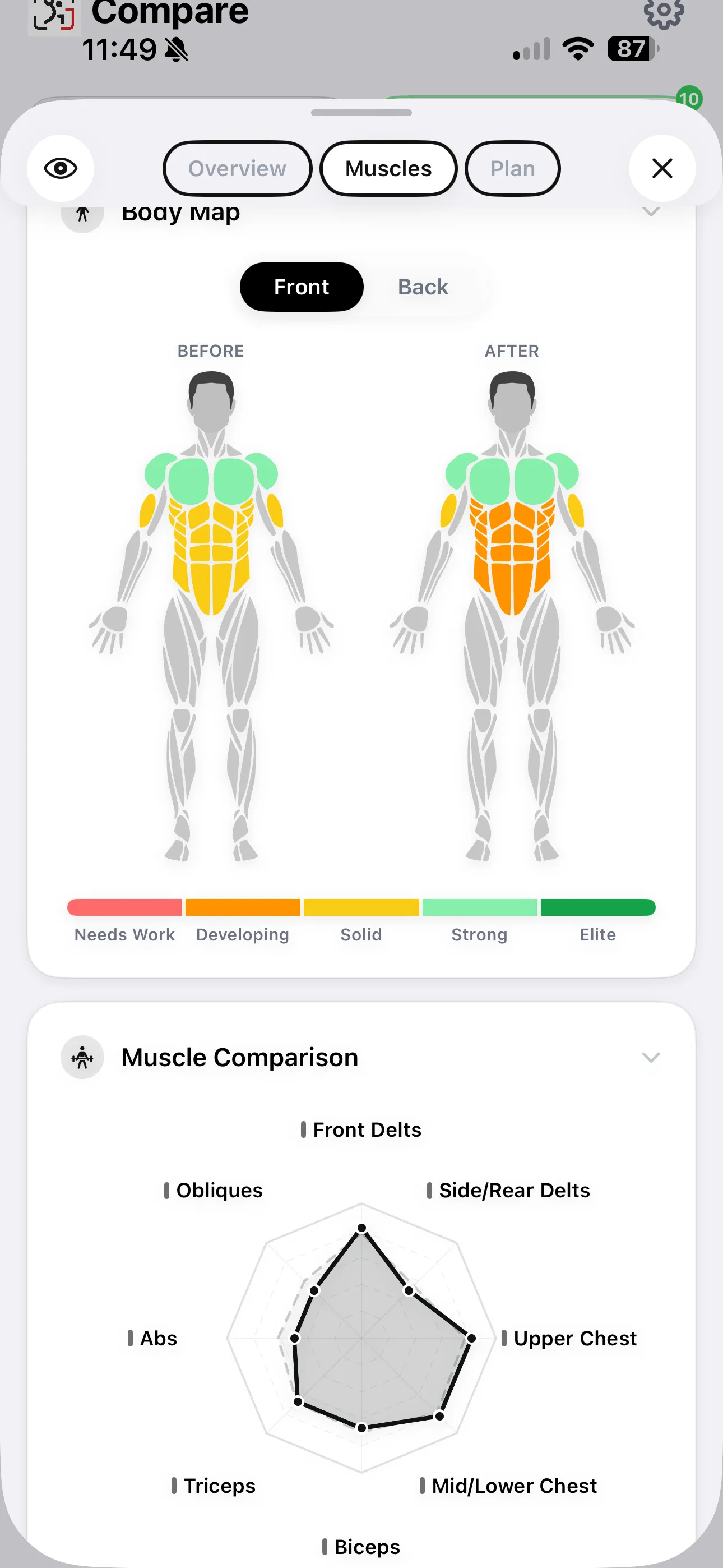
Per-muscle ratings across months: when the delts score climbs while body fat holds, the gain was tissue rather than water.
Frequently asked questions
How much muscle can a beginner gain in a month?
Commonly cited coaching heuristics put a dedicated male beginner around 1 to 2 pounds of actual muscle per month during the first year, with women around half that in absolute terms. The scale will usually show more in the first weeks because glycogen and water arrive quickly. Those heuristics assume consistent training, adequate protein, and enough calories.
Can you gain 5 pounds of muscle in a month?
Almost certainly no for a natural lifter. Commonly cited rates top out around 2 pounds per month even for genetically lucky beginners. A 5-pound scale jump in a month is real weight, though — typically a mix of glycogen, water, gut contents, and some fat, with muscle as the smallest slice. Enhanced lifters and people regaining lost muscle are the exceptions.
How much muscle can women gain in a month?
Commonly cited heuristics put women at roughly half the absolute numbers men see — around 0.5 to 1 pound per month as a beginner, tapering toward 0.25 or less with training age. Relative to starting muscle mass, the rates are similar between sexes. The same visibility problem applies: monthly changes are smaller than daily water fluctuations, so judge progress over several months.
How long does it take to see noticeable muscle gain?
Commonly cited timelines put visible-to-you changes around 8 to 12 weeks and visible-to-others changes around 3 to 6 months, assuming consistent training and reasonable nutrition. A single month of gain — a pound or two at best — hides easily under clothing, lighting, and day-to-day bloat. Photos taken under matched conditions surface the change earlier than the mirror does.
Why did I gain 4 pounds in my first month of lifting?
Mostly glycogen and water. New training signals your muscles to store more glycogen, and each gram of glycogen holds roughly 3 grams of water — a quick several-pound jump that is commonly mistaken for rapid muscle growth. Some of the 4 pounds may be muscle and some may be fat if you're eating in a surplus. The jump flattens after the first several weeks.
Verify the month the scale can't
GainFrame turns progress photos into body fat estimates, per-muscle ratings, and a physique score — so a month of training gets judged on composition instead of water weight. Free to start on iOS.
Download GainFrame Free