
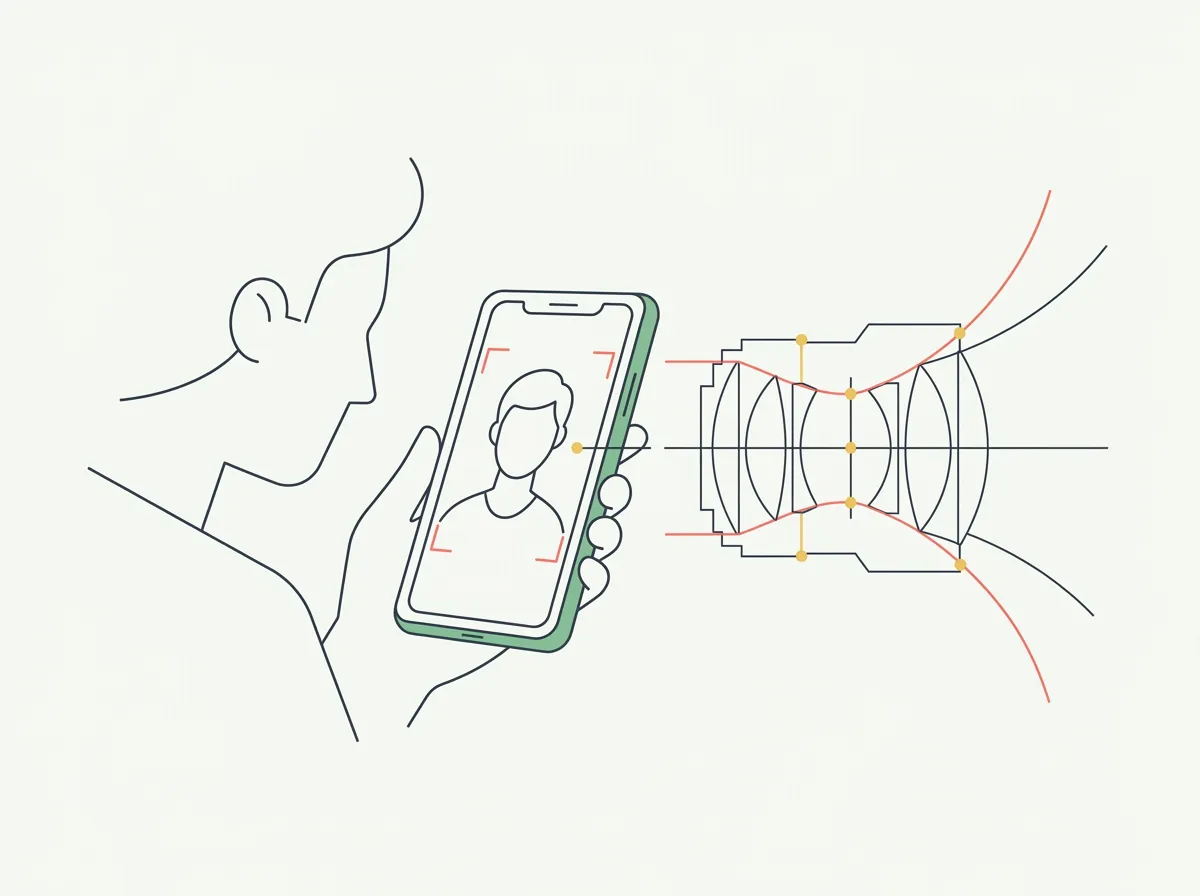
Quick answer: Cameras commonly make you look heavier through optics: phone wide-angle lenses exaggerate whatever is closest at close range, low camera angles widen the midsection, and harsh flash erases the shadows that show shape. The mirror also flatters you with motion, depth, and posture you fix without noticing. Standardized photos from six-plus feet split the difference honestly.
You checked the mirror before you left the house and thought: fine, good even. Four hours later a tagged photo lands and the person in it looks fifteen pounds heavier than the one you signed off on. You untag it, then spend the evening wondering which version is real.
If that photo stung, this page is for you, and the first thing to know is that a chunk of the gap is measurable camera physics, the same physics that makes some lifters ask the exact opposite question. The lens giveth and the lens taketh away, depending on where it is and where you are. Here's each mechanism, plus the one honest part nobody enjoys hearing, delivered gently.
How does your phone's lens make you look bigger?
The main phone camera is a wide-angle lens, and wide-angle lenses at close range are commonly demonstrated to exaggerate whatever sits nearest to them. At selfie distance, "nearest" is usually your face, your cheeks, or the arm holding the phone, all of which get rendered larger than life while the rest of you warps around them.
This is the selfie-arm problem in one sentence: a lens two feet from your face has opinions about your face. Portrait photographers back up and zoom in for exactly this reason, close, wide shots are widely reported to round faces and thicken features, while longer distances render proportions closer to how people see you across a room.
Group photos have a version of this too. Stand at the edge of a wide-angle group shot and lens stretch commonly widens whoever is near the frame's border. You didn't gain weight between the middle of the couch and the end of it.
What does camera height do to your proportions?
Where the camera sits vertically changes what dominates the frame. A camera below your eye-line, a phone on a table, a friend shooting from a seated position, a lazy arm angle, looks up at your midsection and jaw from below, which commonly widens both. Chin softness that barely exists at eye level can appear from a low angle on almost anyone.
Height works the other way around too, which is why every practiced selfie angle is slightly above eye level. Neither angle is the truth. They're two different exaggerations, and the unflattering one just happens to be where candid photos get taken from.
Why does flash make you look heavier?
What you read as "shape" on a body is mostly shadow, small gradients of light that show where a jaw ends, where a waist curves in, where muscle separates. Direct flash fires flat light straight at you and fills in nearly all of it. The result is commonly described by photographers as flattening: a face with no shadow under the cheekbones reads rounder, and a torso with no side shading reads wider.
Add the typical party context, indoor, night, harsh overhead bulbs or a bare flash, and a candid photo gets the least flattering light a body can stand in. The same effect, in reverse, is why abs appear and vanish depending on the room.
Why does the mirror show a slimmer you?
The mirror holds a few advantages the camera never gets. You see yourself live, in three dimensions, and in motion, your eyes integrate hundreds of angles per second and settle on a generous composite. A photo is one frozen millisecond, one angle, possibly mid-breath, mid-chew, or mid-blink. Nobody's worst frame matches their moving average.
You also fix your posture the instant you face a mirror, without noticing you do it. Shoulders back, spine longer, chin slightly out, a reflex rehearsed over thousands of glances. The candid camera catches the unrehearsed slouch, and slouching genuinely compresses your midsection into a wider shape.
And you've only ever met the flipped version of yourself. Photos show the unflipped you, which reads as subtly wrong to its owner, a familiarity effect commonly invoked to explain why most people prefer their mirror image. "Wrong" gets felt as "worse," and "worse" often gets felt as "heavier."
Is the photo closer to what other people see?
Here's the part that deserves gentleness: partly, yes. Other people see the unflipped you, from ordinary distances, without your mirror posture. In that narrow sense a photo carries information the mirror hides, and pretending otherwise doesn't help you.
But hold the whole truth, because it cuts the other way just as hard. Other people also see you animated, talking, laughing, moving through rooms, and a frozen bad frame represents that experience about as well as one blurry screenshot represents a film. Nobody who knows you is studying your midsection in a group photo. You are the only person alive who zooms in on that picture, and you're examining a version of yourself that flash, angle, and lens distortion all voted against at once.
So the barbecue photo is real evidence, collected badly. If you also feel like the scale and the mirror disagree about you, normal BMI but looking softer than expected covers what body composition explains that a single number can't.
What's the honest middle between the mirror and the candid?
A standardized photo. Every distortion above is a variable, and variables can be pinned: camera six or more feet away, roughly chest height, one consistent light source, same spot, same relaxed pose, same time of day. At that distance the wide-angle exaggeration mostly collapses, at that height the angle stops editorializing, and in that light the shadows stay comparable week to week.
Photos taken this way sit between the mirror's flattery and the candid's cruelty, and they gain the one power neither has, which is memory. You cannot stand next to March-you in a mirror. Two standardized photos put March and July side by side and end the argument. The full setup guide covers the checklist, and this walkthrough shows how to do it alone with a propped phone and a timer.
Once your setup is consistent, you can estimate body fat from a photo. Treat the result as a rough estimate, not evidence that an unflattering candid means you gained fat.
Keeping those check-ins comparable is the job GainFrame was built for: it auto-aligns any two photos so framing and scale match, then estimates the body fat change between them. The numbers are estimates from photos rather than a clinical scan, but they're consistent, which is exactly what the tagged-photo spiral lacks.
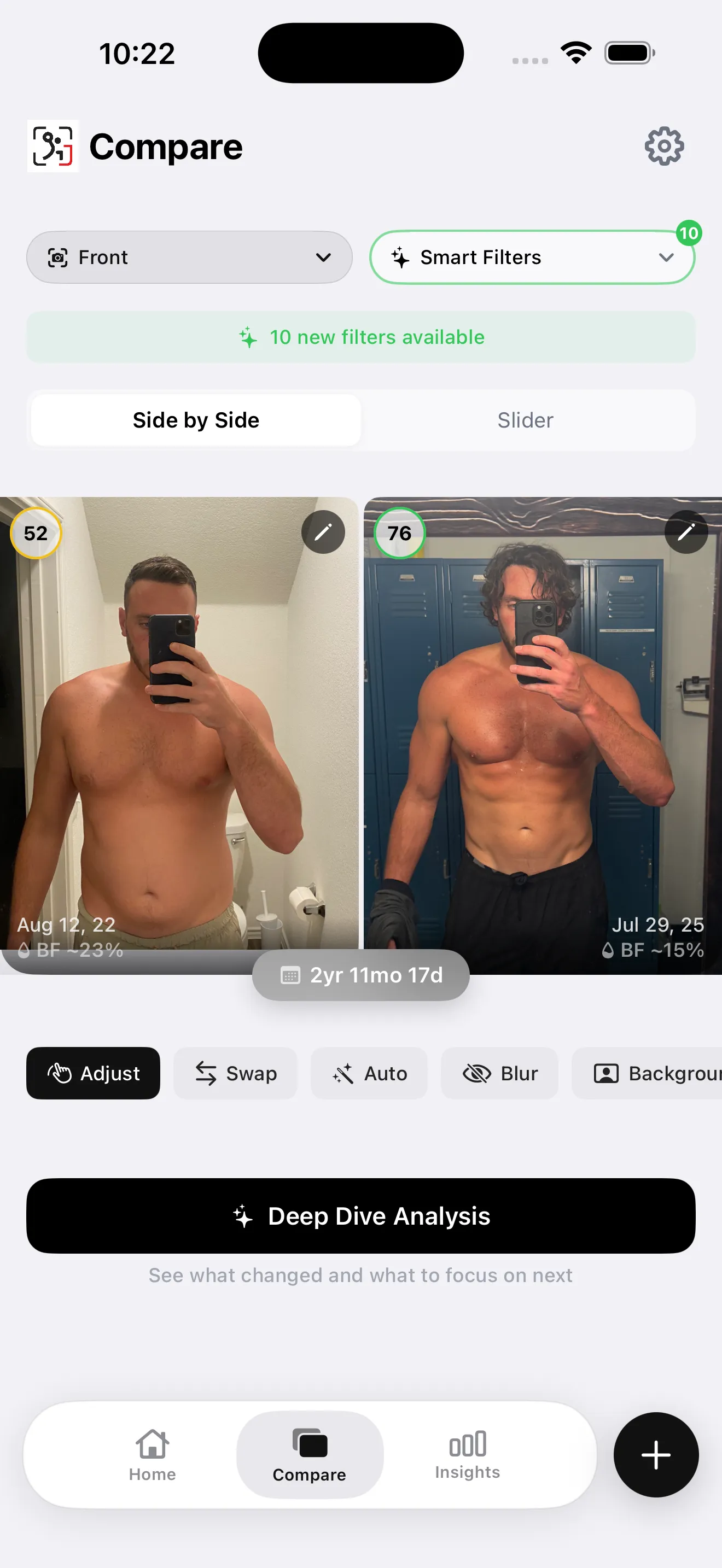
Two standardized check-ins, auto-aligned: when distance, light, and framing are fixed, the difference on screen is your body, and neither mirror nor flash gets a vote.
Frequently asked questions
Why do I look fat in pictures but not in the mirror?
Usually it's a stack of camera effects plus one human effect. Phone wide-angle lenses at close range are commonly demonstrated to exaggerate whatever sits nearest the lens, low angles widen the midsection, and flash flattens the shadows that show shape. Meanwhile the mirror shows a moving, familiar, posture-corrected view. The photo and the mirror are measuring different things.
Does the camera really add ten pounds?
The saying survives because there is something real under it. Wide-angle lenses at close range, unflattering focal lengths, and flat frontal light can each make a body read heavier than it looks in person. The effect is commonly estimated in the visually noticeable range rather than a precise number, and it fades almost entirely once the camera moves back to six or more feet.
Why do I look bigger in selfies?
Front cameras are among the widest lenses on a phone, and you hold them at arm's length, the worst combination for distortion. Whatever is closest to the lens gets enlarged, usually your face and upper arm, while proportions behind it warp. Held low, the same lens widens the midsection too. A propped phone with a timer, shot from farther away, removes most of this.
Do other people see me the way I look in photos?
Closer to the photo than to the mirror, honestly, other people see the unflipped you from normal conversational distance, without the posture adjustments you make in front of a mirror. But they also see you moving, in three dimensions, with expressions, which no frozen frame captures. A bad candid is still a worst-case sample, and nobody else studies it the way you do.
How do I take photos that show what I actually look like?
Standardize everything. Put the camera six or more feet away at roughly chest height, use one consistent light source, stand relaxed in the same spot, and shoot at the same time of day. That removes the distortions a casual photo adds and the flattery a mirror adds. Two photos taken this way, weeks apart, are the most honest comparison you can get for free.
Retire the tagged-photo spiral
GainFrame turns standardized check-in photos into a consistent record, auto-aligned comparisons, estimated body fat, and physique scores, so one bad candid stops rewriting how you see your progress. Free to start on iOS.
Download GainFrame Free