
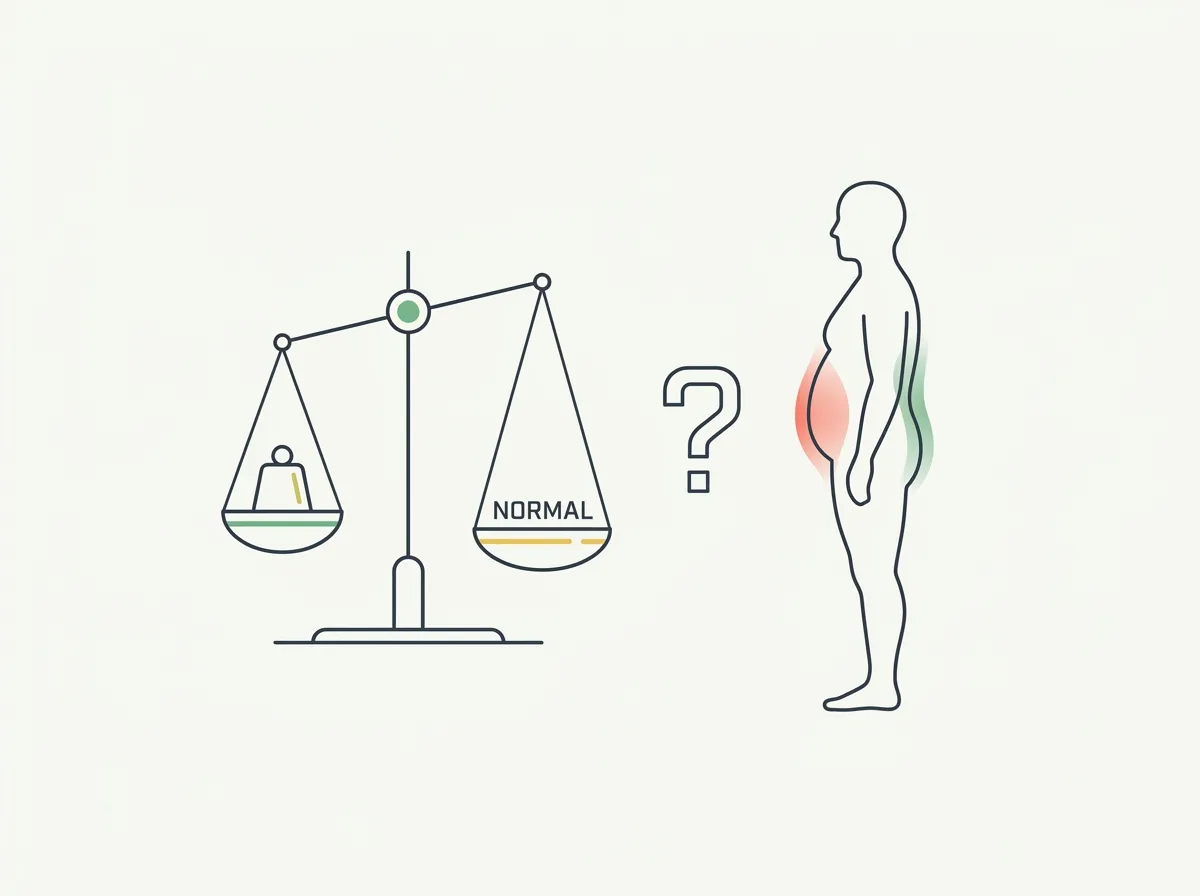
Quick answer: BMI compares weight to height and can't see composition. With little muscle and a higher body fat percentage, you can sit at a normal BMI and still look soft — a pattern researchers commonly describe as normal weight obesity. The fix is recomposition rather than more dieting: lift, eat adequate protein, hold calories near maintenance.
You're 5'10" and 160 lb. That's a BMI of 23 — dead center of the normal range, and your doctor spent zero seconds on it at your last physical. Then a beach photo from the weekend shows a soft belly hanging over the waistband, arms with no shape, and a chest that reads as neither lean nor strong.
Both things are true at once. The chart is measuring your weight, and the photo is showing your composition, and they are two different facts about the same body. This page is about that specific gap — why it exists, how wide it can get, and which numbers actually close it.
Two neighboring guides are worth flagging up front. If you want the full breakdown of why BMI and body fat percentage disagree, that's body fat percentage vs BMI. If you want the complete diagnostic for the pattern itself, read how to tell if you're skinny fat. This page stays on the narrower question: you have a normal BMI, you look heavier than it says, and you want to know what's going on.
Why can a normal BMI still look fat?
BMI is weight divided by height squared. That's the entire formula — it has no input for muscle, fat, bone, or where any of it sits. A pound of muscle and a pound of fat count identically, even though muscle is denser, takes up less space, and looks completely different under skin.
So the number only means what your composition lets it mean. A lifter at 5'10" and 160 lb might be carrying 145 lb of lean mass and look sharp at BMI 23. An untrained person at the same height and weight might be carrying 120 lb of lean mass, with the other 40 lb as fat — same BMI, dramatically softer appearance.
You can compare how the same height and weight map to BMI bands in the BMI body visualizer.
Researchers commonly describe the second case as normal weight obesity: a normal BMI paired with a body fat percentage in the range usually associated with obesity. It's the clinical name for what gym culture calls skinny fat, and the everyday search phrasing — skinny but belly fat, normal weight but overweight looking — all points at the same body.
Placement makes it worse. Men preferentially store fat at the midsection, so a modest total amount of excess fat can still produce a visible belly. Your BMI is averaging that belly across your whole frame; your mirror is looking straight at it.
How does this happen without being overweight?
Almost nobody arrives here on purpose, and the route is usually one of two slow drifts.
The sedentary default. Muscle is expensive tissue, and a body that never lifts anything heavy keeps the minimum. Through your 20s and 30s, an untrained frame commonly trades a little muscle for a little fat each year while total weight barely moves. The scale reports stability; the contents have quietly changed.
The dieting history. Repeated weight-loss diets without strength training shed muscle along with fat — commonly a meaningful fraction of every pound lost. Regain the weight, as most people do, and it comes back with a higher fat share than what left. A few cycles of that and you weigh what you weighed at 22, composed differently.
Both routes end at the same place: a normal weight with a low-muscle denominator underneath it. And that's the part BMI structurally can't flag, because the formula assumes your weight has typical contents. Yours doesn't.
How different can two people look at the same BMI?
Wider than most people expect. As an illustrative range — this varies with frame, training history, and where you store fat — a 5'10" man at 160 lb could plausibly sit anywhere from roughly 12% body fat to roughly 28%. The first is visibly athletic. The second is past the threshold commonly used for obesity-level body fat in men. Same height, same weight, same BMI of 23.
Here's what that gap looks like. These are standardized, photorealistic AI renders from our body fat visualizer — same build, pose, and lighting, so only body fat changes between images. Treat them as illustrative of the composition spread, since two real people at one BMI won't match these frames exactly.
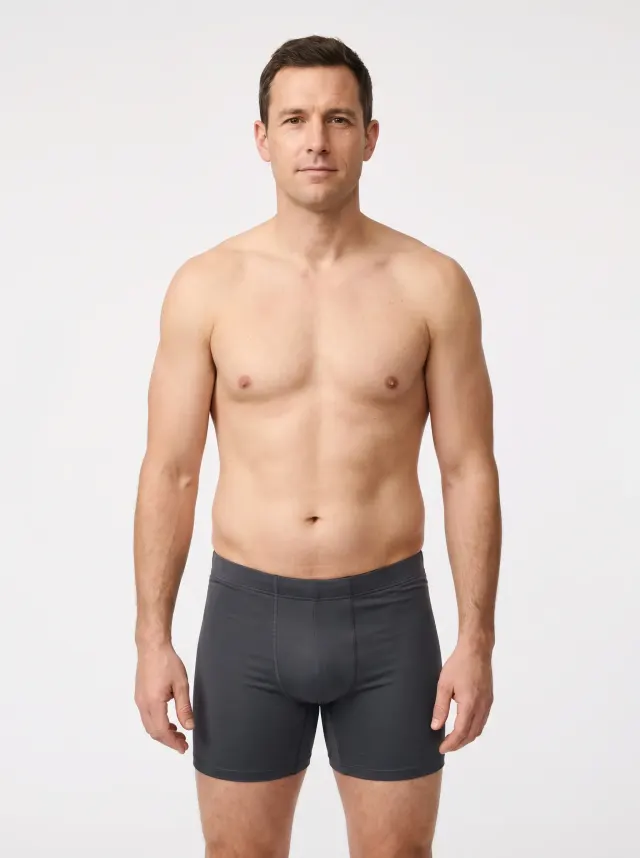
23% body fat. A normal BMI can look like this — soft midsection, minimal visible muscle, and nothing on the chart to flag it.
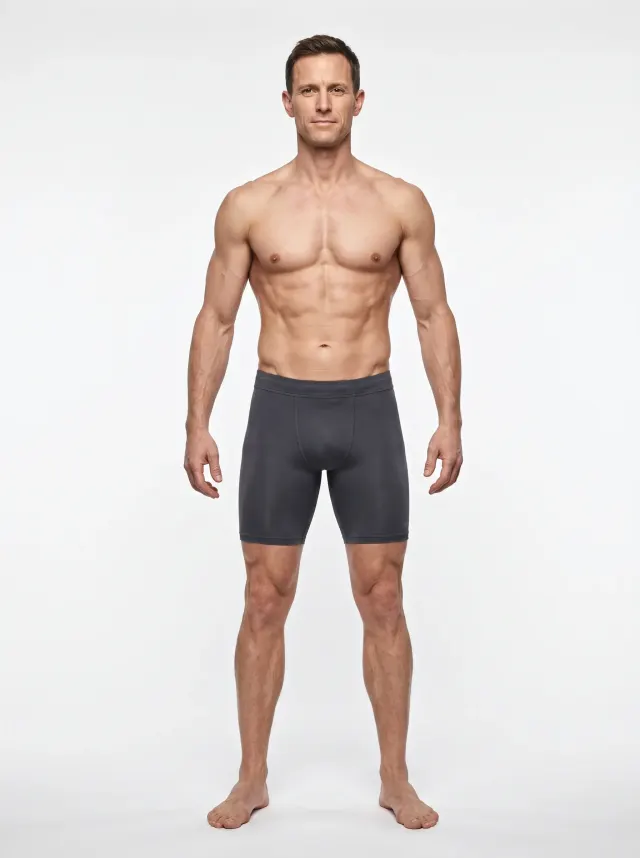
13% body fat — the same BMI territory with the contents rearranged. More muscle, less fat, and a completely different mirror.
Sit with that comparison for a second, because it reframes the goal. The man in the second image doesn't necessarily weigh less than the first. He's carrying different contents at a similar weight — which is why the fix in the last section isn't a diet.
What should you measure instead of BMI?
If BMI can't see the problem, stop asking it. Three measurements can, and all three are free.
- Waist-to-height ratio. Wrap a tape at your navel, relaxed, and compare to your height. Over 0.5 — a 35-inch waist at 5'10" — is a commonly cited screening flag for excess central fat, and it works at any BMI. The full protocol and thresholds are in our waist-to-height ratio guide.
- A body fat estimate. You don't need a clinic. Compare a relaxed photo against a reference chart, run it through our free photo-based estimator, or use a tape-measure formula. Any of these puts you in the right bracket, which is all the decision needs.
- Consistent photos. Same spot, same lighting, same relaxed pose, front and side. Photos catch what every formula compresses away — where the fat sits, what the arms and shoulders look like, whether anything is changing month to month.
If you want a structured 60-second version of this check, the skinny-fat self-assessment quiz walks through seven yes/no flags and scores the pattern for you.
What's the fix — and why isn't it a diet?
The instinct at BMI 23 with a soft belly is to eat less, because eating less is what worked on every chart-visible weight problem you've ever heard of. But run the math on this one. Your problem is the ratio of muscle to fat at your current weight; a pure deficit shrinks both, and you land at 150 lb as a smaller copy of the same softness.
The lever that actually moves is recomposition: build muscle while slowly losing fat, letting the ratio shift under a nearly flat scale weight. Untrained and detrained people — which describes almost everyone in this pattern — respond fastest to it. The compressed formula:
- Lift 3–4 times a week with progressive overload: more weight or reps over time, tracked.
- Eat adequate protein — commonly cited targets sit around 0.7–1 g per pound of body weight daily.
- Hold calories at maintenance or a small deficit. No aggressive cut. The scale staying put while your waist shrinks is the plan working, and the reasoning is spelled out in the skinny fat to muscular playbook.
One measurement note, because it decides whether you stick with this. Recomp progress is nearly invisible to a scale by design, so you need instruments that read composition. A weekly waist measurement is one. Photos are the other — and GainFrame turns those photos into an estimated body fat percentage, FFMI, and a 1–100 physique score over time, which makes a three-month recomp legible week by week instead of feeling like nothing is happening. Photo-based estimates rather than clinical measurement, iOS only, free tier covers 25 photos.
Frequently asked questions
Can you have a normal BMI and high body fat?
Yes. BMI only compares total weight to height, so it can't distinguish a pound of muscle from a pound of fat. Someone with low muscle mass can carry a body fat percentage well above the healthy range while their BMI sits comfortably in normal territory. Researchers commonly describe this combination as normal weight obesity.
Why do I look fat when my weight is normal?
Because appearance is driven by composition and fat placement, and BMI sees neither. With little muscle, a higher share of your normal weight is fat, and in men that fat tends to concentrate at the belly. The result is a soft midsection and no visible muscle at a weight every chart calls fine.
What body fat percentage is high at a normal BMI?
Reference ranges commonly place average men around 18–24% body fat and flag roughly 25% and above as excess; for women the corresponding bands sit higher, around 25–31% and 32+. Research on normal weight obesity commonly uses cutoffs in that same territory. A normal BMI with body fat at or past those marks fits the pattern.
Should I lose weight if my BMI is normal but I look fat?
Usually a pure diet is the wrong lever. Cutting from a normal BMI with low muscle leaves you a smaller, equally soft version of yourself. Most coaches point this profile toward recomposition: lift 3–4 times a week, eat adequate protein, and hold calories at maintenance or a small deficit so the muscle-to-fat ratio shifts.
How do I check if I'm normal weight but high body fat?
Three quick screens. Measure your waist at the navel — over half your height is a commonly cited flag. Get a body fat estimate, whether from reference photos, a photo-based AI tool, or a tape-measure formula. And take a relaxed front photo in consistent lighting; the visual evidence is usually the clearest of the three.
See what your BMI can't
GainFrame estimates body fat percentage, FFMI, and a 1–100 physique score from your progress photos — so a recomp that's invisible to the scale shows up as a visible trend. Free to start on iOS.
Download GainFrame Free