
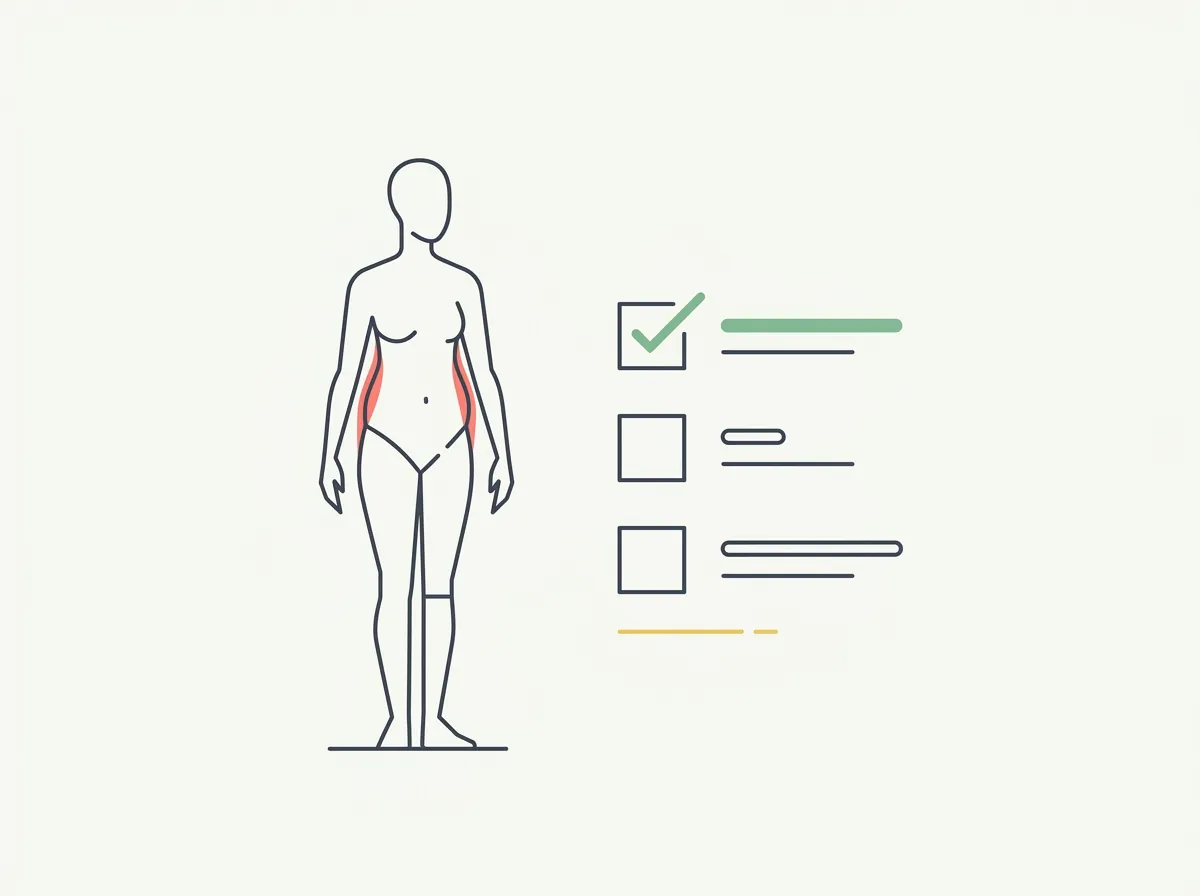
Quick answer: If you have a normal-weight BMI but a soft midsection, little visible muscle, and no consistent strength training history, you likely fit the skinny-fat pattern. Run the seven checks below: five or more yes answers is the classic profile. The fix is recomposition — lifting, adequate protein, and a small deficit or maintenance calories.
You're 5'10" and 165 lb. BMI 23.7 — dead center of "normal." Your doctor has no notes. And yet with your shirt off there's a soft layer over the stomach, no line anywhere on your arms, and a chest that somehow manages to be both flat and soft at the same time.
The scale has no category for that. This page does — it's the pattern usually called skinny fat, and you can check whether you fit it in about 60 seconds.
Run the checks, then scroll down to see what the pattern actually looks like on standardized renders. If you already know your answer and want the plan, skip straight to the skinny fat to muscular playbook. Everyone else: grab a tape measure if you have one, and count your yes answers.
The 60-second self-check
Seven yes/no questions. Answer honestly — nobody's watching, and flattering answers only waste your own time.
- Is your BMI in the normal range (roughly 18.5–24.9) but your midsection noticeably soft? This is the signature combination. Weight that's fine on paper, distributed in a way no chart can see.
- Is your scale weight "normal" but you have no visible muscle anywhere? No shoulder caps, no chest line, no visible forearm definition. Weight without shape.
- Is your waist more than half your height? Measure at the navel, relaxed. A 5'10" (70 in) person clears this check at a 35-inch waist. Waist-to-height above roughly 0.5 is a commonly cited screening flag for excess central fat — even at a normal weight.
- Do your arms and shoulders lack any shape at a normal body weight? Skinny-fat arms look the same flexed and unflexed. If your sleeve fills out from softness rather than a deltoid, that's a yes.
- Have you never strength trained consistently — meaning 6+ months of progressive lifting? Sporadic gym phases don't count. Skinny fat is largely the default state of an adult body that has never been given a reason to hold muscle.
- Do you look noticeably better in clothes than without them? Clothes hide composition. If the fitted-shirt version of you and the shirtless version of you seem like different people, that gap is the pattern.
- Has your weight been stable for years while your body slowly got softer? Stable weight can hide a slow trade of muscle for fat — same 165 lb, different contents. If photos from five years ago show a tighter version of you at the same weight, that's a yes.
How do you score it?
Count your yes answers.
| Yes answers | What it suggests | Your next read |
|---|---|---|
| 5–7 | Classic skinny-fat pattern | The recomp playbook |
| 3–4 | Leaning that way — early enough to redirect easily | Bulk, cut, or recomp? |
| 0–2 | Probably not skinny fat | You likely just need a normal training goal |
Two caveats worth ten seconds. First, question 3 carries the most weight of the seven — a waist over half your height at a normal BMI is the strongest single flag in the list. Second, this is a pattern check, not a measurement. If you scored 3–4 and want an actual number instead of a vibe, get a body fat estimate before deciding anything.
What does skinny fat actually look like?
The pattern has a recognizable shape: normal weight, soft midsection, flat arms and shoulders, little visible muscle anywhere. The images below are standardized, photorealistic AI renders from our body fat visualizer — same build, pose, and lighting, so the only variable is body fat percentage.
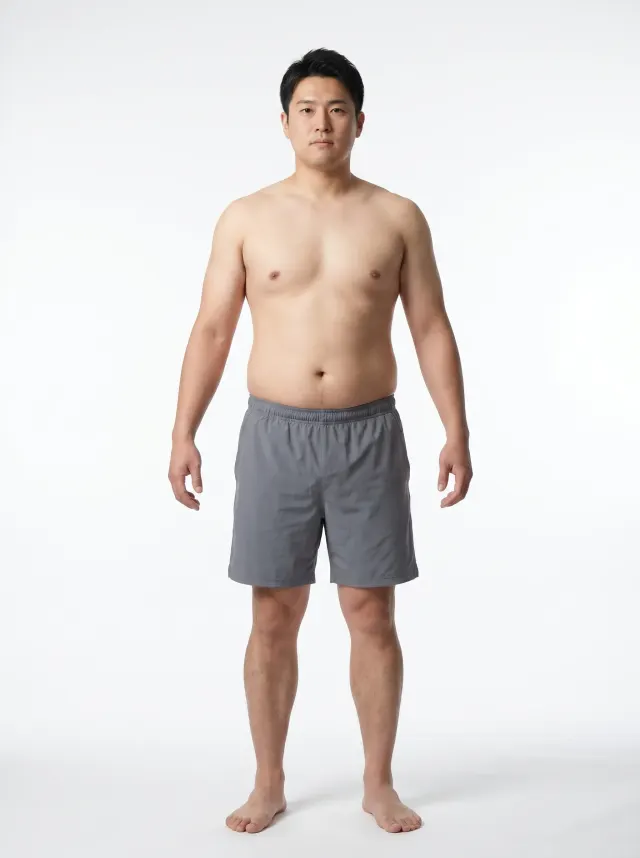
A man at 23% body fat with low muscle mass — squarely in the range most descriptions of skinny fat point to. BMI would call this healthy.
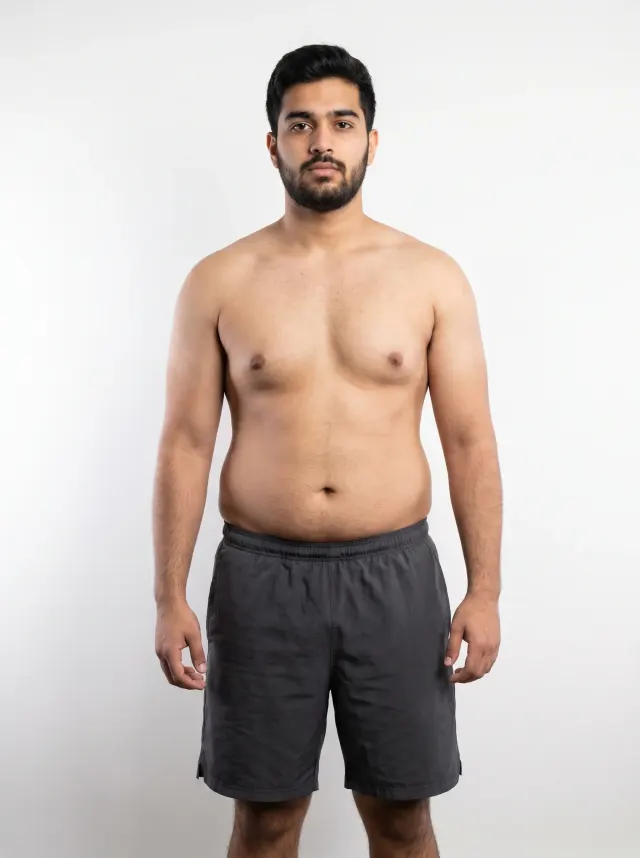
At 28%, the midsection softness is unmistakable — yet at a normal height and weight, BMI can still read "normal" here.
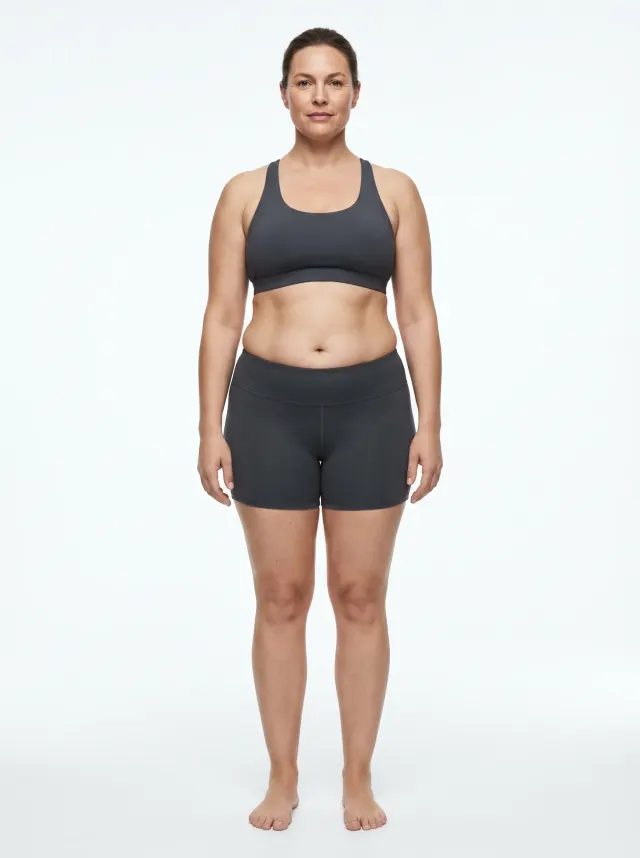
The female version of the pattern — commonly described around 30–35% body fat at a normal scale weight. Women carry the softness lower: hips, thighs, lower belly.
If your mirror looks closer to these renders than your scale weight suggests it should, that agreement between mirror and checklist is the pattern confirming itself.
What are the physical signs, beyond the mirror?
Four signals show up again and again in the classic presentation:
- A soft belly at a healthy weight. Consistent midsection softness that diet alone never firms up. This often tracks with visceral fat, which BMI cannot see.
- No definition even when flexing. Flat arms, no chest separation, no shoulder caps — muscle exists, but there is too little of it to shape anything.
- Weak baseline strength. Struggling with push-ups or an empty-bar press at a "healthy" weight points to the low-muscle half of the equation.
- Pants fit tighter while the scale holds still. Waist creep at stable weight means the fat-to-muscle ratio is drifting the wrong way underneath a constant total.
The scale and BMI miss all four because they measure total mass and geometry. Neither one measures composition, and skinny fat is a composition problem.
What's the fix if you scored high?
Here's the part most skinny-fat people get wrong: they diet. A pure cut makes a skinny-fat body smaller and equally soft — you end up a lighter version of the same shape, because the problem was never total weight. It was the ratio of muscle to fat at that weight.
The fix is recomposition, and skinny-fat beginners are the single best-positioned group for it. Untrained muscles respond fast, so you can build muscle and lose fat at the same time. The formula, compressed:
- Lift 3–4 times a week, progressively — adding weight or reps over time, not just showing up.
- Eat adequate protein — commonly cited targets sit around 0.7–1 g per pound of body weight daily.
- Hold calories at maintenance or a small deficit. No aggressive cut, no dirty bulk. Let the ratio shift underneath a nearly-flat scale.
That's the preview. The full plan — exercise selection, how the scale behaves, what changes in which month — is in the skinny fat to muscular guide, and the decision logic between the three diet approaches is in bulk, cut, or recomp.
What if you want a number instead of a checklist?
A yes/no quiz tells you the pattern. It can't tell you whether you're at 22% body fat or 28%, and it definitely can't tell you six months from now whether the recomp is working — because during recomposition the scale barely moves by design.
Two free ways to get an actual estimate. Our AI body fat estimator gives you a percentage from a single photo in the browser, no signup — and its sibling, the AI body transformation tool, shows what a year of consistent recomp training would look like on that same photo. And if you want the tracking side too, GainFrame scores your photos over time — body fat %, FFMI, and a 1–100 physique score with a four-part breakdown, so the checklist above becomes a trend line. iOS only, estimates rather than clinical measurement, and the free tier covers 25 photos.
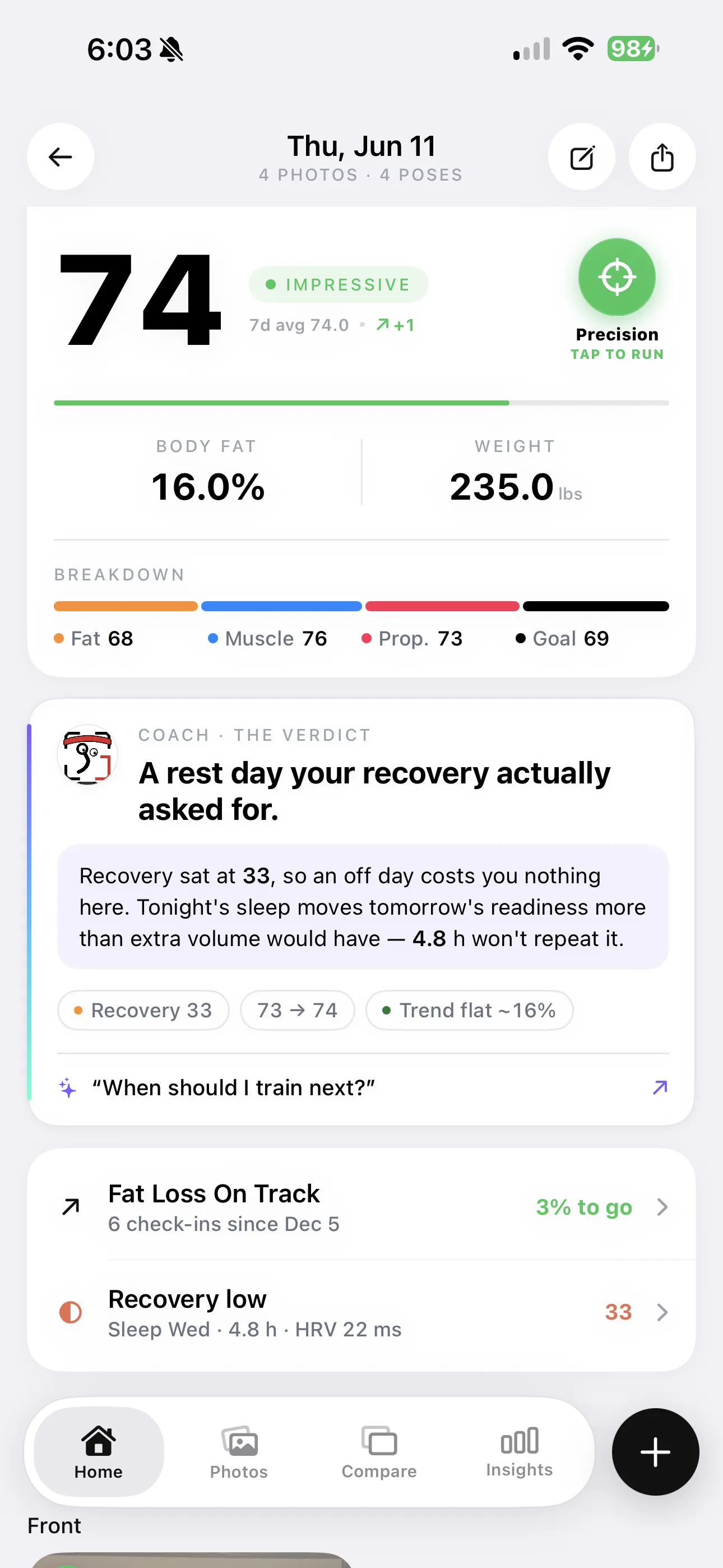
A checklist tells you the pattern once. A scored photo tells you whether it's changing.
Frequently asked questions
Can you be skinny fat with a normal BMI?
Yes — that's the defining feature. BMI only compares weight to height, so a person with little muscle and a higher body fat percentage can land squarely in the normal range. The pattern is sometimes called normal-weight obesity in research literature. It's why the scale and your doctor's chart can both say fine while the mirror disagrees.
What body fat percentage counts as skinny fat?
There's no official cutoff. The pattern is commonly described as a normal-weight BMI paired with body fat above roughly 20–25% for men or 30–35% for women, combined with low muscle mass. The combination matters more than any single number — a muscular person at 20% looks completely different from an untrained person at 20%.
Should skinny-fat people cut or bulk first?
Usually neither, at least not aggressively. A hard cut leaves you smaller and still soft; a hard bulk adds fat to an already-soft frame. Most coaches point skinny-fat beginners toward recomposition — lifting at maintenance calories or a small deficit with adequate protein — because untrained lifters can build muscle and lose fat simultaneously.
How long does it take to fix skinny fat?
Expect months, not weeks. Noticeable changes in photos commonly show up around 8–12 weeks of consistent lifting and adequate protein, and a full transformation from skinny fat to visibly athletic typically takes 12–24 months. The scale may barely move the whole time — that's expected during recomposition, since muscle gain offsets fat loss.
Is a waist-to-height ratio above 0.5 always a problem?
It's a screening flag, not a diagnosis. Keeping waist circumference under half your height is a commonly cited guideline associated with lower metabolic risk, and it catches midsection fat that BMI misses. If you're above 0.5 at a normal weight, that's one of the strongest single indicators of the skinny-fat pattern — worth confirming with photos or a body fat estimate.
Turn the checklist into a trend line
GainFrame scores your progress photos — body fat %, FFMI, and a 1–100 physique score — so you can watch the skinny-fat pattern actually reverse instead of re-taking a quiz. Free to start on iOS.
Download GainFrame Free