
Quick answer: The best fitness app for men depends entirely on which job you're hiring it for. Seven jobs, seven answers: Hevy for lifting, MacroFactor for food, GainFrame for visible change, Fitbod or Ray for coaching, Renpho for weight trends, WHOOP or Oura for recovery, Strava for cardio. Most men need two or three.
I spent about eighteen months with roughly nine fitness apps installed. Seven of them I opened once. The two survivors were a workout log and a nutrition tracker, and the reason is boring: those were the only two tied to a decision I made every single day.
That's the problem with ranking fitness apps one through ten. A lifting tracker and a recovery ring aren't competing for the same slot — they answer different questions, and the right question depends on what you're actually trying to change. So this list is sorted by goal. If you want the four-app version of the same idea, our best fitness app stack for 2026 is the shorter companion piece to this one.
Which app should you pick for your goal?
Ratings and rating counts below are from the US App Store at the time of writing and move around.
| Goal | App | iOS rating | Price |
|---|---|---|---|
| Build muscle | Hevy | 4.9 (81K+) | Free / Pro |
| See visible change | GainFrame | 4.9 (39) | Free / $5.99 mo |
| Eat for it | MacroFactor | 4.8 (19K+) | ~$12/mo |
| Get a program written | Fitbod | 4.8 (278K+) | Subscription |
| Get coached out loud | Ray | 4.8 (253) | Subscription |
| Track weight & composition | Renpho | 4.7 (7K+) | ~$30 scale |
| Recovery (hardest data) | WHOOP | 4.8 (44K+) | Membership |
| Recovery (least friction) | Oura | 4.9 (271K+) | Ring + membership |
| Cardio | Strava | 4.8 (364K+) | Free / Premium |
| Train without a gym | Nike Training Club | 4.8 (279K+) | Free |
Goal 1: Build muscle
1. Hevy — Best workout tracker for most men
Platform: iOS & Android · Price: Free tier; Pro optional · iOS: 4.9 stars, 81,000+ ratings
If you lift, this is the slot that matters most, and Hevy has quietly become the default. Fast set logging, custom routines, rest timers, and per-exercise progression charts that make it obvious whether your bench is actually moving or just feels like it is. The free tier is genuinely usable forever, which is rare.
The case for Hevy over the alternatives comes down to friction and data portability. You log between sets on a phone with sweaty hands — anything slower gets abandoned by week three. Strong is the other serious contender and wins on a few interface details; we broke the whole thing down in Hevy vs Strong.
Best for: progressive overload you can prove. Limitations: it logs what you did, and nothing about what you look like or eat.
Goal 2: See whether it's showing up
2. GainFrame — Best for tracking visible physique change
Platform: iOS App Store · Price: Free (25 photos lifetime) with Pro at $5.99/mo or $39.99/yr · iOS: 4.9 stars, 39 ratings
Your workout log says your rows went up 40 pounds. Your scale says you're the same weight. Neither one answers the actual question, which is whether your back is bigger. GainFrame is the app I built for that gap: take a photo, get an estimated body fat percentage, FFMI, a 1–100 physique score, and individual ratings across 12 muscle groups, tracked over time.
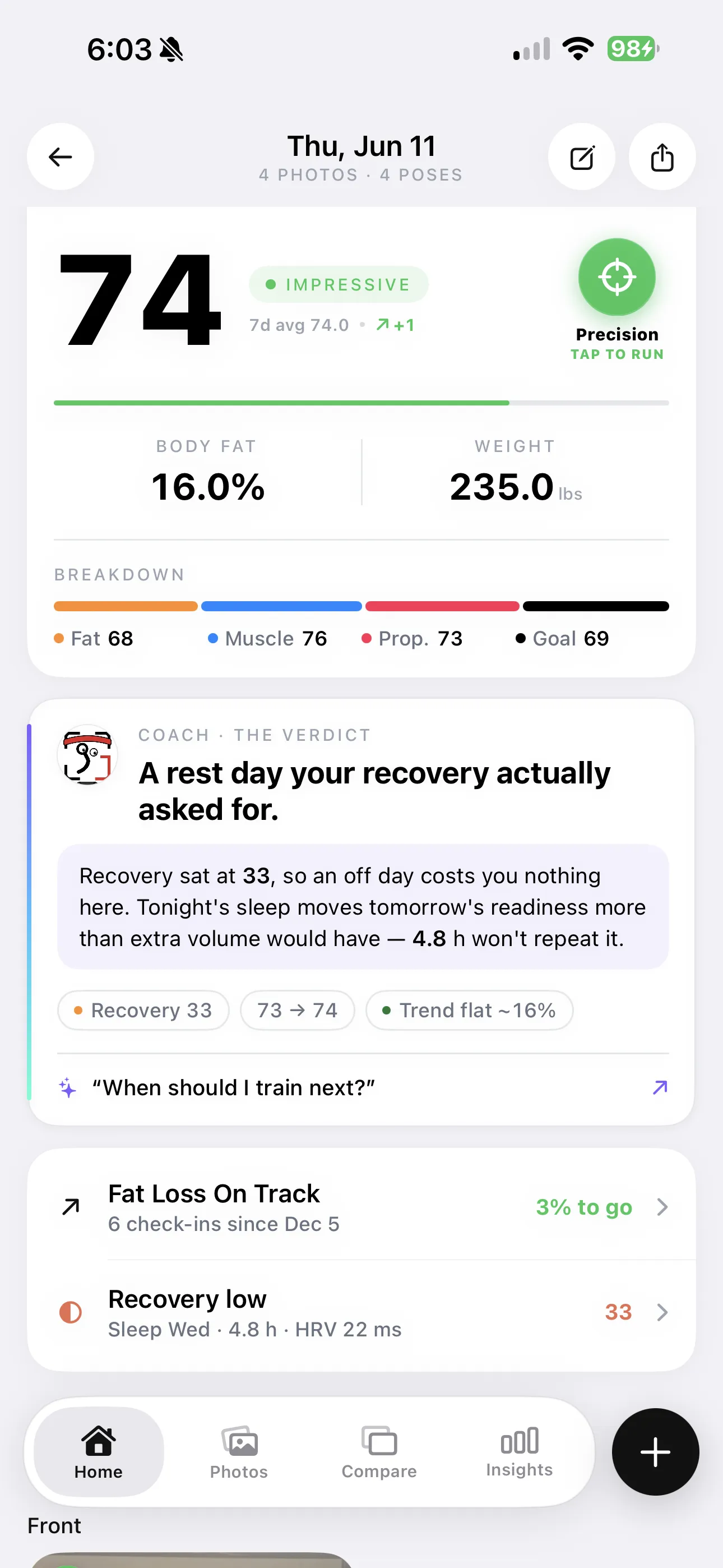
One photo produces the score, the body fat estimate, and the FFMI — the number that actually moves when you add muscle.
The per-muscle view is the part that changes training decisions. Chest and quads climbing while rear delts and hamstrings sit flat is a programming problem you can see months before a mirror check catches it. There's a Hevy integration too, so the workout you did that day is attached to the photo.
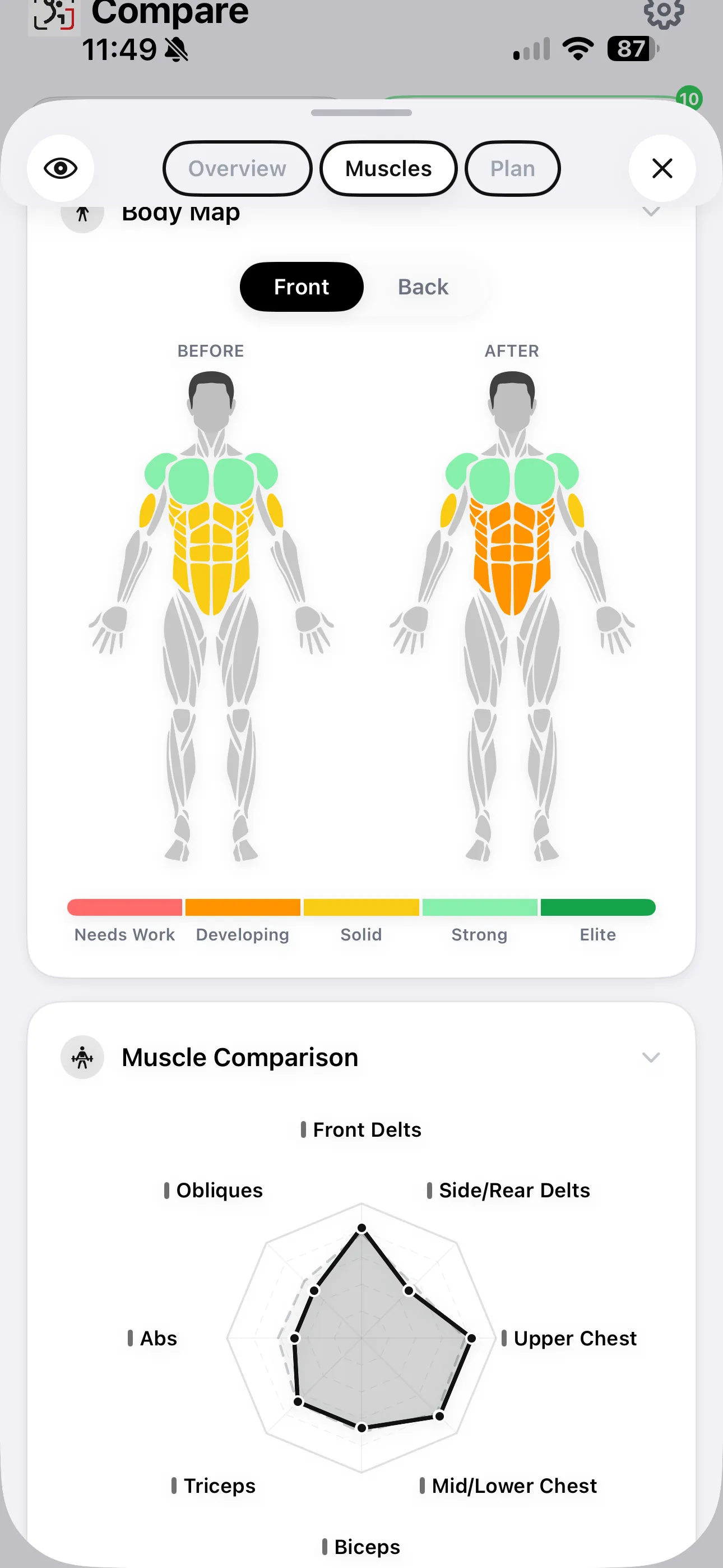
Twelve muscle groups, scored per photo. The flat ones are your next training block.
Best for: the weekly verdict on whether training and eating are producing a visible result. Limitations: iOS only, with no Android version; the numbers are AI estimates from photos, not clinical measurements. The rating count is small because the app is new — worth knowing before you weigh it against a 300,000-review incumbent. For the wider category including cross-platform options, see our AI body fat estimator roundup.
Goal 3: Eat for it
3. MacroFactor — Best nutrition tracker
Platform: iOS & Android · Price: around $12/mo, cheaper annually · iOS: 4.8 stars, 19,000+ ratings
Training gets the attention; food decides the outcome. MacroFactor's distinguishing feature is its adaptive expenditure algorithm — it reads your weight trend against your logged intake and updates your calorie target on its own, instead of making you re-run a TDEE calculator every few weeks and guess whether the plateau is real.
The logging itself is fast, the food database is well curated, and there's no ad layer or coaching upsell. It is the one app on this list I'd tell someone to pay for first if they can only pay for one. Our full MacroFactor review covers where it's worth the money and where it isn't.
Best for: cutting or lean bulking with a target that self-corrects. Limitations: subscription-only with no meaningful free tier; logging food is a daily habit that plenty of people quit.
Goal 4: Get coached
4. Fitbod — Best for having the program written for you
Platform: iOS & Android · Price: subscription with a free trial · iOS: 4.8 stars, 278,000+ ratings
Some men don't want to design a training split, and there's no virtue in forcing it. Fitbod generates each session from your history, available equipment, and which muscles it thinks are recovered. Walk into a hotel gym with three dumbbells and a cable stack and it will hand you a workout in about ten seconds.
The tradeoff is that algorithmic session generation nudges toward variety, and hypertrophy generally rewards repeating the same lifts long enough to progress on them. Treat the generated plan as a starting structure you lock in for a block.
Best for: beginners and anyone whose equipment changes week to week. Limitations: variety can undercut progressive overload; it costs more than logging your own program in a free app.
5. Ray — Best for coaching that talks back
Platform: iOS · Price: subscription · iOS: 4.8 stars, 253 ratings
Ray is a voice-first AI trainer: you talk, it responds, it adjusts. The appeal is real for people who bounce off form-filling and want something closer to a conversation with a trainer. It's early software with a small review base, and voice coaching is genuinely polarizing — some people find it motivating, others find it exhausting by session three.
We tested it properly in our Ray review, and the category as a whole in best AI personal trainer apps.
Best for: wanting a coaching voice in your ear without hiring a person. Limitations: iOS only; small user base; AI coaching still can't see your form.
Goal 5: Track weight and composition
6. Renpho — Best cheap smart scale
Platform: device + app (iOS & Android) · Price: roughly $30 for the scale · iOS: 4.7 stars, 7,000+ ratings
A $30 BIA scale gives you a daily weight that syncs itself, which removes the single most common excuse for not weighing. The body composition percentages it reports are estimates from bioelectrical impedance and swing with hydration, temperature, and time of day — the trend across weeks carries information, the individual reading mostly doesn't.
Weigh at the same time daily, read the weekly average, and ignore the day-to-day. Our Renpho scale review covers what $30 actually buys and where the body fat number goes wrong.
Best for: an automatic weight trend with zero friction. Limitations: BIA body fat estimates are noisy; treat the percentage as a rough direction, not a measurement.
Goal 6: Recovery
7. WHOOP — Best recovery data for serious training
Platform: device + app · Price: membership-based, hardware included · iOS: 4.8 stars, 44,000+ ratings
WHOOP measures sleep, HRV, and resting heart rate continuously and converts them into a daily recovery score plus a training strain target. For men training hard enough that recovery is genuinely a limiting factor, that's actionable. For men training three times a week, it's a subscription to being told you should sleep more.
There's a screenless band and no watch face, which some people prefer and others find pointless. If the recurring cost is the sticking point, we compared the cheaper routes in best WHOOP alternatives for lifters.
Best for: high training volume where recovery is the actual constraint. Limitations: ongoing membership cost; strain scoring is built around cardiovascular load and underrates heavy lifting.
8. Oura — Best recovery tracking you'll forget you're wearing
Platform: device + app · Price: ring purchase plus monthly membership · iOS: 4.9 stars, 271,000+ ratings
Same category, different tradeoff. A ring is easier to sleep in than a band, the battery lasts several days, and the sleep staging is the part most users rate highest. Oura's readiness score is more of a lifestyle signal than a training prescription, which suits people who lift but don't want a coach in their notifications.
Best for: sleep and readiness data with minimal friction. Limitations: meaningful upfront hardware cost on top of the subscription; less training-specific than WHOOP.
Goal 7: Cardio
9. Strava — Best for runs and rides
Platform: iOS & Android · Price: free tier; Premium optional · iOS: 4.8 stars, 364,000+ ratings
This one sits outside our lane, so keep the recommendation brief and take it at face value: Strava is the default for cardio for the same reason Hevy is for lifting — everyone's already there. Route tracking, segments, and a social feed that produces real accountability. Some analysis moved behind Premium over the years, which annoys long-time users, and the free tier still covers logging and basic trends.
Best for: running, cycling, and the social layer that gets you out the door. Limitations: poor for tracking lifting; we don't test cardio apps deeply, so weigh this against a running-focused source.
Goal 8: Train without a gym
10. Nike Training Club — Best free bodyweight and home workouts
Platform: iOS & Android · Price: free · iOS: 4.8 stars, 279,000+ ratings
Nike made the whole library free, and it's a lot of value for zero dollars: guided strength, mobility, and conditioning sessions with video, plus multi-week programs. For travel weeks, gym closures, or a starting point before a membership, it's the obvious default.
It won't replace progressive overload with barbells — the loading options in a living room cap out fast. Use it to keep the habit alive rather than as the main plan if muscle is your goal.
Best for: no equipment, no cost, no excuse. Limitations: limited loading means limited hypertrophy ceiling; no serious tracking or progression logic.
So which two or three should you actually install?
Ten apps is a list, not a plan. Every app you add is another daily habit, and habits fail at a predictable rate. Pick by what you're trying to change in the next three months.
- Building muscle: Hevy plus a photo tracker. The log proves the input, the photos prove the output.
- Losing fat: MacroFactor plus a scale. Calories decide it; the weight trend confirms it.
- Recomping or generally in shape: a training log, a nutrition tracker, and a weekly photo. That's the whole stack.
- Just starting: one app. Hevy, or Nike Training Club if you don't have a gym yet. Add the second when the first is a habit.
Nobody needs ten. The men who make visible progress are usually running two apps they open without thinking about it, for a year.
Frequently asked questions
What is the best fitness app for men in 2026?
There isn't one — the best app depends on the job. For lifting, Hevy is the consensus pick. For nutrition, MacroFactor. For seeing whether your training is changing your physique, a photo-analysis app like GainFrame. For cardio, Strava. Most men get further by picking two of these than by hunting for a single app that does everything.
How many fitness apps do you actually need?
Two or three. A training log and a nutrition tracker cover the two levers that actually drive results, and a visual tracker tells you whether they're working. Everything beyond that is optional. Ten apps means ten daily habits, and the failure mode of a big stack is that you stop opening all of them.
Is a free fitness app good enough?
For training logs, yes. Hevy's free tier covers routines, history, and progression for most lifters indefinitely. Nutrition and coaching apps are where the paid tiers earn their keep, because the adaptive math and program generation are the product. Start free everywhere, then pay only for the one app you've opened every day for a month.
What is the best app for tracking muscle gain?
Two signals together. A workout log like Hevy shows whether your lifts are climbing, which is the strongest indirect evidence of muscle gain. A photo-analysis app shows whether the size is showing up visually, with per-muscle scores and FFMI. Strength rising with no visual change usually means neural adaptation rather than new tissue.
Do you need a smartwatch or ring to track fitness?
No. Wearables measure recovery and sleep, which are inputs to training quality rather than measures of progress. If you already sleep reasonably and train hard, a WHOOP or Oura mostly confirms what you suspect. The money is better spent on a scale and a nutrition subscription until your training is consistent enough for recovery data to change decisions.
Find out if the training is actually working
GainFrame scores your progress photos — estimated body fat, FFMI, a 1–100 physique score, and 12 muscle-group ratings tracked over time. Free to start on iOS.
Download GainFrame Free