

Quick answer: A Renpho scale is the best $30 you can spend on weight automation: accurate weight, seamless app sync, an effortless daily habit. The body fat percentage is a foot-to-foot BIA estimate that can swing several points with hydration, so treat it as a rough trend at most. Composition-focused? See our Renpho alternatives roundup.
Here's the Renpho experience in one week: Monday the scale says 22.1% body fat. Wednesday, after a salty dinner and a hard leg day, it says 25.3%. Friday it's back to 22.8%. Meanwhile your weight moved half a pound. Did you gain three points of fat and lose them again? No. You watched hydration noise wearing a percent sign.
This review is about what the $30 actually buys, because the answer is genuinely two-sided: one of the best value purchases in fitness tracking, wrapped around a number you shouldn't take literally. If you already own one and want upgrades, our Renpho alternatives roundup ranks those; this page is the review of the thing itself.
How this review was researched
Straight up: this review synthesizes Renpho's published specs, the BIA research literature, and aggregated user reviews across the product line, without a lab test of every model. Where reviewer experiences vary, we say so rather than picking a side. Disclosure: we make GainFrame, a photo-based body tracking app that pairs with (rather than competes against) a scale like this.
What do you actually get for $30?
Renpho sells a family of Bluetooth and Wi-Fi smart scales, most commonly in the $20 to 35 range, that measure weight and estimate body composition via foot-to-foot bioelectrical impedance (BIA): body fat, muscle mass, water, and a dozen-plus related metrics. A small current runs up one leg and down the other, and an algorithm models your whole body from that lower-body sample.
Readings sync automatically to the RENPHO Health app, which holds a strong rating on the App Store, around 4.7 across roughly 7,200 ratings at the time of writing, and connects onward to Apple Health and similar platforms. That app quality is a real part of the value: plenty of budget scales ship with software that feels like an afterthought, and Renpho's commonly gets praised as the reason people stick with the habit.
The pitch, in short: full body composition tracking for the price of a single InBody scan at a gym. Whether that pitch holds depends entirely on which number you're buying it for.
What does the Renpho scale do well?
- Price-to-function is close to unbeatable. Around $30 for accurate weighing, automatic sync, trend charts, and multi-user support. Nothing else in body tracking delivers this much workflow per dollar.
- The weight measurement is the quiet star. Renpho scales are commonly reported to weigh accurately and consistently, and weight is the input every serious tracking method actually needs. An automated, zero-effort weight trend is most of what a scale should be.
- The sync removes the failure point. Manual weight logging dies in week three. Step on, walk away, the chart updates. Habit-proofing the measurement is arguably worth the $30 by itself.
- The app clears the budget-scale bar easily. Clean trends, data export, broad platform sync, solid rating. Reviewer opinions vary on the deeper features, but the core loop is commonly described as frictionless.
Is the Renpho scale accurate?
This is the honest center of the review, and it splits cleanly by metric. The weight number is accurate: it comes from a load cell measuring you directly, and consistency across weigh-ins is what the product is commonly praised for. The body fat percentage is an estimate, and a volatile one.
Foot-to-foot BIA measures the electrical resistance of your lower body, then models the rest. Resistance depends heavily on water, so the estimate moves with hydration, meal timing, alcohol, training, and time of day, commonly by 2 to 4 points within a normal week in which your actual body fat barely changed. The number also carries a model bias: the algorithm guesses your torso and upper body rather than measuring them. We've covered the mechanics in depth in our smart scale accuracy breakdown, and Renpho behaves exactly like the category.
The practical reading: fine for long-term trends, unreliable for absolutes. Weigh in under consistent conditions, same time of day, before food, and the multi-week direction of the body fat estimate carries some signal. Any single morning's number, and especially any day-to-day comparison, is mostly noise. If a 25.3% reading after taco night can ruin your morning, the kindest setting is to hide the metric and keep the weight trend.
Who should buy a Renpho scale?
- Anyone who wants cheap, automated weight tracking. This is the core buyer, and the product genuinely delivers. If your plan involves a weight trend, a cut, a bulk, or maintenance, $30 automates it permanently.
- People building a first tracking habit. The zero-friction weigh-in is a gateway habit, and the app makes the trend visible enough to stay motivating.
- Trend-literate users who want a rough composition signal for free. If you already know to read multi-week direction and ignore single readings, the BIA estimate is a tolerable bonus on top of an excellent weight tool.
Who should skip it or upgrade?
- Anyone buying primarily for the body fat number. You'd be buying the product's weakest output. Better-instrumented BIA exists: our Hume Body Pod review covers the hand-electrode upgrade at ~$229, the Withings Body Scan goes further at ~$400, and our Renpho alternatives roundup ranks the full field, including no-hardware options.
- People a fluctuating number will genuinely stress. A 3-point overnight swing lands hard if you don't know it's water. A simple tape measure routine is calmer; see tape measure vs smart scale.
- Anyone expecting clinical measurement at $30. No consumer scale delivers that at any price; a periodic DEXA is the accuracy anchor if absolutes matter to you.
How does the Renpho scale work with Apple Health and beyond?
The Apple Health handoff is where the $30 stops being a silo. Turn on Health sharing in the RENPHO Health app and every weigh-in's weight, body fat, and lean mass get written to Apple Health automatically. From there the series belongs to you: any app you authorize can read it, which is what turns a bathroom gadget into infrastructure. Our best smart scales for Apple Health roundup compares how the whole category handles this.
The honest framing, disclosure repeated: GainFrame is our app, and this pairing is exactly how we'd use a Renpho. GainFrame reads the scale's weight, body fat, and lean mass from Apple Health, never connecting to the scale or your RENPHO account directly, and puts the trend next to scored progress photos: estimated body fat, FFMI, and 12 muscle-group ratings per check-in. Photo estimates have their own error sources, but they're immune to the hydration noise that whipsaws BIA, and they show where your body is changing, which no foot-to-foot current can. The full setup takes about two minutes; the RENPHO integration guide walks every step.
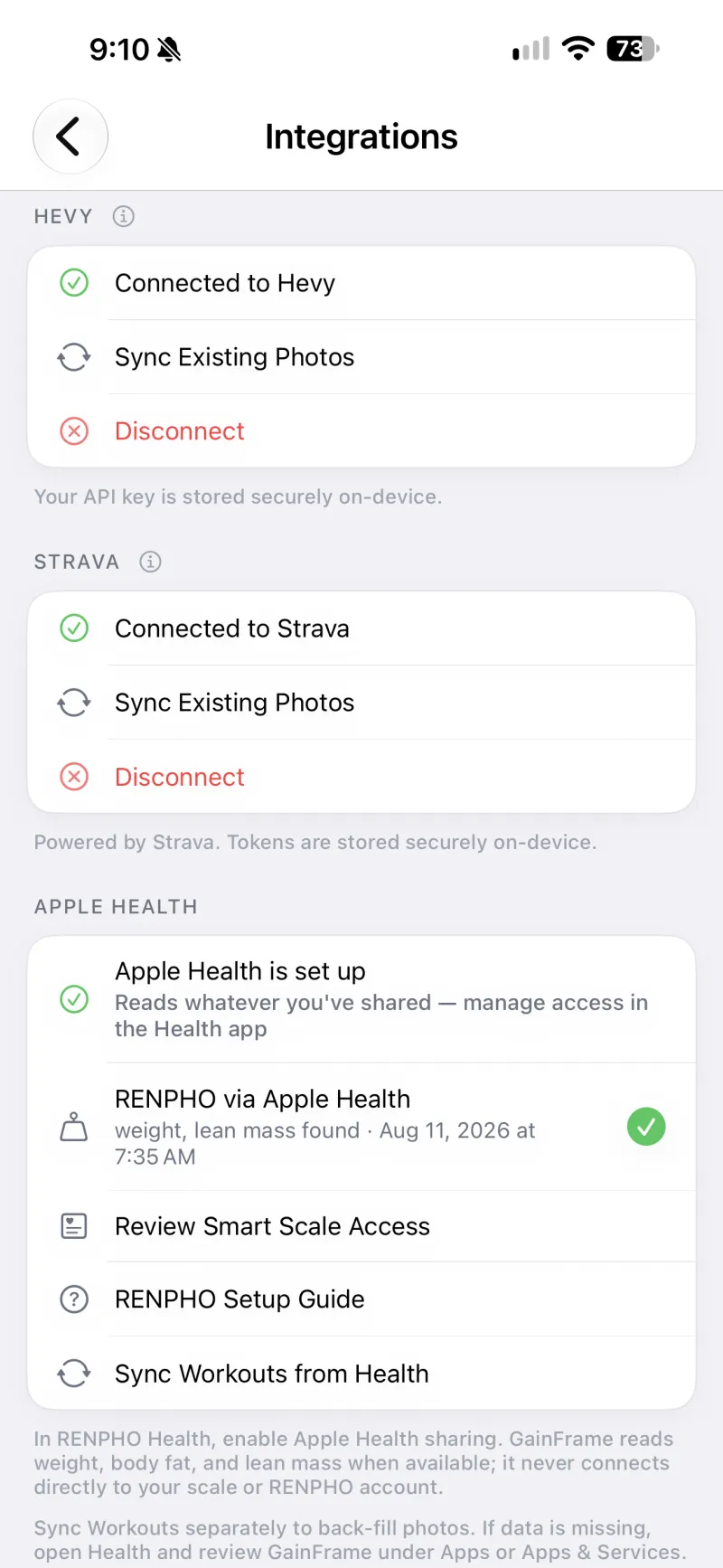
The Renpho's readings flowing onward: weight and lean mass arriving via Apple Health, verified with a timestamp on the morning weigh-in.
Choosing between ecosystems? Our RENPHO vs Withings for Apple Health comparison follows the data from the named scale models through their apps into Health.
Verdict
Renpho: buy it for the weight, shrug at the body fat
The Renpho scale is one of the best value purchases in fitness tracking: accurate weight, automatic sync, a genuinely good app, at a price that makes the decision easy. That's the product, and it earns its millions of bathrooms.
The composition metrics are the marketing rather than the product. They're foot-to-foot BIA estimates that swing with water, useful only as a loose long-term trend and misleading as daily numbers.
Buy it if: you want cheap, effortless weight automation; that's most people reading this.
Skip or upgrade if: the body fat number is the point; better BIA hardware, photo-based tracking, or a periodic DEXA all serve that goal better.
Frequently asked questions
Is the Renpho scale accurate?
Split the question in two. For body weight, yes: Renpho scales are commonly reported to track weight reliably, which is the metric the whole product hinges on. For body fat and the other composition metrics, no single reading should be trusted. They're foot-to-foot BIA estimates that can swing several points with hydration, meal timing, and time of day.
Why does my Renpho body fat percentage change every day?
Because the scale measures electrical resistance through your lower body, and your hydration changes daily. A salty dinner, a hard workout, alcohol, or weighing at a different time shifts your body water enough to move the estimate 2 to 4 points. Real body fat changes by tenths of a percent per week; daily swings are measurement noise.
Is a Renpho scale worth it in 2026?
For automated weight tracking, absolutely. Around $30 buys accurate weigh-ins, automatic sync, a well-rated app, and a trend chart, which is most of what a daily scale habit needs. Buy it for the weight trend and treat the composition numbers as a loose bonus. If the body fat number is your main reason for buying, look elsewhere.
Does the Renpho scale sync with Apple Health?
Yes. Enable Apple Health sharing in the RENPHO Health app and each weigh-in's weight, body fat, and lean mass get written to Health automatically. Most Renpho models sync over Bluetooth, so the app needs to be on a phone near the scale at weigh-in time. From Apple Health, any app you authorize can read the series.
What is better than a Renpho scale for body composition?
Depends on budget and what you want fixed. Multi-point BIA devices like the Hume Body Pod or Withings Body Scan add hand electrodes for a better estimate. Photo-based analysis tracks visible shape and sidesteps hydration noise entirely. A periodic DEXA scan is the accuracy anchor. Our Renpho alternatives roundup ranks the options by what each fixes.
Add the layer the $30 scale can't see
GainFrame turns progress photos into scored check-ins with body fat %, FFMI, and 12 muscle ratings, and reads your Renpho's weight trend straight from Apple Health. The composition layer to pair with the scale. Free to start on iOS.
Download GainFrame Free