
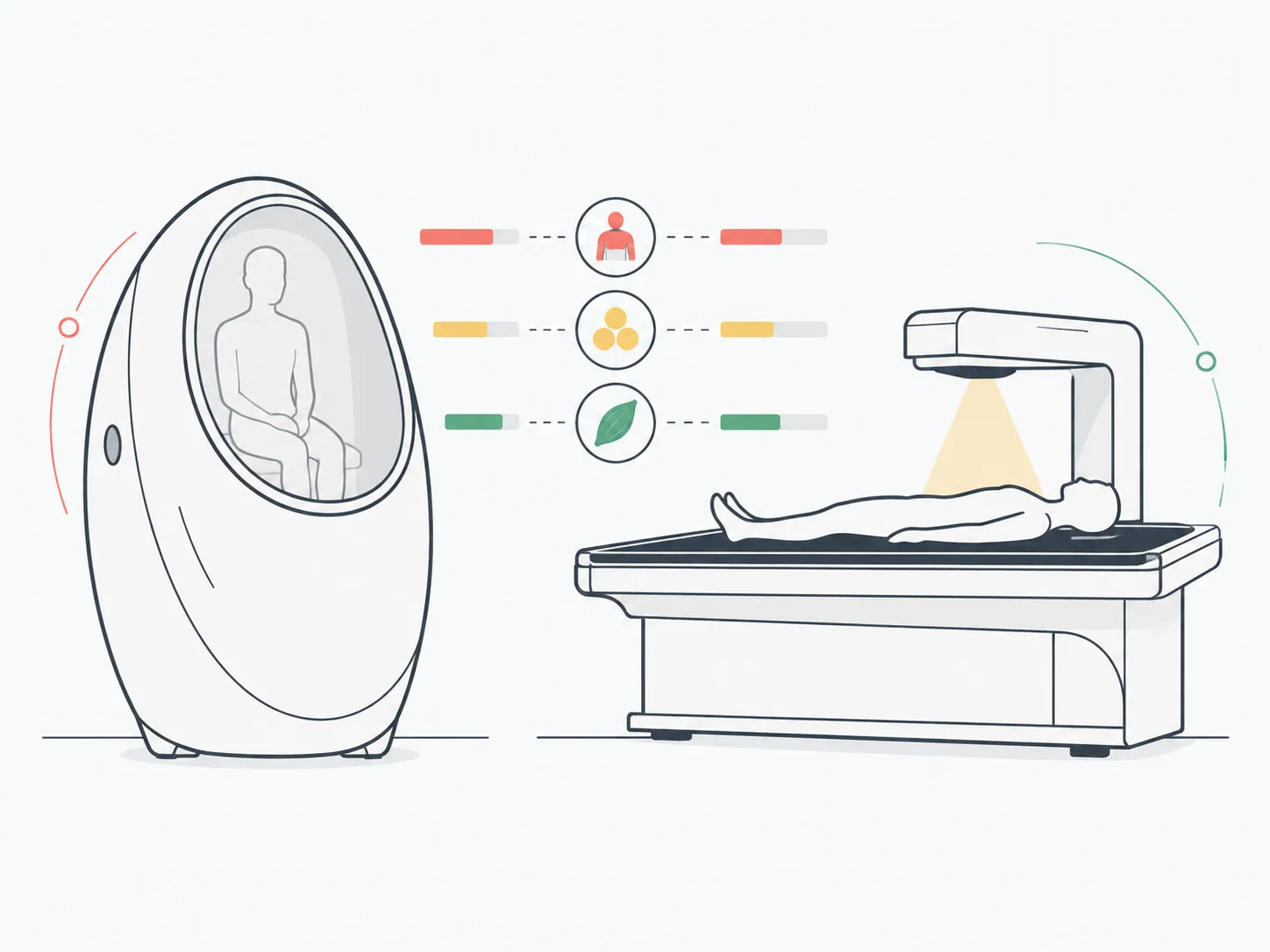
Quick answer: BOD POD estimates whole-body fat and fat-free mass from air displacement and body weight, without X-rays. DEXA estimates fat, lean soft tissue and bone mineral, with regional detail. Choose based on the report you need, access and repeatability. Keep each method's history separate because their body-fat percentages are not interchangeable.
The BOD POD vs DEXA decision starts with the report you want to receive. A total body-fat estimate can answer one question. A map of regional fat, lean soft tissue and bone mineral can answer several others. Neither report gives you an error-free count of muscle gained since your last workout.
This is a published-source comparison of the methods. We have not performed a BOD POD test. The DEXA example below is the author's previously published GE Lunar report, used to show what the fields mean, without presenting it as a head-to-head validation.
Should you choose BOD POD or DEXA?
Choose BOD POD when you want a quick whole-body estimate without X-rays and can repeat a standardized test at the same facility. Choose DEXA, also called DXA, when regional composition and separate bone-mineral information make the report more useful to your goal.
Availability, preparation and repeatability matter as much as the label. Before booking, ask the facility to show you a sample report and explain what it can reasonably detect across repeat visits. If the actual question is clinical bone density, speak with a clinician about the appropriate examination.
How does BOD POD estimate body fat?
BOD POD uses air-displacement plethysmography. You sit inside a chamber while the system estimates body volume from pressure changes. Combined with body mass, that produces body density, which an equation converts into fat and fat-free mass.
COSMED's current BOD POD documentation describes this whole-body approach and a test taking less than five minutes. The appointment can take longer because it includes preparation, instructions and calibration. The system also offers a thoracic gas-volume measurement option.
Clothing, hair and lung-volume handling matter because the method depends on volume. Follow the facility's instructions about fitted clothing, a swim cap, food and exercise. A procedure that feels simple still requires a consistent protocol.
How does DEXA estimate body composition?
DEXA uses two X-ray energy levels to estimate fat, lean soft tissue and bone mineral. A whole-body scan can also divide the result into regions, such as arms, legs and trunk. GE HealthCare's body-composition overview illustrates those outputs.
That regional information is its main practical advantage in this comparison. You can inspect whether a change appears mostly in the trunk or limbs, or whether a side-to-side difference persists. Small differences still need the facility's precision information and consistent positioning.
DEXA uses ionizing radiation. A provider should determine whether the examination is appropriate, including when pregnancy is possible. A fitness composition scan also should not be treated as a substitute for a diagnostic hip or spine bone-density study.
What will each report show?
| Question | BOD POD | Whole-body DEXA |
|---|---|---|
| Physical signal | Air displacement and body mass | X-ray attenuation at two energies |
| Main composition model | Fat and fat-free mass from body density | Fat, lean soft tissue and bone mineral |
| Total body-fat percentage | Estimated | Estimated |
| Separate arm, leg and trunk results | Not part of the standard whole-body density result | Available in regional analysis |
| Bone-mineral information | Not separately measured | Reported separately; clinical BMD is a different use case |
| Visceral-fat information | Not anatomically localized by the density test | Estimated by some systems and software |
| X-rays | None | Used |
| Preparation concerns | Clothing, hair, lung volume and facility protocol | Positioning, recent intake, hydration and facility protocol |
| Best fit | Repeatable whole-body composition estimate | Regional detail and an occasional reference scan |
Ask which report your facility supplies. A generic DEXA booking does not guarantee every composition field or a visceral-fat estimate. Likewise, a calculated resting-metabolic-rate field is different from measuring your energy expenditure with indirect calorimetry.
What does a real DEXA report add to the comparison?
The author's GE Lunar Prodigy report shows 18.6% total body fat, 41.7 pounds of fat mass, 182.1 pounds of lean mass and 9.0 pounds of bone mineral content. It also lists regional rows for the arms, legs, trunk, android and gynoid areas.
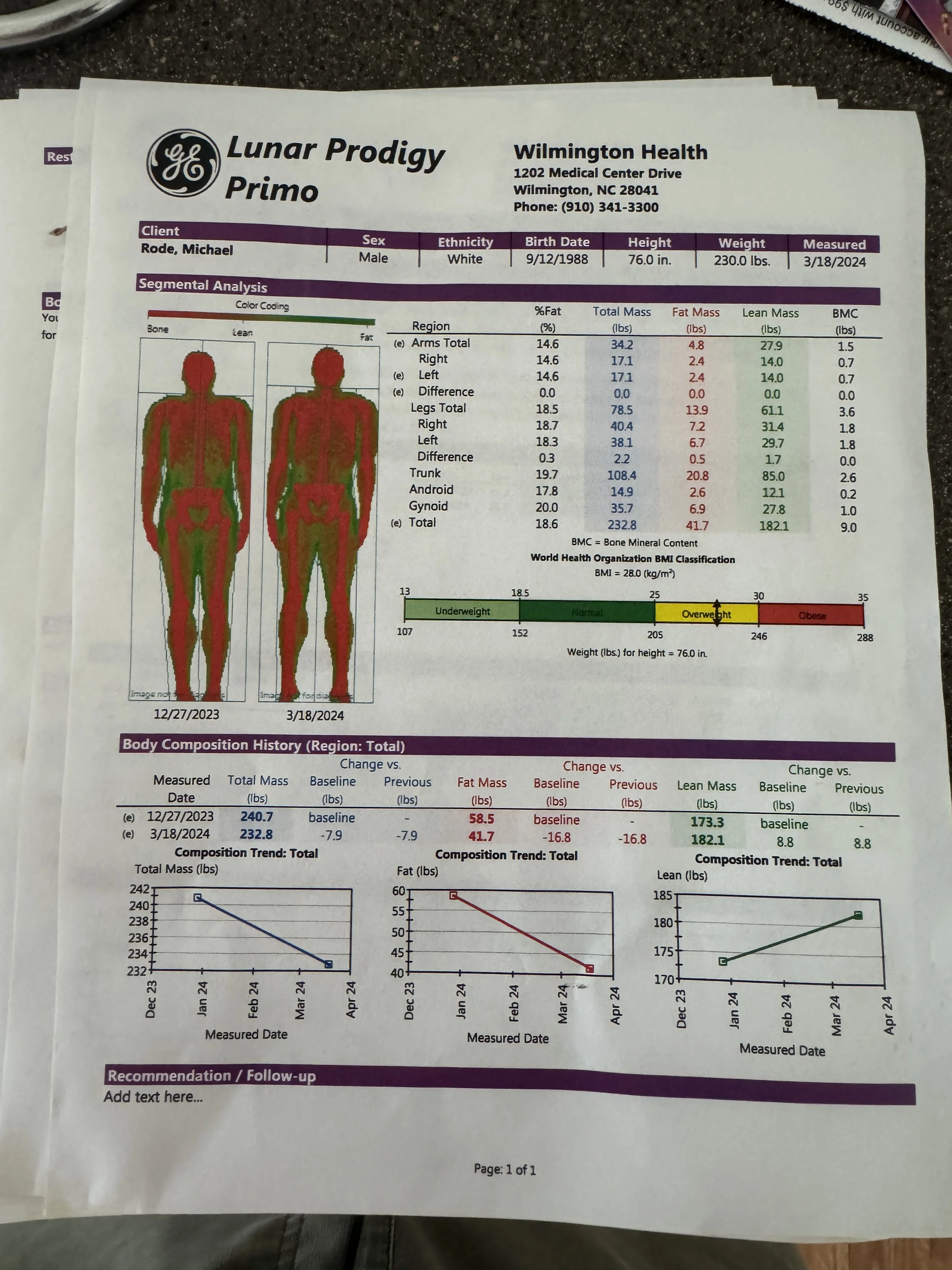
The author's previously published report, shared with permission. It demonstrates the information in a DEXA report; it is not a comparison against a BOD POD result.
A BOD POD's standard density result does not tell you that one arm or one leg carries a particular amount of lean tissue. If those regional questions are why you are booking, DEXA has the more relevant output. For a field-by-field explanation, use the DEXA report guide.
Keep the labels intact when comparing methods. BOD POD fat-free mass includes everything in its non-fat compartment. DEXA's lean-soft-tissue column separates bone mineral. Copying both into a spreadsheet column called “muscle” would erase that distinction.
Why can BOD POD and DEXA disagree?
The methods observe different physical signals and apply different assumptions. BOD POD converts body density into composition; DEXA uses tissue attenuation and scanner software. Protocol, body characteristics and the equation or software version can influence their agreement.
A 2015 study by Lowry and Tomiyama compared both methods in 64 adults across underweight, normal-weight and overweight/obese groups. BOD POD tended to read higher than DXA in thinner participants and lower in heavier participants, with larger discrepancies at the underweight end.
What that study did not establish: a correction factor for every lifter, every modern machine or every repeat visit. Its population and protocol limit how broadly you should apply the findings. It supports caution about interchangeable percentages, rather than a promise that one method always reads higher.
A later study of thoracic gas-volume estimation also examines a BOD POD-specific source of variation. Ask whether your facility measures or predicts lung volume and keeps that choice consistent for follow-up visits.
Which method is better for tracking muscle gain?
DEXA is more informative when you need regional lean-tissue estimates. However, lean tissue includes water and other non-fat soft tissues. An increase in that column alone cannot establish how much contractile muscle you built.
BOD POD can track a whole-body fat-free-mass estimate. It does not localize a change to your shoulders, chest or legs. Use either result alongside your training log, circumference measurements and consistent photographs.
For a gym impedance test as a third option, read InBody vs DEXA. Keep each method's history separate. Switching methods halfway through a training block can create an apparent gain or loss that comes from the measurement change.
How should you prepare and plan repeat testing?
Use the facility's protocol, and record enough context to repeat it. Ask these questions before paying:
- Will I use the same device and analysis procedure next time? Record the model and any software or protocol change the facility flags.
- What should I do about meals, fluids and exercise? Follow the supplied instructions rather than combining preparation advice from unrelated tests.
- What clothing and positioning are required? For BOD POD, confirm the swim-cap and fitted-clothing requirements. For DEXA, ask about metal and positioning.
- What change exceeds your repeat-test error? A facility's precision information is more useful than a generic accuracy claim.
- Can I keep the full report? Save the date, units and original labels as well as the headline percentage.
Plan your next visit around a question that enough training time could answer. Repeated testing is useful only when the expected change is large enough to distinguish from measurement variation. A clinician should guide testing for a medical purpose.
How should you compare the cost?
Prices vary by facility, country, package and whether interpretation is included. We did not verify a universal price for either service, and neither method is always cheaper everywhere. Compare local quotes for the same deliverable: the test, a full report, an explanation and any planned repeat visit.
Travel and scheduling affect the value too. A convenient facility with a consistent protocol may serve your tracking goal better than a distant test you will never repeat. Our DEXA alternatives guide and measurement-method roundup explain the other routes.
What are the limits of this recommendation?
This guide synthesizes published methods and studies, plus one first-party DEXA report. It does not include a new BOD POD trial or establish a universal accuracy ranking. Facilities, populations and software differ, and both methods can be affected by test conditions.
Between appointments, the free photo body-fat estimator can provide a rough visual check. It is sensitive to lighting, pose and framing and cannot calibrate a laboratory result. Keep the original reports and use consistent observations to judge your longer-term direction.
What else should you know?
Is BOD POD more accurate than DEXA?
There is no universal winner for every person and protocol. Research comparing the methods has found differences that depend on participant characteristics and testing conditions. DEXA supplies regional detail, while BOD POD supplies a whole-body density-based estimate. Ask about the facility's protocol and repeat-test error before interpreting a small change.
Why is my BOD POD result different from my DEXA scan?
The methods measure different physical signals and use different models. BOD POD estimates composition from body density, while DEXA uses X-ray attenuation and scanner software. Clothing, lung-volume handling, positioning and other test conditions can contribute to differences. Keep separate baselines rather than assuming one fixed conversion works for everyone.
Does BOD POD measure muscle in each arm and leg?
A standard BOD POD density test does not localize composition to individual arms, legs or the trunk. It estimates whole-body fat and fat-free mass. DEXA can provide regional lean-soft-tissue values, although those values include more than skeletal muscle. Use training performance and other observations alongside either report.
Does BOD POD use radiation?
BOD POD uses air-displacement measurements rather than X-rays. DEXA uses ionizing radiation, and the provider should assess whether the scan is appropriate for you. Tell the facility if pregnancy is possible. The absence of X-rays does not make a BOD POD result automatically more accurate or suitable for every purpose.
Can I use BOD POD and DEXA interchangeably?
Keep separate histories for the two methods. Their headline percentages and lean-related fields come from different models and may have different definitions. If you change methods, record the switch and establish a new baseline. Comparing a later result with an earlier result from another method can misrepresent your actual progress.
Which costs less, BOD POD or DEXA?
There is no universal price winner. Local access, packages, interpretation and repeat-visit pricing affect the total. Request quotes for the same deliverable and ask whether you receive the full report. Travel and scheduling also matter if your goal requires a repeat visit under a consistent protocol.
Which sources support this comparison?
- COSMED's current BOD POD documentation
- GE HealthCare's body-composition overview
- 2015 study by Lowry and Tomiyama
- later study of thoracic gas-volume estimation
Keep the trend beside your photos
GainFrame is our iPhone app for organizing progress photos and reviewing estimated body-composition trends. Read about the app and its creator, or start your own photo history.
Get GainFrame for iPhone