
Quick answer: DEXA is the stronger reference for a periodic body-composition baseline because it separates bone mineral, fat, and lean soft tissue. InBody is faster and easier to repeat, but hydration and test conditions affect its BIA estimate. Use one method consistently for trends instead of treating the two numbers as interchangeable.
Your gym's InBody says 16% body fat. A DEXA scan a few days later says 20%. You trained hard, skipped breakfast for one test, drank more water before the other, and now you have two expensive-looking reports that disagree.
That is the central InBody vs DEXA problem. Both methods can help you track body composition, but they measure different physical signals and calculate the final number differently. The most useful choice depends on whether you need a periodic reference scan or a convenient trend you can repeat under controlled conditions.
Scope: This guide explains fitness-focused body-composition reports. It does not diagnose a health condition or interpret a clinical bone-density study. Discuss medical findings, pregnancy, implanted devices, or treatment decisions with a qualified clinician.
For an Evolt appointment, use the Evolt 360 result-evaluation checklist. If you are choosing where to get DEXA, the BodySpec service review covers booking and support separately from this methods comparison.
Which is more accurate for body fat, InBody or DEXA?
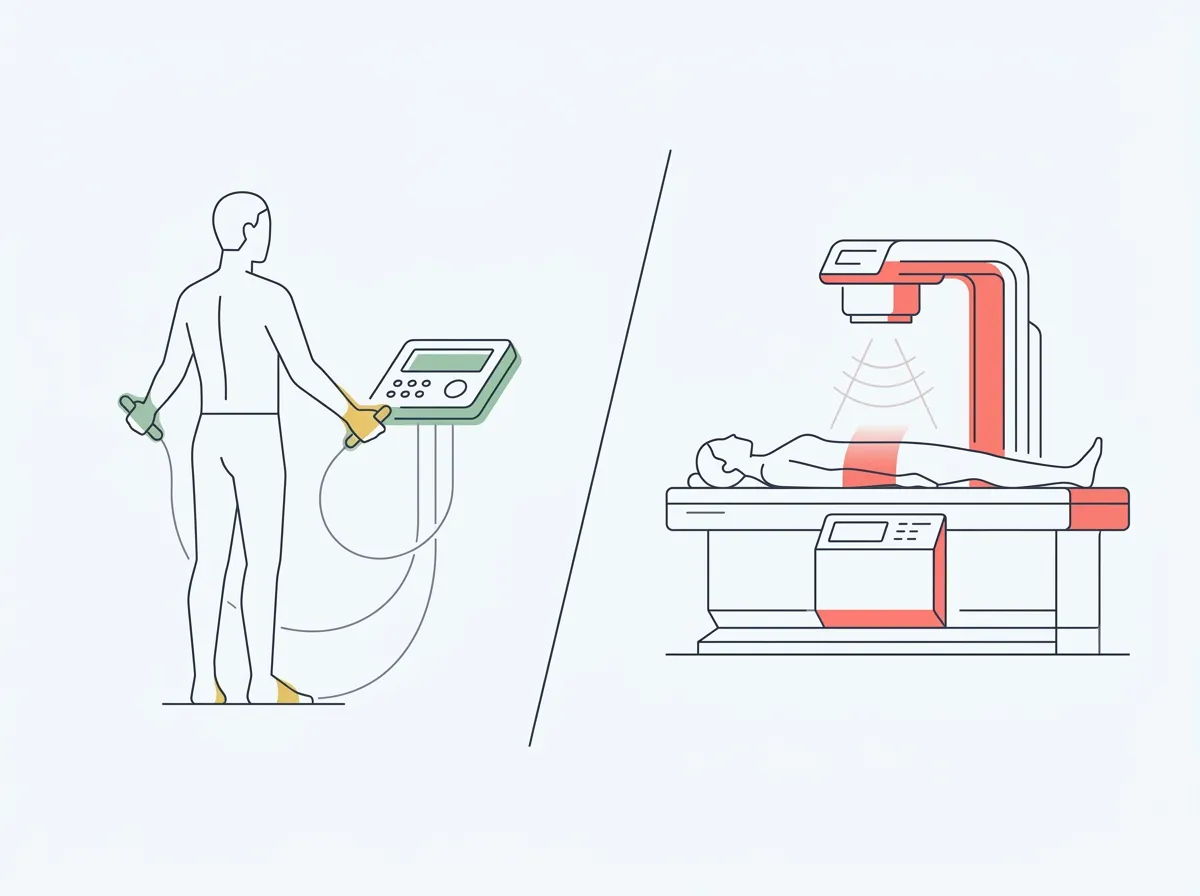
DEXA is the stronger reference method for body-fat percentage and regional composition. It sends two low-energy X-ray beams through the body and estimates three compartments: bone mineral, fat mass, and lean soft tissue. Researchers commonly use DEXA as the criterion method when validating BIA devices.
InBody uses direct segmental, multi-frequency bioelectrical impedance analysis. You stand barefoot on electrodes and hold hand electrodes while small electrical currents travel through five body segments. The device measures impedance, estimates body water, and derives fat-free mass and body fat from those measurements and physiological models.
The distinction between correlation and agreement matters. A device can track who is leaner or heavier very well while still returning a systematic offset from DEXA. In a study of 795 physically fit active-duty adults, the InBody 770 showed high correlation with DEXA, yet its body-fat estimates had a 3.9 percentage-point mean absolute error and averaged 3.4 points lower than DEXA.
That result does not create a universal correction formula. It describes one device, one study population, and one protocol. Your local InBody model, DEXA machine, hydration, recent training, and body type can produce a different gap.
How do InBody and DEXA measure your body differently?
The two methods begin with different raw signals.
InBody measures electrical impedance. Water-rich tissue conducts current differently from fat tissue. Multiple frequencies and separate arm, leg, and trunk measurements give professional InBody models more detail than a basic foot-only smart scale. The final fat and lean values are still derived estimates that depend on body-water assumptions.
DEXA measures X-ray attenuation. The scanner records how two X-ray energy levels pass through the body while you lie still. Software separates the image into bone mineral and soft-tissue regions, then estimates how much of the soft tissue is fat or lean.
DEXA does not directly weigh every muscle fiber. Its "lean" value includes water, organs, connective tissue, and other fat-free soft tissue. InBody's segmental lean output also should not be read as a pure measurement of contractile muscle.
How do InBody and DEXA compare side by side?
| Dimension | InBody | DEXA |
|---|---|---|
| Primary signal | Electrical impedance through body water | Two-energy X-ray attenuation |
| Main output | Water, fat-free mass, body fat, and segmental estimates | Bone mineral, fat mass, lean soft tissue, and regional estimates |
| Typical access | Gyms, clinics, training facilities, and some home devices | Medical, sports-performance, and commercial scanning clinics |
| Test time | Usually a short standing test | Often about 6 to 10 minutes, depending on the facility and machine |
| Repeat-test sensitivity | Strongly affected by hydration, meals, exercise, posture, and skin contact | Affected by hydration, meals, recent exercise, positioning, analysis regions, machine, and software |
| Regional view | Segmental arms, legs, and trunk estimates on many professional models | Regional fat and lean soft tissue, often including android and gynoid areas |
| Bone information | No direct bone-mineral measurement | Whole-body bone-mineral estimate; a fitness body-composition scan is not automatically a diagnostic osteoporosis exam |
| Radiation | None from the BIA test | Uses a small dose of ionizing radiation |
| Cost | Varies by gym or clinic and may be included with membership | Varies by facility; UC Davis lists $95 for an initial body-composition assessment and $75 for follow-ups |
| Best role | Frequent trend tracking under standardized conditions | Periodic reference measurements and regional composition detail |
Why do InBody and DEXA give different results?
The reports disagree because each method has a different model and different sources of variation. The difference is expected, even when both tests are performed correctly.
For InBody, water distribution is central. Food, fluid, alcohol, a hard training session, using the bathroom, cold skin, and standing posture can change impedance. InBody's own preparation guidance emphasizes consistent conditions, bare hands and feet, removing heavy items, using the restroom, standing upright before testing, and staying still during the test.
DEXA also benefits from standardized conditions. Research reviews report that food, hydration, recent exercise, positioning, and the operator's region placement can influence lean and fat estimates. Results can also differ between manufacturers, machine generations, and software versions.
A scan performed on a different machine after a large meal is a weak comparison with a fasted baseline on another machine. The equipment may be excellent while the comparison is noisy.
What does a real DEXA body-composition report show?
Our first-party GE Lunar report below shows why DEXA provides more than one headline percentage. The total row reports 18.6% body fat, 41.7 lb of fat mass, 182.1 lb of lean mass, and 9.0 lb of bone mineral content. Separate rows show arms, legs, trunk, android, and gynoid regions.
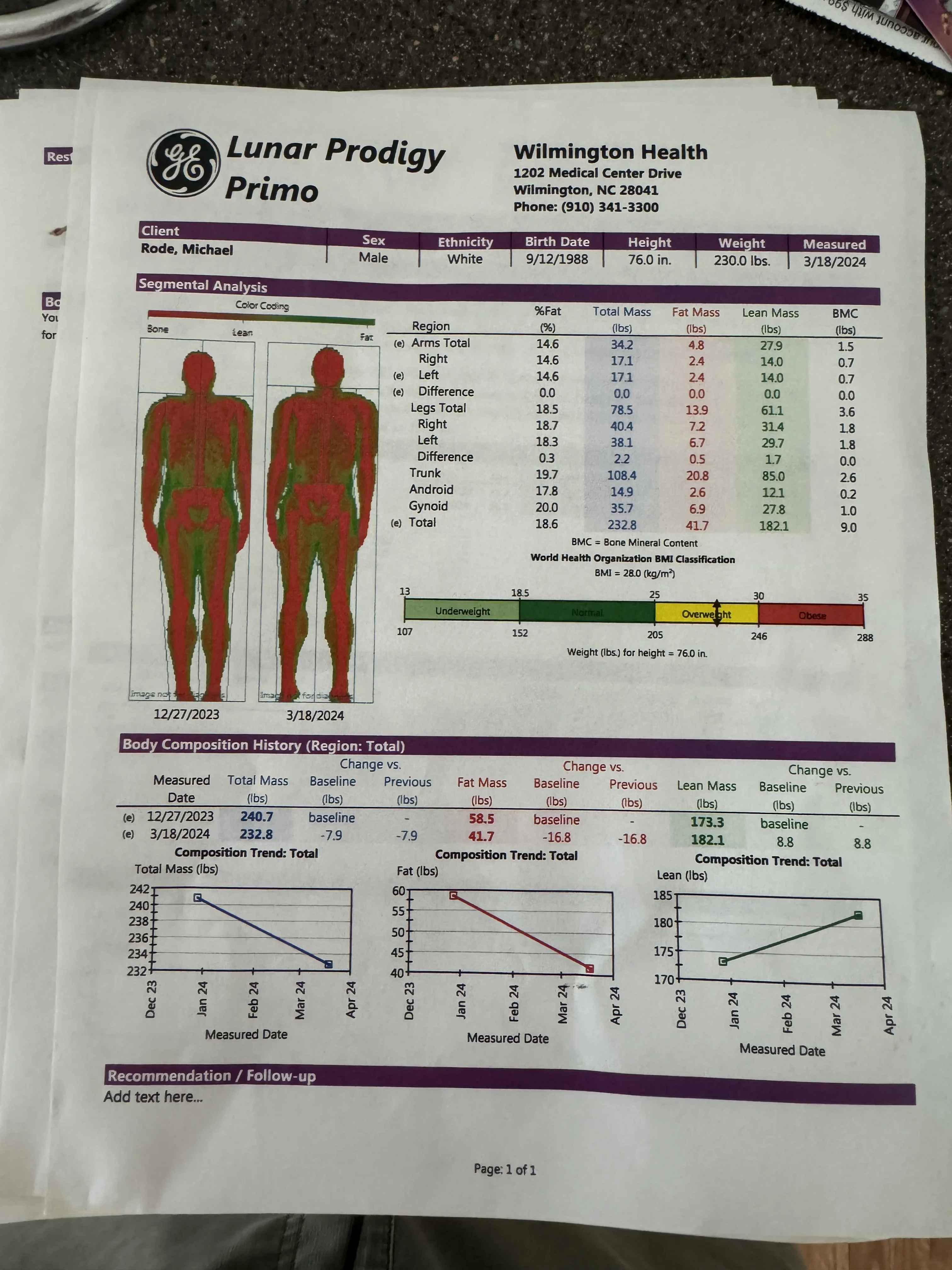
A real DEXA body-composition report. This personal example demonstrates the fields and is not a population reference range or medical interpretation.
DEXA's regional rows can help you compare left-to-right lean soft tissue and see where fat mass is concentrated. Android and gynoid regions describe abdominal versus hip and thigh distribution. Some systems also estimate visceral adipose tissue, but the report and facility should explain exactly how that value is derived.
The most valuable section is often the history table. A second scan on the same machine, under similar conditions, lets you compare changes in total mass, fat mass, and lean mass. One isolated scan describes a moment. A standardized series shows direction.
If you are also considering air displacement, compare BOD POD and DEXA for differences in report fields, preparation and repeat testing.
Which test should you repeat for progress tracking?
Choose the method you can repeat consistently enough for your decision.
- Choose DEXA when you want a periodic reference, regional detail, or bone-mineral information to discuss with a qualified professional.
- Choose InBody when the same device is readily available and you want more frequent feedback without radiation or an appointment.
- Use both carefully when DEXA anchors the occasional baseline and InBody supplies a separate, higher-frequency trend between scans.
Keep each method in its own history. A 17% InBody result and a 20% DEXA result do not mean you gained three points. They are readings from different systems. Progress is the change from InBody to InBody or DEXA to DEXA under comparable conditions.
If neither method is convenient every week, progress photos and tape measurements can fill the gap. GainFrame is one iOS option for organizing photos and estimating visible body-composition trends, with the clear limitation that a photo estimate is not a BIA or DEXA measurement.
How should you standardize your next InBody or DEXA test?
Use this quick checklist before repeat testing:
- Book the same time of day when possible.
- Use the same device and facility.
- Follow that facility's food and hydration instructions.
- Avoid a hard workout before the test when the protocol requests it.
- Use the bathroom beforehand.
- Wear similar lightweight clothing and remove external metal for DEXA.
- Record unusual factors such as travel, soreness, illness, or fluid retention.
- Compare the full report, including fat mass and lean mass, instead of reacting only to body-fat percentage.
Consistency cannot remove every source of error. It reduces the avoidable noise so a real change has a better chance of standing out.
What did the InBody validation study leave unanswered?
The 795-person study provides useful evidence because it directly compared the InBody 770 with a GE Lunar iDXA in a large, physically fit sample. It did not validate every InBody model, every DEXA machine, or every body type. The participants were active-duty adults, so the findings may not transfer cleanly to older adults, people with obesity, or people with conditions that alter fluid balance.
The study also compared measurements at one point in time. A cross-sectional agreement result does not prove that the two methods detect small changes equally well during a bulk, cut, or recomp. Longitudinal tracking needs its own repeatability evidence and disciplined testing conditions.
Which should you choose in 2026?
Use DEXA when the decision needs a stronger reference measurement, regional fat and lean estimates, or bone-mineral context. It costs more, takes an appointment, and works best as an occasional checkpoint.
Use InBody when access and repetition matter more. A professional multi-frequency device can produce a useful trend when you use the same machine and standardize hydration, food, exercise, and timing.
The practical framework is simple. Pick one primary method. Establish a repeatable protocol. Compare like with like. Use a second method as context instead of forcing its number into the first method's history.
Track the Weeks Between Body-Composition Tests
Keep standardized progress photos, body-fat estimates, FFMI, and physique changes together on your iPhone. Use the visual trend between your repeat InBody or DEXA checkpoints.
Download GainFrame FreeFrequently asked questions
Is InBody more accurate than DEXA?
DEXA is generally used as the reference method when researchers validate InBody and other BIA devices. InBody can produce useful, repeatable trends, but its estimate depends more heavily on body water and testing conditions. DEXA also has limitations, including machine, software, positioning, and hydration effects, so neither result is a perfect truth.
Why is my InBody body-fat percentage lower than my DEXA result?
InBody estimates body composition from electrical impedance and a model of body water, while DEXA estimates fat, lean soft tissue, and bone mineral from X-ray attenuation. A large study of active-duty adults found its InBody 770 read lower on body-fat percentage than DXA on average. Your difference can be larger or smaller.
How far apart can InBody and DEXA results be?
The gap varies by device, person, and test conditions. In one study of 795 physically fit adults, the InBody 770 had a 3.9 percentage-point mean absolute error for body fat against DXA and averaged 3.4 points lower. That group average cannot predict the exact gap for an individual test.
Can I use InBody and DEXA together?
Yes. Use DEXA as an occasional reference and InBody as a more frequent trend tool if that fits your budget and access. Keep separate histories for each method. Avoid adjusting every InBody score by a fixed amount, because the difference can change with hydration, training, device model, and the individual being tested.
Which is better for tracking muscle gain, InBody or DEXA?
DEXA provides regional lean soft-tissue estimates and is useful for spaced-out reference scans. InBody offers convenient segmental lean analysis that can be repeated more often. Neither directly isolates contractile muscle from every other component of lean tissue. Track strength, circumference, photos, and one consistently measured body-composition trend alongside either method.
Sources
- InBody Technology - official explanation of direct segmental multi-frequency BIA.
- InBody Result Sheet Interpretation - official output definitions and test-condition guidance.
- InBody preparation guidance - official preparation checklist.
- Potter et al., InBody 770 compared with DXA - original study in 795 active-duty adults.
- UC Davis DXA body-composition analysis - current scan workflow, example pricing, outputs, and non-diagnostic disclaimer.
- Body composition with DXA: principles and limitations - review of preparation, positioning, and interpretation limits.