
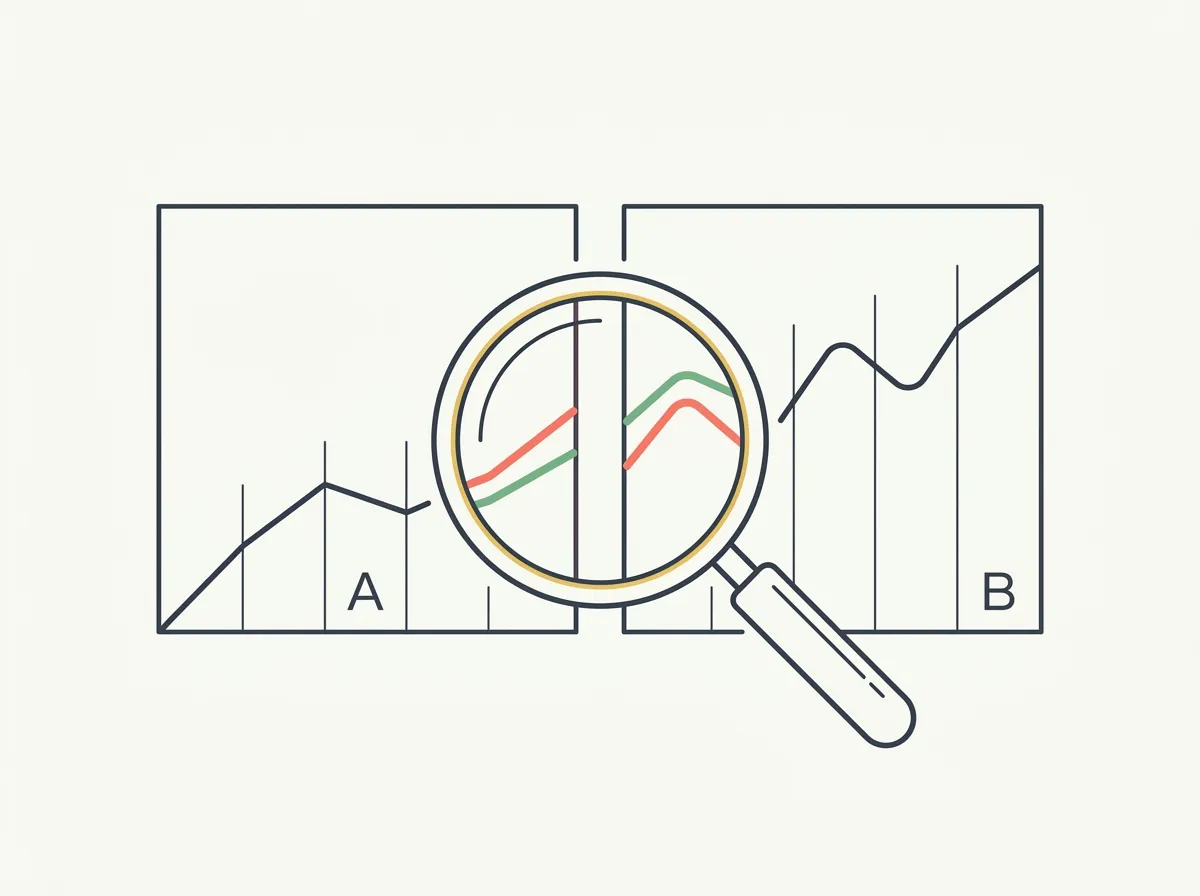
Quick answer: To know if a habit is actually changing your body, run a controlled two-week experiment: change one variable, hold training, calories, protein, and sleep constant, and compare your body-fat trend and weight before and after. A real effect shows as a trend shift larger than your normal week-to-week noise. Anything shorter or messier is a guess.
Three weeks ago you started creatine. You also added a fourth training day, started going to bed an hour earlier, and bumped your protein. You feel great. So which one is working?
You have no idea. Nobody would. You changed four things at once, which means you ran four experiments simultaneously and can't read any of them. This is how most people "test" supplements and routines — and it is why they end up paying for habits that do nothing, forever.
There is a better way, and it is not complicated. It is the same method a lab uses, scaled down to one person and two weeks.
Why can't you tell if a fitness habit is working by feel?
Because feel is noise. How you feel in the gym is driven by sleep, stress, hydration, caffeine, and your last meal — none of which measure body composition.
You can feel pumped and full while slowly losing muscle on too steep a deficit. You can feel flat and weak during a textbook recomp. The subjective signal and the actual result come apart constantly. If you judge a habit by vibes, you will keep the placebos and drop the things that quietly work.
The fix is to stop trusting feel and start trusting a measured before-and-after. That requires two things: an objective measure, and discipline about changing one variable at a time.
What is a body-composition experiment?
It is a single-subject experiment with you as the subject. You isolate one variable, hold everything else constant, and measure the outcome across a defined window.
The structure is borrowed from any real experiment:
Change a single thing — one supplement, one sleep target, one cardio block.
Two weeks minimum. Body composition moves slowly; a day or two means nothing.
A before-window of normal data to compare against. No baseline, no result.
The outcome you measure should be the thing you actually care about — usually your body-fat trend and weight, sometimes a lift number. The before-window is your control. The after-window is the test. If the trend shifts more than your normal noise, you have a signal.
How do you run a 2-week body experiment?
- Pick one variable. One supplement, one habit, one change. Write it down so you don't quietly add a second one mid-test.
- Set your baseline. Track one to two weeks of normal life first — body fat, weight, and the relevant signal — before you change anything.
- Hold everything else constant. Same training, same calories, same protein, same sleep. The one change should be the only difference between the two windows.
- Run it for two weeks. Longer is better. Track consistently, same conditions each time, so the comparison is fair.
- Compare after against before. Read the two windows side by side. A real effect is a trend shift bigger than your week-to-week wobble — not a single good day.
The hardest part is discipline, not measurement. The instinct to overhaul everything at once is exactly what makes the result unreadable. One variable, two weeks, then decide.
How do you read the result without fooling yourself?
This is where most self-experiments fall apart: people see one good check-in and declare victory. Your body has normal week-to-week noise — water, sodium, glycogen, sleep — and a single reading inside that noise is meaningless.
The honest read is a trend versus a trend. Did the after-window's slope actually differ from the before-window's, by more than your usual variation? If your body fat normally bounces a point in either direction week to week, a half-point move proves nothing.
This is also where a tracking app can do the boring part for you. GainFrame surfaces patterns across your check-ins automatically — flagging when a metric drifts off its usual range, or when two signals tend to move together — and it labels them honestly as correlations to investigate, not conclusions.
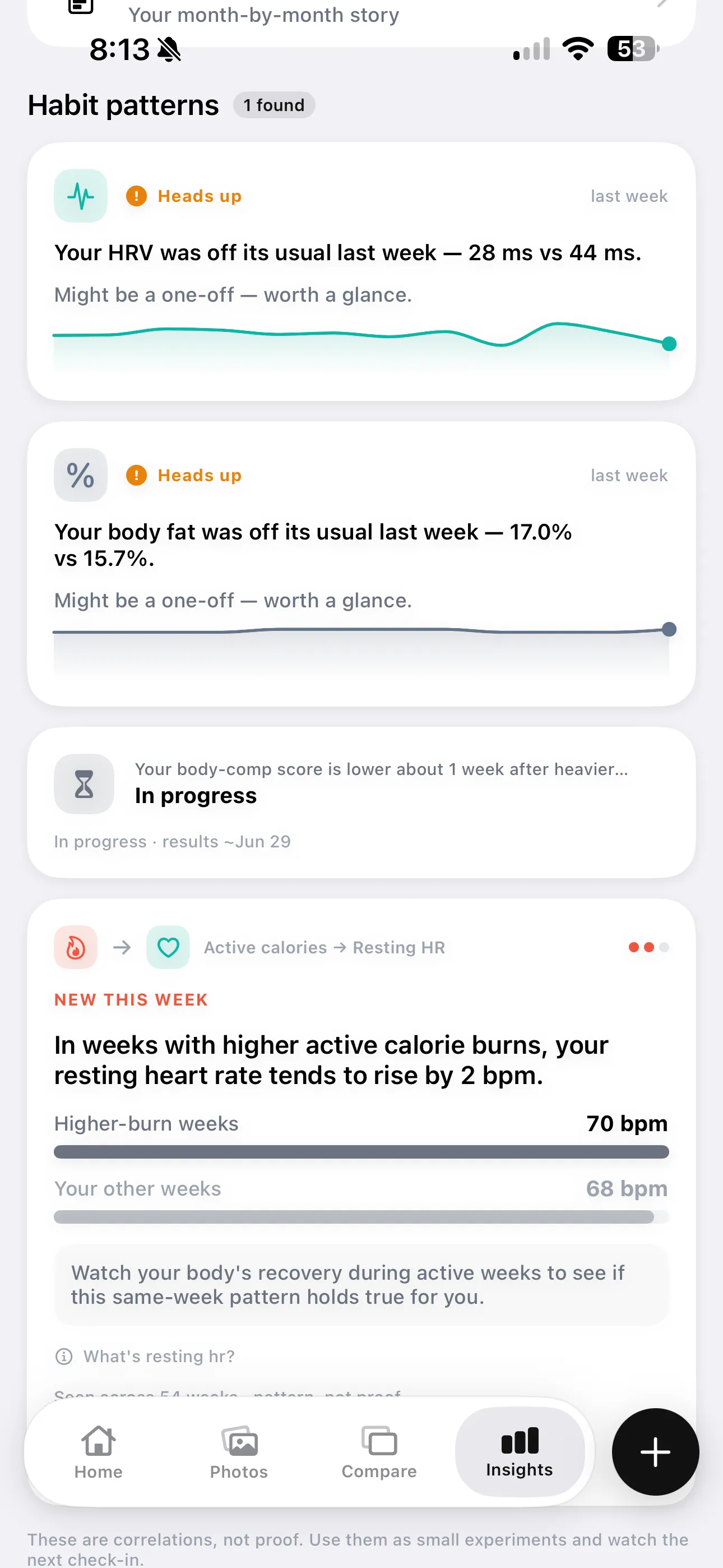
Pattern cards surface correlations to investigate — explicitly "not proof," meant to become your next experiment.
That distinction is the whole game. A card that says your body fat read higher in weeks you slept less is a hypothesis. It tells you what to test next: hold everything constant, fix your sleep for two weeks, and see if the pattern repeats. A correlation points; an experiment confirms.
What habits are actually worth testing this way?
Not everything needs an experiment. Lifting works. Being in a deficit loses fat. A surplus builds mass. Those have decades of evidence — testing them is a waste of two weeks.
Test the marginal habits — the ones you're unsure about and paying for in money or time:
- A specific supplement you're not sure does anything
- A sleep target (7 vs 8 hours) you suspect matters
- A cardio protocol and whether it's eating your recovery
- A protein bump above what you already eat
- A new split, tested on strength and body-fat trend rather than how "hard" it feels
Run them one at a time. Keep the ones that move the trend, drop the ones that don't, and stop paying for placebos.
You don't need a lab to know what works for your body. You need one variable, two weeks of honest data, and the discipline not to change five things at once.
Frequently Asked Questions
How long does it take to know if a supplement is working?
For most physique-relevant habits, two weeks is the minimum to see a signal above daily noise, and four weeks is more reliable. Body composition changes slowly, so a single week tells you almost nothing. The key is comparing a stable before-window to a stable after-window rather than judging day to day.
Why can't I tell if a habit is working by how I feel?
Feel is driven by sleep, stress, hydration, and the last meal — none of which track body composition. You can feel pumped and be losing muscle, or feel flat and be recomping perfectly. Objective measures like body fat trend, weight, and strength are what actually reveal whether a change is working.
What does it mean to hold variables constant?
It means changing only one thing at a time. If you start creatine, change your split, and sleep more in the same week, you can't attribute any result to any one of them. Holding training, calories, protein, and sleep steady while you test a single new variable is what makes the result interpretable.
Are the correlations an app shows me proof that something works?
No. A correlation — for example, body fat reading higher in weeks you slept less — is a hypothesis, not proof. It tells you where to look. The way to confirm it is to deliberately change that one variable, hold the rest constant, and see whether the pattern repeats in a controlled window.
What habits are worth testing with a body experiment?
The ones you're unsure about and could drop: a specific supplement, a sleep target, a cardio protocol, a protein bump, or a new training split. Things with large, well-established effects — lifting, being in a deficit or surplus — don't need testing. Test the marginal habits you're paying for in money or time.
Run the experiment on real data
GainFrame tracks your body-fat trend and score across every check-in and surfaces patterns between your habits and your body — labeled honestly as correlations to test, not conclusions. It's the baseline-and-after layer a two-week experiment needs. Free for your first 25 photos, iOS.
Download GainFrame Free