

Quick answer: Creatine can increase the amount of water your body holds. If your weight rises after you start taking it, mark the date and compare a few weigh-ins under the same conditions. A bathroom scale measures total mass. A weekly waist measurement, photo and training note give you other changes to compare over the next four weeks.
You start creatine on Monday. By Friday your scale reads two pounds heavier, your belt still fits on the same hole and your last workout felt ordinary. What can you actually tell from those three things? Start by writing down the two dates. The gap matters more than a guess about what each pound represents.
Why can starting creatine change the number on the scale?
Your muscles store creatine. In a controlled study, 32 adults who already lifted weights received either creatine monohydrate or a placebo. The researchers measured body water with dilution tests, weighed the participants and sampled muscle tissue. In the creatine group, total body water rose by an average of about 1.4 liters from baseline at day seven and 2.0 liters at day 28. They found no significant change in the distribution of fluid between compartments. Read the Powers study.
Those figures describe liters of water measured in a group under a particular protocol. They do not tell you how many pounds your scale should move or where any extra water sits. A restaurant meal, a different weigh-in time and the food still in your digestive tract can all land on the same day's reading. The water-weight guide covers these other possibilities.
How much of the first week's change is muscle or fat?
One experiment gives a good reason to be careful with the word muscle. Researchers randomized 63 adults to a creatine group or a control group. Before their training program began, the creatine group gained about half a kilogram more DXA-measured lean body mass over seven days. Lean mass includes water. That difference tells us what the scanner detected. It cannot tell a lifter how much new muscle protein they built in a week. Read the randomized trial.
Your bathroom scale has even less information. If it reads 75.8 kg one morning, the only direct observation is 75.8 kg of total body mass under those conditions. You can record that number accurately and leave its cause open.
What might four weeks of creatine water weight look like in a log?
Here is a fictional example. This lifter already weighed in three mornings a week. Their baseline readings were 75.0, 75.2 and 75.1 kg, for a mean of 75.1 kg. During week two, readings of 75.9, 75.5 and 76.0 kg average 75.8 kg. Even the order you happen to look at those three mornings changes the story you might tell yourself.
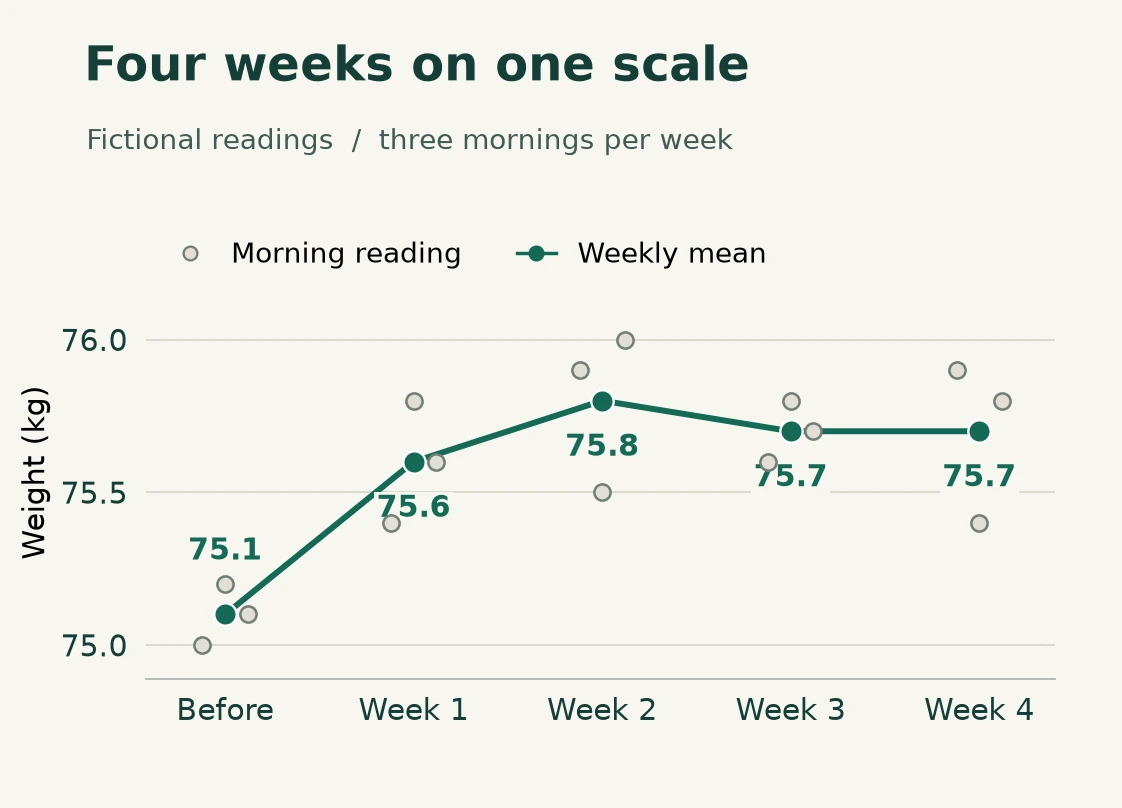
Each gray circle is a fictional morning reading. The green line connects the weekly means. Before starting, the mean was 75.1 kg. The four weekly means were 75.6, 75.8, 75.7 and 75.7 kg.
By week four, the weekly mean is 0.6 kg above baseline. That's a fair summary of the log. Subtracting the two means still cannot give you a water, muscle or fat total. A different person could have a flatter line. Even this lifter's chart would look different if we added a reading after dinner.
What should you record each week?
Download the fillable four-week log. You can use it on your device or print it. If you usually weigh once a week, enter that one value and leave the other fields blank. If you never recorded a baseline, start with the first reading you have and mark how many days had passed.
- Scale. Use the same scale on the same firm floor, at a similar time, in comparable clothing. A morning before breakfast is one repeatable option. When averaging several readings, divide their sum by the number you actually recorded. NHS guide to recording weight.
- Waist. Choose a tape landmark you can find again and write it on the sheet. Measure with the tape level and the same tension. Record the unit, too. The tape measurement guide illustrates several landmarks.
- Photo. Keep the camera height, distance, light and pose similar. Write the date on your sheet. A picture gives you a record of appearance. It cannot distinguish water from muscle.
- Training. Pick one lift you repeat. Log the load, sets and reps and anything that made this session unusual. A rep at a different load or through a shorter range of motion answers a different question.
How do you read a rising scale next to a steady waist?
Suppose the scale mean rose from 75.1 to 75.7 kg, the tape read 81 cm on both dates, and you did one more rep at the same load. Write those observations down separately. The tape reports circumference at one point. The extra rep describes that lift on that day. Neither observation partitions the 0.6 kg.
At your fourth check-in, circle the measurements you actually repeated under similar conditions. Keep the photos with their dates and carry the last consistent weigh-in into your next log. If your photos seem to tell a different story from the scale, compare progress photos and scale weight to decide which question each can answer.
What else should you know about tracking creatine water weight?
How soon can creatine water weight show up?
Researchers have measured changes in total body water after seven days in a study of adults who lifted weights. The visits were scheduled on specific days, so they cannot identify the exact morning a change began. Use your actual start date and record how much time passed before the first comparable reading.
What if my weight stays the same after starting creatine?
A flat trend tells you what happened to total body mass during the period you recorded. A scale cannot measure how much creatine your muscles stored. Save the consistent readings you have, and use your training log to follow the particular exercises you care about over time.
Does a higher smart-scale muscle reading prove I gained muscle?
A home scale that reports muscle uses an estimate. In a research setting, even a DXA lean-mass reading includes water. Keep the device and measurement conditions consistent if you want to compare its readings. Record the units and label the result as an estimate in your log.
Can I use weekly weigh-ins if I missed the first few days?
Yes. Enter the date you began taking creatine, then record the date of the first weight you have. One reading per week can still give you four dated observations. Mark the missing baseline and avoid filling it in later from memory or treating your first recorded value as a before reading.
Can a waist measurement or photo tell me how much water I gained?
A tape records circumference at the landmark you chose. A photo records appearance in that light, pose and frame. Neither measures body water. Keeping both can tell you whether you see a repeatable change alongside the weight trend, especially when you use the same setup at each check-in.
Start with the dates you have
Enter your start date, record one comparable weigh-in and choose a day to check again.
Get the four-week log