
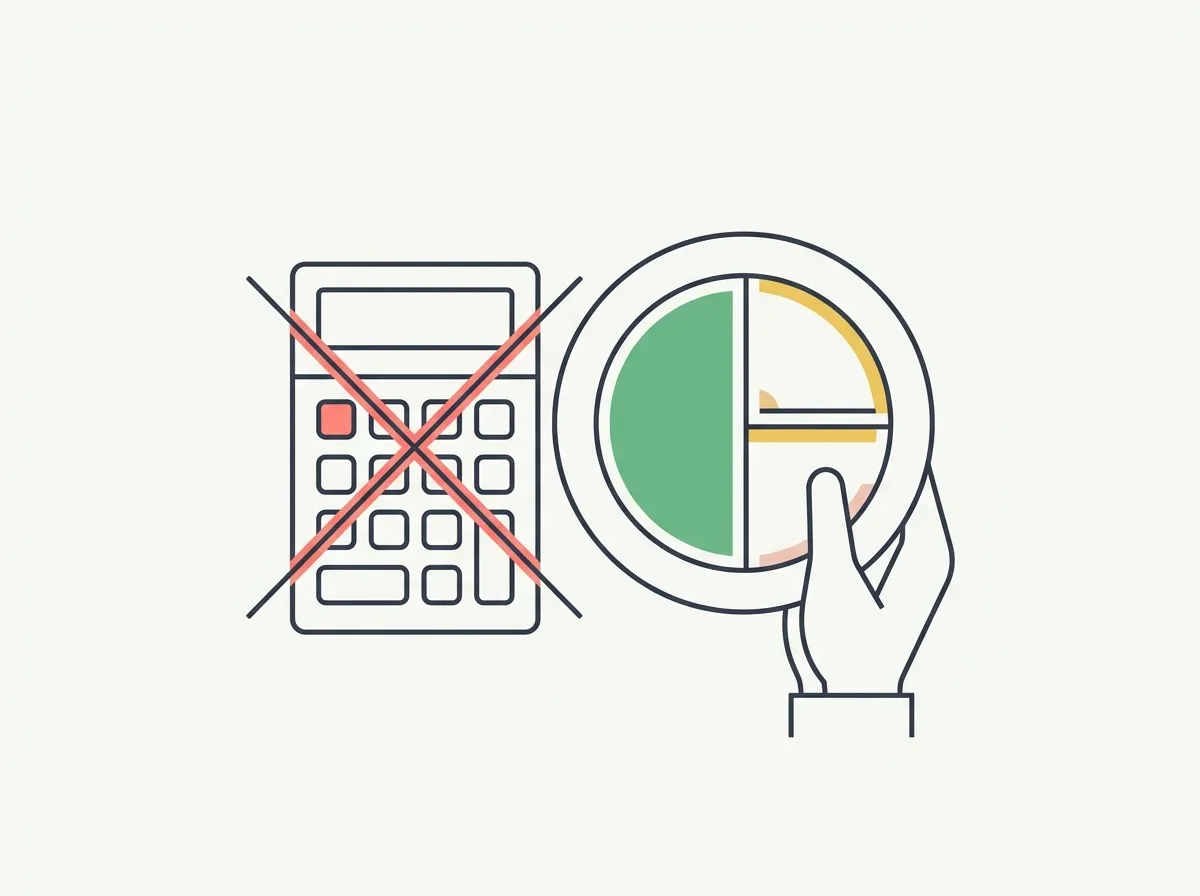
Quick answer: Yes, you can cut without counting — if you replace counting with structure. Fixed meals, protein-anchored plates, hand-portion rules for carbs and fats, zero liquid calories, and one deliberate food swap create a deficit without a log. Then verify with a weekly weight average, a waist measurement, and monthly photos. If the trend stalls, tighten one rule.
Most failed cuts follow the same arc. A food-scale honeymoon, two or three gram-perfect weeks, then one restaurant meal with no database entry, then a quiet uninstall. The arithmetic itself is easy — a few hundred calories a day. The bookkeeping is what dies, and when the log dies, the cut usually dies with it.
There's a second path, and it's the one a lot of coaches quietly run their non-tracking clients on: replace the counting with rules, and replace the food log with a tape measure and a camera. It's less precise. It also has a much better completion rate for a lot of people, and a completed imprecise cut beats an abandoned precise one every single time.
Can you actually cut fat without counting calories?
Let's be plain about the tradeoff first: counting is the most reliable method available. A food log plus a scale gives you the tightest feedback loop in fitness, error is visible within days, and if you can sustain it, our first cut guide walks through exactly that approach. Nothing below beats a well-kept log on precision.
But precision only pays while you're actually doing it. Self-monitoring is commonly associated with better weight-loss outcomes in research — with the obvious catch that those results come from the people who kept monitoring. A method's real-world value is its precision multiplied by your odds of still following it in week twelve, and for many people that second number collapses fast when every meal needs a barcode scan.
So the honest framing: if logging feels sustainable to you, log. If you've quit three cuts at the three-week mark, the structure-based approach below trades a little precision for a lot of staying power. Every calorie still counts either way — you're just choosing rules that do the counting implicitly.
Which methods actually work without a food log?
None of these is magic. Each one is a mechanism for eating fewer calories without measuring them, and they stack — most people doing this well run three or four at once.
Fixed meal structure. Eat the same breakfast and the same lunch every day, portions you've settled once. Two-thirds of your day is now decision-free and roughly calorie-constant, so the only meal that can drift is dinner. Repetition sounds grim and, in practice, most people already eat this way — this just chooses the repeated meals on purpose.
Protein-anchored plates. Build every meal around the protein first — commonly the most satiating macronutrient per calorie, and the one that protects muscle in a deficit. When a palm or two of chicken, fish, eggs, or Greek yogurt goes on the plate before anything else, there's simply less room and less appetite left for the calorie-dense stuff.
Hand-portion rules for carbs and fats. The heuristic coaches commonly use: a palm of protein, a fist of vegetables, a cupped hand of carbs, a thumb of fats per meal. Hands scale with body size and travel with you to restaurants. It's portion arithmetic without numbers, and to start a cut you simply remove one cupped hand or one thumb from the day.
Eliminating liquid calories. Soda, juice, sweetened coffee drinks, and alcohol commonly add several hundred daily calories with close to zero satiety. Switching to water, black coffee, and diet versions is the single biggest calorie cut most people can make without their hunger noticing anything happened.
Time-boxed eating windows. An eight-hour eating window works for some people purely as a portion-control mechanism: fewer eating opportunities, no late-night grazing. Worth hedging clearly — controlled comparisons commonly find time-restricted eating matches ordinary calorie restriction when intake ends up equal, so the window has no special metabolic power. If it makes you ravenous and prone to huge evening meals, drop it without guilt.
Single-swap deficits. Change exactly one thing and hold it: the daily mocha becomes black coffee, fries become a side salad, the 9pm bowl of cereal disappears. One swap is commonly worth 150–300 calories a day, which is a real cutting pace on its own for a smaller person and a solid foundation for anyone.
How do you know it's working if you're not logging?
This is the part most no-tracking advice skips, and it's the part that makes the whole thing work: measurement replaces logging. You don't need to know what went in if you can see what's happening as a result. Three signals, checked on a schedule:
A weekly weight average. Daily weigh-ins, same conditions, averaged into one weekly number — or weigh three mornings and average those. Single days swing wildly on water and food timing (that noise is a whole topic of its own), and reacting to them is how daily weighing sabotages people. The weekly average is the number that tells the truth.
A weekly waist measurement. Tape at the navel, relaxed, same morning conditions. The waist keeps moving during recomps and water-weight stalls when the scale flatlines, which makes it the best tiebreaker you can get for free.
Photos every two to four weeks. Same pose, same light, same spot. Photos catch the changes neither number describes — where the fat is coming off and how the shape is shifting.
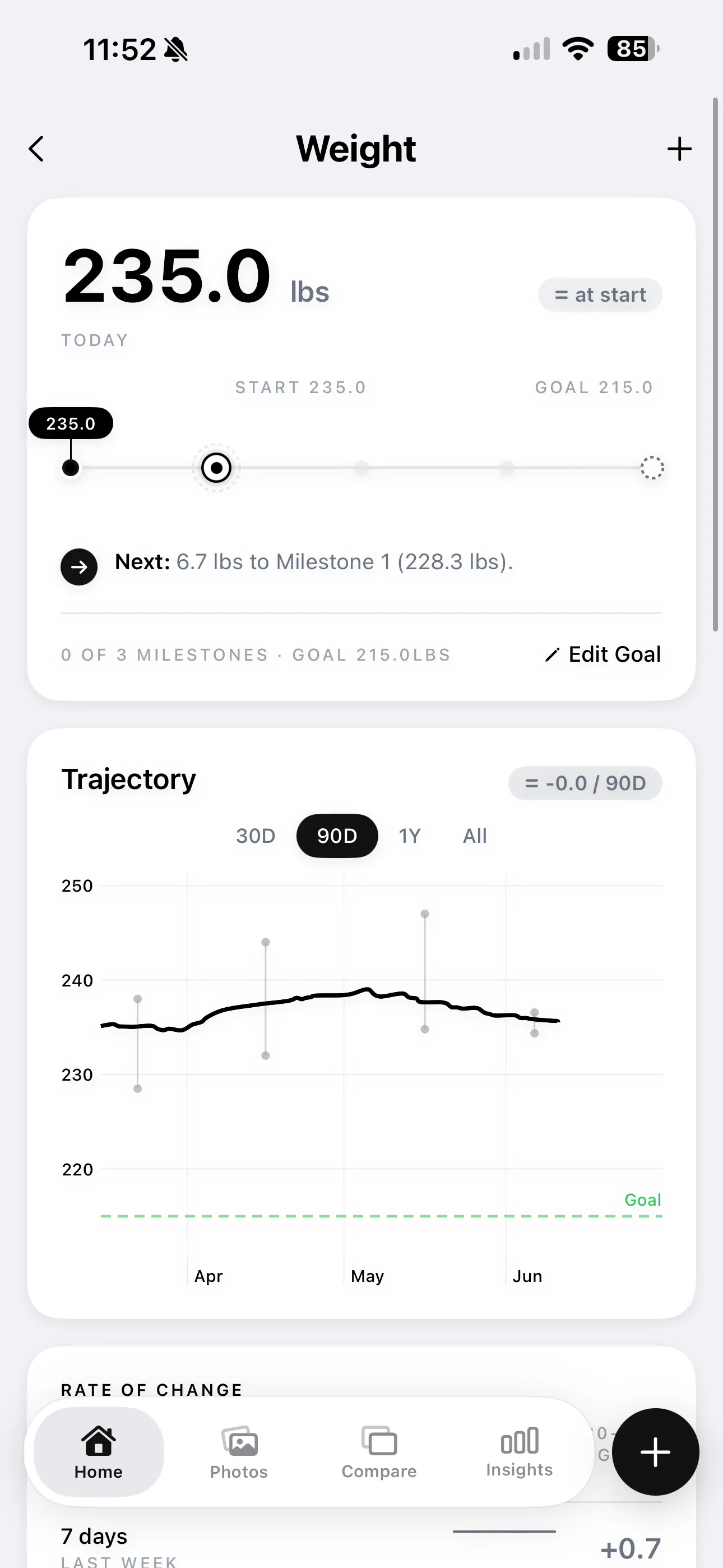
The weekly-average trend is the verdict on a no-tracking cut — if it's drifting down, the rules are working.
Then run the decision rule, which is beautifully simple. If the trend is moving, the method is working — keep going and change nothing. If everything is flat for two to three weeks, tighten exactly one rule — remove one cupped hand of carbs, or add one more liquid-calorie swap — and give it two more weeks. One change at a time, so you always know what worked. GainFrame exists for exactly this loop: weight trend, and body fat estimated from your progress photos, in one place — estimates rather than clinical measurements, but consistent week to week, which is precisely what a trend needs.
When is counting calories actually worth it?
Structure has limits, and pretending otherwise would undercut everything above. Three situations where the log earns its overhead:
Stalls that survive two tightenings. If you've tightened rules twice and the average, the tape, and the photos are all still flat after several weeks, you need an audit. Even a three-day logging spot-check — no commitment to continue — commonly reveals a few hundred invisible calories in oils, snacks, and weekend drift.
The last five pounds. The leaner you get, the smaller your deficit margin, and eventually the error bars on hand portions exceed the deficit itself. Getting from lean to very lean commonly requires the precision only a log provides. Most people never need this — and if you're unsure whether you should even be cutting right now, that's a separate decision.
You're a data person. Some people find logging genuinely satisfying rather than draining. If that's you, this entire article is optional reading — the log was never your bottleneck.
For everyone else: rules, tape, camera, patience. Fat loss timelines don't care whether the deficit came from a spreadsheet or a smaller plate.
Frequently asked questions
How fast should you lose weight without counting calories?
Same target as any sensible cut: roughly 0.5–1% of body weight per week on the weekly average, which commonly preserves muscle better than aggressive rates. Structure-based methods often land on the slower end of that range, which is fine — a slower cut you complete removes more fat than a fast one you quit in week three.
What should you eat when cutting without tracking?
Anchor every meal on protein — a palm or two of meat, fish, eggs, or dairy — then vegetables, then a fist of carbs and a thumb of fats. Repeat the same breakfast and lunch daily so food decisions only happen at dinner. Keep drinks at zero calories. None of this needs a scale, and all of it pushes intake down.
Does intermittent fasting work for cutting without counting?
It can, as a portion-control mechanism. Controlled comparisons commonly find time-restricted eating produces similar fat loss to ordinary calorie restriction when total intake ends up matched — the window helps by removing eating opportunities rather than through any special metabolic effect. If a compressed window leaves you ravenous and prone to big evening meals, it's the wrong tool for you.
How do you know a no-tracking cut is working?
Watch three signals: your weekly weight average (single weigh-ins are too noisy), your waist at the navel, and photos every few weeks. If at least one is trending the right way over two to three weeks, the method is working. If all three are flat, tighten exactly one rule and give it two more weeks.
When should you switch to counting calories?
Three cases. You've tightened your rules twice and the trend is still flat after several weeks — you need the audit a log provides. You're chasing the last few pounds, where the margin for error shrinks below what hand portions can detect. Or you genuinely enjoy data, in which case logging costs you little. A three-day logging spot-check is also a useful middle ground.
Measurement replaces the food log
GainFrame tracks your weight trend and estimates body fat percentage from weekly progress photos — the feedback loop that tells you whether a no-counting cut is actually working. Free to start on iOS.
Download GainFrame Free