
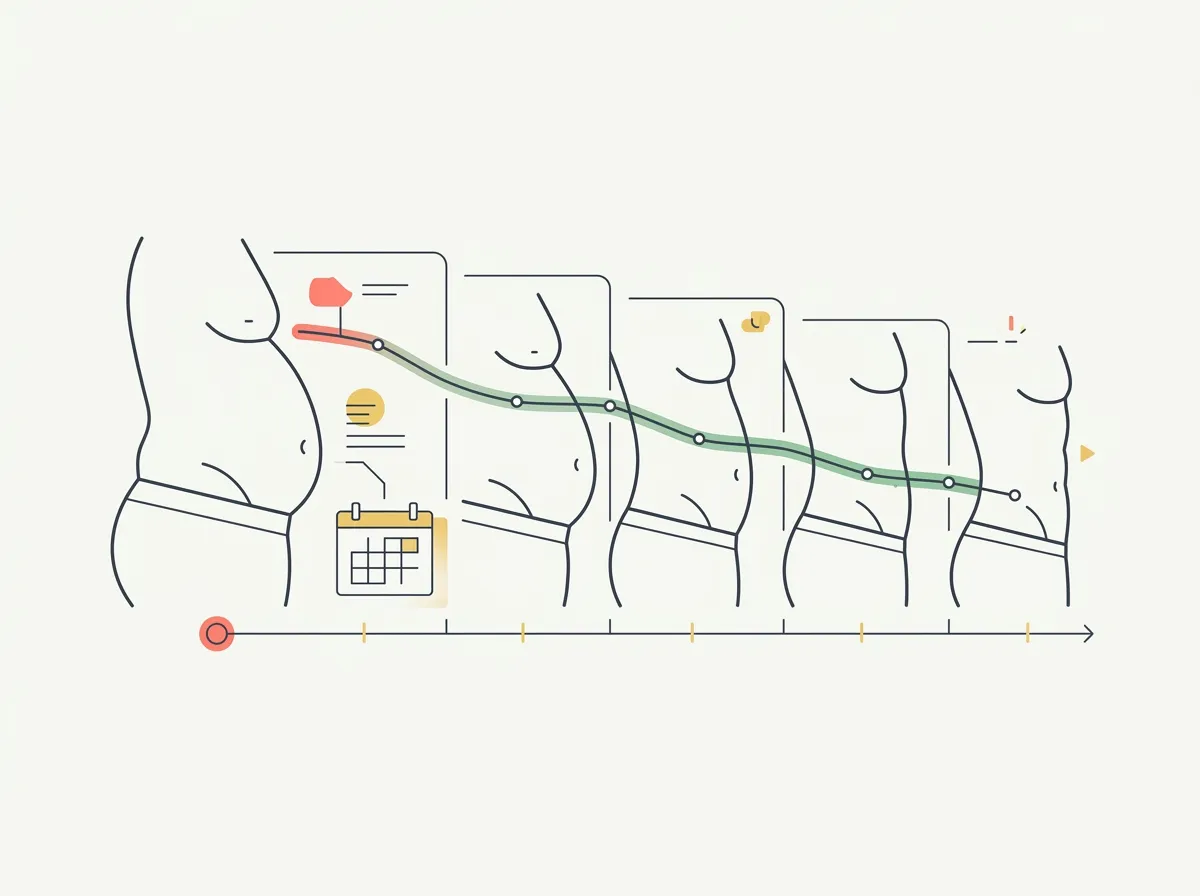
Quick answer: At a sustainable loss rate of 0.5–1% of bodyweight per week, most people starting overweight see roughly 1–2 inches come off the waist per 8–12 weeks. A noticeably soft belly commonly starts flattening in 4–8 weeks; a genuinely lean waist takes several months. You can't speed it up by targeting the belly.
Three weeks into your diet, the scale says you're down 5 pounds. Your face looks a little sharper. Your belly looks exactly the same, and you're starting to wonder whether the whole thing is working.
It probably is — belly fat just runs on a slower, lagged schedule than the scale, and almost nobody tells you the actual numbers up front. One note before the math: if your real question is why your waist is stuck while your weight drops — plateaus, measurement error, water retention — that's a diagnostic problem, and our why is my waist not shrinking guide walks through it step by step. This page answers the other question: when everything is working, how long does it actually take?
Can you lose belly fat first?
No, and this is the fact the entire timeline is built on. Spot reduction — burning fat from a specific area by exercising that area — is one of the most consistently debunked ideas in fitness. Crunches strengthen the abdominal muscles underneath, and the fat sitting on top of them responds only to an overall energy deficit.
Where your body releases fat first is largely genetic and hormonal, and you don't get a vote. For many men the pattern commonly runs in reverse order of storage: the belly and love handles filled in first, so they empty last. Face, arms, and chest often lean out weeks before the lower stomach moves.
So "how long to lose belly fat" is really "how long to lose enough total fat that your body finally taps the belly reserves." That's a question arithmetic can answer.
How fast does belly fat actually come off?
The sustainable loss rate most guidance converges on is roughly 0.5–1% of bodyweight per week. Faster is possible, but past that range the losses increasingly include muscle and the diet increasingly ends in a rebound — our first cut guide covers how to set the deficit properly.
Translate that rate to the tape and you get the number that matters. For most people starting overweight, 0.5–1% per week works out to roughly 1–2 inches off the navel waist per 8–12 weeks. Treat that as illustrative arithmetic rather than a promise — bodies vary, and the ratio of pounds lost to inches lost shifts as you get leaner. But it's the right order of magnitude, and it immediately explains why week 3 looks like nothing: a third of an inch doesn't show in a mirror.
For context on what those inches mean, commonly cited survey data puts the average American male waist around 40 inches at the navel, while the commonly used health target is a waist under half your height — about 35 inches for a 5'10" man. That gap, divided by 1–2 inches per 8–12 weeks, is the honest length of the project.
How long will it take from your starting point?
Here's the arithmetic worked out for three common starting points, using body fat percentage as a rough proxy for how much belly you're carrying. These assume a consistent 0.5–1% per week pace with adequate protein and training — illustrative ranges, not guarantees:
| Starting point | Rough body fat | Visibly flatter belly | Lean waist (under half your height) |
|---|---|---|---|
| Soft belly (~22%) | Upper end of average | ~4–8 weeks | ~3–5 months |
| Notable belly (~28%) | Above average | ~8–12 weeks | ~6–9 months |
| Large belly (~33%) | Obese range | ~10–16 weeks | ~12 months or more |
Two things to notice. First, "visibly flatter" arrives much sooner than "lean" — most people get a meaningful mirror change inside the first 2–3 months from any starting point. Second, the leaner endpoint scales hard with where you start: from 33%, a year is a realistic ask, and pretending otherwise is how diets die at week 6. If your target is further still — visible abs — that's its own leaner territory with its own timeline. The free six-pack timeline calculator runs that math from your photo, weight, and planned calorie deficit.
Here's what that progression looks like on the same body. These are standardized, photorealistic AI renders from our body fat visualizer — same build, pose, and lighting, so only body fat changes between images:

The starting point: ~28% body fat. The belly is the dominant feature and the waist is wider than the health target for most heights.

~23% — roughly 3–5 months in at a sustainable pace. Visibly flatter, clothes fit differently, but the lower belly softness is still there.

~18% — commonly 6–9 months from the 28% start. The waist is comfortably under half of height and the belly no longer leads the silhouette.
Notice that each 5-point drop reads as a distinct phase, and the belly is the last region to fully resolve in the sequence — exactly the last-in, first-out pattern described above.
Why do the first weeks show the least change?
The early weeks of a diet are the statistical worst stretch for belly-watching, for three stacked reasons.
The scale drop is partly water. The first week or two of a deficit commonly drains glycogen and its bound water — several pounds that were never belly fat. The scale sprints, the tape walks.
The waist lags the scale. Fat loss is distributed across your whole body, and the belly's share arrives late for most men. It's common to lose 8–10 pounds before the navel measurement moves a full inch.
The change that is happening is invisible. Visceral fat — the deep abdominal fat packed around your organs — commonly responds to a deficit and regular exercise earlier than the subcutaneous layer you can pinch. Your visceral fat level can be improving meaningfully in the first month while the mirror reports nothing. Health-wise that's the most important fat you'll lose all year; it just doesn't photograph.
The practical takeaway: judge the first 4–6 weeks by scale trend and tape, and don't ask the mirror for a verdict it can't give yet.
What actually speeds it up?
The honest list is short, and none of it is a supplement.
Deficit consistency beats deficit size. A moderate deficit you hold for 12 straight weeks outperforms an aggressive one you abandon at week 5. Every restart pays the water-weight toll again and resets the lag window.
Protein and lifting protect the result. Adequate protein — commonly cited guidance lands around 0.7–1 g per pound of bodyweight — plus resistance training biases the loss toward fat rather than muscle. Same scale drop, visibly better waist outcome.
Sleep is quietly load-bearing. Short sleep is commonly associated with worse hunger regulation and worse fat-loss outcomes. It won't headline anyone's transformation post, but 7+ hours makes every other lever easier to hold.
What doesn't speed it up: ab circuits, waist trainers, fat-burner pills, and dropping calories to crash levels. The first two don't touch fat at all, and the last one trades two fast weeks for a rebound.
Since the change arrives in fractions of an inch across months, the tracking method matters. A weekly navel measurement plus consistent progress photos catches the trend the daily mirror can't see. GainFrame estimates body fat percentage from your progress photos and tracks the trend over time, so the slow weeks still register as movement — estimates from photos rather than clinical measurement, but consistent week to week, which is exactly what a timeline like this needs.
Frequently asked questions
How long does it take to lose belly fat?
At a sustainable deficit losing 0.5–1% of bodyweight per week, most people starting overweight take roughly 8–12 weeks to lose 1–2 inches off the waist. A soft belly commonly starts visibly flattening within 4–8 weeks; getting genuinely lean takes several months to a year depending on your starting point. Treat those as illustrative arithmetic, not guarantees.
Can you target belly fat specifically?
No. Spot reduction is one of the most consistently debunked ideas in fitness — ab exercises strengthen the muscles underneath while the fat on top responds only to an overall deficit. Belly fat comes off on the same schedule as total body fat, and for many men the belly is among the last places to lean out.
Why is my stomach the last place I lose fat?
Fat storage and release patterns are largely hormonal and genetic. For many men, the lower belly and love handles store fat readily and release it reluctantly, so the belly is commonly the first place fat arrives and the last place it leaves. That's normal, and it means the fix is patience at a deficit rather than a different exercise.
Why hasn't my belly changed after 4 weeks of dieting?
Four weeks is commonly inside the lag window. Early scale loss is partly water and glycogen, waist measurements trail the scale, and for many men the belly is the last region to respond visibly. If your weight is trending down about 0.5–1% per week, the belly change is coming; if weight is flat, the deficit needs attention first.
Does visceral fat go away faster than the fat you can pinch?
Commonly, yes. Visceral fat — the deep fat around the organs — tends to respond to a deficit and regular exercise earlier than subcutaneous fat, the layer you can pinch. That means your health markers often improve weeks before the mirror shows much, which is a real win even when it doesn't feel like one.
Watch the timeline actually happen
GainFrame estimates body fat percentage and physique scores from your progress photos — so the slow, week-by-week belly change shows up as a tracked trend instead of a mirror argument. Free to start on iOS.
Download GainFrame Free