
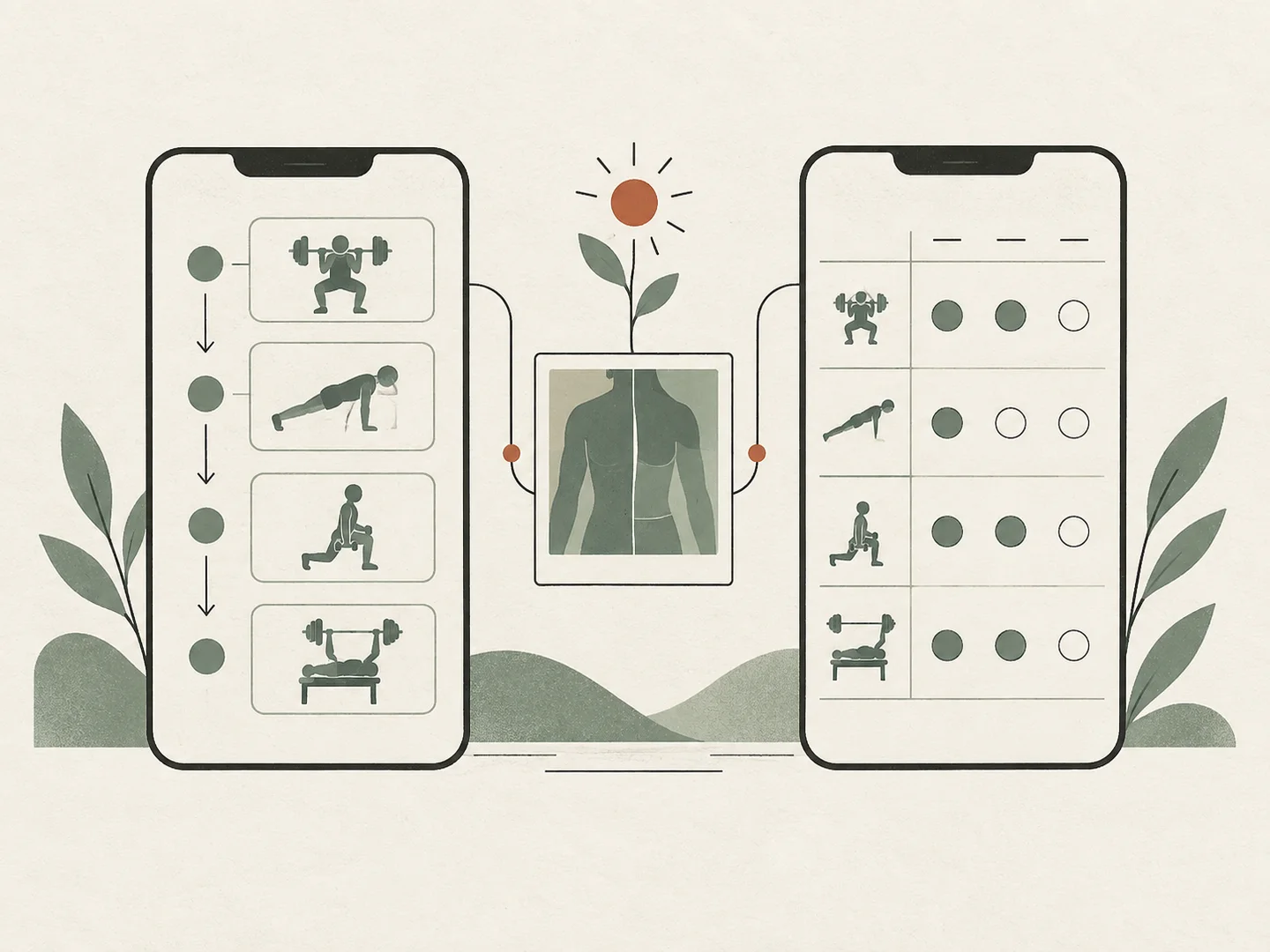
Illustration created for this guide. It does not depict a tested product interface or a measured transformation.
Quick answer: Fitbod emphasizes adaptive workout suggestions. Hevy combines a workout log with optional Hevy Trainer programming, so the choice now includes two planning workflows. Start with the exercises, equipment and edits you need each week. Hevy also documents private progress photos. Compare the actual trial experience and renewal price before switching.
A workout app earns its place during an ordinary session: the bench is occupied, your next set needs changing, and you want to record what actually happened. Fitbod and Hevy both deserve a test against those tasks.
Research basis: Published product documentation checked September 23, 2026. This is a source-based comparison, without a hands-on training trial or an independent claim that either app produces better gains. The cover is an illustration. Written by Michael Rode, GainFrame's founder.
What is the main difference between Fitbod and Hevy?
Fitbod describes personalized sessions informed by your goals, available equipment, workout history and estimated recovery. That makes its recommendation workflow a useful starting point if choosing the next session is your main difficulty. Its own comparison article is a vendor source, so we use it for feature descriptions rather than its verdict about competitors. Fitbod's product comparison
Hevy supports routine logging and now offers Hevy Trainer, included with Pro. Trainer builds a program around your goals, equipment and schedule, with progression suggestions. Hevy describes a rule-based system rather than a generative AI model. Calling Hevy only a manual logger misses that option. Hevy Trainer overview and how Trainer builds a program
| Your priority | What to test in Fitbod | What to test in Hevy |
|---|---|---|
| Help choosing sessions | Relevance of suggested exercises | Trainer's proposed program |
| Your existing routine | Saving and editing the workout | Building and repeating the routine |
| A busy gym | Replacing an unavailable exercise | Editing the session without losing your log |
| Progression | The reason for the next load or rep target | Trainer targets or your own progression rules |
| Visual check-ins | Whether its current workflow fits your needs | Private photo history and comparisons |
The table is a trial plan. It does not score recommendation quality we have not measured.
Can Hevy track progress photos privately?
Yes. Hevy documents adding photos through Profile → Measures → + → Add Picture, with dated comparisons. It says those photos remain private even when your profile is public. Its guide currently describes one photo per day. Check that limit if you take front, side and back shots together; do not assign false dates just to fit an app's storage model. Hevy progress-photo guide
A private library and a private shared image are separate decisions. Before exporting a comparison, check faces, reflections, badges and background screens. Our gym photo privacy editor lets you cover those details locally and save a separate PNG.
How much do Fitbod and Hevy cost?
Fitbod's current comparison page lists $15.99 monthly or $95.99 annually in US dollars. Hevy's Trainer page lists Pro at $2.99 monthly, $23.99 annually or $74.99 for lifetime access. Hevy also offers a free logging tier. These are published US offers checked September 23, 2026; your store, tax, promotion and renewal terms can differ. Fitbod pricing source and Hevy pricing source
Compare the entire renewal charge. An annual plan may display a monthly equivalent while charging the full year at once. A lower price matters only if the workflow supports the training you intend to do.
How can you compare them during a trial?
Use one familiar routine as your reference. Avoid changing your program just to give each app something novel to recommend.
- Enter the equipment you actually have, including the dumbbell or plate increments.
- Build or generate a session that fits your usual time window.
- Replace one exercise and change one set while logging.
- Record a session honestly, including missed repetitions.
- Inspect the next recommendation and check whether you understand it.
- Locate your history and any export or account controls you rely on.
Keep a short note after each session: what saved time, what added friction, and what you had to correct. That evidence is more useful than choosing from screenshots alone.
Should you switch if your current app works?
Name the missing behavior first. If you need a simpler logging flow, compare logging. If you need help selecting sessions, compare the two planners. If you mainly need a photo timeline, try the existing photo features before adding another subscription.
For a separate visual record, GainFrame is one option alongside a private phone album and Hevy's built-in library. You can also turn existing check-ins into a local photo timelapse without moving your workout history.
What else should you know?
Does Hevy generate workouts now?
Yes. Hevy Trainer provides program generation and progression within Hevy Pro. Its documentation describes a rule-based approach. You can still choose to log a routine yourself. During a trial, check that the proposed exercises, available equipment and weekly schedule match the way you actually train.
Is Fitbod better than Hevy for beginners?
That depends on the guidance you need and the workflow you can follow. Test entering your equipment, understanding an exercise, changing a set and reviewing the next session. This comparison does not establish superior training results for either app. Start with an appropriate routine you understand.
Are Hevy progress photos public?
Hevy states that progress photos in its Measures feature remain private even when a profile is public. That protection does not apply to a copy you choose to share elsewhere. Inspect the exported picture, its background and your sharing destination before posting or sending it.
Do you need another app for progress photos?
You may already have enough with Hevy or a private photo album. A dedicated tool can help when you want a repeatable comparison or an export format your library lacks. Decide which task is missing before adding software, and preserve the original dates of your check-ins.