
Quick answer: Fitbod, Ray, and GymStreak help plan training, while GainFrame Coach uses your recorded body-composition and activity context to discuss progress. Start with the job you need: workout suggestions, conversational guidance, or interpretation of your check-ins. Compare each app’s current features during a trial and avoid paying for overlapping tools you will not use.
There is no "best AI personal trainer app" that wins on every dimension. That phrase is doing a lot of work in most listicles, and it hides the fact that Fitbod, Ray, GymStreak, and GainFrame Coach are not competing for the same job. They overlap on the marketing page; they diverge sharply on what they actually do.
This comparison is structured around the four jobs each app does best. Pick the one that matches the question you're trying to answer, or stack two or three, because they're designed not to step on each other.
The four-app comparison at a glance
| Dimension | Fitbod | Ray | GymStreak | GainFrame Coach |
|---|---|---|---|---|
| Primary job | Workout planning | Real-time in-gym coaching | Simple weekly routines | Cross-source data analysis |
| Price (2026) | $9.99/mo | $19.99/mo | $12.99/mo | $5.99/mo or $39.99/yr |
| Platforms | iOS / Android | iOS only | iOS / Android | iOS only |
| Voice coaching | No | Yes (conversational) | No | No |
| Computer-vision rep count | No | Yes | No | No |
| Strava integration | No | No | No | Yes |
| Hevy / strength-app sync | Limited | No | No | Yes |
| Body composition tracking | No | No | No | Yes (DEXA-validated ±0.4%) |
| Future-physique image generation | No | No | No | Yes |
| Reasoning depth control | No | No | No | Yes (Fast/Standard/Thorough) |
| Persistent multi-month context | Training only | Partial | Training only | Yes (training + body + recovery) |
| Best for | Algorithm-driven programming | Solo lifters who want a coach voice | Set-and-forget routines | Lifters who want their data interpreted |
Fitbod, the algorithm that writes your workout
Fitbod is the strongest pure workout planner in this comparison. The algorithm has been trained on hundreds of millions of completed sets across years of user data, and the routine quality reflects it: progressive overload calls feel right, recovery-aware exercise selection actually accounts for what you trained two days ago, and the equipment substitution logic is smooth. Tell Fitbod you have a power rack, dumbbells, and a cable machine, and the program writes itself around what you have.
Where Fitbod fits in your stack: this is the app you open before a workout. You arrive at the gym, Fitbod hands you the day's session, you execute, you log the sets, and Fitbod adapts the next session based on what you did. That is the entire loop. Done well.
What Fitbod does not do: it does not coach you in the gym, it does not analyze your physique, it does not pull Strava or sleep data into the picture. The app is opinionated about its lane and stays in it. That is a strength when you know what you want out of it.
Pick Fitbod if: You want the best algorithmic workout planner at $10/mo, you train confidently without needing a voice in your ear, and you log your sets manually.
Considering another automated planner? Our Gravl vs Fitbod comparison covers the published differences and the ordinary gym tasks to test before you subscribe.
Ray, the conversational coach in the gym with you
Ray is the only app in this comparison that actually feels like a trainer is in the gym with you. You set the phone up before a session, Ray talks to you between sets, the voice model calls out the next exercise, counts your reps via computer vision, flags form drift, and responds when you say "this feels too light" or "I need more rest before the next set." It is the closest thing to a real-time conversational AI coach that exists right now.
The voice interaction is what justifies the $20/mo price tag. If you train alone and find yourself zoning out between sets or losing track of where you are in the routine, having a coach speak to you is a different experience entirely. The vision-based rep counting is accurate enough to be useful, it will tell you that you completed 7 of the planned 8 reps and adjust the next set accordingly.
What Ray does not do as well as Fitbod: the underlying programming layer. Ray's routines are good but the adaptive logic is less mature than Fitbod's. And Ray is iOS-only.
Pick Ray if: You train solo, you want a real-time coach voice, and you are willing to pay $20/mo for an in-session presence the other three apps cannot replicate.
GymStreak, the simple weekly routine on autopilot
GymStreak is the app for lifters who find Fitbod's options overwhelming. Tell GymStreak your goals, your equipment, and how many days a week you want to train, and it generates a weekly program that adapts based on what you logged. The interface is opinionated and clean, fewer knobs than Fitbod, less customization, but a lower decision-making burden when you walk into the gym.
The AI adaptation isn't as deep as Fitbod's planner, but it's enough to keep the program fresh and progressive over weeks and months. Cross-platform availability (iOS and Android both) is a real plus for non-iPhone users, most apps in this category are iOS-only.
What GymStreak does not do: it does not have voice coaching, computer-vision rep counting, or any kind of body composition tracking. The pitch is workout simplicity, full stop.
Pick GymStreak if: You want a routine that updates itself in the background, you do not want to tune knobs, and you train on Android.
GainFrame Coach, the analyst that reads everything
GainFrame Coach is the one app in this comparison that does not write your workout at all. That is the deliberate design. Coach sits downstream of your training, it reads what you actually did across every data source, and answers questions a workout planner structurally cannot.
What Coach reads on every question (you do not paste any of this):
- Your last 30 check-ins: body fat %, GainFrame Score, weight, and the four score components
- 90 days of Apple Health: sleep, HRV, daily steps, exercise minutes, nutrition macros
- Hevy weekly strength volume by muscle group
- Strava cardio history, run distance, ride distance, activity types, week-over-week trends
- Your stated goal (cut, bulk, recomp) and any persistent memory notes Coach has saved from prior conversations
- Your progress photos, used both for body composition scoring and for image generation
Three Coach capabilities have no equivalent in Fitbod, Ray, or GymStreak. Each one is screenshotted below.
Strava cardio analysis in the conversation
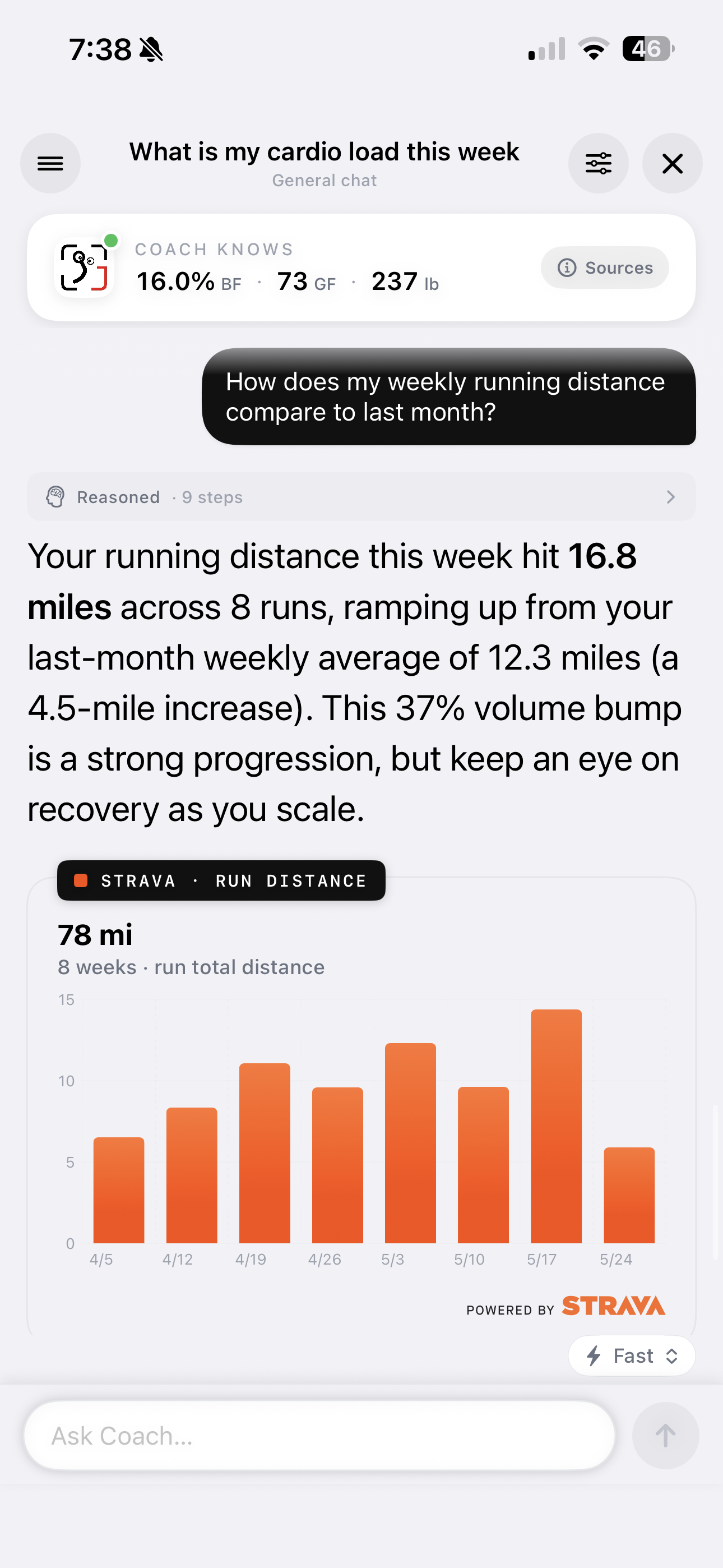
Coach is the only app here that treats cardio as part of the coaching surface. Fitbod and GymStreak are strength-app first; Ray is in-session strength coaching. If you do both cardio and lifting and you want a single AI surface that sees both, that is a Coach feature the others structurally do not offer.
Future-physique projection from your actual photos
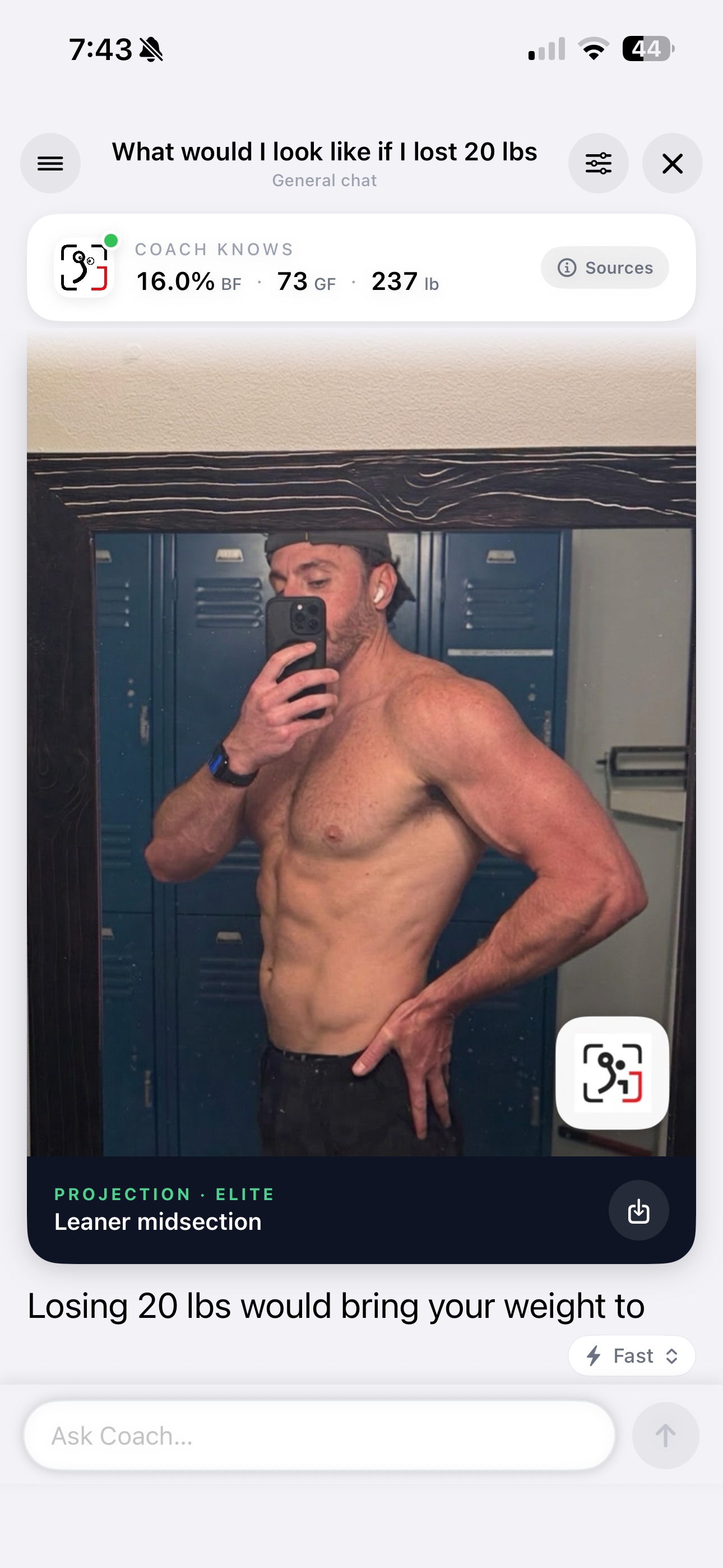
This one breaks the category. Workout-AI apps write routines; they do not render visuals of your future body. Coach uses your own photos as the source, holds your identity and frame constant, and projects a version of you at a different composition. The output gives you something to aim at visually, not just numerically.
Reasoning Mode, pick how deep Coach thinks
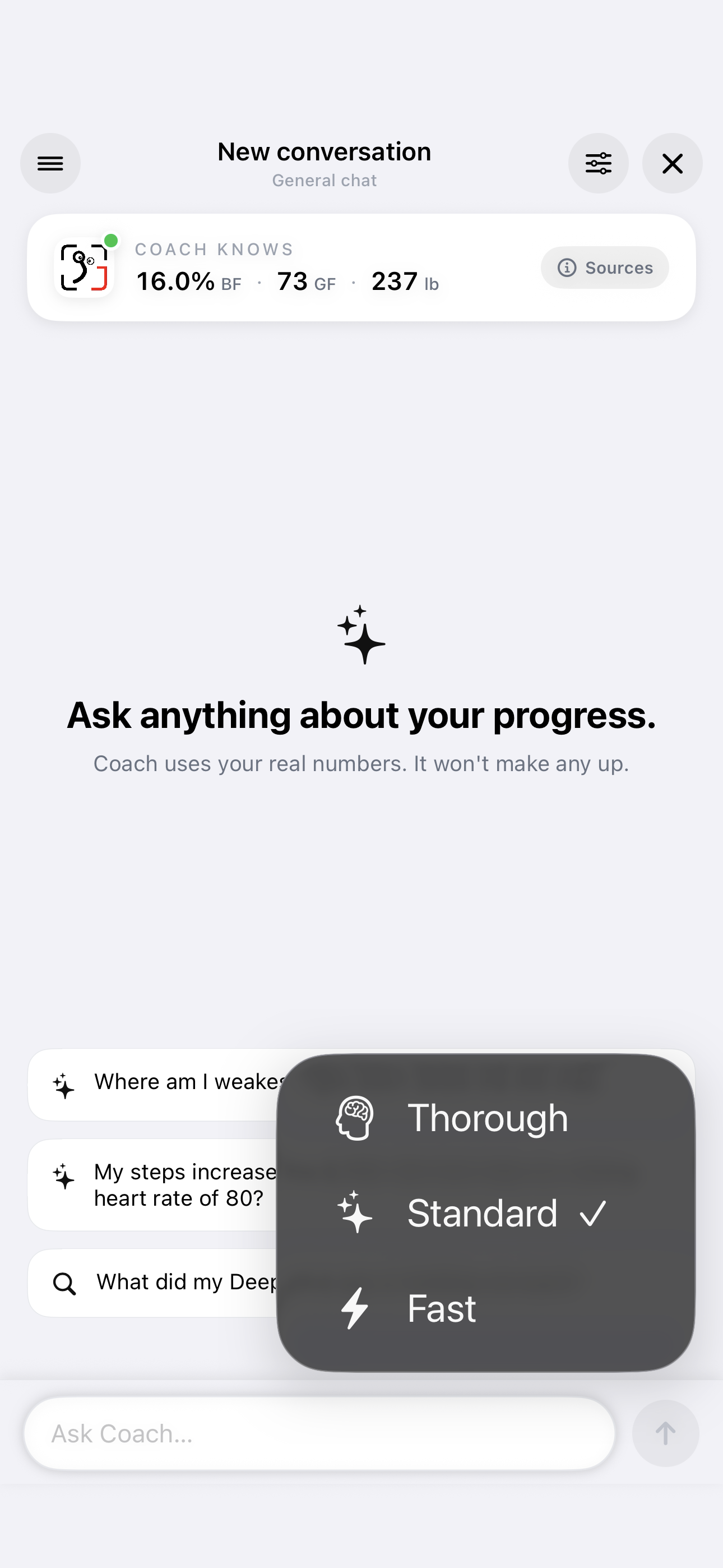
Most AI fitness apps decide for you how much "thinking" the model is allowed to do. Coach exposes the setting. Fast is the right pick mid-workout when you want a one-line answer. Standard is the everyday default. Thorough is for long-form reviews of your training block when you want Coach to walk every metric before committing to a take.
Pick GainFrame Coach if: You already have a workout solution and what you actually need is help interpreting whether it is working. Coach is the analyst layer for a stack you have already built.
The stack that works for serious lifters
The honest answer for most serious lifters is that no single app in this comparison covers all four jobs. The stack does.
Pick one workout AI from the first three based on how you train:
- Want algorithmic programming? Fitbod ($9.99/mo).
- Want a coach voice in the gym? Ray ($19.99/mo).
- Want simplicity? GymStreak ($12.99/mo).
Add GainFrame Coach ($5.99/mo) as the analyst that reads everything your workout app produces, and your Strava, and your sleep, and your photos, and answers questions the workout app can't reach.
Total monthly cost: $15.98 (Fitbod + Coach) to $25.98 (Ray + Coach). Compare that to a $150/hr personal trainer one time a week, you save $584-$594/mo by running the stack instead. The hybrid options (Future, Trainiac) split the difference at $79-$149/mo, but you are paying for a human in the loop. If the human is what you need, that is the spend. If you do not need a human, the AI stack covers the four jobs for under $40.
Decision matrix: which combination fits which lifter
You're starting out, want one app, train at home: GymStreak. Simple weekly routine, low decision burden, cross-platform.
You're an intermediate lifter, want best-in-class programming, cost-conscious: Fitbod alone. $10/mo, deep planning algorithm, no extra apps required.
You're a solo lifter, want the in-gym coach experience: Ray alone, or Ray + GainFrame Coach if you also want post-workout analysis. Ray fills the in-session role no other app can.
You do both lifting and cardio, you want a single coaching surface for both: Fitbod + GainFrame Coach. Fitbod handles the strength routine, Coach pulls Strava plus the strength data and analyzes both.
You're doing body recomposition, you want to know if it's working: Any workout app + GainFrame Coach. Coach answers the "is the routine actually working?" question that no workout planner does. The workout app you pick is almost interchangeable for this purpose; the analyst layer is the one that matters.
You want a real human in the loop, not just AI: None of the four. Look at Future or Trainiac, the AI+human hybrids, but expect to pay $79-$149/mo.
What else should you know?
How should you choose between Fitbod, Ray, and GymStreak?
Start with the workflow you need from a trainer app: suggested sessions, conversational guidance, or a plan that fits your weekly routine. Check equipment support and edit a sample workout before subscribing. The comparison describes different approaches; it does not establish that one algorithm produces better physical results for every lifter.
Do you need a workout planner if you already follow a program?
You may only need a logger when your program already comes from a coach or another source you trust. Decide whether you want software to change the plan or simply record it. Paying for automated recommendations adds little value if you routinely replace them with the sessions you intended to follow.
Can a workout app tell whether you gained muscle?
A workout record shows the training you logged and changes in recorded performance. It cannot establish exactly how much muscle you gained. Add consistent progress photos and other relevant measurements, and look for agreement across observations over time. Treat body-composition estimates as estimates rather than precise confirmation of one workout plan.
What should you check during a workout-app trial?
Enter your actual equipment and schedule, complete a normal session, replace an unavailable exercise, and correct a mistaken set. Then review whether the next recommendation makes sense in context. Check the trial end date and renewal amount before it expires. This is a usability evaluation, not a study of training outcomes.
Should you subscribe to more than one AI trainer?
Choose one main source for the plan unless you have a clear reason to use another. Overlapping recommendations can add decisions without improving your record. A separate progress tool may serve a different purpose. Make each app earn its place by helping you answer a specific question about training or progress.
Run the stack. Coach is the analyst layer.
Whichever AI trainer you picked, GainFrame Coach reads everything it produces, plus Strava, plus Apple Health, plus your photos, and answers the questions a workout planner can't reach. Strava integration, future-physique projection, Reasoning Mode, DEXA-validated body composition scoring. $5.99/mo or $39.99/yr. Free tier covers 25 photos lifetime, enough to evaluate it without a subscription.
Download GainFrame Free