
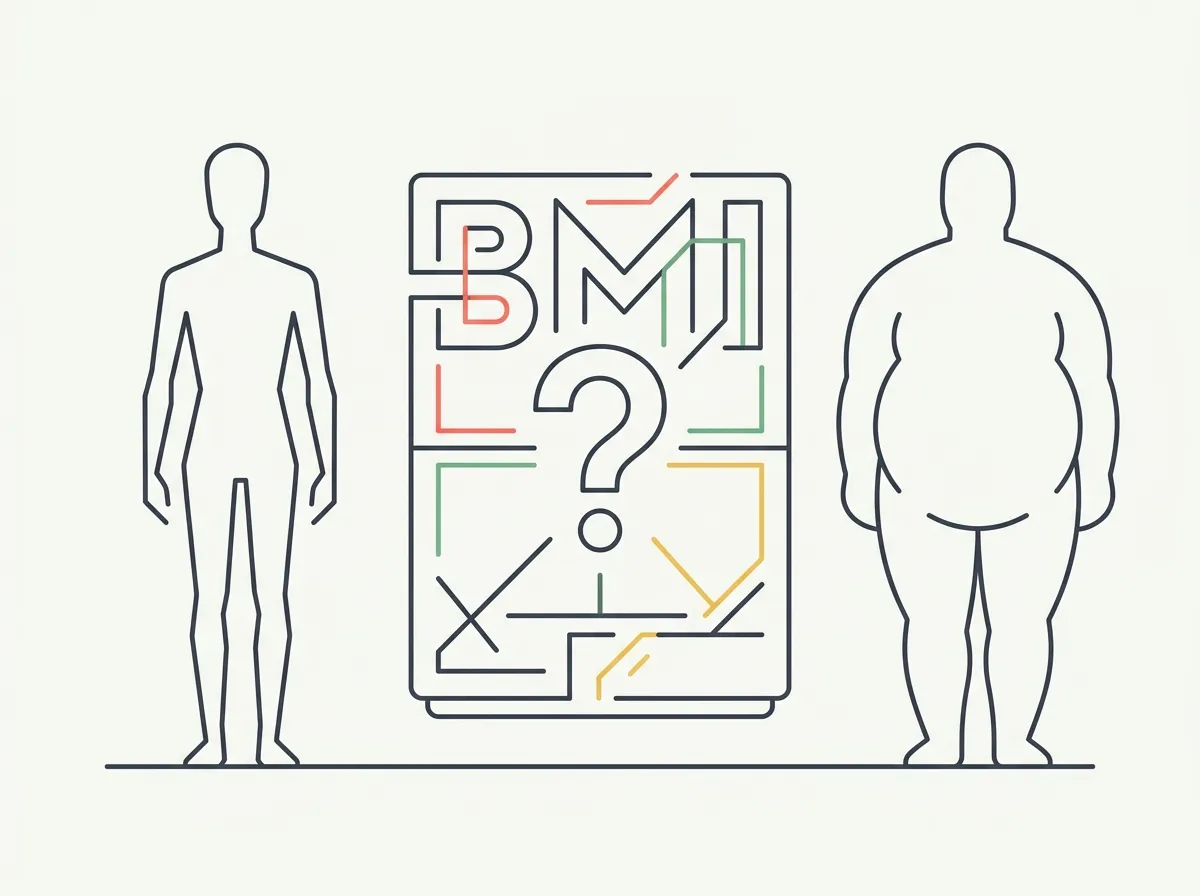
Quick answer: BMI is accurate at the job it was built for — screening large populations cheaply. It gets less reliable the further an individual sits from average: muscular people read overweight, and normal-weight bodies carrying high fat read healthy. For a personal one-number check, waist-to-height ratio and a body fat estimate both beat it.
Run the numbers on a 5'10" lifter who weighs 200 pounds at 12% body fat. BMI: 28.7 — overweight, approaching obese. Now run a 5'10" desk worker at 150 pounds with thin arms and a soft midsection: 21.5, textbook healthy. One of these men has visible abs.
That contradiction is why "is BMI accurate" gets searched millions of times, and the honest answer has two halves. If you want the direct head-to-head with body fat percentage, our body fat percentage vs BMI comparison covers which metric to track. This page answers the accuracy question itself — including the part where BMI's defenders are right.
What does BMI actually measure?
BMI is weight in kilograms divided by height in meters squared. That's the entire formula — devised in the 1830s by a Belgian statistician studying populations, adopted more than a century later as a convenient proxy for body fat.
Notice what the inputs leave out: muscle mass, bone density, fat location, age, sex, training history. BMI cannot see any of it, because it was never designed to. It answers one question — is this much total mass typical for this height? — and everything downstream follows from that.
The accuracy debate is really a debate about whether that one question is the question you're asking.
When is BMI accurate?
Here's the part lifters skip past: at population scale, BMI works, and epidemiologists commonly defend it for good reason.
Across thousands or millions of people, BMI correlates with body fat percentage reasonably well — most people with a BMI of 32 are carrying excess fat, and studies commonly report that population-level BMI tracks with rates of diabetes, cardiovascular disease, and mortality. The heavily muscled outliers exist, but they're rare enough that they barely move population statistics. Roughly speaking, very few people are walking around with a BMI inflated by muscle; many are walking around with one inflated by fat.
BMI is also nearly free. It needs a scale and a stadiometer, no trained technician, no device, no lab. When a health system wants to screen a whole country and flag who needs a closer look, cheap-and-mostly-right beats expensive-and-precise. That's a legitimate engineering trade-off, and calling BMI a dumb metric misunderstands what it's for.
The key word is screen. A screening tool flags people for follow-up. The failures start when a screening number gets treated as an individual diagnosis.
When does BMI lie about individuals?
Four failure modes, and they cover a lot of people.
It reads muscle as a health problem
Muscle is dense, and BMI charges you for every pound of it. The worked example again: 5'10", 200 pounds, 12% body fat — leaner than the vast majority of American men — computes to BMI 28.7, "overweight." The same chart would prefer he lose 30 pounds, most of which would have to be the muscle he spent years building.
This misread applies well before bodybuilder territory. A few years of consistent lifting is enough to push many men into the 25–27 BMI range while their body fat sits in the fit range. If that's you, your BMI is measuring your training history, and the accurate response is to check composition instead.
It reads skinny fat as healthy
The mirror-image failure gets less attention and arguably matters more. Someone with low muscle mass can carry a high body fat percentage — much of it visceral fat around the organs — while their total weight stays modest and their BMI reads normal. The pattern is sometimes called normal-weight obesity, and it's common enough that we wrote a full guide to having a normal BMI but looking fat.
This is the more dangerous failure because it reassures. The muscular lifter flagged as overweight knows the number is wrong. The skinny-fat reading tells someone with a genuinely risky fat pattern that everything is fine.
It applies one chart to every body
The standard BMI cutoffs were derived largely from studies of European populations, and clinical literature commonly notes they don't transfer cleanly. At the same BMI, people of some Asian backgrounds tend to carry more body fat and face metabolic risk at lower cutoffs — several health bodies use lower thresholds for these populations — while the standard cutoffs may overstate risk for some other groups. Age adds another wrinkle: older adults lose muscle, so an unchanged BMI can hide a composition that has quietly worsened. Treat the exact cutoff lines as calibrated for a population average that may not include you.
It can't see where the fat sits
Two people at the same BMI, same body fat, different storage patterns face different risks — abdominal and visceral fat is the metabolically nasty kind, and fat carried on hips and thighs is comparatively benign. BMI is blind to the difference by construction. That's exactly the gap waist-to-height ratio fills: it's just as cheap as BMI, needs only a tape measure, and directly captures the fat location that predicts risk. If you want one number to replace BMI for personal screening, that's the one.
What do two bodies at the same BMI look like?
The formula's blindness is easier to see than to explain. These are standardized, photorealistic AI renders from our body fat visualizer — same build, pose, and lighting, so only body fat changes between images. A lean, muscular man and a softer, less-muscled man can land on nearly identical BMIs while looking like this:
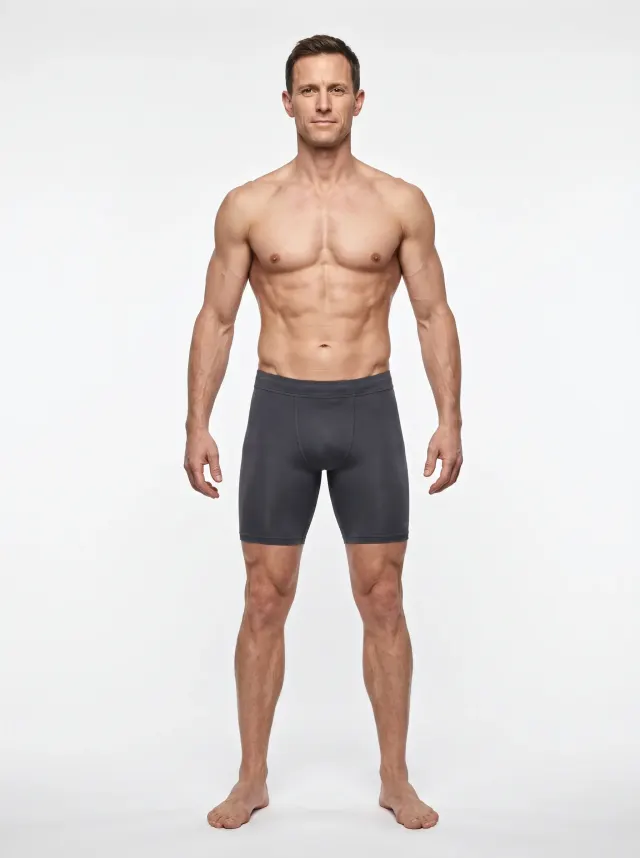
13% body fat. Carry this much muscle at average height and BMI commonly lands in the "overweight" band.
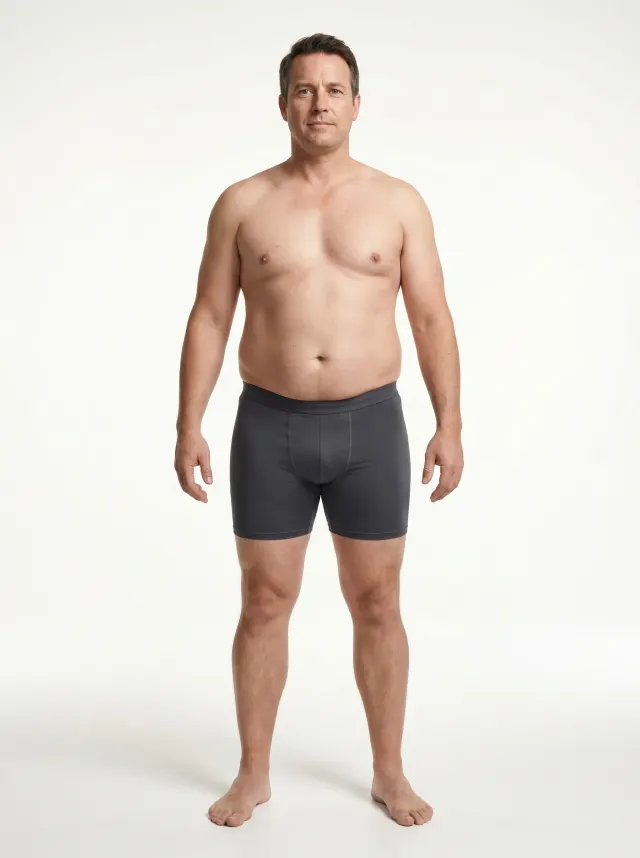
28% body fat. Swap muscle for fat and total weight — the only thing BMI reads — can barely move.
Same scale reading, opposite physiques, opposite health pictures. Every limitation in the section above is a version of this one blindness. It's also why weighing more than you look is so common among people who train.
So is BMI accurate? The fair verdict
Match the tool to the job and the contradiction dissolves:
| Use case | BMI usefulness |
|---|---|
| Population-level health screening | Good — cheap, scalable, tracks outcomes in aggregate |
| First flag for a sedentary person | Reasonable starting point — follow up with composition |
| Anyone who lifts consistently | Poor — reads muscle as excess weight |
| Normal-weight, low-muscle person | Poor — can miss high body fat entirely |
| Tracking a cut or recomp | Poor — can't tell fat loss from muscle loss |
| Judging individual health risk | Weak alone — waist-to-height adds the missing location signal |
One sentence version: trust BMI as a rough first flag for people near the population average, and distrust it in proportion to how far your composition sits from that average.
What should you use instead of BMI?
Three measurements, in ascending order of information.
Waist-to-height ratio. Keep your waist under half your height. Costs a tape measure, takes thirty seconds, and captures abdominal fat — the thing BMI most dangerously misses. The best single-number replacement.
A body fat percentage estimate. This is the number BMI is trying to approximate, measured directly. The commonly used reference bands for men run athletic 6–13%, fitness 14–17%, average 18–24%, with 25%+ elevated; our body fat percentage chart shows what each band looks like. Calipers, smart scales, and photo-based estimates all work if you use the same method consistently.
Progress photos over time. Any single measurement carries error; the trend across months doesn't lie. GainFrame estimates body fat percentage, BMI, FFMI, and a physique score from progress photos on iOS — so you see the composition BMI can't, next to the BMI itself for context. They're estimates from photos, done on-device with nothing stored on a server, and consistent estimates are exactly what a trend needs.
If your BMI worried you enough to land here, spend the next ten minutes on a tape measure and a photo instead of the chart. Both will tell you more.
Frequently asked questions
Is BMI accurate?
At population scale, yes — BMI correlates with body fat well enough across millions of people that epidemiologists commonly defend it as a cheap, effective screening tool. For individuals it gets less reliable the further you sit from average: muscular people read overweight, and normal-weight bodies carrying high fat read healthy. Treat your own BMI as a starting flag, never a verdict.
Why does BMI say I'm overweight when I'm muscular?
BMI only knows weight and height — it cannot tell muscle from fat. Muscle is dense, so a 5'10" lifter at 200 pounds and 12% body fat computes to a BMI of 28.7, squarely in the overweight range, despite carrying less fat than most men in the normal range. Any measure that looks at composition, like body fat percentage, resolves the contradiction instantly.
Can you have a normal BMI and still be unhealthy?
Yes — this is BMI's quieter failure. A person with little muscle and a high fat percentage can land in the normal BMI range while carrying substantial abdominal fat, the pattern often called skinny fat or normal-weight obesity. BMI reads the total mass as fine because it cannot see what the mass is made of or where it sits.
What is more accurate than BMI for individuals?
For a one-number health screen, waist-to-height ratio — keep your waist under half your height — captures abdominal fat that BMI misses while staying just as easy to measure. For physique tracking, a body fat percentage estimate plus consistent progress photos tells you what changed and where. Each takes minutes and answers the question BMI only gestures at.
Should I ignore BMI completely?
No — that overcorrects. If your BMI is 32 and you don't lift, the number is telling you something real, and doctors commonly use it as a legitimate first flag. Ignore it selectively: when you carry meaningful muscle, or when a normal reading contradicts what the mirror and tape measure say. In both cases, get one composition-aware measurement before drawing conclusions.
See what BMI can't
GainFrame estimates body fat percentage, FFMI, and a physique score from your progress photos — the composition behind the scale weight, tracked over time. Free to start on iOS.
Download GainFrame Free