
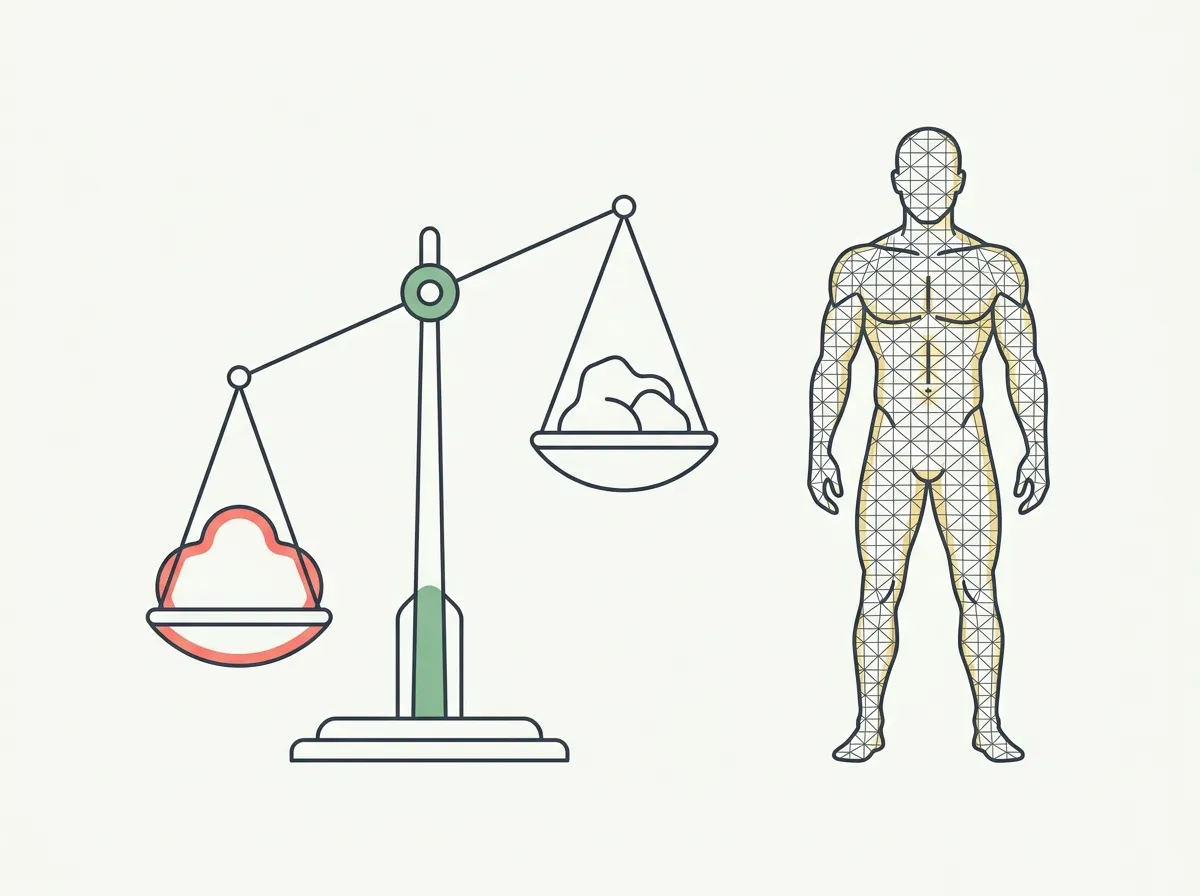
Quick answer: Muscle tissue is denser than fat — a muscular 190 pounds occupies visibly less space than a soft 190. Add frame differences and how your height distributes mass, and the scale can read heavy on a lean-looking body. The scale measures mass; if you look lean and strong, FFMI is the better instrument.
You tell someone your weight and they argue with you. "There's no way you're 195 — you look 175, tops." Then you step on a scale at the gym in front of them and win a bet you never wanted to make.
If your scale number runs 10–20 pounds heavier than strangers guess, you're living the flattering mirror image of the skinny fat problem — where people weigh less than they look and the composition story is bad. Yours is the good version. This page covers the mechanisms, roughly how much each one explains, and the number that describes your body better than weight ever will.
Why do you weigh more than you look?
Four mechanisms stack, and they're worth ranking, because people tend to credit the wrong one.
Muscle density is the big one. Muscle tissue is commonly cited at around 1.06 g/ml versus roughly 0.9 g/ml for fat — meaning a pound of muscle takes up something like 15–20% less space than a pound of fat. Carry an extra 15 pounds of muscle instead of 15 pounds of fat and you weigh the same while looking dramatically smaller and harder.
Frame and bone mass are real but commonly overstated — a large frame is worth a few percent of body weight, a handful of pounds at most.
Height and distribution create an illusion in the observer. Weight scales roughly with body volume, while people estimate weight from your silhouette. A taller frame, or mass spread evenly across shoulders, legs, and back, reads lighter than the same pounds concentrated at the midsection.
Low body fat itself sharpens the effect. Definition — visible delts, forearm veins, a jawline — pattern-matches to "light" in most people's heads, because most heavy bodies they've seen were soft.
How much of the gap does muscle density explain?
For most lifters, the majority of it. The comparison to hold in your head is 10 pounds of fat vs 10 pounds of muscle — same weight, visibly different volume, with fat commonly described as taking up nearly a third more space per pound.
Play that forward across a body. Two men at 5'10" and 190 pounds can look like different species: one at 15% body fat carries roughly 161 pounds of lean mass, one at 28% carries roughly 137. The first man's 190 is packed into a denser, smaller, tighter volume. Strangers guess him 15 pounds lighter and guess the second man 10 pounds heavier, and both guesses are just volume estimates doing what volume estimates do.
This is also why the effect strengthens as you train. Every recomp cycle — fat out, muscle in — makes you heavier-per-visual-pound. Lifters who've trained for years routinely report weighing "way more than anyone believes," and the disbelief is the compliment.
Do big bones actually explain it?
Partially, and less than the phrase suggests. Frame size is measurable and genuinely varies — wrist circumference and elbow breadth are the commonly used markers, and our body frame size guide covers how to check yours in about a minute.
But the skeleton is commonly cited at around 12–15% of body weight, and the variation between a small and large frame within that is commonly estimated at only a few percent of total mass. A genuinely large-framed man might carry 5–8 pounds more bone and the wider chassis to hang muscle on. That's real, and it nudges the scale.
What it can't do is explain a 20-pound gap between how you look and what you weigh. If the gap is big, the answer is almost always tissue composition, with frame as a rounding term. "Big bones" earns its reputation as an excuse when it's used to explain fat; in your case it's a minor supporting actor in a story muscle is carrying.
Why does BMI call you overweight when you look lean?
Because BMI is weight divided by height squared, and it has no idea what the weight is made of. Muscle is dense, so the same mechanism that makes strangers underguess your weight makes BMI overguess your fatness. A 5'10" man at 195 pounds sits at a BMI of 28 — "overweight" — whether that 195 is a soft desk body or a lean, trained one.
This is the mirror image of the normal BMI but look fat problem, where low muscle mass lets a genuinely high-body-fat person pass the BMI check. Same broken instrument, opposite failure. BMI misses fat on the under-muscled and invents fat on the muscled, and the full breakdown of when to trust which number is in our body fat percentage vs BMI guide.
You can visualize how height and weight map to BMI before comparing that screening number with body fat or FFMI.
The practical takeaway: a muscular person's "overweight" BMI reading is a known, common false positive. If your waist is under half your height and you can see muscle definition, the BMI category is describing your density, and describing it as a flaw.
What number should you track instead of weight?
The scale measures mass. Your question is about composition — and if you look lean and strong at a "heavy" number, the scale is simply the wrong instrument pointed at the right body.
FFMI (fat-free mass index) is the right one. It takes your lean mass and normalizes it for height — essentially BMI rebuilt to count muscle instead of punishing it. Commonly cited reference points: around 19 for an average untrained man, 22 for a clearly trained one, and roughly 25 as the ceiling commonly associated with natural training. Our FFMI percentiles guide shows where a given score lands against other men, and the free FFMI calculator does the arithmetic.
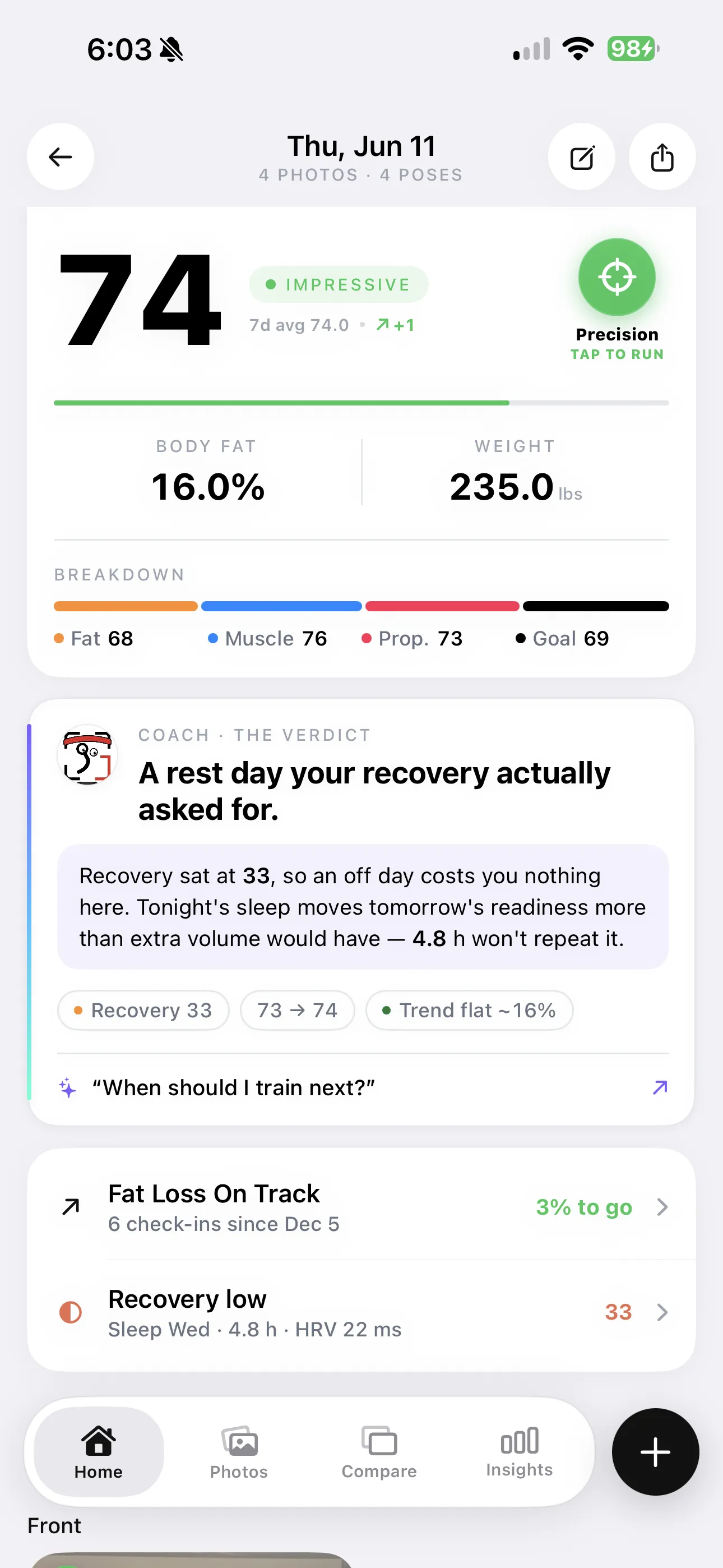
One photo, and the weight number gets its context: body fat, muscle, proportions — 235 pounds, scored on what it's made of.
FFMI needs a body fat estimate as input, which is where photos come in. GainFrame estimates body fat percentage, BMI, and FFMI from a progress photo, plus a 1–100 physique score — so the "heavy" scale number finally gets read alongside what the mass actually is. These are estimates from photos rather than clinical measurement, but they're consistent shot to shot, which is what a trend needs. And to be clear about the reframe: weighing more than you look is the outcome years of training aims at. The scale isn't reporting a problem. It's reporting density.
Frequently asked questions
Why do I weigh more than I look?
The most common reason is body composition: muscle is denser than fat, so a lean muscular body packs more pounds into less visible volume. Frame and bone mass differences add a little, and taller or evenly distributed builds hide mass well. The scale reports total mass and says nothing about what that mass is made of.
Is it good to weigh more than you look?
Usually, yes. Looking leaner than your scale weight suggests generally means a higher share of your mass is muscle, which is associated with better strength, metabolic health, and appearance. The main caveat is verification — confirm the flattering story with a body fat estimate or FFMI rather than assuming it.
Do big bones explain weighing more than you look?
Frame size is real — wrist and elbow measurements genuinely vary between people, and a larger frame does carry more bone mass. But skeletal differences are commonly estimated to shift total body weight by only a few percent. Frame can explain a handful of pounds; it cannot explain a 20-pound gap between the mirror and the scale.
Why is my BMI overweight if I look fit?
BMI divides weight by height squared with no information about what the weight is made of. Muscle is dense, so a muscular build routinely pushes BMI into the overweight range at low body fat. This is a well-known limitation of BMI, and it's why body fat percentage and FFMI describe lifters far better.
What should I track instead of scale weight?
Body fat percentage tells you what share of your mass is fat, and FFMI tells you how much muscle you carry for your height. Together they separate everything the scale conflates. Progress photos taken under consistent conditions add the visual trend. Weight is still worth logging as one input rather than the verdict.
Get the number that matches the mirror
GainFrame estimates body fat, FFMI, and a physique score from a progress photo — so the scale weight strangers don't believe finally comes with the context that explains it. Free to start on iOS.
Download GainFrame Free