
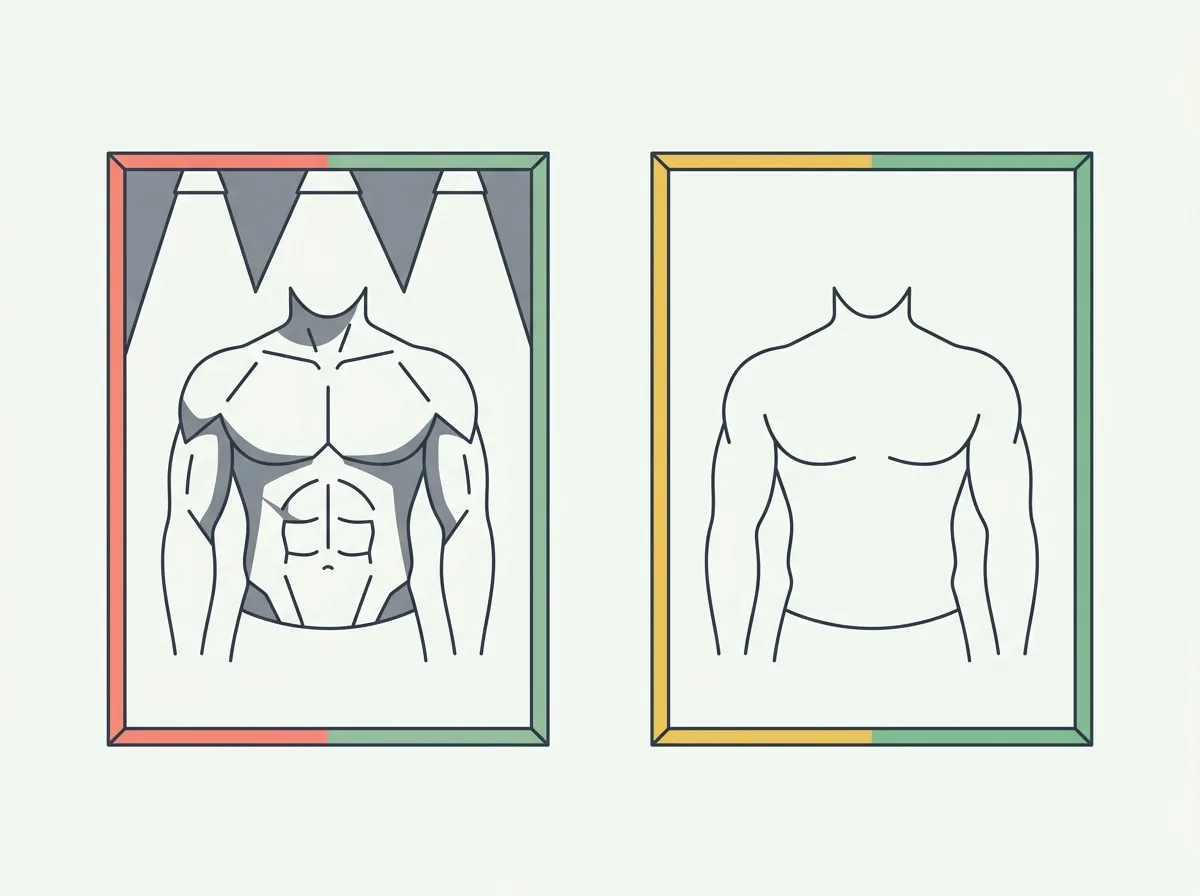
Quick answer: The gym mirror stacks real advantages: overhead directional light carves shadows into muscle definition, a post-set pump temporarily enlarges whatever you just trained, and slightly tilted mirrors are widely reported. Your home bathroom stacks the opposite — diffuse light, no pump. Both are showing a version of you; standardized photos under consistent conditions settle it.
Last set of arms done, you catch the mirror on the way to the water fountain and think: it's working. Ninety minutes later you're brushing your teeth at home, catch that mirror, and half the progress has apparently been repossessed on the drive.
You're seeing two honest reports from two very different measurement rooms. The gym version of you is real, the bathroom version of you is real, and understanding what each mirror adds and subtracts is what stops the nightly deflation. The lighting half of this story runs deep enough that it has its own full breakdown — here's the complete stack.
What is gym lighting doing for you?
Muscle definition is mostly shadow. Gym lighting is commonly bright, overhead, and directional, and light raking down a torso from above drops small shadows into every groove between muscles — the line of a bicep, the split of a shoulder, the edge of a chest. Deeper shadows read as more separation, which is why stage bodybuilders have been lit from above for decades.
Your bathroom typically runs the opposite scheme: soft, warm, diffuse light from a frosted fixture or a front-facing vanity bulb. Diffuse light arrives from many angles at once and fills in whatever shadow any single angle casts. Same muscle, no shadow, no visible definition. The lighting deep-dive walks through the physics and how many apparent body fat points a light source can swing.
How real is the pump?
Completely real, and completely temporary. Training a muscle drives extra blood into it — exercise is commonly cited to transiently increase muscle blood volume and fluid, which is the tight, full, "grew two sizes in an hour" feeling. Measured on a tape, a hard arm session can add visible fullness on the spot.
Then it leaves. The commonly reported pattern is that most visible fullness drains over the following few hours as blood flow normalizes, with subtle fullness occasionally lingering into the next day — hours in any case, never weeks. So the gym mirror is always grading the pumped version of you, and the bathroom mirror at 10 p.m. is always grading the drained one. Neither is lying; they're sampling different states of the same body. If you want the version of size that persists, the signs you're actually building muscle is the checklist for changes that survive the drive home.
Are gym mirrors actually tilted?
The internet's favorite gym conspiracy, and it deserves an honest hedge. The claim: some gyms hang mirrors with a slight backward lean at the top, which is widely reported to elongate the reflection and make the viewer look taller and leaner. Lifters swear they've seen it; gyms and mirror installers commonly deny doing it on purpose; and glass that's imperfectly mounted or slightly warped can produce the same effect by accident. Cheap mirror stock at home can distort in the unflattering direction just as easily.
The fair conclusion is that tilt is plausible in some rooms and unproven as an industry practice — and that it doesn't need to be deliberate to matter. A degree or two of lean changes the geometry of your reflection either way. It's one more reason two mirrors in two buildings were never going to agree.
How much of it is in your head?
Some — and this part works in your favor at the gym. You look at the gym mirror seconds after doing something hard, with elevated adrenaline, a sense of accomplishment, and an expectation of progress. That state is commonly reported to color self-perception generously; you're primed to find evidence the training works, and the mirror obliges.
The bathroom check runs the opposite script. It happens at tired, neutral, or self-critical moments, with no recent win to celebrate, and often with a specific insecurity queued up for inspection. Same face in the glass, entirely different judge behind the eyes.
Which mirror is the honest baseline?
The home bathroom is closer to your resting truth — diffuse light, no pump, no adrenaline is roughly how you look to the world on an average Tuesday. But calling it "the honest one" gives it too much credit, because it carries its own distortions: unflattering light hides definition you genuinely have, and the self-critical viewing conditions bias the reading downward. The gym mirror overpays you; the bathroom mirror underpays you.
Chasing a verdict between two biased instruments is the wrong game. The physique that matters is the trend — whether this month's body carries more muscle and less fat than last month's — and neither mirror can remember last month. This is the same trap as looking smaller in photos than in the mirror or looking heavier in candids: every casual viewing condition edits you, in one direction or the other.
How do standardized photos settle it?
By freezing every variable except you. One room, one light source, one spot on the floor, one relaxed pose, one time of day — morning before food is the commonly recommended least-noisy slot, which also guarantees you're never accidentally measuring a pump. Shoot weekly or biweekly under those exact conditions and the photos become the referee both mirrors need: comparable, dated, and immune to lighting mood. The full setup checklist takes five minutes to implement.
Consistency is where the discipline usually leaks, and it's the part GainFrame automates: check-in photos get auto-aligned so framing and scale match across weeks, with estimated body fat and muscle-group ratings computed per photo. Estimates from photos rather than a clinical scan — but the same instrument every time, which is precisely what the gym-versus-bathroom whiplash lacks.
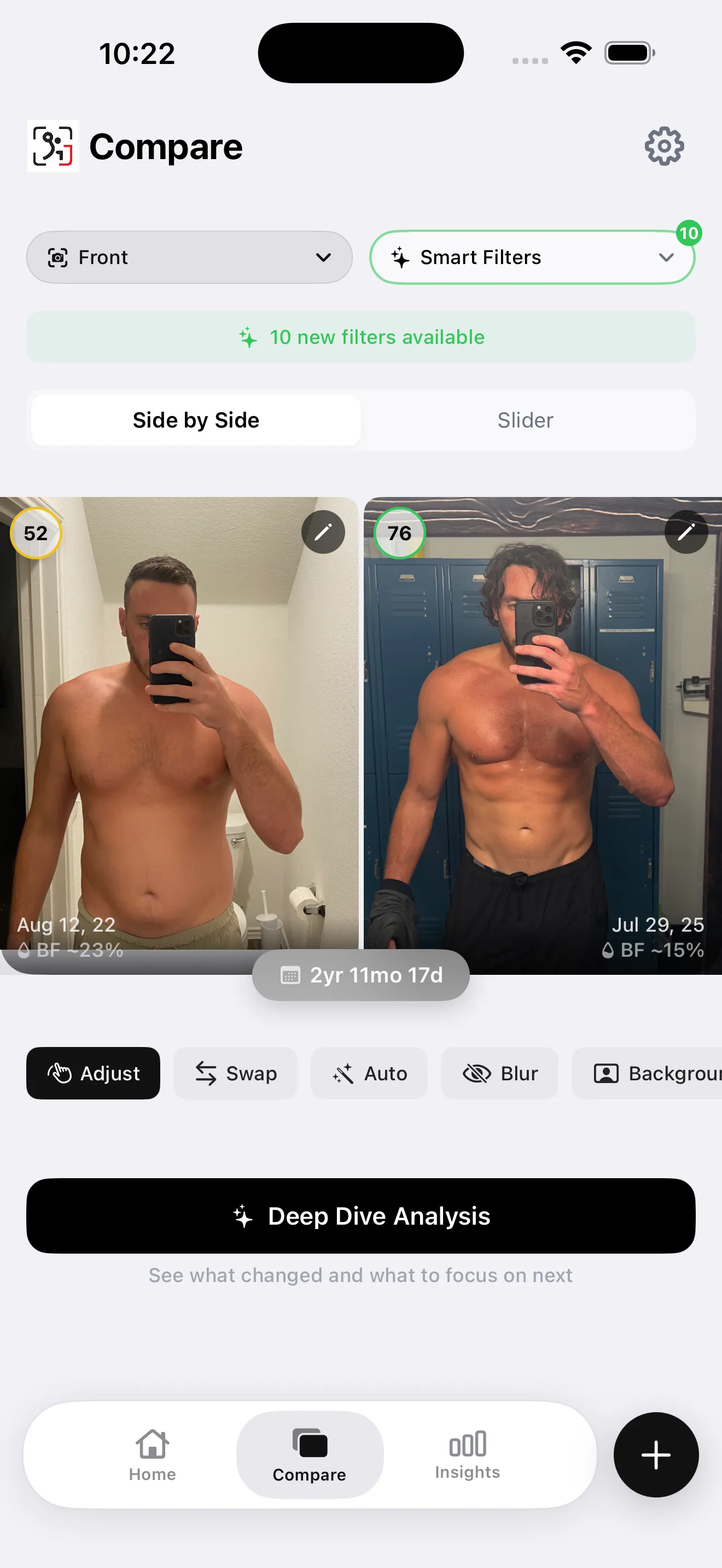
Two check-ins under identical conditions: no pump, no gym light, no tilted glass — whatever changed between these frames is you.
Frequently asked questions
Why do I look so much better in the gym mirror than at home?
Several effects stack in the gym's favor. Overhead directional lighting casts shadows into the grooves between muscles, which reads as definition. You're usually looking right after training, when a pump has temporarily enlarged the muscles you worked. And you arrive primed to see progress. Home bathrooms offer diffuse light, no pump, and no adrenaline — the same body, minus every flatterer.
How long does a pump last?
The visible fullness commonly fades over a few hours as blood volume in the trained muscle returns to baseline — most of it within two to three hours, with subtle fullness sometimes lingering into the next day. The pump reflects fluid, so it isn't fake, and repeated training does drive lasting growth. The mistake is comparing a pumped Monday to a cold Thursday.
Are gym mirrors designed to make you look better?
It's a persistent claim: a mirror leaned slightly back at the top is widely reported to elongate the reflection and flatter proportions, and lifters swear some gyms use it. Gyms and mirror manufacturers commonly deny doing this deliberately, and imperfect wall mounting can produce small tilts by accident. Either way, the lighting and the pump explain most of the effect on their own.
Which mirror shows the real me?
Neither one, fully. The gym mirror adds flattering light, a pump, and post-workout optimism; the home mirror subtracts all three but adds its own bias, because you check it at unflattering moments and study flaws. Your real physique sits between them. A standardized photo series under one set of conditions is the only view that stays comparable across weeks.
How should I track progress if mirrors disagree?
Pick one set of conditions and never vary it: same room, same single light source, same spot, same relaxed pose, same time of day — morning before food is the least noisy. Shoot weekly or biweekly and compare across weeks rather than days. When every variable except your body is frozen, the disagreement between mirrors stops mattering.
Give both mirrors a referee
GainFrame scores standardized check-in photos — estimated body fat, FFMI, and 12 muscle-group ratings — and auto-aligns any two dates side by side, so your progress stops depending on which room you saw it in. Free to start on iOS.
Download GainFrame Free