
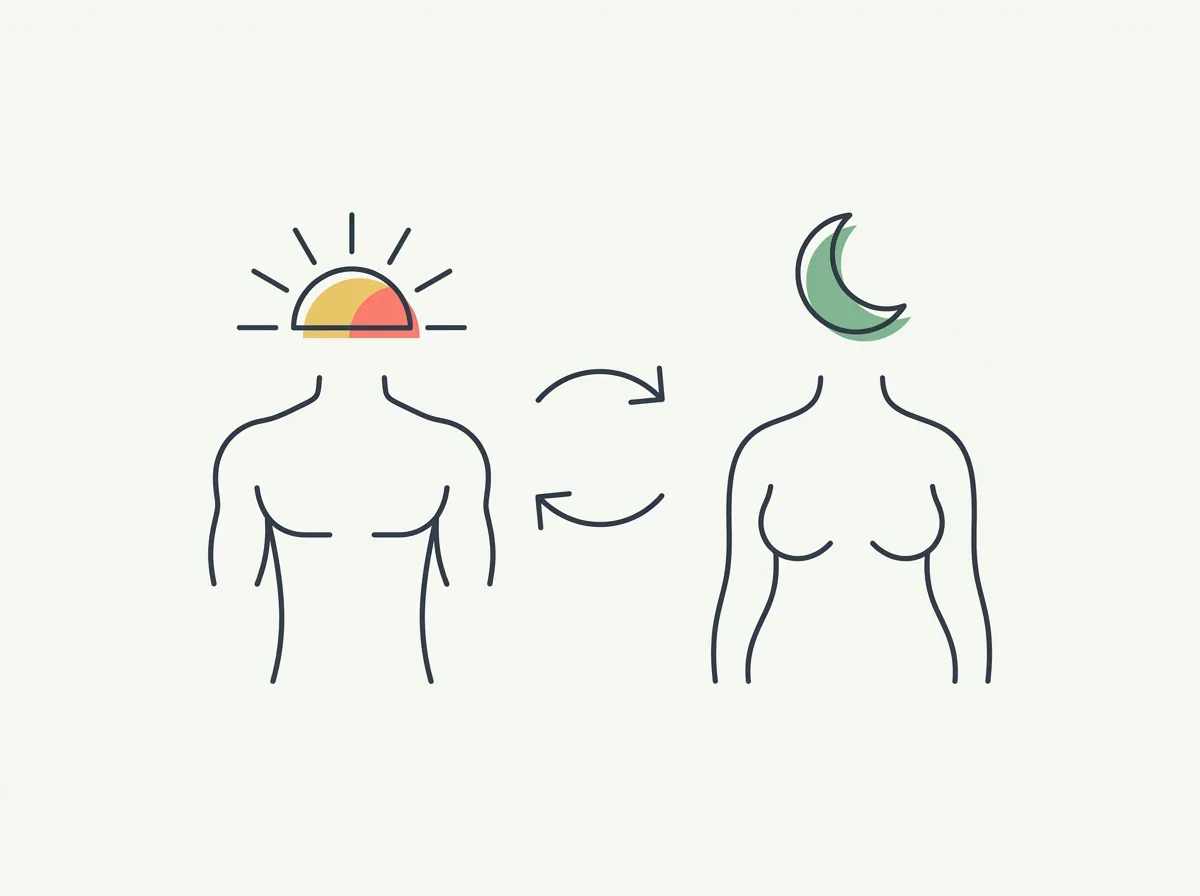
Quick answer: Overnight, glycogen and water partially drain, your stomach empties, and lying flat redistributes fluid away from your midsection — so you wake up tighter and more defined. Food, carbs, and a day upright reverse it by evening. The swing is commonly observed, completely normal, and can read like 1–2 body fat points.
7:04am, bathroom mirror: abs visible, waist tight, and you make a mental note that the cut is finally working. 9:30pm, same mirror: the abs are gone, the waist is soft, and you're renegotiating the entire plan. Twelve hours, zero fat gained, two completely different verdicts.
Every body does this, every day, at every body fat percentage. The morning version and the evening version are both you — you're just watching water, glycogen, and food volume commute through your midsection on a schedule. Here's the physiology behind the daily cycle, how big it actually gets, and the one tracking rule that stops it from wrecking your progress photos.
Why do you look leaner in the morning?
Four overnight effects stack, all pushing the same direction.
Your stomach and gut are empty. After 8–12 hours without food or drink, there's simply less volume in your abdomen. A normal day of eating commonly moves multiple pounds of food and liquid through your system, and much of it sits in exactly the region you scrutinize in the mirror. By morning it's processed or gone.
Glycogen and its water have partially drained. Your body stores carbohydrate as glycogen, and glycogen binds water — roughly 3 grams per gram is the commonly cited figure. An overnight fast dips into those stores, taking the bound water with them. Our weight fluctuation guide covers how this same mechanism moves the scale; here it moves the mirror.
Lying flat redistributed your fluid. After a day upright, gravity pools fluid lower in the body. Eight horizontal hours lets it spread back out, which is commonly noticed as a slightly tighter midsection and slightly puffier face first thing — the trade reverses over the morning.
You're mildly dehydrated. A night of breathing and no drinking leaves you a little down on water, which can slightly tighten the look of skin over muscle. Morning cortisol's fluid effects are sometimes mentioned here too. These are the smallest contributors, but they lean the same way.
None of this is fat. Fat loss runs on a timescale of weeks; everything on this list runs on a timescale of hours.
How big is the morning-to-evening swing?
Bigger than most people expect, which is exactly why it causes so much false panic.
Scale weight commonly moves 2–5 pounds between a morning and evening weigh-in on the same day. Visually, the swing is commonly observed to read like one to two body fat points of apparent difference — someone genuinely at 15% can photograph like 14% in the morning and 16–17% after a salty dinner and a long day. That's an apparent range wider than a month of real cutting progress, produced in half a day, by lunch and gravity.
The swing also isn't constant. High-sodium meals, a big carb day, travel, a hard workout, and (for women) cycle phase all commonly widen it. Which means the gap between your best morning and worst evening on a bad week can be dramatic — and still mean nothing about your actual body fat trend. Ab visibility sits right at the threshold where these small volume changes matter, the same edge effect our lighting and abs guide covers from the other direction.
Why do you look fuller at night — and when is that a good thing?
The evening isn't purely the villain in this story. The same mechanisms that soften your waist also fill your muscles.
By evening, replenished glycogen — with its bound water — sits partly inside muscle tissue, and muscles full of glycogen look rounder and fuller than depleted ones. Add the acute pump from an afternoon or evening training session and you get the flip side of the daily cycle: arms, shoulders, and chest commonly look their best at night, right when the midsection looks its worst.
This is why physique athletes carb up before stepping on stage rather than starving beforehand, and why lifters commonly like an evening post-training mirror check — it's a legitimate preview of what the muscle you're building looks like at full volume. There's a related effect in gym mirrors specifically, which our gym mirror guide breaks down. Enjoy the evening version. Just don't measure with it.
What's the tracking lesson? Pick one time and never mix them
Everything above compresses into one rule: a progress photo is only comparable to another photo taken under the same conditions, and time of day is the biggest condition of all.
Morning is the honest baseline. After the bathroom, before food or water — that's the most repeatable state your body hits all week, because evenings inherit whatever the day held: sodium, carbs, training, stress, travel. This is the same check-in standard in our complete progress photo guide: same time, same light, same spot, same poses.
Never compare a morning photo to an evening photo. The morning-versus-evening gap can read like 1–2 body fat points — so a Tuesday 7am photo against a Saturday 9pm photo is a comparison with a built-in error larger than most months of genuine change. It manufactures fake regress in one direction and fake progress in the other, and both conclusions send you chasing adjustments your plan doesn't need.
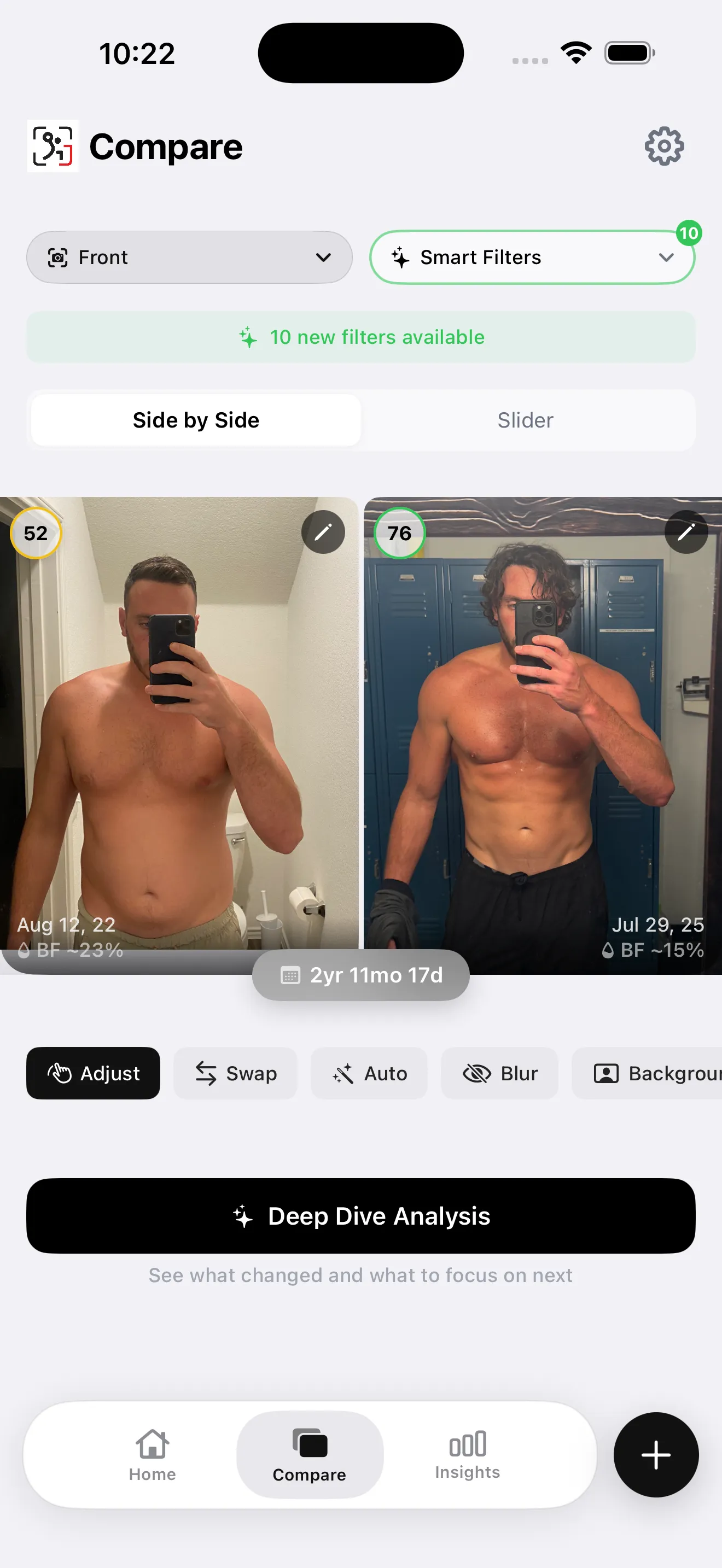
Two morning check-ins, same conditions. When the timing is constant, the difference between photos is actually you.
This is the entire reason standardized check-ins exist. GainFrame estimates body fat percentage and physique scores from progress photos and lines up your check-ins side by side — and those estimates are only as good as your consistency, which is why a fixed morning routine matters. Estimates from photos rather than clinical measurement, but under repeated conditions the trend across weeks is the signal, and the daily cycle averages out to noise.
Frequently asked questions
Why do I look leaner in the morning?
Several overnight effects stack. You haven't eaten for 8–12 hours, so there's no food or drink volume in your stomach and gut. Glycogen and its bound water have partially drained. Lying flat all night redistributes fluid away from your midsection. And mild overnight dehydration slightly tightens the skin's appearance. All of it reverses across the day.
Why do my abs show in the morning and disappear by night?
Ab visibility depends on how much sits between skin and muscle, and by evening there's simply more in the way: food volume in the gut, replenished glycogen and water, and fluid that gravity has pulled downward during a day upright. Your body fat didn't change between breakfast and dinner. The overlying volume did, and abs are sensitive to small changes there.
How much difference can morning versus evening make?
The swing is commonly observed to read like one to two body fat points of apparent difference, and scale weight commonly moves 2–5 pounds across the same day. Someone genuinely at 15% can photograph like 14% at 7am and 16–17% at 9pm after a salty dinner. That apparent range is water, food, and fluid position rather than fat.
Should I take progress photos in the morning or evening?
Morning, before food and after the bathroom, is the commonly recommended baseline — it's the most repeatable state your body hits, since evenings vary with whatever the day held. But the deeper rule is consistency: one time of day, every time. A photo series that alternates morning and evening shots has a built-in swing larger than weeks of real progress.
Is the morning version or the evening version the real me?
Both are real — they're the same body at different points in a normal daily fluid and food cycle. Morning is the more repeatable measurement state; evening, especially after training and carbs, is the fuller look. For tracking, use morning. For judging how you look at dinner, that fuller evening version is also genuinely you.
Compare like with like
GainFrame estimates body fat percentage and physique scores from standardized progress photos — so your morning check-ins get compared to other morning check-ins, and the trend you see is real change. Free to start on iOS.
Download GainFrame Free