
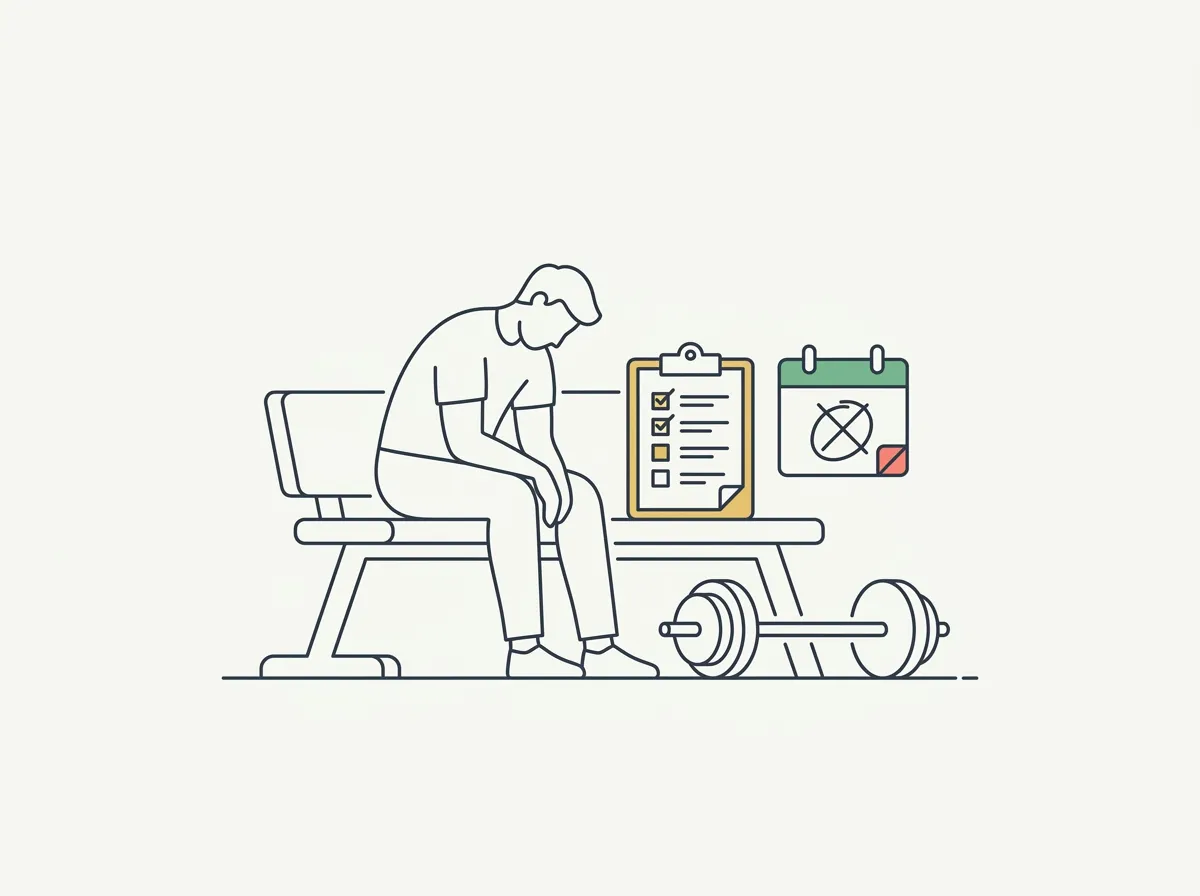
Quick answer: Count your yes answers on the eight checks below. Zero to two suggests normal training fatigue, three to five points toward functional overreaching where a deload week is commonly recommended, and six or more calls for extended recovery. This is a self-reflection tool for lifters — persistent fatigue, sleep, or mood symptoms deserve a clinician, whatever you score.
Your bench was 225 for 5 a month ago. Last week it was 215 for 4, at what felt like a harder effort. You're sleeping badly despite being exhausted, you snapped at someone over nothing yesterday, and this morning you caught yourself hoping the gym would be closed.
Something is off. The question is whether it's a normal rough patch, an accumulated recovery debt, or the thing lifters always jump to first: overtraining. The eight checks below take about two minutes and sort the pattern out.
One thing before you start. Fatigue, poor sleep, mood changes, and appetite shifts can all have medical causes that have nothing to do with your program. This checklist is a training self-reflection to help you decide whether your programming and recovery deserve a look. It cannot diagnose anything, and symptoms that persist for weeks — especially after you've reduced training and improved sleep — warrant a conversation with a clinician.
The 2-minute self-check
Eight yes/no questions. Each one is a signal commonly associated with overreaching — none is proof on its own. Answer for the last two to three weeks, honestly.
- Have your lifts been declining for two or more weeks at equal or greater effort? One bad session means nothing. A multi-week downtrend on the same movements, with honest effort, is the most commonly cited performance flag there is.
- Is your sleep worse even though you're tired? Lying exhausted but wired at midnight, or waking at 4 a.m. unable to drop back off. Paradoxically disturbed sleep is commonly reported alongside accumulated training stress.
- Is your morning resting heart rate elevated above your normal? A sustained bump of several beats per minute over your own baseline — a single high morning after late food or alcohol doesn't count. No baseline? That's worth fixing; more below.
- Has your motivation flipped from wanting to train to dreading it? Recovery debt commonly shows up as dread before it shows up on the bar. If sessions you used to look forward to now feel like a tax, that's a yes.
- Does soreness routinely hang around past 72 hours? Normal post-session soreness fades in a day or three. Soreness that lingers most of a week, in muscles you train regularly, suggests recovery isn't keeping pace.
- Are you noticeably more irritable than usual? Mood is one of the earlier signals commonly reported — short fuse, low patience, small things landing hard. Ask someone who lives with you if you're not sure.
- Has your appetite changed markedly in either direction? Both suppressed appetite and constant hunger are commonly reported under accumulated stress. The flag is a clear departure from your normal, sustained across weeks.
- Are your progress photos flat or moving backwards despite consistent effort? Weeks of honest training with visibly no change — or a softer, flatter look — can indicate the stimulus is outrunning your recovery rather than building anything.
How do you score it?
Count your yes answers.
| Yes answers | What it suggests | Commonly recommended move |
|---|---|---|
| 0–2 | Normal training fatigue | Train on. Maybe tighten sleep. |
| 3–5 | Functional overreaching territory | A deload week is commonly recommended — half volume, keep the movements |
| 6+ | Extended recovery warranted | 1–2 weeks of markedly reduced training, and consider a clinician if symptoms persist |
Two notes on reading your score. Question 1 carries the most weight — a sustained performance decline at equal effort is the closest thing this list has to a hard signal, and several of the others (sleep, mood, appetite) are common in ordinary stressful life whether or not a barbell is involved. And a high score doesn't tell you why recovery is failing, only that it looks like it is. The next section is about the why.
Are you overtrained or just under-recovered?
Here's the context that changes what most people do with their score. True overtraining syndrome — the state where performance and health stay suppressed for months even with rest — is commonly described in the sports science literature as rare and serious, mostly documented in endurance athletes running enormous volumes. The average lifter training 4–6 hours a week is very unlikely to be there.
What's common is the milder pattern: overreaching layered on top of under-recovery. The training didn't get too big; the recovery underneath it got too small. Five hours of sleep, protein at half of target, a stressful month at work — run that under an unchanged program and you produce most of the checklist above without your program ever being the villain.
That distinction is good news, because the fix for under-recovery is cheap and fast. The commonly recommended version: one deload week — roughly half your normal volume, same movements, nothing to failure — plus a deliberate push on sleep and food. Most lifters who score 3–5 on this checklist reportedly feel like a different person after one honest week of that. If a genuine deload plus two weeks of decent sleep changes nothing, that's precisely the moment the clinician conversation stops being optional, because you've now ruled out the obvious cause.
Worth saying: some of what feels like backsliding during hard training is measurement confusion, not decline — scale weight in particular rises for reasons that have nothing to do with fat, which we cover in why your weight goes up when you start lifting.
What should you track to catch it early?
Every question on the checklist is easier to answer with data than with memory. Three signals cover most of it:
Strength trend. Log your main lifts. A downtrend over 2–3 weeks at equal effort is visible in a log and invisible in your memory, which will helpfully rewrite history in either direction. This is also the signal that keeps expectations sane — natural progress is slow enough that a month of "no progress" is often just a normal month.
Resting heart rate, and HRV if you have a wearable. Morning resting HR needs nothing fancier than a phone timer or a $30 tracker, and a personal baseline turns question 3 from a guess into a reading. If you want the fuller version — HRV, sleep staging, a daily readiness number — our guide to recovery scores for lifters covers what those numbers mean for training decisions, and the WHOOP alternatives roundup compares the hardware options at each price.
Photos and weight, together. A flat or softening photo trend during honest training is question 8; a weight trend sliding down unintentionally is an under-eating flag. GainFrame keeps both in one place — it scores progress photos for body fat percentage and per-muscle-group change, and tracks your weight trend against them, so "am I actually going backwards?" gets answered by data instead of a 6 a.m. mirror mood. Estimates from photos rather than clinical measurement, iOS only, free tier covers 25 photos.
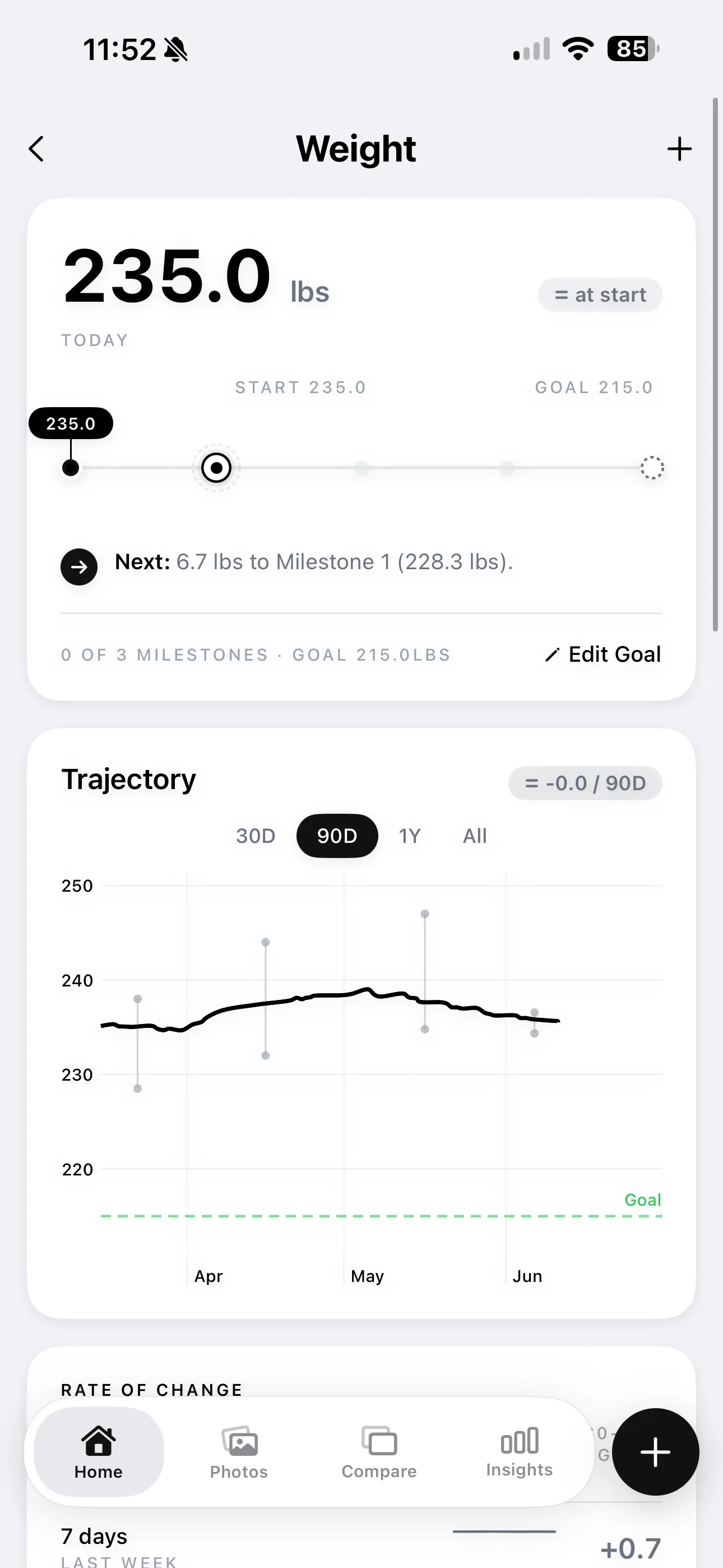
An unplanned weight downtrend during hard training is an under-recovery flag worth catching in week two, not month two.
Frequently asked questions
What are the most common signs of overtraining?
The signals most commonly described include declining performance over weeks despite equal effort, disturbed sleep, elevated morning resting heart rate, persistent soreness, irritability, appetite changes, and a motivation crash. No single sign is diagnostic — fatigue, mood, and sleep problems all have other causes. It's the cluster, sustained for weeks, that points toward a recovery problem.
What is the difference between overreaching and overtraining?
Overreaching is a short-term dip in performance from accumulated training stress that resolves with days to a couple of weeks of reduced load — it's common and sometimes even planned. Overtraining syndrome is commonly described as a rare, serious condition where performance and health stay suppressed for months. Most tired lifters are overreached or under-recovered, and neither requires months off.
How long does it take to recover from overtraining?
It depends which state you're in. Functional overreaching commonly resolves within one to two weeks of reduced training. Non-functional overreaching is commonly described as taking weeks to months. True overtraining syndrome can reportedly take many months. In practice, most lifters feel dramatically better after one honest deload week plus a stretch of adequate sleep and food.
Should I take a deload week if I think I'm overtraining?
If you scored three or more on the checklist, a deload is the cheap experiment. Cut volume roughly in half for a week, keep the movements, sleep as much as you can, and eat at maintenance or above. If your lifts and mood rebound, you were under-recovered. If nothing improves after two deloads, that's worth a conversation with a clinician.
Can overtraining symptoms be caused by something else?
Yes — and this matters. Persistent fatigue, sleep disruption, mood changes, elevated resting heart rate, and appetite shifts can come from illness, thyroid issues, anemia, low energy availability, depression, and other medical causes. This checklist is a self-reflection tool for training stress and can't rule any of that in or out. If symptoms persist for weeks despite reduced training and better sleep, see a clinician.
Catch the downtrend before the burnout
GainFrame tracks your weight trend and scores your progress photos — body fat %, FFMI, per-muscle ratings — so a stall or slide shows up in data weeks before it shows up as dread. Free to start on iOS.
Download GainFrame Free