
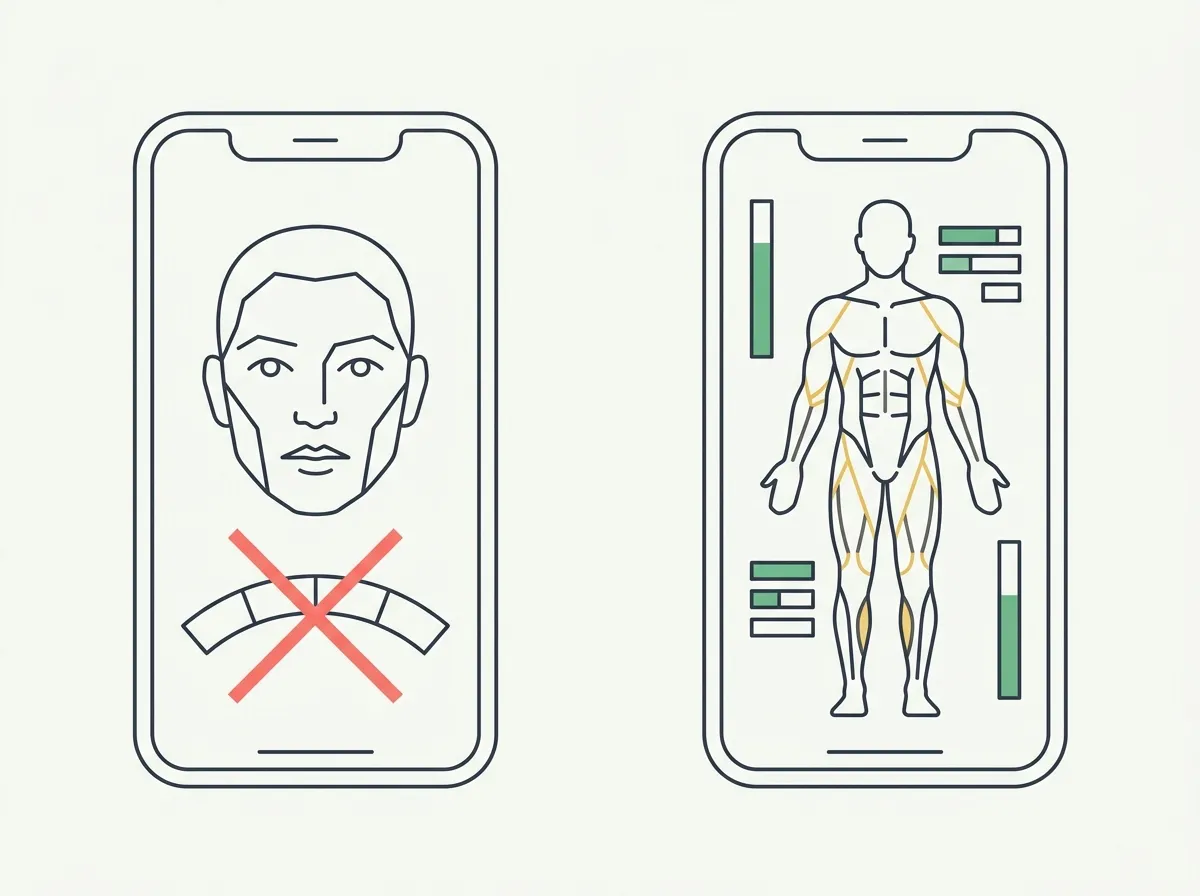
Quick answer: Umax rates your face — for your physique, the closest equivalents are GainFrame (1–100 physique score plus body fat, FFMI, and 12 muscle ratings from one photo), Recomp AI (scan-based composition estimates), and simpler one-shot physique raters. The difference that matters: a rating you can track beats a rating you screenshot once.
Umax turned "let AI rate me" into a genre. Take a selfie, get scored, get told what to fix — 50,000+ App Store ratings say the format works.
But Umax stops at your chin. If the thing you're actually working on is your physique — the training, the cut, the recomp — a face score tells you nothing. The same instant-AI-rating experience exists for your body, and the apps doing it fall into two camps: ones that hand you a number, and ones that hand you a number that means something next month.
What separates a useful physique rating from a gimmick?
Three tests, before you trust any body-rating app:
- Is the score decomposed? "You're a 71" is entertainment. "Your delts rate Strong, your chest rates Developing, and here's the body fat estimate dragging the total" is information.
- Is it consistent? Same methodology on every photo, or a vibes-based number that changes with lighting?
- Does it track? A rating that lives in a timeline — score versus your own last month — is a training signal. A one-shot rating is a screenshot for the group chat.
| App | What it rates | Price | Tracks over time? |
|---|---|---|---|
| GainFrame | Physique 1–100 + BF% + 12 muscles | Free / $5.99 mo | Yes — full timeline |
| Umax | Face only | Free / subscription | Re-scan on demand |
| Recomp AI | Composition + circumferences | Free / subscription | Scan-to-scan |
| One-shot physique raters | Single body score | Usually free + ads | Rarely |
| MeThreeSixty | Measurements (no rating) | Free | 5 scans on free tier |
1. GainFrame — The Umax experience, for your physique
Platform: iOS App Store · Price: Free (25 photos) with Pro at $5.99/mo or $39.99/yr
GainFrame is the closest thing to "Umax for your body" that's also a serious tracking tool. One photo returns a 1–100 physique score — decomposed into body fat, muscle, proportions, and goal-fit — plus individual ratings for 12 muscle groups on a Needs Work → Elite scale.
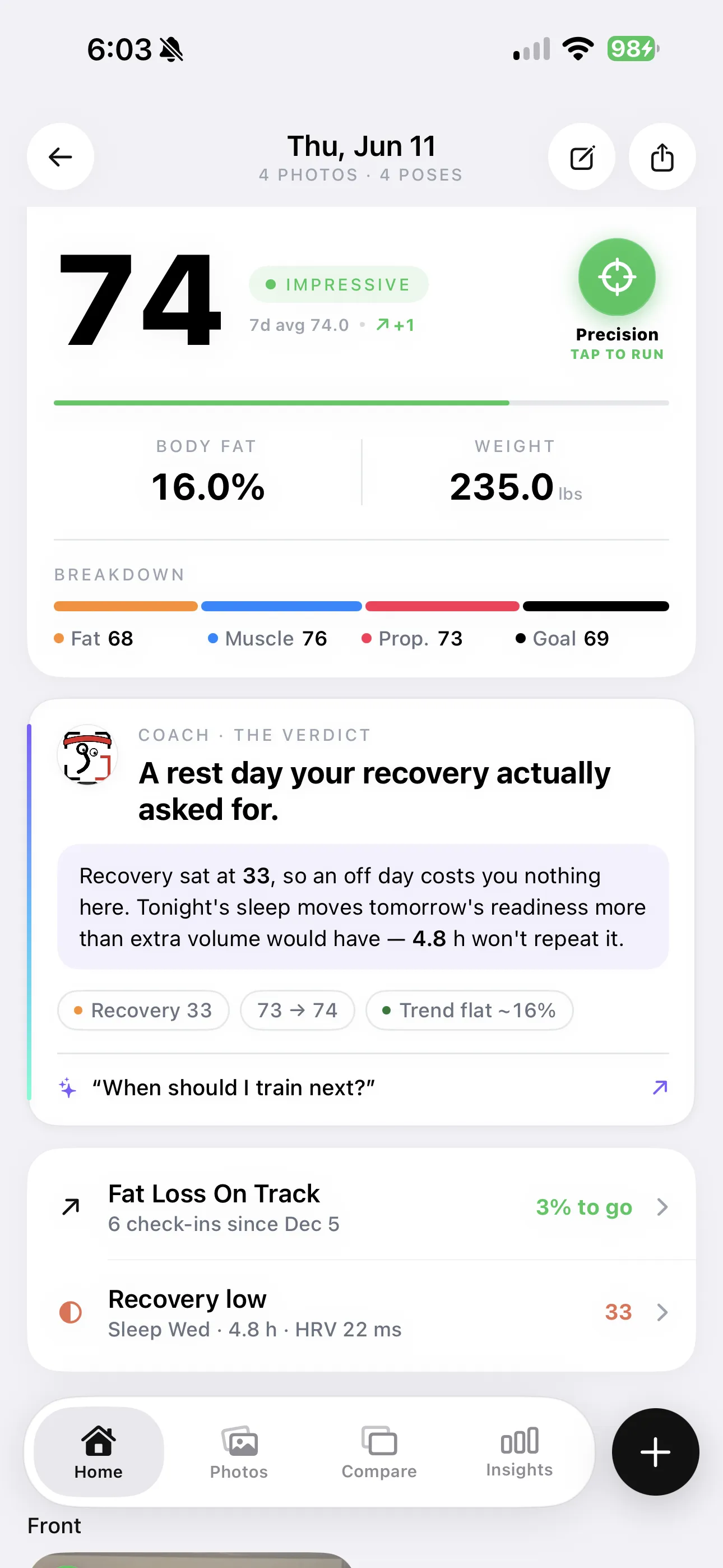
The score card: a 1–100 rating that's decomposed — so you know what's dragging it and what to train.
The part Umax-style apps skip: every score lives in a timeline. Compare two check-ins and it quantifies exactly what changed — which muscle groups moved up a tier, where body fat went. Your rating becomes a progress metric instead of a verdict.
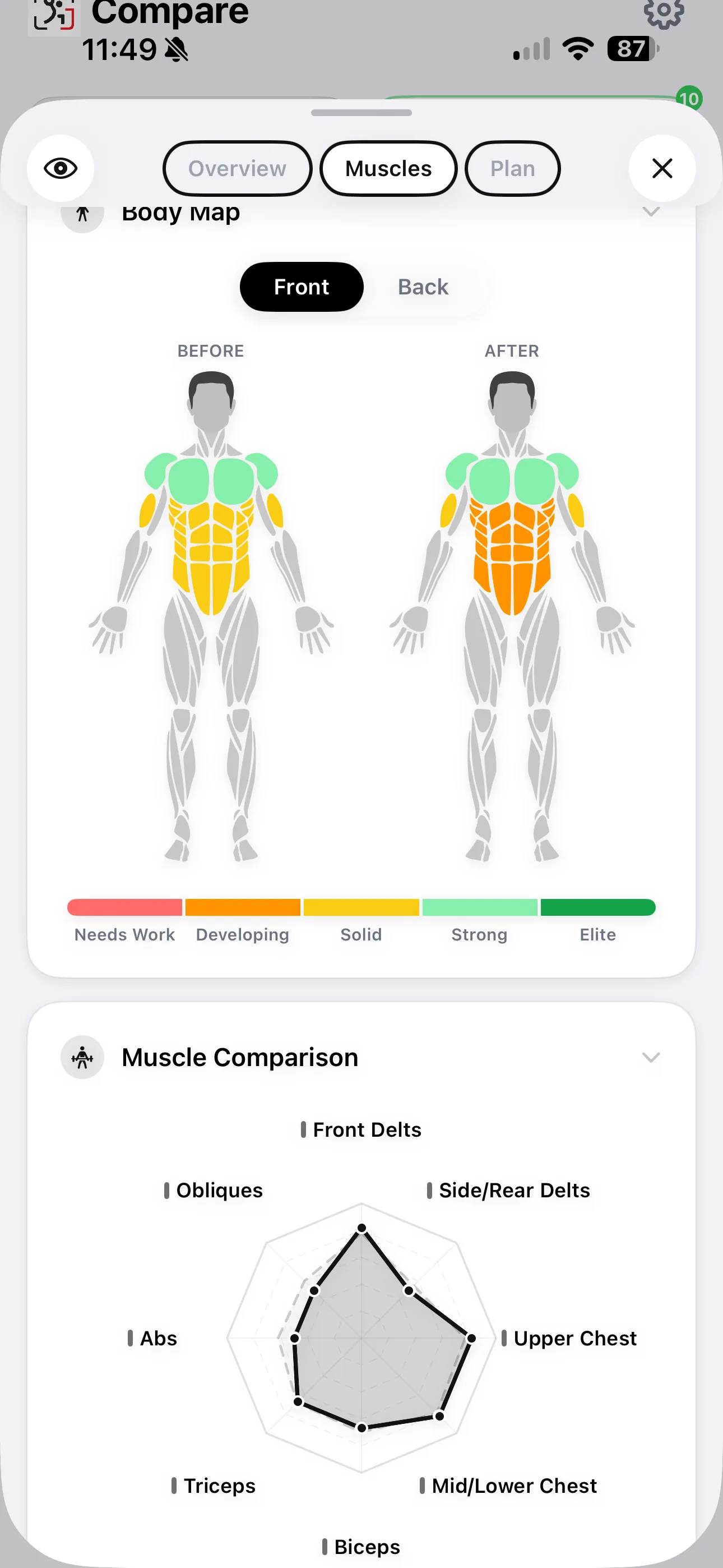
The muscle map — the "what to fix" layer a single number can't give you.
Best for: anyone who wants the rating and the plan. Limitations: iOS only; physique-focused (it won't rate your jawline — our body fat and jawline explainer covers that connection instead).
2. Umax — Keep it for what it does
Platform: iOS · Price: Free with subscription
Honest inclusion: if face ratings are what you want, Umax is the category leader and nothing here replaces it. It just doesn't look below the neck. Pairing Umax (face) with a physique tracker covers both — they don't overlap.
Best for: the looksmaxxing use case it invented. Limitations: no physique analysis at all.
3. Recomp AI — Rating via scan
Platform: iOS · Price: Free with subscription tiers
Recomp AI approaches the same instinct through a camera scan: a 3D model with body fat, lean mass, and circumference estimates. Less "rating," more "readout" — there's no single score to chase, which some people prefer. We compare it directly in Recomp AI vs GainFrame.
Best for: scan-session composition data over a gamified score. Limitations: newer app, smaller track record; timeline features thinner than its scan.
4. One-shot physique raters — Know what you're getting
A rotating cast of "rate my physique" apps offer a free single score, usually ad-supported, methodology unexplained. As entertainment, fine. As a signal — the score can't be compared to anything, so it expires the moment you close the app. Our AI physique rating apps roundup covers the current crop in detail.
Best for: curiosity. Limitations: everything else.
5. MeThreeSixty — Numbers without the rating
Platform: iOS & Android · Price: Free
If ratings feel gimmicky to you entirely, MeThreeSixty inverts the formula: no score, just a 3D avatar with 14+ measurements. It's the "just give me data" option — covered fully in our body scanning apps roundup.
Best for: measurement people. Limitations: no interpretation — you do the judging.
Frequently asked questions
Is there an app like Umax for your body?
Yes. Umax rates faces; several apps apply the same instant-AI-rating idea to your physique. GainFrame scores your body 1–100 from a photo with body fat, FFMI, and 12 muscle-group ratings. Recomp AI scans your body into composition estimates. Simpler "rate my physique" apps give a single score without the tracking.
How does Umax work and what does it rate?
Umax analyzes a selfie and returns ratings across facial attributes with suggestions for improving them — the app behind the "looksmaxxing" trend, with tens of thousands of App Store ratings. It's face-focused: it doesn't analyze your physique, body composition, or muscle development. For body-side analysis you need a physique-focused app.
Are AI physique ratings accurate or just a gimmick?
A single rating with no explanation is entertainment. Ratings become useful when they're decomposed (which muscle groups score low and why), consistent (same methodology every photo), and tracked (the score moves when your body changes). That's the difference between a novelty rater and a tracking tool — judge apps by whether the number is actionable.
What is the best free app to rate your physique?
GainFrame's free tier scores 25 photos — each gets a 1–100 physique score plus body fat, FFMI, and muscle-group ratings, which is the most detail available without paying. Free one-shot raters exist but typically return a single unexplained number. If you want the rating to mean something next month, pick one that keeps history.
Is getting your physique rated by AI bad for body image?
It can cut both ways. A number with no context can feed fixation — that's a fair criticism of rating apps generally. Framed as a progress signal (your score versus your own last month, not versus other people), it tends to work like any other metric. If scores make you feel worse rather than more informed, drop the number and keep the photos.
Get rated — then get better
GainFrame scores your physique 1–100 from one photo, breaks it into body fat, muscle, and proportions, and tracks every score so next month's number means something. Free to start on iOS.
Download GainFrame Free