
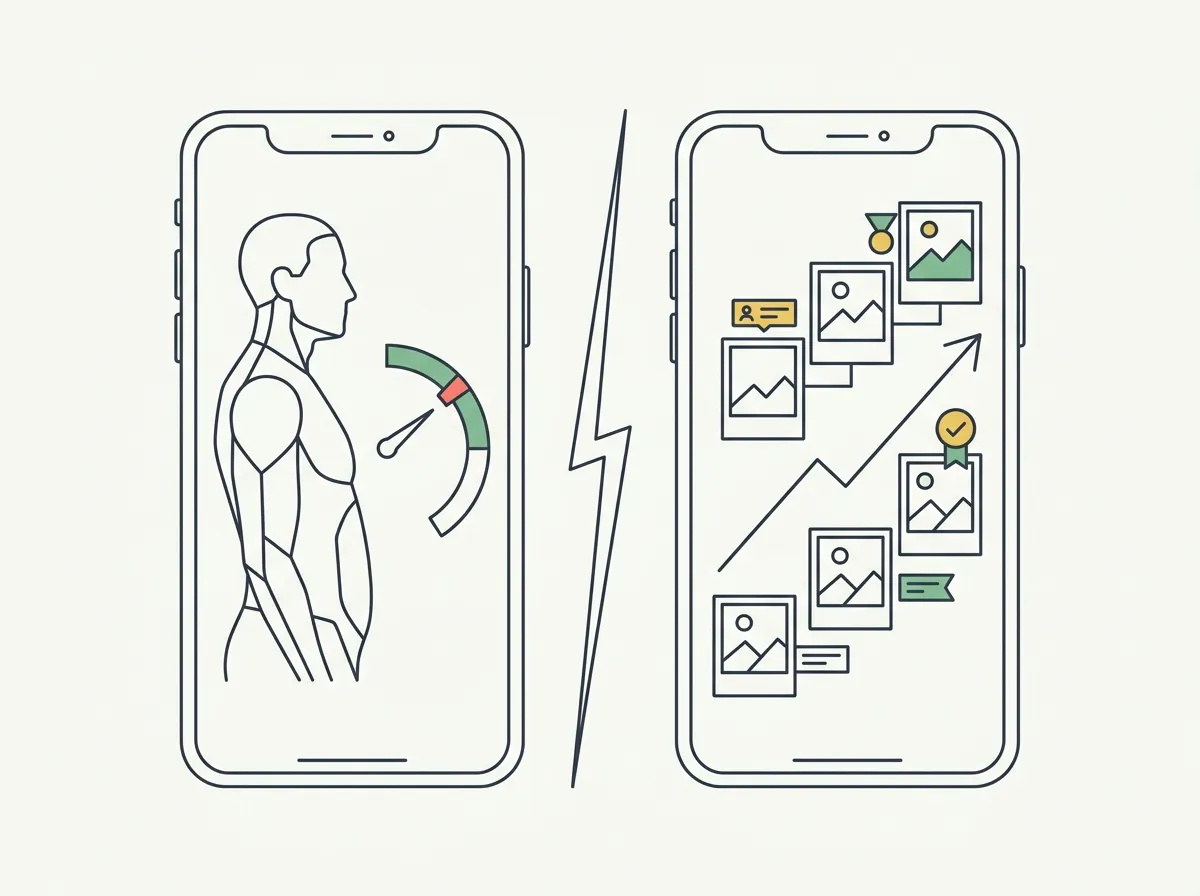
Quick answer: Recomp AI is scan-centric. Each phone-camera scan returns a 3D model with body fat, lean mass, and circumference estimates. GainFrame is timeline-centric. Every photo becomes a scored check-in with body fat, FFMI, physique score, and 12 muscle ratings, compared across months. For recomp's slow changes, scans answer "what am I now"; the timeline answers "is it working."
Body recomposition has a measurement problem. The scale barely moves (that's the whole point), so the usual feedback loop is broken. Two apps have shown up with the same pitch for fixing it: point AI at your body and let it quantify what's changing.
Recomp AI and GainFrame are genuinely aimed at the same person. The difference is architectural. One is built around the scan, a fresh set of numbers every session. The other is built around the timeline, every check-in scored and stacked against every check-in before it. That difference decides which one fits you.
What is Recomp AI and what does it do well?
Recomp AI, from ISO Labs, scans your body with your phone's camera (no DEXA appointment, no hardware) and returns a 3D model with estimates for body fat percentage, lean mass, and circumference measurements across body regions. Side-by-side model comparisons show where you're losing fat and adding muscle between scans.
Its strengths are real:
- The recomp framing is right. Showing fat vs lean change per region speaks directly to the "is my recomp working?" question generic scanners ignore.
- The scan output is rich. Composition plus regional circumferences in one session is more than most photo apps attempt.
- It's growing fast. A 4.7 App Store rating, and ISO Labs ships updates frequently.
The caveats: it's newer, with a smaller review base (hundreds, not tens of thousands), and when we last tested it the experience centered on individual scans. The long-term timeline, comparison, and integration features were thinner than the scan itself. Pricing is subscription-based and has shifted over time; check the App Store listing for current numbers.
What does GainFrame do differently?
GainFrame starts from the opposite end: the timeline is the product. Every photo, taken today or imported from years of camera roll, becomes a scored check-in: body fat %, BMI, FFMI, a 1-100 physique score, and ratings for 12 individual muscle groups.
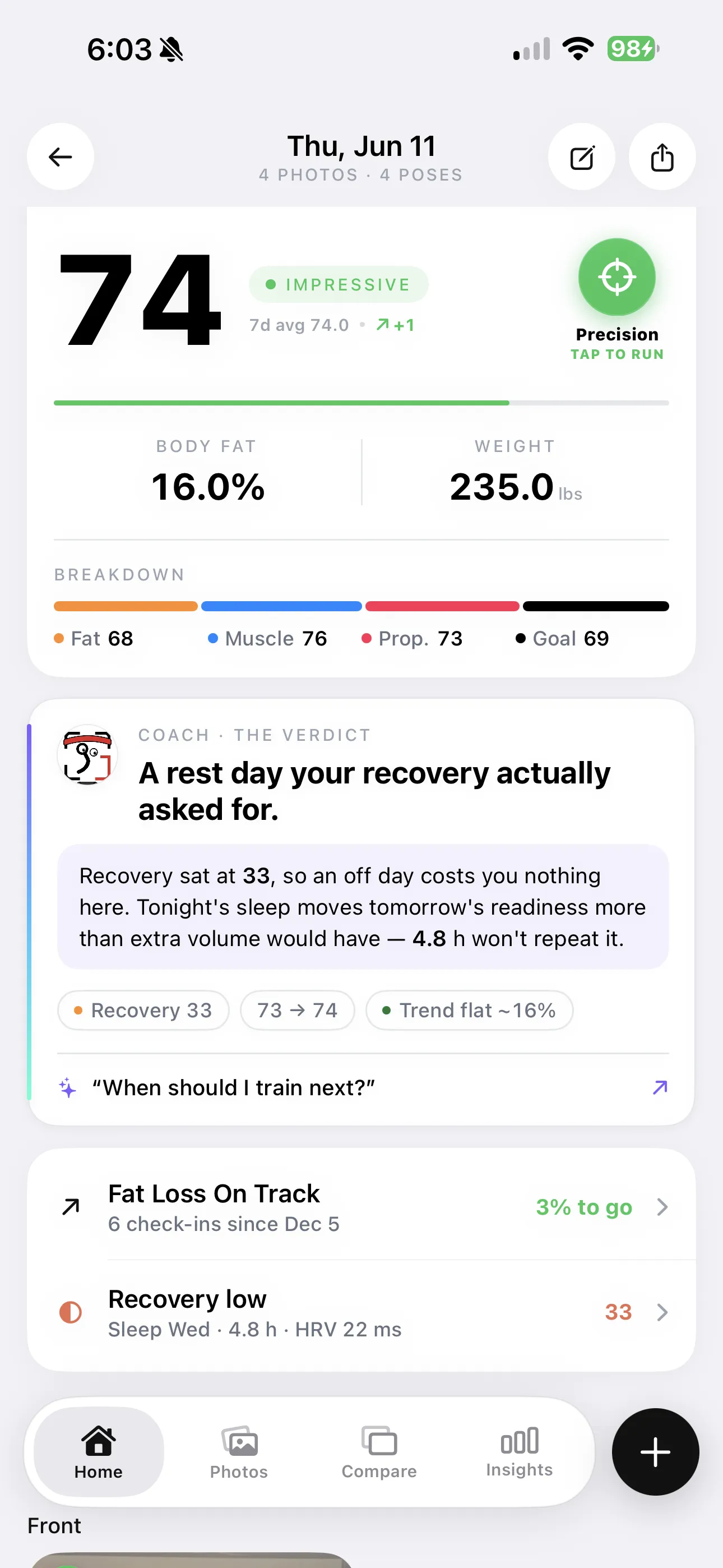
Every check-in gets scored: body fat, physique score, and a four-part breakdown including goal fit.
For recomp specifically, the comparison report is the killer feature. Pick two check-ins months apart and it quantifies the delta, body fat down, FFMI up, which muscle groups moved tiers, with your actual photos side by side as evidence.
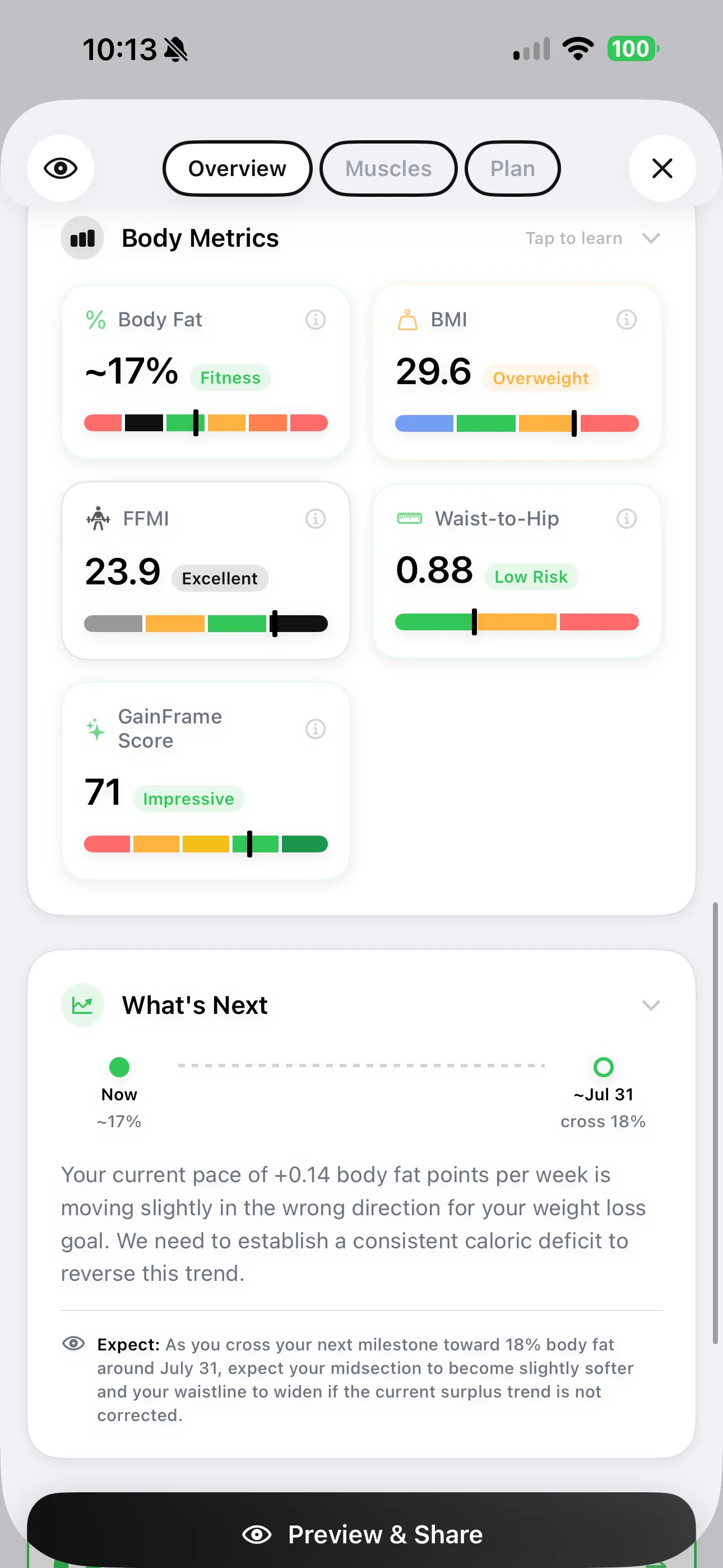
The comparison report: composition metrics plus where your body-fat trend is actually heading.
Weight sits alongside it with milestone tracking, and Hevy workout volume attaches to check-in days so training context lives next to the visual result. Photos are analyzed by AI but never stored on a server; everything is on-device with no account.
Caveats, honestly: iOS only, 25 photos on the free tier, no circumference estimates, and its numbers are estimates from images. The trend is the signal, not any single reading.
Recomp AI vs GainFrame: feature comparison
| Feature | Recomp AI | GainFrame |
|---|---|---|
| Core unit | The scan | The timeline |
| Body fat + lean mass estimates | + FFMI + 1-100 score | |
| Regional circumference estimates | ||
| 12 muscle-group ratings | Every check-in | |
| Real-photo before/after comparison | 3D models | Auto-aligned photos |
| Camera-roll backfill import | Auto pose-sorted | |
| Workout integration | Hevy | |
| Track record | Newer, smaller review base | Established review base, frequent updates |
| Pricing | Free + subscription (check listing) | Free tier; $5.99/mo or $39.99/yr |
| Platform | iOS | iOS |
| Best for | Scan-session composition data | Judging recomp over months |
Which fits your recomp?
Choose Recomp AI if: you want circumference and lean-mass estimates per region, you like the scan-session workflow, and today's numbers matter more to you than a long history.
Choose GainFrame if: you want to judge whether the recomp is working. That means scored photos stacked over months, muscle groups tracked individually, old camera-roll photos backfilled into the record, and your Hevy training sitting next to the visual result.
If the split you care about is abs training versus full-body physique tracking rather than scan versus timeline, AbsMaxx vs GainFrame covers that comparison.
The deeper point: recomp is judged in months, not sessions. Whatever tool you pick, the value compounds only if you check in consistently under consistent conditions. If you're still setting up your approach, our skinny fat to muscular playbook and body recomposition timeline guide cover the training side.
Frequently asked questions
What is Recomp AI?
Recomp AI, from ISO Labs, is an iOS app that scans your body with your phone's camera and returns a 3D model plus estimates for body fat percentage, lean mass, and regional circumference measurements. It's framed specifically around body recomposition (losing fat and building muscle at the same time), with side-by-side model comparisons between scans.
Is Recomp AI accurate?
Like every phone-camera body scan, Recomp AI produces estimates, not clinical measurements. Consistent clothing, lighting, and posture keep readings comparable; sloppy setups add noise. It's a newer app with a smaller review base than the established scanners, so its long-run consistency has less public track record. Treat readings as trend data.
How much does Recomp AI cost?
Recomp AI is free to download with subscription tiers for full features; ISO Labs has adjusted pricing over time, so check the current App Store listing before deciding. GainFrame is $5.99/month or $39.99/year with a free tier covering 25 photos.
Which is better for body recomposition, Recomp AI or GainFrame?
Recomp AI is scan-centric: each session gives you fresh composition and circumference estimates. GainFrame is timeline-centric: every photo becomes a scored check-in with body fat, physique score, and 12 muscle-group ratings, compared across weeks and months. For judging a slow process like recomp, the longitudinal view is usually the more useful one.
Does GainFrame estimate circumferences like Recomp AI?
No. GainFrame doesn't produce circumference estimates. It analyzes photos for body fat percentage, FFMI, a physique score, and per-muscle ratings. If regional measurements are a hard requirement, Recomp AI or a 3D scanner like MeThreeSixty covers that; GainFrame covers what the change looks like.
Can I track recomp without any scanning app?
Yes, the classic method is weekly progress photos, a scale trend, and one or two tape measurements. Apps automate the judgment: AI scoring quantifies what photos show, and scans quantify shape. If you'd rather stay manual, our body recomposition tracking guide covers the photo-first workflow.
Judge your recomp in months, not scans
GainFrame turns every photo into a scored check-in (body fat, FFMI, physique score, 12 muscle ratings) and quantifies exactly what changed between any two. Free to start on iOS.
Download GainFrame Free