
Quick answer: Four ways to get your physique assessed honestly. AI photo analysis is instant, consistent, and unembarrassing. Posting to Reddit is free but brutal and inconsistent. A coach costs money and gives the best read. Objective metrics - body fat, FFMI, shoulder-to-waist - skip opinion entirely and are the most actionable.
"Rate my physique" is one of the most-searched fitness phrases there is, and the instinct behind it is completely reasonable. You've been training for months. The mirror tells you something different every morning depending on light and sleep. You want somebody outside your own head to tell you where you actually stand.
The problem is that most of the places offering to do it hand back a single digit with no explanation. A 6/10 tells you nothing you can train. This page covers the four real options, what each one is good at, and what the difference is between feedback that changes your next training block and feedback that just changes your mood.
If your question is specifically about abdominal definition, rate your abs from a photo. Keep the general physique rater for the broader assessment.
Why can't you rate your own physique?
Because you've never seen yourself the way anyone else does. You see a mirror image, in your own bathroom light, at whatever hour you happen to be standing there, with years of memory layered on top of what's currently in front of you.
That memory is the biggest distortion. People deep into a cut routinely still see their starting body, and people early in a bulk routinely see a leaner version of themselves than the camera does. Our piece on why you look better in the gym mirror covers the lighting half of the problem in detail.
An outside read fixes the memory problem. Which outside read you pick determines whether it also fixes anything else.
What are the honest ways to get your physique rated?
| Option | Cost | Speed | Consistency | Actionable? |
|---|---|---|---|---|
| AI photo analysis | Free tiers to ~$6/mo | Seconds | High - same model every time | Yes, if it decomposes |
| Forum / Reddit post | Free | Hours to days | Low - depends who replies | Sometimes |
| Coach assessment | ~$50-200+ | Days | High, single expert | Highest |
| Objective metrics | Free (tape) | Minutes | Very high | Yes, but no verdict |
Ranked below by how reliably the answer is useful, not by how good the answer feels.
1. AI photo analysis - fastest and most consistent
Upload a photo, get a score. The genuine advantages here are speed and repeatability: no waiting on strangers, no scheduling, no showing your body to anyone you know - and the same model grades your first photo and your fiftieth by the same standard, which no human rater can promise.
The variable is depth. A rater that returns "72" and nothing else is entertainment. One that breaks the number into body fat, muscle development, and proportions, then tracks it against your last photo, is a feedback loop. Our tested roundup of AI physique rating apps sorts the category on exactly that line.
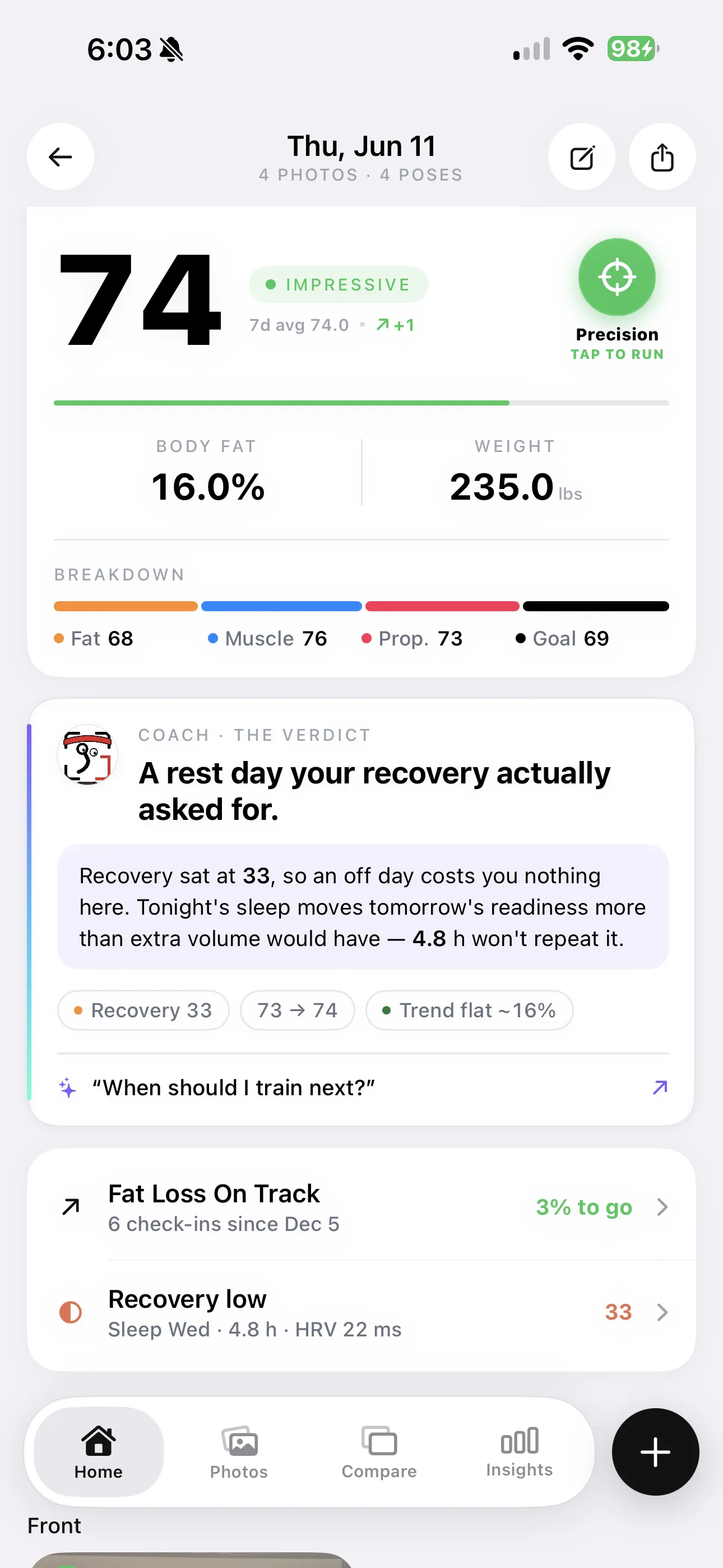
A rating that decomposes: the overall number plus the four inputs that produced it, which is the part you can actually train.
GainFrame does the tracked version of this - a 1-100 score per photo with 12 muscle-group ratings, body fat, and FFMI, kept as a history so each rating is measured against your own last one. It's iOS only, and the numbers are estimates from photos rather than clinical measurement. If you want a rating in the next 30 seconds with nothing installed, the free physique rater runs in your browser.
Best for: a repeatable read you can take every month. Limitations: software can't tell you your rear delts are lagging for your goals - it doesn't know your goals unless you tell it.
2. Posting to Reddit or a forum - free, experienced, unpredictable
Fitness communities will rate you for nothing. r/bodybuilding, r/naturalbodybuilding, r/nattyorjuice and similar subreddits have genuinely experienced lifters in them, and an experienced eye still catches structural things - a lagging body part, a posture issue, a proportion problem - faster than most software does.
The costs are real and worth naming. Responses are wildly inconsistent depending on who happens to be online. Tone runs from helpful to cruel, and harsh feedback about your body lands harder than harsh feedback about anything else. And the photo is public and permanent; scrubbing it later is mostly wishful thinking.
If you post anyway, ask a specific question. "Rate me" invites a number. "I've been training legs 2x/week for six months - do quads or hamstrings look further behind?" invites an answer you can use.
Best for: structural feedback from experienced eyes, free. Limitations: inconsistent, occasionally harsh, permanently public.
3. A coach's assessment - the best answer, for money
An experienced coach or competition judge looking at your photos will give you the highest-quality read available. They'll factor in your training history, your goals, your timeline, and your structure - the things a score can't know - and hand you a priority list rather than a rating.
Expect to pay somewhere in the range of a consult fee or a monthly coaching rate depending on how deep you go. For anyone prepping for a stage, a shoot, or a specific date, it's the option that pays for itself.
Best for: anyone with a deadline or a specific goal. Limitations: costs money; quality varies by coach, so check their actual clients.
4. Objective metrics - skip the opinion entirely
The fourth option is to stop asking for a verdict and start collecting numbers. Body fat percentage, FFMI against percentiles, waist-to-height ratio, and shoulder-to-waist all describe your physique without anyone's taste involved.
This is the least satisfying option and often the most useful. Nobody tells you you're a 7. But "waist-to-height 0.52, FFMI 21" is a position on two maps, and both maps come with a direction to walk.
Best for: people who want a plan instead of a verdict. Limitations: no aesthetic judgment at all - metrics can't tell you a physique looks good.
What does good physique feedback actually look like?
The test is whether you could turn the feedback into a training change by tomorrow.
"You're a 6/10" fails it. So does "you need to grow," "solid base," and "come back in a year." These are impressions. They feel like assessments because they arrive in the shape of one.
"Your delts look narrow relative to your chest at this body fat, and it's probably why the taper reads flat" passes it. So does "your body fat is likely in the low 20s, so definition work is premature - the abs are there, they're covered." So does "left lat is visibly less developed than right on the back pose."
The pattern: useful feedback names a body part or a metric, states the relationship, and implies the fix. If the feedback contains no nouns from your own body, it isn't about your body.
How do you take photos worth rating?
Every rater on this list - human or software - is only as good as the photo you gave it. Standardize five things and the assessment quality jumps immediately:
- Same lighting. Overhead light carves shadows that read as definition. Flat front light is honest. Pick one and keep it.
- Same time of day. Morning, before food and training, is the least noisy.
- Same distance and lens height. Camera at mid-torso, phone on a stable surface. Handheld high-angle shots flatter and ruin comparisons.
- Front, side, back. A front-only photo hides half the physique - including the half most likely to be lagging.
- Relaxed and flexed. Both, every time. The gap between them is information.
Our progress photo pose guide has the specific poses, and how to take progress photos by yourself covers the logistics if there's nobody to hold the camera.
What if the rating makes you feel worse?
That's a common outcome and worth planning for before you ask. A number attached to your body carries weight that a number attached to your bench press doesn't, and the effect compounds if you check it often.
Two guardrails help. Rate on a schedule - every four to eight weeks, matched to how fast bodies actually change - rather than whenever you feel bad about how you look, because the second habit turns the tool into a mood thermometer. And compare only against your own previous photo. Comparison against strangers, leaderboards, or a stage-lean reference is where ratings stop being informative.
If the number reliably makes you feel worse rather than better informed, drop the number and keep the photos. Our piece on progress photos and body image goes further on that, including when tracking is worth stepping away from entirely.
Frequently asked questions
Where can I get my physique rated for free?
To rate your body for free, use a browser-based physique rater: upload one photo and get a score with no signup. Fitness subreddits will rate you for free too, with far less predictable quality. Several apps include a free tier - GainFrame scores 25 photos free. For a no-cost read with the most detail, an app free tier beats a one-shot web score.
Is it worth posting my physique on Reddit?
Sometimes. Subreddits like r/bodybuilding can give you genuinely experienced eyes for free, and a lagging body part is often spotted faster by a human than by software. The costs are real: responses are inconsistent, tone runs harsh, and your photo is public permanently. Go in with a specific question rather than asking for a number.
How accurate is an AI physique rating?
Photo-based estimates typically land within a few percentage points of clinical body fat measurement for most users, which is useful for trends and unreliable for single-point precision. Consistency is the real advantage - the same model grades your first photo and your fiftieth the same way, which no human rater can do.
What is the best way to get an honest assessment of my body?
Combine one objective source with one opinionated one. Take standardized photos and get numbers from them - body fat, FFMI, muscle-group ratings - then take a specific question to a coach or an experienced lifter. Numbers tell you what changed; an experienced human tells you what to prioritize next.
Why does my physique rating feel wrong?
Usually because the photo and the mirror disagree. Camera lens, lighting angle, time of day, and pump all change how a physique reads, and you're comparing an unflattering still against years of mirror memory. Retake under standardized conditions before trusting a rating that surprised you - and compare it only against your own previous photo.
Get the read without the comment section
GainFrame rates your physique 1-100 from a photo - body fat, FFMI, and 12 muscle-group ratings, tracked against your own history so every rating has something to compare to. Free tier covers 25 photos; Pro is $5.99/month or $39.99/year. iOS.
Download GainFrame Free