
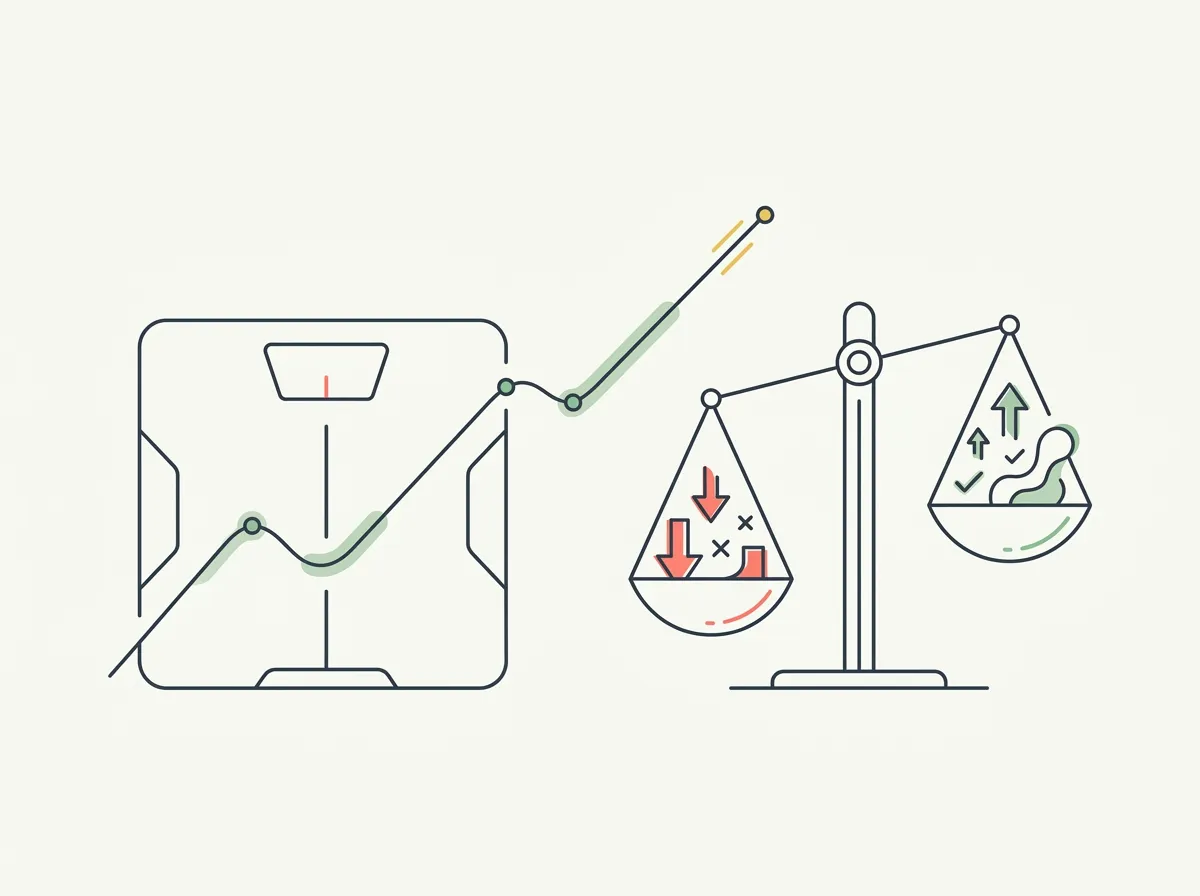
Quick answer: A smart scale is worth it for the automatic weight trend: step on, and every weigh-in syncs to your phone with zero logging effort. The body fat and muscle numbers are rough BIA estimates that swing with hydration. Buy one for the trend line, and treat the composition metrics as a bonus.
Manual weight logging dies in week three. You know this because you have lived it: a notes file with eleven entries, the last one from a Tuesday two months ago. Meanwhile the question that actually decides your next training block, whether your average weight moved this week, goes unanswered.
That is the case for a smart scale in one paragraph. It is also, conveniently, about $30. The complication is everything else on the readout: body fat percentage, muscle mass, bone mass, metabolic age. Those numbers are why people return smart scales angry, and why the honest answer to "are smart scales worth it" depends entirely on which number you are buying.
For a specific purchase, the Hume versus RENPHO comparison compares the Body Pod with the MorphoScan Nova, while the Oxiline MD Pro review evaluates that model's offer and ownership checks.
What does a smart scale do that a regular scale cannot?
Three things, and the first one carries the product.
It logs every weigh-in for you. The scale sends each reading to its companion app over Bluetooth or Wi-Fi, and from there into Apple Health or Google Fit. The habit that dies in a spreadsheet survives when the only required action is standing still for three seconds.
It turns weigh-ins into a trend. Single weigh-ins are close to useless. Your weight can move 2 to 4 pounds in a day on water, food timing, salt, and training. A trend line over weeks averages that noise into a direction you can act on. We cover the daily-swing mechanics in why your weight fluctuates.
It estimates body composition. This is the feature on the box, and it is the one to hold loosely. The estimate comes from bioelectrical impedance, and it moves with your hydration.
What are the real pros of a smart scale for lifters?
Generic reviews frame smart scales around family use and weight loss. For someone training seriously, the value shows up differently.
A cut or a lean bulk runs on the weekly weight average. If the plan says gain half a pound a week and your seven-day average moved 1.5 pounds, you adjust before a month of overshooting sticks. The scale automates the input side of that loop completely.
The lean mass reading, for all its noise, has one legitimate use: direction over months. Commonly cited BIA error ranges run several percentage points against DEXA on any single reading, but a lean mass line that climbs across a twelve-week block while your weight holds steady is telling you something real about the recomp. The multi-month direction carries signal even when the Tuesday number does not.
And because most smart scales write to Apple Health, the weight and lean mass series become portable. Any app you use for training or physique tracking can read them. Your weigh-in stops being trapped in the scale vendor's app.
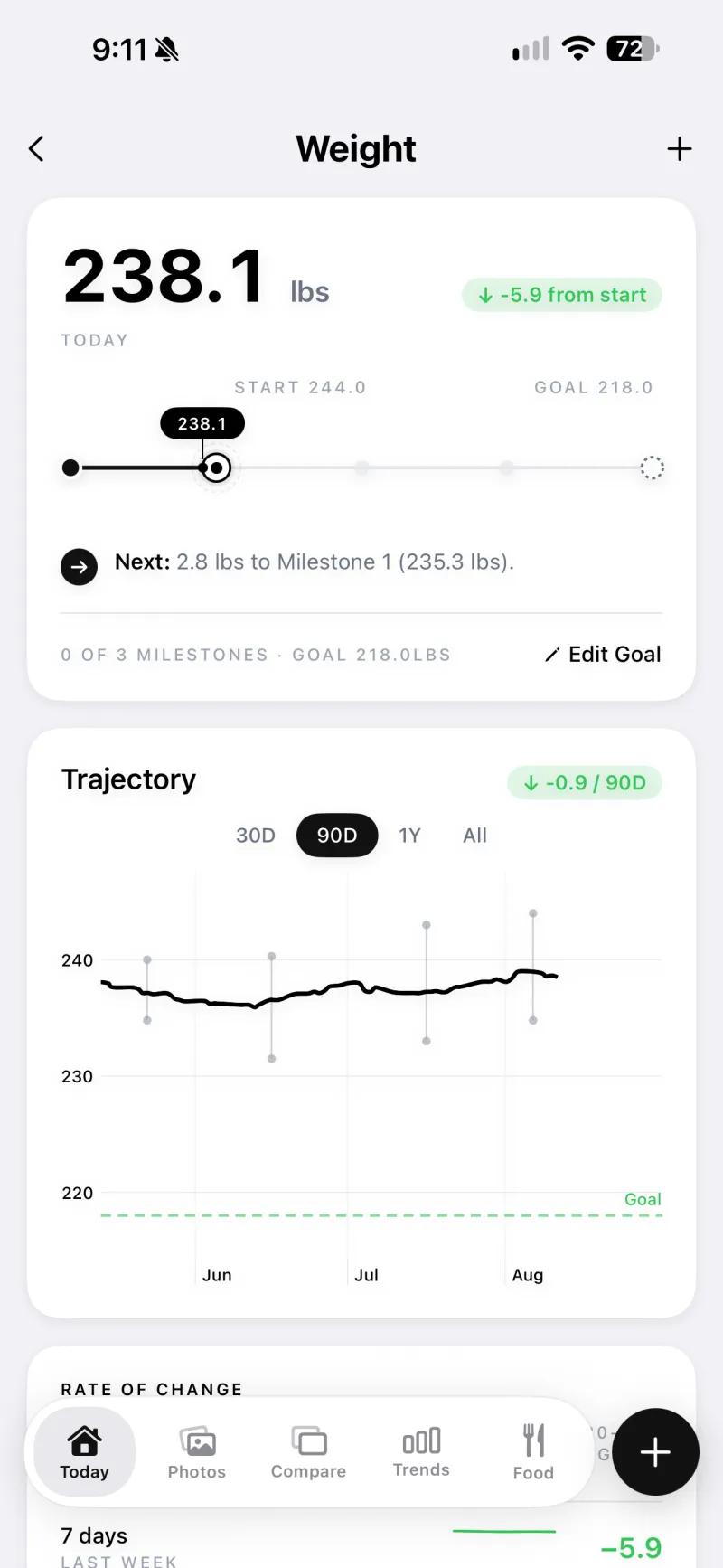
What the scale is genuinely good at, read through Apple Health: a trajectory, a rate of change, and milestones toward a goal. No single morning number required.
What are the cons of a smart scale?
The composition numbers swing with water. A salty dinner, a hard leg day, alcohol, or a late weigh-in can move the body fat estimate 2 to 4 points overnight while your actual body fat barely changed. Foot-to-foot scales also model your upper body rather than measuring it. The full breakdown lives in are smart scales accurate; the short version is that weight is measured and composition is inferred.
The absolute numbers can be far off. A scale that reads you at 18% when a DEXA says 23% is behaving normally for the category. If you need the true number rather than the direction, no consumer scale delivers it.
Daily data has a mental cost. A number that jumps three points overnight lands hard if you do not know it is water. If weighing daily stresses you more than it informs you, that is a real argument for weighing less often or skipping the scale entirely.
Some people should not use one. Manufacturers generally advise that people with pacemakers or other implanted electronic devices, and people who are pregnant, avoid BIA scales because of the electrical current. The current is tiny, but the guidance is consistent across brands.
How do smart scales work?
The mechanism explains both the pros and the cons, so it is worth thirty seconds. The scale passes a small, imperceptible electrical current through your feet. Lean tissue is mostly water and conducts the current well; fat resists it. The scale measures that resistance and feeds it into a regression model along with your height, age, and sex.
Weight comes from a load cell, measured directly, which is why it is trustworthy. Everything else on the readout comes out of the model, which is why it wobbles with anything that changes your body water. Same physics at $30 and at $400; the expensive scales add hand electrodes and better hardware to narrow the error, as our smart scale roundup breaks down tier by tier. The strongest consumer example of that upgrade is covered in our Hume Body Pod review: a handheld sensor bar that measures the upper body instead of inferring it.
When should you skip the smart scale?
If your goal is visual, a leaner waist or a fuller upper body, the scale is a slow proxy for it. A $5 tape measure at the navel tracks fat loss directly, and we put the two head to head in tape measure vs smart scale. Photos do the same job for shape. A scale adds convenience to those setups; it does not replace them.
If a fluctuating number reliably ruins your morning, skip it without guilt. Consistency in training and food beats any measurement tool, and the calmest tracking stack you will stick with is the right one.
How do you get useful data out of a smart scale?
- Standardize the weigh-in. Same time every morning, after the bathroom, before food or water, barefoot on a hard floor. Protocol does more for your data quality than any hardware upgrade.
- Read the seven-day average, never the daily number. Every scale app and Apple Health can show a rolling trend. That line is the product you bought.
- Sync it to Apple Health. One-time setup in the scale's app. From then on your weight series belongs to you, and every fitness app you use can build on it.
- Add a visual layer for composition. The scale cannot see where change happens. GainFrame reads weight, body fat, and lean mass from Apple Health, including readings that arrive from a RENPHO or similar smart scale, and pairs that trend with scored progress photos so the number and the mirror get tracked together. It is iOS only and the free tier caps at 25 photos; photo estimates are AI readings rather than physical measurements, with their own error sources, but they do not move because you ate salt last night.
- Judge blocks, not days. Compare four-week stretches: average weight, waist, photos. That cadence matches how fast bodies actually change.
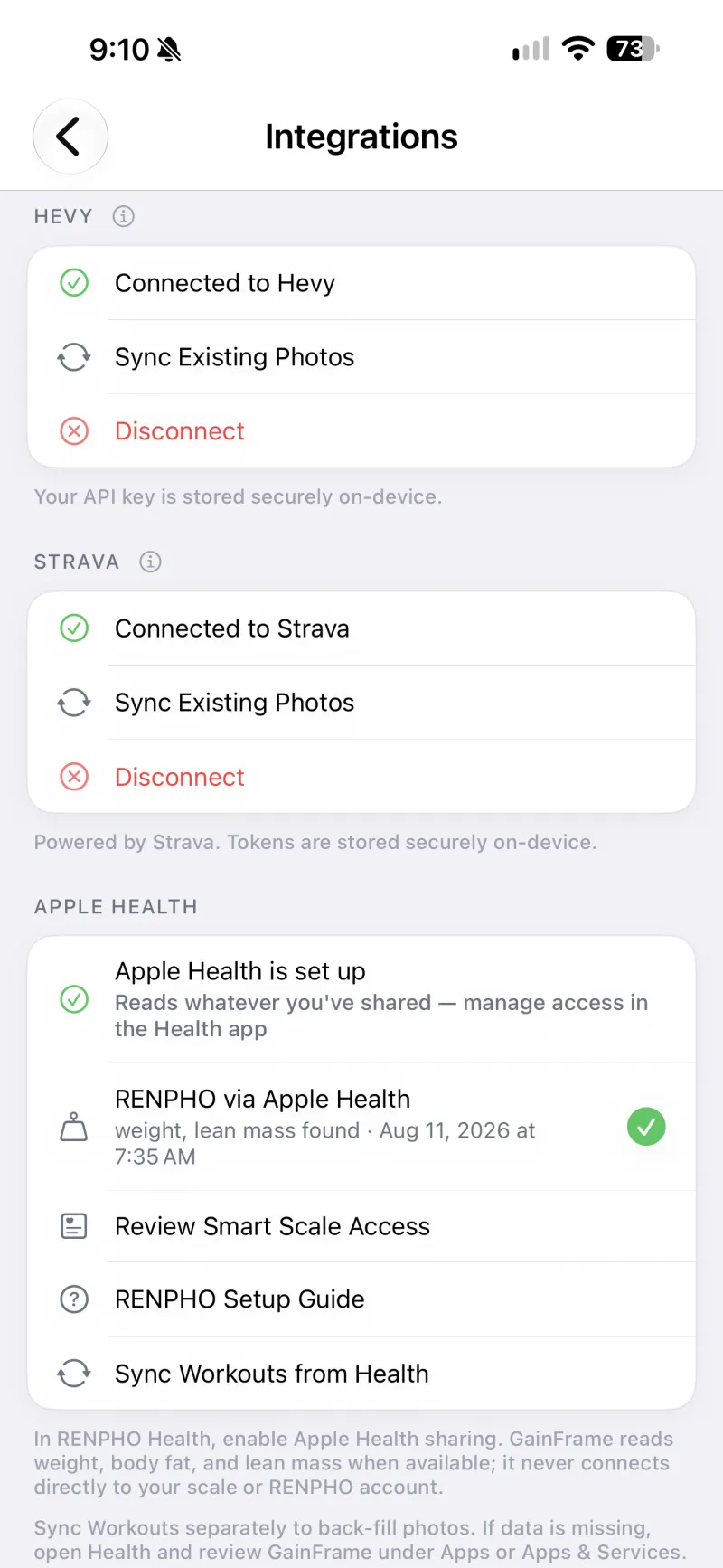
The sync chain in practice: the scale writes weight, body fat, and lean mass to Apple Health, and any app you allow can read the series from there.
The one-sentence verdict: a smart scale is a $30 habit machine for the weight trend, sold in a box that oversells the other thirteen numbers. Buy it for the automation, read the average, and let something visual answer the composition question.
Frequently asked questions
Are smart scales worth it for weight loss or muscle gain?
Yes, if you buy one for the weight trend. An automatic morning weigh-in that syncs itself is the most reliable input for judging a cut or a lean bulk week to week. The body fat and muscle readings are estimates that swing with hydration, so use them loosely or ignore them.
How do smart scales measure body fat?
Through bioelectrical impedance analysis, or BIA. The scale passes a small current through your feet, measures the resistance, and feeds it into a model with your height, age, and sex. Lean tissue holds water and conducts well; fat conducts poorly. The output is a modeled estimate, and hydration changes it day to day.
Are cheap smart scales worth it compared to expensive ones?
For the weight number, a $30 scale and a $400 scale are effectively equal, and weight is the metric that matters most. Paying more buys hand electrodes and extra health features, which narrow the composition error without removing the hydration sensitivity. Most lifters get nearly all of the value at the budget tier.
Who should skip a smart scale?
Anyone a fluctuating number will genuinely stress, since daily swings of a few pounds and a few body fat points are normal water movement. Manufacturers also advise people with pacemakers or other implanted devices, and people who are pregnant, to avoid BIA scales. A tape measure and photos cover the same goals calmly.
What should you pair a smart scale with?
A visual record. The scale gives you a clean weight trend, and it tells you nothing about where change is happening. Weekly progress photos, a tape measurement at the navel, or a photo-based analysis app fill that gap. Sync the scale to Apple Health and the weight side takes care of itself.
Put the scale's trend next to your photos
GainFrame reads your smart scale's weight and lean mass from Apple Health and pairs the trend with scored progress photos, so you see the number and the shape change together. On-device, no account, free to start on iOS.
Download GainFrame Free