
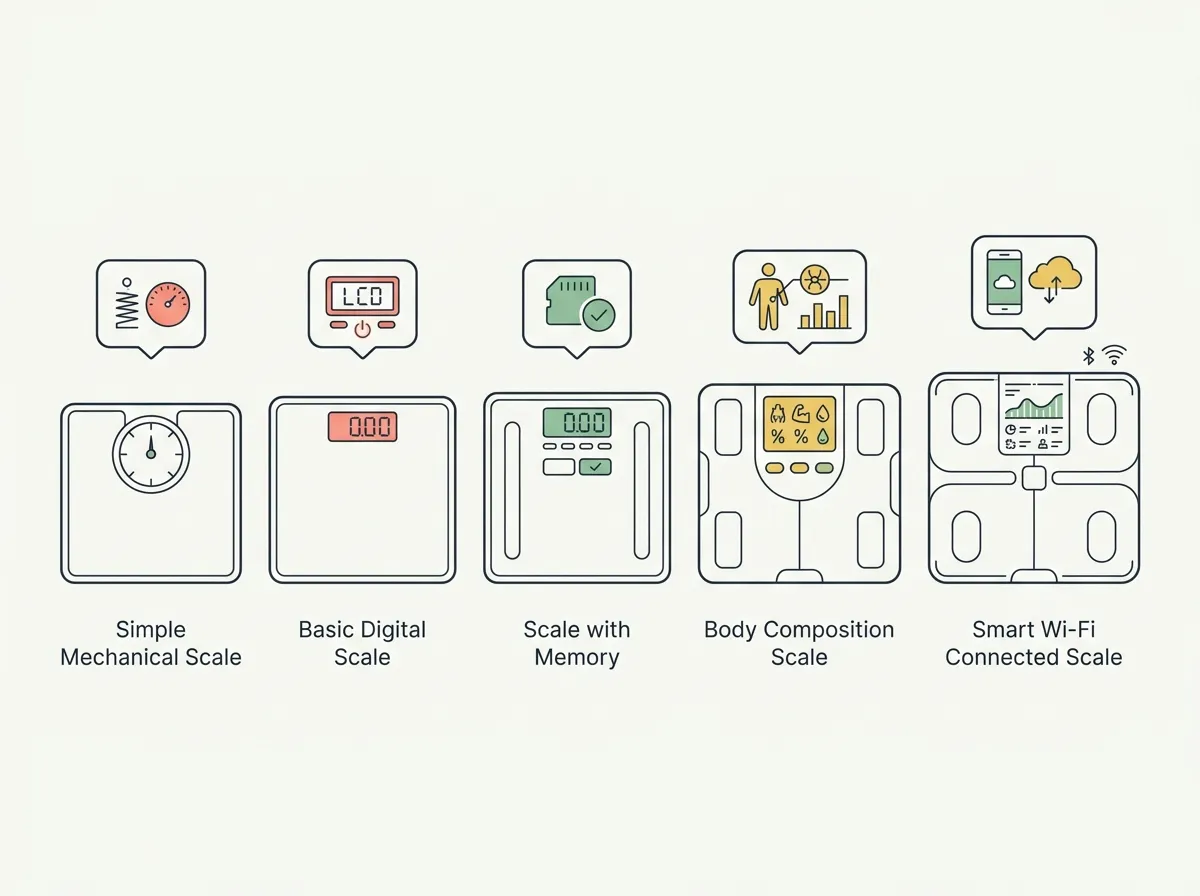
Quick answer: The best smart scale for most people is the cheapest one that weighs accurately, a ~$30 Renpho, because every scale in this category estimates body fat from the same hydration-sensitive BIA physics. Paying more buys hand electrodes and better hardware, which narrows the error without eliminating it.
The pitch on every smart scale box is the same: step on, get your body fat, muscle mass, water percentage, bone mass, visceral fat rating, and metabolic age. The pitch is identical at $30 and at $400.
What separates the tiers is how much hardware sits behind the estimate, because the composition numbers are estimates on every model. Foot-only current paths versus hand-and-foot. Single frequency versus multi-frequency. Two electrodes versus eight. This roundup ranks the field by what the hardware genuinely adds at each price, names the tier where the returns flatten, and ends with the option nobody in the scale industry wants to mention.
This is the hardware side of the category. For the software side, the apps that estimate composition without buying anything, see our body composition apps guide. And if you are still deciding whether to buy any scale at all, are smart scales worth it answers the pros-and-cons question first.
For individual purchase decisions, read the Oxiline Scale MD Pro evaluation, Arboleaf CS10K review, or the Hume Body Pod versus RENPHO MorphoScan Nova comparison. These use exact model names so specifications from older hardware do not get mixed together.
How do body composition scales actually work?
Every device here uses bioelectrical impedance analysis. A small, imperceptible current runs through your body; lean tissue conducts it well because it holds water, fat conducts it poorly. The scale measures the resistance, feeds it into a regression model along with your height, age, and sex, and reports a body fat percentage.
The consequence of that mechanism is the caveat you'll see repeated under every entry below, because it applies to every entry below: your reading moves with your water content. A salty dinner, a hard training session, a poor night's sleep, or weighing in at 6pm instead of 6am can shift the estimate by several points overnight, and none of that is fat. We break down which numbers on the readout survive that problem in are smart scales accurate.
| Scale | Electrodes | Price | Best for |
|---|---|---|---|
| Hume Body Pod | Hand + foot | ~$229 | Best consumer BIA overall |
| Withings Body Scan | Hand + foot, segmental | ~$400 to 500 | Premium health station |
| InBody home devices | Hand + foot, multi-frequency | ~$240 to 380 | Brand continuity with gym scans |
| Tanita FitScan | Foot-only (most models) | ~$60 to 150 | Dependable mid-range |
| Omron HBF-516 | Hand + foot | ~$80 | Cheapest with hand sensors |
| Renpho | Foot-only | ~$20 to 35 | Budget weight automation |
1. Hume Body Pod: Best consumer BIA scale
Price: ~$229 · Electrodes: hand-held sensor bar plus foot plate · Platform: iOS + Android
The Body Pod is the answer to the biggest structural flaw in cheap scales. A foot-only device sends current up one leg and down the other, which means everything above your hips is inferred rather than measured. The Body Pod's retractable handheld bar adds a second current path through your arms and trunk, so the upper-body portion of the estimate comes from an actual measurement.
It positions itself as an at-home InBody, and it largely earns that framing. The app is competent, the multi-frequency readings are a genuine step up from single-frequency budget hardware, and the segmental output gives you limb-level lean mass rather than one whole-body number.
The BIA caveat still applies. Better electrodes narrow the error band; they don't change what's being measured. Your Body Pod reading will still move with hydration, and it will still disagree with a DEXA scan by more than you'd like. Full detail in our Hume Body Pod review.
Best for: anyone whose actual goal is the composition number rather than the weight number. Limitations: ~$229 is a real commitment for an estimate; hydration sensitivity is reduced, unsolved.
If Hume is on your shortlist, compare two handle-based scales before deciding whether the MD Pro or Body Pod fits your recordkeeping routine.
2. Withings Body Scan: Best premium health station
Price: ~$400 to 500 · Electrodes: retractable handle, segmental · Platform: iOS + Android
The Body Scan is the most sophisticated piece of hardware in the category. Retractable handle for hand electrodes, segmental composition by limb, a six-lead ECG, vascular age estimation, and nerve health assessment through the feet, wrapped in the Withings app that handles multiple household users gracefully.
Whether that's worth roughly triple the Hume price depends entirely on whether you want the health-monitoring layer. The ECG and vascular features are genuinely differentiated and have nothing to do with body composition. If you strip those away and compare only the fat percentage, you're comparing a $400 device to a $229 device running similar hand-and-foot BIA.
The BIA caveat still applies. A premium price tag doesn't buy immunity from hydration; the composition figures on a $400 scale swing with water the same way a $30 scale's do. Our Withings Body Scan review works through the value question honestly.
Best for: people who want a whole-health station and will use the cardiovascular features. Limitations: price; the composition advantage over the ~$229 tier is smaller than the price gap suggests.
For a simpler Withings purchase, see Withings Body Smart and Body Comp compared. That guide separates their shared tracking features from the extra health metrics.
If you are comparing the newer generation, check BodyScan 2 features and ownership costs separately. The original Body Scan and BodyScan 2 have different hardware and feature availability.
3. InBody home devices: Best for continuity with gym scans
Price: ~$240 to 380 · Electrodes: hand + foot, multi-frequency · Platform: iOS + Android
InBody makes the commercial machines you've stepped on at a nicer gym or a medical office, and its home devices bring the same measurement philosophy into a consumer package: multi-frequency, hand-and-foot, segmental. The specific appeal is continuity: if your baseline came from an InBody machine, staying inside the same measurement family avoids the step change you get from switching brands.
If you are choosing between a gym test and a periodic clinical reference, our InBody vs DEXA comparison covers the measurement methods, validation evidence, and repeat-testing tradeoffs.
The home units are not the commercial machines. Fewer frequencies, fewer contact points, and a smaller model than the several-thousand-dollar units, so treat home readings as their own series rather than as directly comparable to a gym scan.
The BIA caveat still applies. InBody's reputation comes from better hardware executing the same physics, and hydration still moves the result. See our InBody alternatives roundup for the full field including non-scale options.
Best for: people already anchored to InBody readings who want home frequency. Limitations: premium price for hardware that's a step down from the commercial units.
4. Tanita and Omron: Best mid-range options
Price: ~$60 to 150 (Tanita FitScan) and ~$80 (Omron HBF-516) · Platform: iOS + Android
Tanita has been making BIA scales for decades, and models like the FitScan BC-401F are the no-drama middle of this market: reliable hardware, a long track record, and mid-range pricing. Most Tanita consumer models are foot-only, which caps how much better than a budget scale they can be on the composition side.
The Omron HBF-516 is the interesting one at this tier because it includes handgrip electrodes at around $80, the cheapest way into hand-and-foot measurement. It's commonly noted as reading body fat slightly high against DEXA, which matters less than you'd think since a consistent bias still tracks change correctly.
The BIA caveat still applies. Both brands are honest, established hardware running the same hydration-dependent model. Consistency of protocol will do more for your data than either purchase.
Best for: buyers who want established hardware without premium spend; Omron specifically if hand electrodes are the priority. Limitations: basic app experiences; Tanita's foot-only models don't improve on budget scales structurally.
5. Renpho: Best budget scale, and the honest default
Price: ~$20 to 35 · Electrodes: foot-only · Platform: iOS + Android
Renpho put a body composition scale into millions of bathrooms at the price of a large pizza order, and it deserves the top-seller position for one reason: the thing it does well is the thing most people actually need. It weighs accurately, syncs to your phone over Bluetooth automatically, and the app is genuinely pleasant for tracking a weight trend.
The composition metrics are the marketing rather than the product. Foot-to-foot BIA with a single frequency is the weakest configuration in this roundup, and the resulting body fat number is best read as a loose long-term trend. Buy it for the weight automation, shrug at the thirteen other numbers. Our Renpho scale review has the full split, best Renpho alternatives covers upgrade paths, and the RENPHO Apple Health setup guide shows how to route its readings onward so the weight, body fat, and lean mass series feed the rest of your tracking stack.
The BIA caveat still applies, most strongly here. Foot-only, single-frequency readings are the most hydration-sensitive numbers in the category.
Best for: almost everyone, honestly: cheap effortless weight tracking with composition as a bonus you don't lean on. Limitations: the composition estimates are the loosest here; don't compare readings against any other scale.
6. No scale at all: Photos and a tape measure
Price: free to ~$5 · Platform: any
The option the category doesn't advertise: you may not need a scale to answer your actual question.
If your goal is visual, a leaner waist, visible abs, a fuller upper body, then a scale is a slow proxy for it. A weekly waist measurement at the navel costs $5 once and measures the thing you care about directly, with no hydration model in between. We put the two head to head in tape measure vs smart scale, and the tape wins more often than the price gap suggests.
For the composition side without hardware, GainFrame analyzes a progress photo and returns an estimated body fat percentage, FFMI, a 1 to 100 physique score, and ratings across 12 muscle groups, tracked across every check-in. The honest limits: it's iOS only, the free tier stops at 25 photos, and the readings are AI estimates from an image rather than a physical measurement, the same category of estimate a scale produces, arrived at differently. What it does have over BIA is that a photograph doesn't change because you ate salt last night.
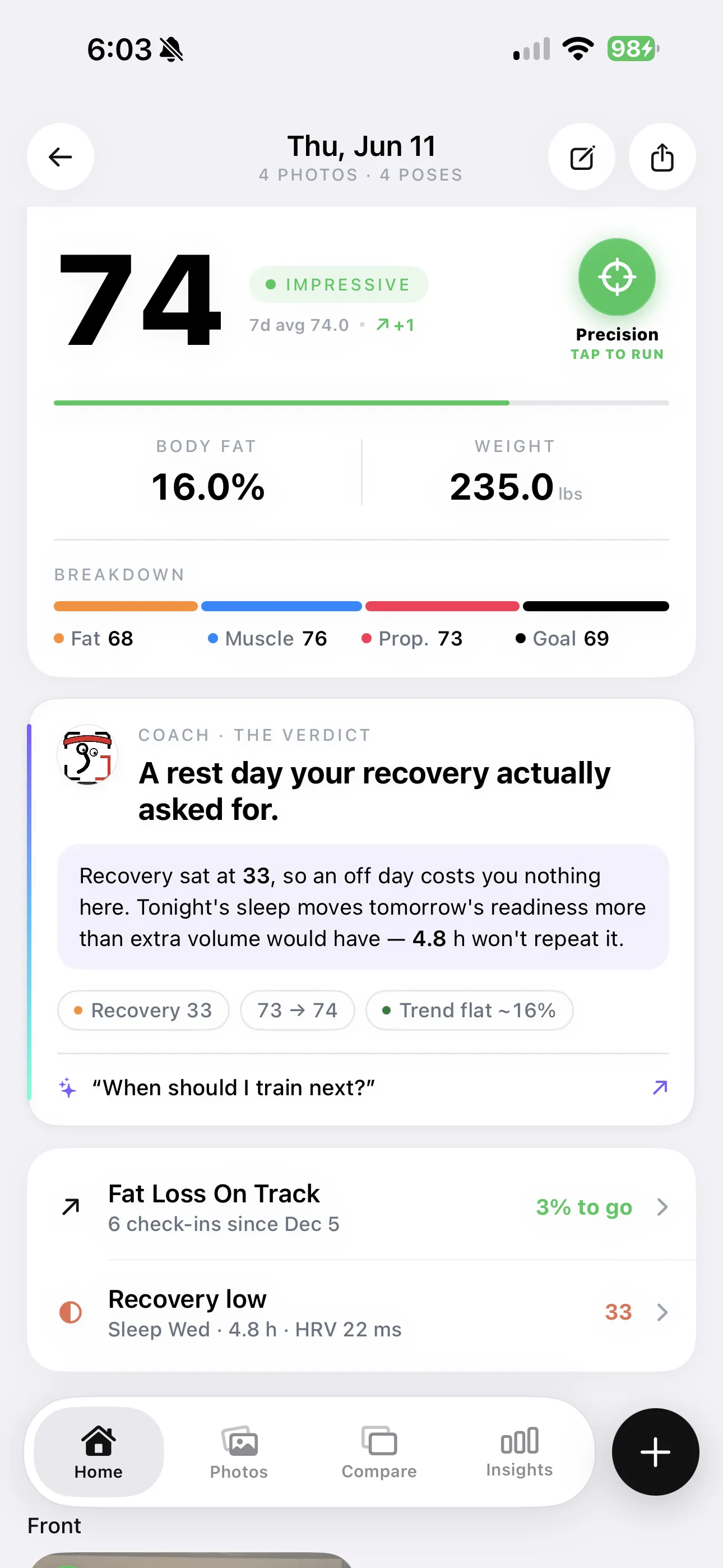
The no-hardware version of the same estimate: a photo instead of a current through your legs.
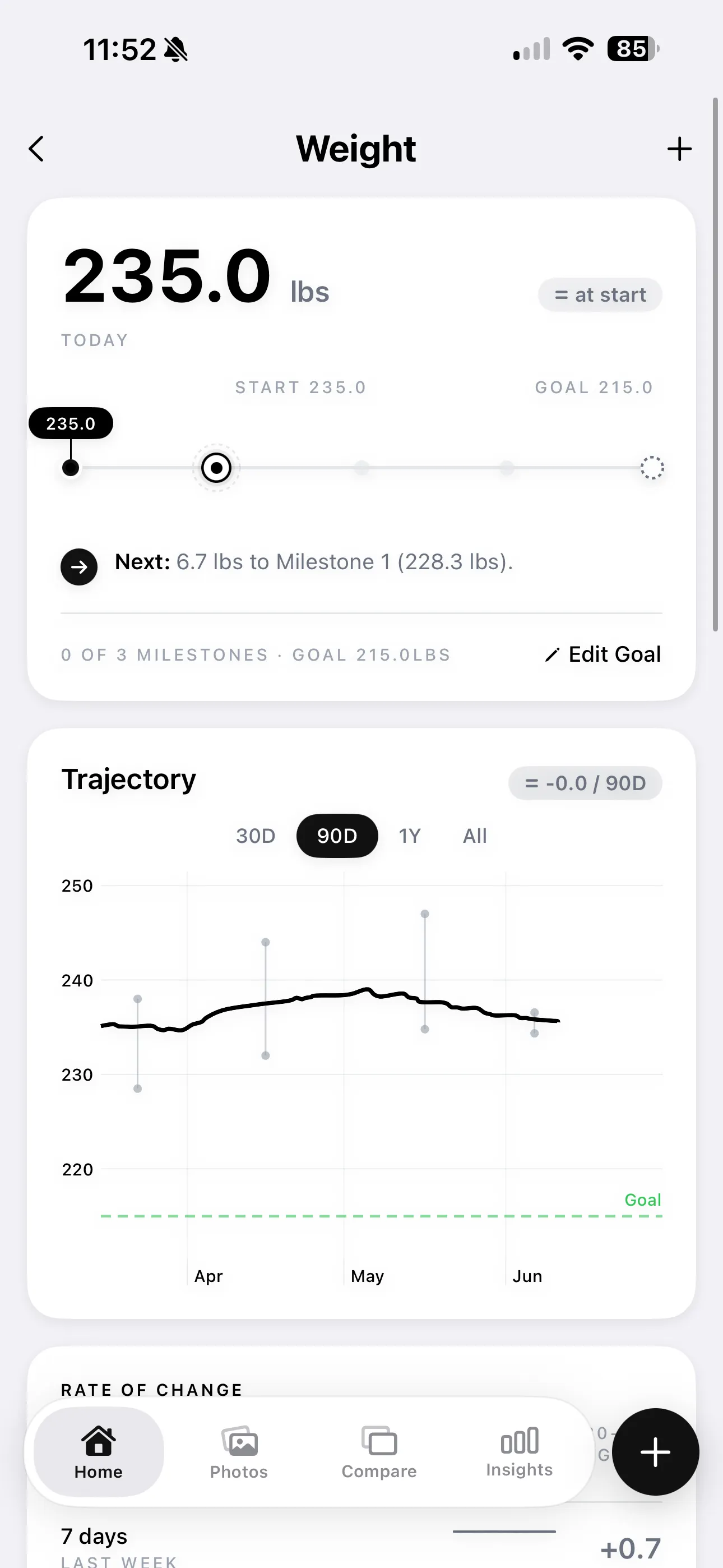
If you do buy a scale, the weight trend is what it's genuinely good at, and that pairs with a visual layer rather than competing with it.
Best for: visual goals, tight budgets, and anyone tired of arguing with a number that changes overnight. Limitations: no automatic daily weight series, which a scale does better than anything else.
Which of these smart scales sync with Apple Health?
All six brands write to Apple Health through their companion apps, so the weight series you build belongs to you rather than to the vendor. The practical difference is how the reading gets there: Wi-Fi models like the Withings and higher-end InBody units upload on their own, while Bluetooth models like the Renpho need their app on a nearby phone at weigh-in time.
If the Apple Health workflow is your main buying criterion, we ranked the field on exactly that axis, including two brands this hardware list skips, in best smart scales that sync with Apple Health.
Which body composition scale should you buy?
| Budget | Buy this | Why |
|---|---|---|
| $0 | Progress photos + a borrowed tape | Direct signal, zero hardware |
| ~$5 | Tape measure | Measures fat loss directly, no model |
| ~$20 to 35 | Renpho | Best value in fitness tracking, full stop |
| ~$80 | Omron HBF-516 | Cheapest hand-and-foot electrodes |
| ~$229 | Hume Body Pod | Best composition read at home |
| ~$400 to 500 | Withings Body Scan | Only if you want the ECG and vascular layer |
| $100 to 200/scan | Periodic DEXA | The anchor everything else trends between |
The pattern in that table: returns flatten hard above the ~$229 tier for composition specifically. Below it, each step buys a real hardware improvement. Above it, you're buying features adjacent to body composition rather than better body composition.
Protocol beats hardware. A $30 scale used every morning under identical conditions produces a more useful data series than a $400 scale used at random times of day. Same time, after the bathroom, before food or water, barefoot on a hard floor, seven-day rolling average. Do that and the price of the scale stops mattering much.
Frequently asked questions
What is the best smart scale for body composition?
For most people, a ~$30 Renpho. It weighs accurately, syncs automatically, and its body fat estimate is no more hydration-proof than a $400 scale's. If you want the best composition read available at home, the Hume Body Pod at ~$229 adds hand electrodes, which measurably improves on foot-only scales. Both are BIA, with the same underlying limits.
Are body composition scales accurate?
The weight number is accurate, since scales measure that directly and precisely. The body fat percentage is a model built from electrical resistance, and commonly cited error ranges run several percentage points against DEXA. Readings also swing day to day with hydration, salt, and training. Treat weight as data and composition as a long-run trend.
Is an expensive smart scale worth it over a $30 one?
It depends what you're buying. Hand electrodes are a genuine hardware upgrade over foot-only scales and justify the Hume Body Pod's price if composition is the point. Premium features on $400 scales, such as segmental readings, heart and vascular metrics, and multi-user handling, are real but sit on top of the same BIA physics a $30 scale uses.
What's the difference between a foot-only and a hand-and-foot scale?
A foot-only scale sends its current up one leg and down the other, so your torso and arms are largely inferred rather than measured. Hand-and-foot devices add a second current path through the upper body, which improves the estimate for arms and trunk. It's the single most meaningful hardware difference in this category.
How should you weigh yourself for the most consistent body composition reading?
First thing in the morning, after using the bathroom, before eating or drinking, barefoot on a hard flat floor, with no socks or lotion on your feet. Same conditions every single time. Then read a seven-day rolling average rather than any individual morning, because daily numbers in this category are mostly water.
Add the layer no scale can measure
GainFrame reads body fat, FFMI, and 12 muscle-group ratings from your progress photos, the shape change a body composition scale can't see, with no hydration noise attached. On-device, no account, free to start on iOS.
Download GainFrame Free