
Quick answer: Commonly cited measurement data puts the average adult woman's upper arm around 11 to 12 inches relaxed, a bit more flexed. The "toned arms" look is a body composition outcome: some visible arm muscle plus a thinner fat layer over it — for most women that shows up around 21–24% body fat.
You search "average bicep size," tape your arm at 11.5 inches, and every chart that comes back tells you whether that's big for a man. The forum debates are about 15-inch arms and flexing photos. Useful reference for you: zero.
This page is the female version. The male numbers and the is-15-inches-big argument live in our average bicep size guide — here we cover what women actually tape, what "toned arms" translates to in measurable terms, why arm fat is so stubborn, and an honest answer to the fear that keeps so many women away from the weight room.
What is the average bicep size for women?
Commonly cited measurement data puts the average adult American woman's upper arm around 11 to 12 inches, measured relaxed at the midpoint between shoulder and elbow — the standard used in most health surveys. Flexed at the peak, most women tape roughly half an inch more. Those are different measurements, and half the confusion in arm-size threads comes from comparing one against the other.
Treat the range as orientation rather than precision — anthropometric surveys differ in protocol and population, and averages track body weight closely. That last part matters more than it sounds: the average includes every body fat level, and arm circumference rises with body weight whether or not any of that weight is muscle. A tape reading above 12 inches says almost nothing by itself about strength, fitness, or how the arm looks.
Which points at the real issue. Nobody searching this actually wants a bigger or smaller tape number — they want to know what their arms look like relative to normal, and whether "toned" is reachable. That's a composition question, and the tape can't answer it.
What does "toned arms" actually take?
Here's the honest translation, because "toned" gets sold as if it were a secret exercise category. Visible arm shape is two ingredients: some arm muscle, and a fat layer over it thin enough to show that muscle. Both, at once. Our body recomposition for women guide covers the full approach; the arm-specific version looks like this.
The same arm at two body fat levels makes the point better than any paragraph. These are standardized, photorealistic AI renders from our body fat visualizer — same build, pose, and lighting, so only body fat changes between images:
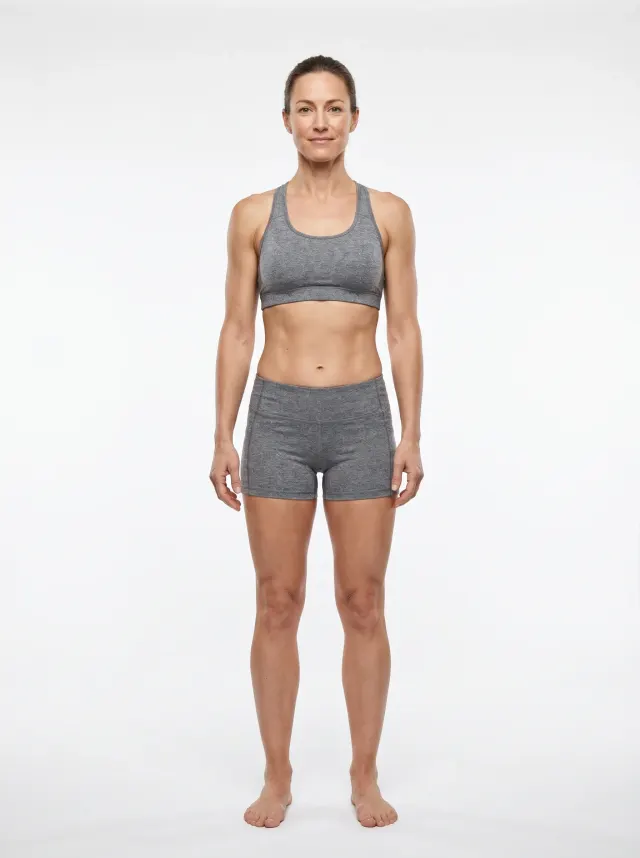
Around 22% body fat — the fitness range. Shoulder cap and arm line visible: this is what "toned arms" is made of.
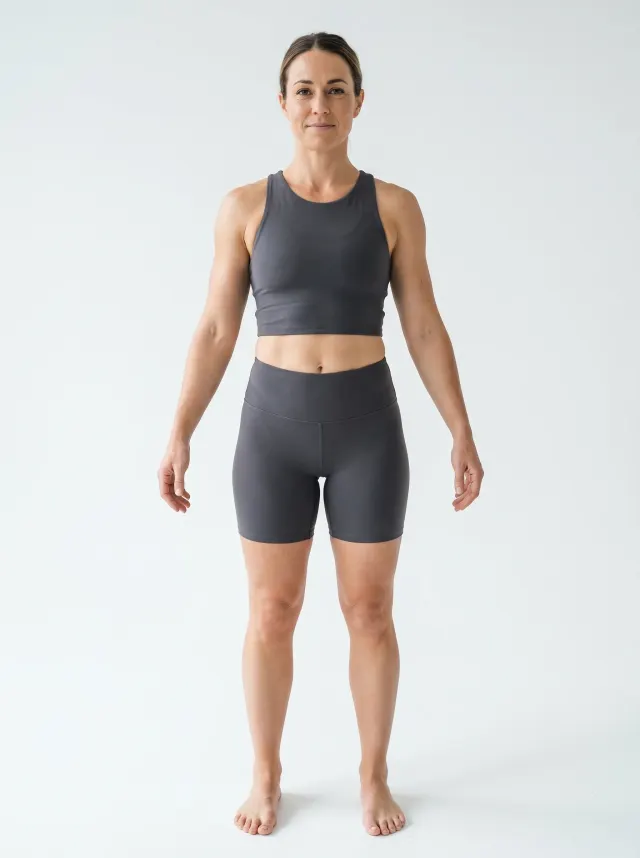
The same frame around 27% — the muscle underneath is identical, and the arm reads softer because the layer over it is thicker.
Notice the muscle didn't change between those images — only the layer over it did. At around 22%, squarely in the commonly cited fitness range for women of 21–24%, the shape shows. A few points higher and the same arm reads soft. Where you sit on that spectrum right now is the single best predictor of how far away "toned" is, and our average body fat percentage for women chart shows where the population actually lands.
Will training your arms make them bulky?
This fear deserves a direct answer, because it has probably cost women more results than any training mistake ever has: for the overwhelming majority of women, accidentally bulky arms are essentially impossible.
The mechanism is hormonal. Women naturally produce a fraction of the testosterone men do — commonly cited figures put it around 10 to 20 times lower — and testosterone is the primary driver of rapid muscle growth. Building even a visible amount of arm muscle takes most women months to years of deliberate, progressive training with plenty of food. The muscular arms you're picturing were built on purpose, over long timelines, usually by athletes training with a precision most people never approach. You cannot stumble into them with two dumbbell sessions a week.
What two or three sessions a week actually produces is the toned look from the renders above: a shoulder with a cap, an arm with a line, a triceps that holds its shape with the arm relaxed. If anything, the practical problem runs the other way — most women find arm muscle frustratingly slow to build, which is exactly why the fear is so misplaced.
Why is arm fat so stubborn?
Because where your body stores fat — and where it gives it up first — is largely set by genetics and hormones, and you don't get a vote. For many women the upper arms are one of the stubborn spots, commonly among the last places to lean out, right alongside hips and thighs. If your arms have stayed soft through diets that visibly changed your waist, that's a normal fat-distribution pattern rather than a personal failure.
The uncomfortable corollary: spot reduction doesn't work. No amount of triceps kickbacks burns the fat sitting over the triceps — fat loss is a whole-body process driven by an overall calorie deficit, and your arms lean out when your body's sequence gets to them. The reliable route is patience: a modest deficit, protein, progressive training to build the shape underneath, and enough weeks for the sequence to reach the arms.
One consolation worth taking seriously: because stubborn-spot fat leaves last, arm changes often show up late in a recomp — right when people tend to quit. The scale stalls, the mirror updates slowly, and progress hides. Photos taken under the same conditions every few weeks catch what daily mirror checks can't.
How do you measure your arm correctly?
Thirty seconds, and your number becomes comparable to the charts and to your own next month:
- Pick one standard and never switch. Relaxed at the midpoint between shoulder and elbow is what health surveys use; flexed at the peak is what lifting charts use.
- Measure cold, before training — a workout commonly pumps the reading up by up to half an inch.
- Tape perpendicular to the arm, snug against the skin without denting it.
- Same arm every time. Dominant arms commonly tape slightly larger; measure both once, then track one.
- Monthly, not weekly. Arms change too slowly for weekly readings to show anything but noise.
What arm changes are realistic in 6–12 months?
The honest numbers, so nothing on this page sets you up for disappointment. On the tape: dedicated beginners commonly add around half an inch of arm circumference in their first year of proper training — muscle simply accrues slowly, especially for women. On the calendar: visible change in arm shape commonly takes 8 to 12 weeks, and definition you'd notice across a room typically takes 6 to 12 months depending on where your body fat starts.
Notice the mismatch — the mirror changes long before the tape does. Half an inch of muscle plus a modest fat reduction transforms how an arm looks while the circumference barely moves, which is why tracking toned-arms progress with a tape measure alone feels like failing even when it's working.
That's the gap photo tracking fills. GainFrame reads progress photos with AI and rates 12 muscle groups individually — biceps among them — alongside an estimated body fat percentage, so you can watch the arm score climb while the fat layer thins, even during the months the tape reads flat. Estimates from photos rather than clinical measurement, but consistent week to week, which is what a trend needs.
Frequently asked questions
What is the average bicep size for a woman?
Commonly cited measurement data puts the average adult woman's upper arm around 11 to 12 inches, measured relaxed at the midpoint of the upper arm. Flexing commonly adds around half an inch. The average includes every body fat level — arm circumference tracks body weight closely, so the tape alone says little about muscle.
Will lifting weights make a woman's arms bulky?
For the overwhelming majority of women, no. Women naturally produce far less testosterone than men — commonly cited figures put it around 10 to 20 times lower — which makes rapid accidental muscle gain essentially impossible. Visibly muscular arms take most women years of deliberate training and eating. Two or three sessions a week produces shape.
How do you get toned arms?
Two changes at once: build some arm muscle with progressive resistance training, and reduce the fat layer over it with a modest calorie deficit held over months. The toned look commonly shows up for women somewhere in the 21–24% body fat range. There is no separate exercise type for tone — light and heavy weights stimulate the same muscle.
Why is arm fat so hard to lose for women?
Where your body stores and releases fat is largely set by genetics and hormones, and for many women the upper arms are one of the stubborn spots — commonly among the last places to lean out. Spot reduction doesn't work; the reliable route is an overall calorie deficit held long enough for the arms' turn to come.
How long does it take to see arm definition?
Visible change in arm shape commonly takes 8 to 12 weeks of consistent training and adequate protein, with clear definition often taking 6 to 12 months depending on starting body fat. The tape barely moves — around half an inch of arm muscle in a year is a normal beginner result. Photos catch the change first.
See your arms change before the tape does
GainFrame rates your biceps — and 11 other muscle groups — from a progress photo, next to estimated body fat. Watch the shape arrive during the months the tape measure reads flat. Free to start on iOS.
Download GainFrame Free