
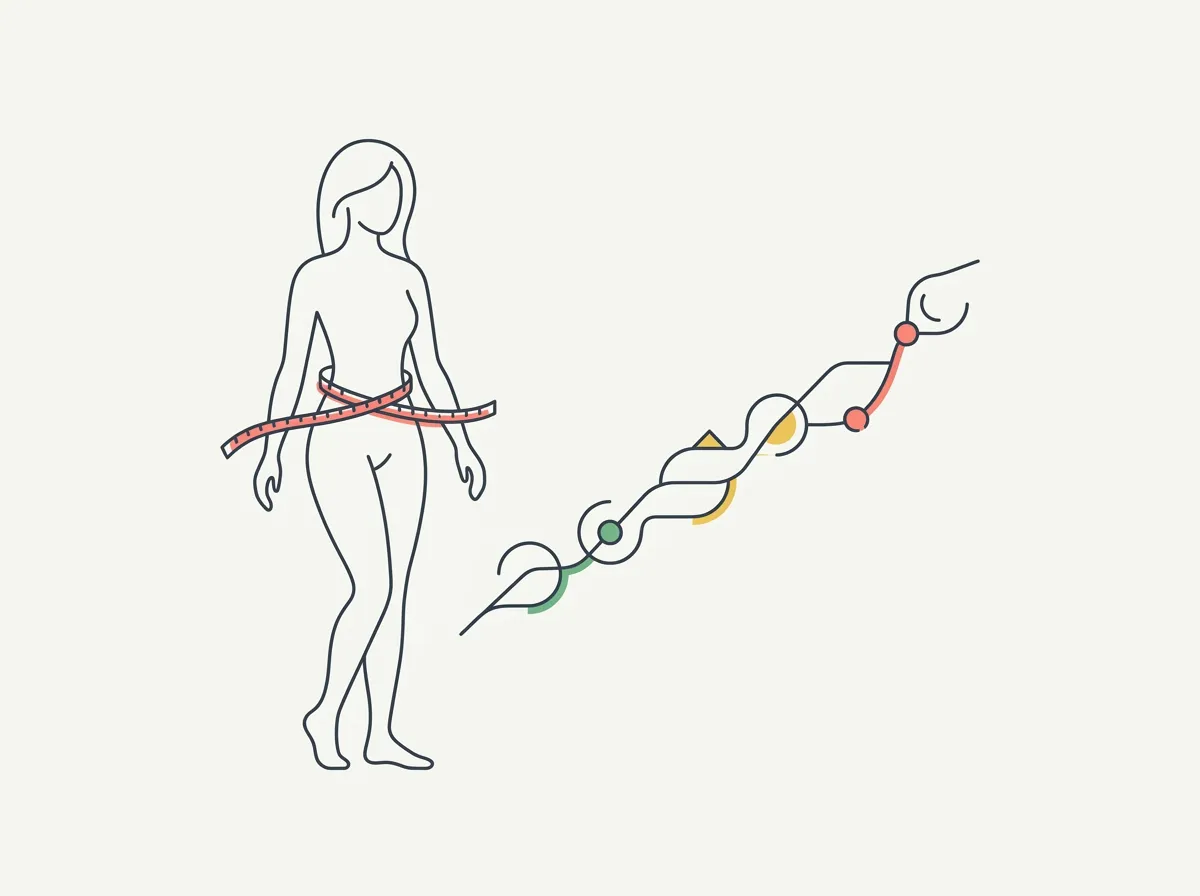
Quick answer: NHANES 2015-2018 measurement data puts the average American woman's waist at 38.7 inches, measured at the iliac crest. Health guidance commonly flags waists over 35 inches in women as elevated risk, so the average sits above the threshold. A better personal target: keep your waist under half your height.
Are you comparing a tape measurement or a clothing size?
| Number you have | What it means | Compare it with |
|---|---|---|
| Waist circumference from a tape | A measurement at a specified body landmark | A reference using the same landmark and protocol |
| A jeans or dress label | A brand's sizing designation | That brand's current garment chart |
| A waist-to-height calculation | Waist measurement relative to your height | Guidance using the same measurement method |
The age table below uses NHANES 2015-2018 data, not a current census of every woman. NHANES locates the waist at the iliac crest; the navel is not automatically the same site. Follow the CDC measurement protocol when comparing with those survey figures. NIDDK explains waist circumference as one health-risk indicator, not a stand-alone diagnosis.
Where does your waist actually sit?
The median woman aged 30–39 measures 37.1". Enter yours to compare.
Percentiles from NHANES 2015–2018 · NCHS Vital and Health Statistics, Series 3, No. 46 (Tables 19–20). Measured at the iliac crest, not at your pants label — the two differ by several inches on most people.
You wear a size 8. Then you wrap a tape measure around your waist at the measurement landmark specified by your chosen protocol, and it reads 37 inches. Nothing in your closet ever mentioned 37, and your first instinct is that the tape is wrong.
The tape is fine. Women's clothing sizes and waist measurements live in two unrelated numbering systems, and the gap between them is why most women have never seen their real waist number. This page covers what's average by age, where the health lines sit, why the size on the label tells you almost nothing, and what a body fat change actually looks like at the waistline.
What is the average waist size for women?
The NHANES 2015-2018 US measurement data published by the National Center for Health Statistics, puts the average adult woman's waist at 98.4 cm, or 38.7 inches, measured at the iliac crest. If that sounds impossibly high, you're reacting exactly the way most people do, because the only "waist" numbers women ever see are dress sizes and jean labels, and neither is a measurement of the navel line.
The average also climbs with age. These are the actual measured figures:
| Age | Average (mean) | Typical (median) |
|---|---|---|
| 20-29 | 36.3 in | 35.0 in |
| 30-39 | 38.3 in | 37.1 in |
| 40-49 | 39.2 in | 37.8 in |
| 50-59 | 39.3 in | 38.5 in |
| 60-69 | 40.0 in | 39.4 in |
| 70-79 | 40.0 in | 39.6 in |
| 80+ | 38.7 in | 38.7 in |
Two columns, because they answer different questions. The mean is the arithmetic average and gets pulled upward by the largest waists in each group. The median is the middle woman, half her age group measures less, half more, which is what most people mean when they ask what's normal. The gap between the two columns is the long right tail of the distribution.
Menopause in particular shifts fat storage toward the midsection for many women, which is visible in the jump between the 40s and 60s rows. The pattern is what matters: the average creeps up roughly an inch per decade, and it crosses the commonly cited 35-inch risk threshold in the average woman's 20s.
That's the uncomfortable arithmetic this page keeps returning to: for American women, average and healthy stopped being the same number a while ago.
What waist size is healthy for a woman?
Two thresholds are worth keeping in your head together.
The flat cutoff. Health guidance commonly flags a waist over 35 inches in women as elevated risk (the parallel figure for men is 40, the full breakdown is in our average waist size for men guide). It's a blunt tool, because 35 inches means something different at 5'2" than at 5'11", but it's the number most screening guidelines use.
The height rule. The refinement most commonly used is the waist-to-height ratio: keep your navel waist under half your height.
| Height | Waist target (under 0.5 × height) |
|---|---|
| 5'0" | under 30 in |
| 5'2" | under 31 in |
| 5'4" | under 32 in |
| 5'6" | under 33 in |
| 5'8" | under 34 in |
| 5'10" | under 35 in |
Why does a tape at your beltline predict anything? Because waist circumference is a rough proxy for abdominal fat, including the visceral fat packed around your organs, which is the metabolically risky kind. It's also why the waist catches problems that weight alone can't: total pounds say nothing about where the body keeps them.
Clear both thresholds and your waist is unlikely to be your limiting health factor, whatever the label in your jeans says.
Why doesn't your clothing size match your real waist?
Three mechanisms stack, and every one of them pushes the label away from the tape.
The numbering system is arbitrary. A men's 34 at least pretends to be 34 inches. A women's size 8 is 8 of nothing, it's an index into a brand's sizing chart, and every brand draws that chart differently. The same body can be a 6, an 8, and a 10 in three stores on the same afternoon.
Vanity sizing drifts the chart. Brands learned that women buy the smaller number, so the fabric behind each label has grown for decades. A garment labeled 8 today commonly holds the fabric a 12 or 14 held generations ago. The label is a marketing decision; the tape is a measurement.
Waistbands skip the navel. Most women's pants sit at or below the hips, several inches under the navel line where health guidelines measure, and for many women the navel line is wider than where the waistband rides.
The practical takeaway: your clothing size is useless as health data. If you want a waist number that means something, it has to come from a tape at your navel, measured the way the surveys measure.
What waist size is a size 8 (and every other size)?
With those caveats stated, here is roughly how US women's dress sizes map to waist measurements on typical published brand charts. Treat every row as a range with an inch or more of brand-to-brand variance in both directions, and remember these are garment waist measurements taken at the natural waist, which sits above the navel line the health surveys use.
| US dress size | Typical waist on brand charts |
|---|---|
| Size 2 | ~25 to 26 in |
| Size 4 | ~26 to 27 in |
| Size 6 | ~27 to 28 in |
| Size 8 | ~28 to 30 in |
| Size 10 | ~30 to 31 in |
| Size 12 | ~31 to 33 in |
| Size 14 | ~33 to 35 in |
| Size 16 | ~35 to 37 in |
Notice the gap this chart exposes: the average measured American waist (38 to 39 inches at survey landmarks) sits above the size-16 row, while the average American woman commonly buys a 14 to 16. That mismatch is vanity sizing plus the measurement-location difference doing their work, and it is exactly why the chart above cannot substitute for a tape at the navel.
How do you measure your waist correctly?
Choose the protocol that matches your comparison. For the NHANES reference used here, locate the top of the hip bone at the side of your body and keep the tape horizontal around the waist at that level. Measure after a normal exhalation, with the tape snug and without compressing the skin. The navel can sit above or below that landmark.
Use the same site and conditions when repeating the measurement. A clothing brand may ask for a different natural-waist location; follow its chart for garment fitting and label that measurement separately. See our body-measurement guide for keeping a consistent record.
What does a 10% body fat difference look like at the waist?
Numbers on a tape are abstract. Here's the same woman at two body fat levels, these are standardized, photorealistic AI renders from our body fat visualizer, same build, pose, and lighting, so only body fat changes between images. 27% sits in the middle of the average range for women; 37% sits above the level where waist measurements commonly cross the 35-inch line.
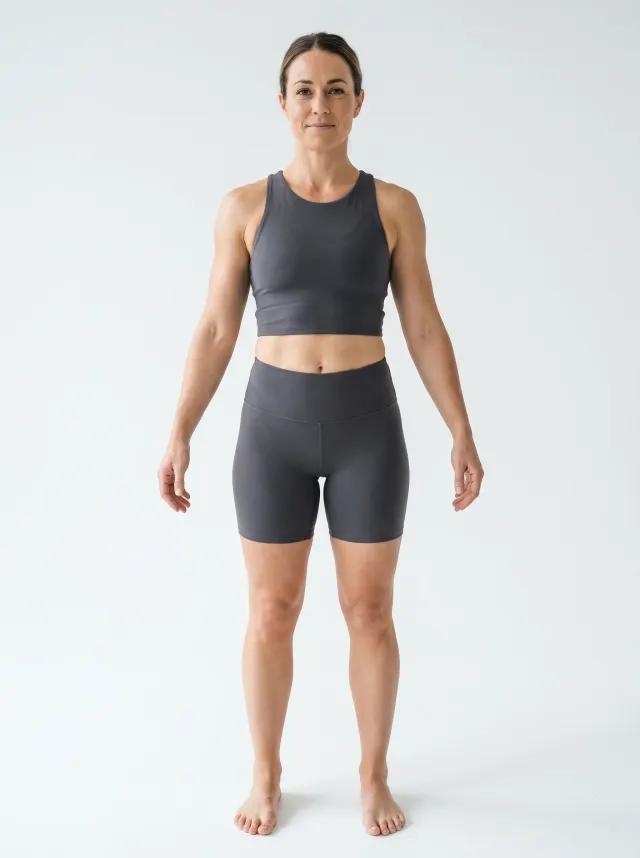
27% body fat, squarely average for women. Some softness at the midsection, and the waist is still clearly the narrowest point of the torso.
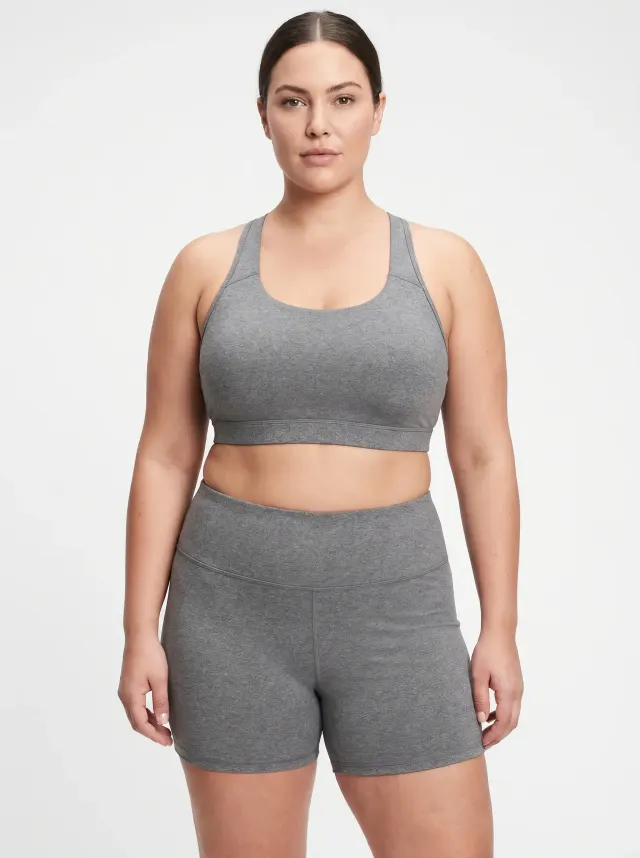
The same frame at 37%, several inches more waist, and the waist-to-hip contrast has largely flattened out.
Notice where the change concentrates. Arms, shoulders, and legs shift a little; the waistline absorbs most of the difference. That's exactly why the navel tape is such an efficient measurement, it sits on the spot where fat change shows up first and largest. Where women's fat distribution differs most from men's is the hips, which have their own numbers, covered in our average hip size guide.
How should you track your waist over time?
A single measurement tells you where you stand against the tables above. The more useful version is the trend: the same tape, the same navel line, the same morning conditions, once a week.
The tape tracks the number, but photos catch what the tape misses, posture, proportion, where the inches came off. GainFrame estimates body fat percentage and physique scores from progress photos, so the waist trend and the visual change live in one place. These are estimates from photos rather than clinical measurements, but they're consistent week to week, which is what a trend needs. For a one-off number today, the free browser body fat estimator does a single scan a day with no download or signup, and our average body fat for women guide puts that number in context.
What else should you know?
What is the average waist size for a woman in the US?
Figures commonly cited from US national health survey data put the average American woman's waist around 38 to 39 inches, measured at the iliac crest in the cited survey. That number surprises most women because clothing sizes measure differently and vanity sizing shifts labels downward. Averages also climb with age, from the mid 30s in women's 20s to around 40 inches past 50.
Is a 35-inch waist healthy for a woman?
35 inches is the level health guidance commonly flags as elevated risk for women, so it sits right at the line. Height matters too: at 5'11", 35 inches is just under half of height; at 5'4", the same waist is well over the 0.5 waist-to-height target and worth addressing.
What is a healthy waist size for a woman?
Two commonly used checks: keep your navel waist under 35 inches, and keep it under half your height. The height rule is the sharper tool, roughly 31 inches at 5'2", 32 at 5'4", 33 at 5'6". Clear both and your waist is unlikely to be your limiting health factor.
Why is my measured waist bigger than my jeans size suggests?
Women's clothing is sized by arbitrary numbers rather than inches, waistbands sit below the navel where most women are narrower, and vanity sizing has shifted labels downward for decades, a modern size 8 holds more fabric than a size 8 from the 1990s. The tape at your navel and the label describe different things.
What waist size is a size 8?
On typical published brand charts, a US women's size 8 corresponds to roughly a 28 to 30 inch garment waist, with real brand-to-brand variance in both directions. That is a natural-waist garment measurement, taken above the survey measurement site, so your measured navel waist can easily run larger than the chart suggests.
Does waist size matter if my weight is normal?
Yes. Waist circumference tracks abdominal fat, including visceral fat around the organs, which the scale and BMI can't see. A woman at a normal weight whose waist creeps past half her height is carrying fat in the highest-risk location while the headline number looks fine. The tape catches what the scale misses.
See the inches come off your waist
GainFrame estimates body fat percentage and physique scores from your progress photos, so the inches coming off your waist show up as visible, tracked change. Free to start on iOS.
Download GainFrame Free