
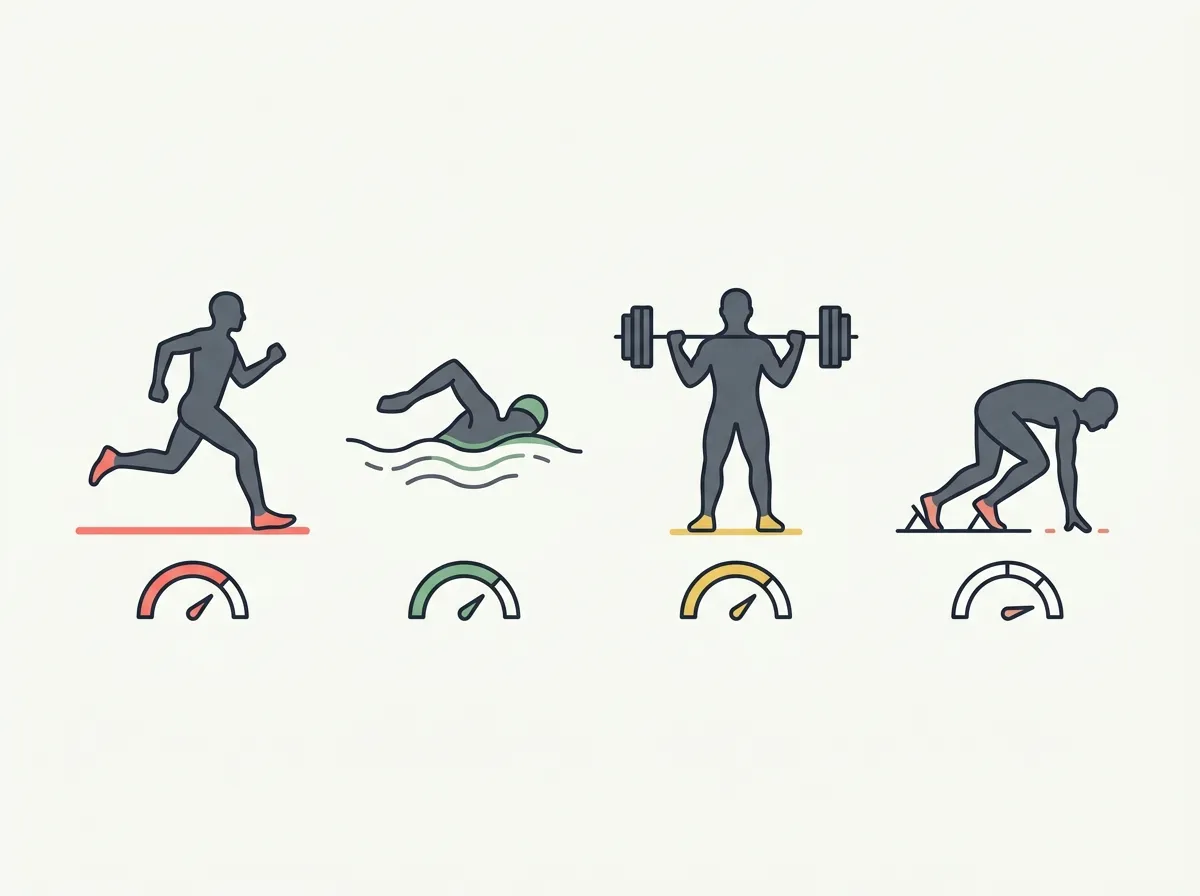
Quick answer: There is no single athlete number. Commonly reported ranges run from roughly 6–13% for male distance runners, through 8–15% for most team sports, to 18–25% or more for football linemen — and women's ranges sit about 6–10 points higher throughout. Leanness is sport-specific, and stage or race-day figures are temporary peaks.
You read somewhere that elite marathoners run at 7% body fat, your scanner just said 16%, and the gap feels like an indictment. Then you learn an NFL lineman — a professional athlete, paid millions, tested constantly — might carry 25%, and the whole comparison starts to wobble.
It should. "Athlete body fat" spans nearly 20 points depending on which sport you point at, which season you measure in, and which source you trust. This page collects the commonly reported ranges by sport, the caveats every one of those numbers deserves, and the more useful question hiding underneath: what any of it means for your own target.
What is the average body fat percentage by sport?
The table below collects commonly reported ranges. One caveat before the numbers: figures vary meaningfully by source, measurement method, and season — a DEXA reading, a caliper protocol, and a bioimpedance scale can disagree by several points on the same athlete on the same day. Treat every row as a band, and every band as approximate.
| Sport | Men (commonly reported) | Women (commonly reported) |
|---|---|---|
| Distance running | ~6–13% | ~12–20% |
| Sprinting | ~8–12% | ~12–18% |
| Bodybuilding (stage) | ~3–8% | ~8–13% |
| Bodybuilding (off-season) | ~10–15%+ | ~15–22% |
| Swimming | ~9–14% | ~14–22% |
| Football (skill positions) | ~8–13% | — |
| Football (linemen) | ~18–25%+ | — |
| Wrestling / combat sports | ~5–14% (weight-class driven) | ~12–20% |
| Basketball | ~7–12% | ~16–24% |
| Soccer | ~8–12% | ~14–20% |
| Powerlifting | ~10–20%+ | ~18–28%+ |
A few rows deserve their own footnotes. Combat-sport figures swing hard with weigh-in timing — a wrestler's certification number and his mid-season walking-around number can differ by several points. Football is really two sports wearing one uniform, which is why it gets two rows. And swimmers commonly sit slightly higher than their dryland leanness would suggest, with a bit of fat being no disadvantage in water.
Why is leanness sport-specific instead of universal?
Because body fat is a cost-benefit line item, and every sport prices it differently. A marathoner pays for every extra pound over every mile, so the sport ruthlessly selects for lightness. A lineman's job is moving 300-pound humans against their will — mass, anchor, and leverage all reward size, and the fat comes bundled with it.
Powerlifting makes the point most honestly: performance and leanness are simply different axes. Some elite lifters are lean, plenty carry 20%+, and the total on the bar doesn't care. A bigger waist can even shorten a squat's range of motion and stiffen the trunk. That's also why the powerlifting row above is the widest in the table — the sport tolerates nearly the whole spectrum.
The corollary most people miss: many team-sport ranges overlap an ordinary fit person far more than the mythology suggests. A soccer midfielder at 11% and a dedicated recreational lifter at 12% are nearly neighbors on the chart. What separates athletes is output — speed, engine, skill — and body fat is one input among many rather than the scoreboard.
Are stage and race-day numbers real life?
They're real for about a week. A bodybuilder's commonly cited 3–8% stage condition is the endpoint of a months-long peaking process — extended dieting, water and sodium manipulation, depleted glycogen — and it's commonly described as unsustainable and hormonally expensive to hold. Off-season, the same athlete lives 5–10 points higher. Race-day marathon leanness follows the same logic on a milder curve.
So when you compare your Tuesday-afternoon self to a competitor's peak-day photo, you're comparing your baseline to someone else's single most extreme hour of the year. The floor of what's sustainable is covered in how lean can you get naturally — and the short version is that the commonly cited maintainable floor for most natural men sits meaningfully above stage condition.
Here's what the two zones actually look like — standardized, photorealistic AI renders from our body fat visualizer — same build, pose, and lighting, so only body fat changes between images.
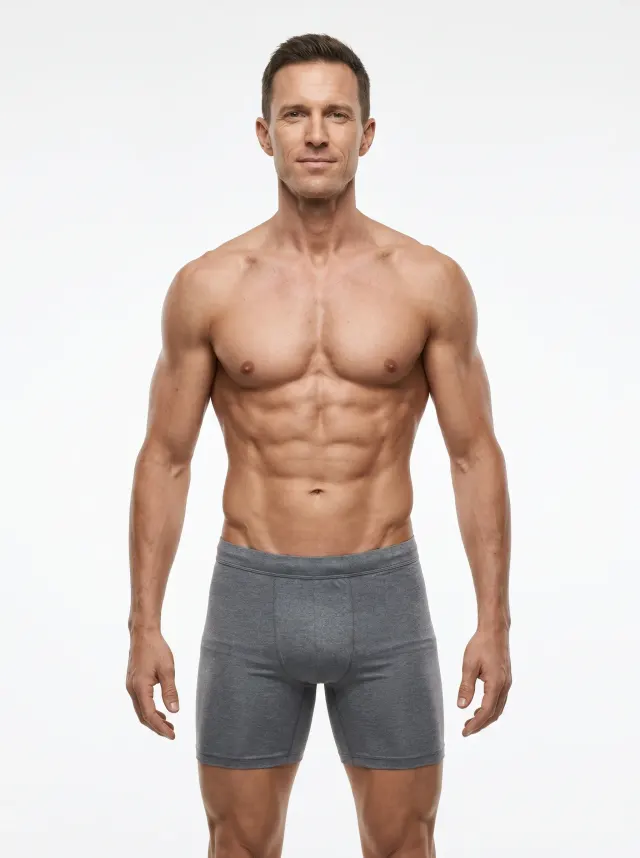
~8% body fat: the "race-day lean" zone commonly reported for elite distance runners and physique competitors near peak — a temporary condition for most.
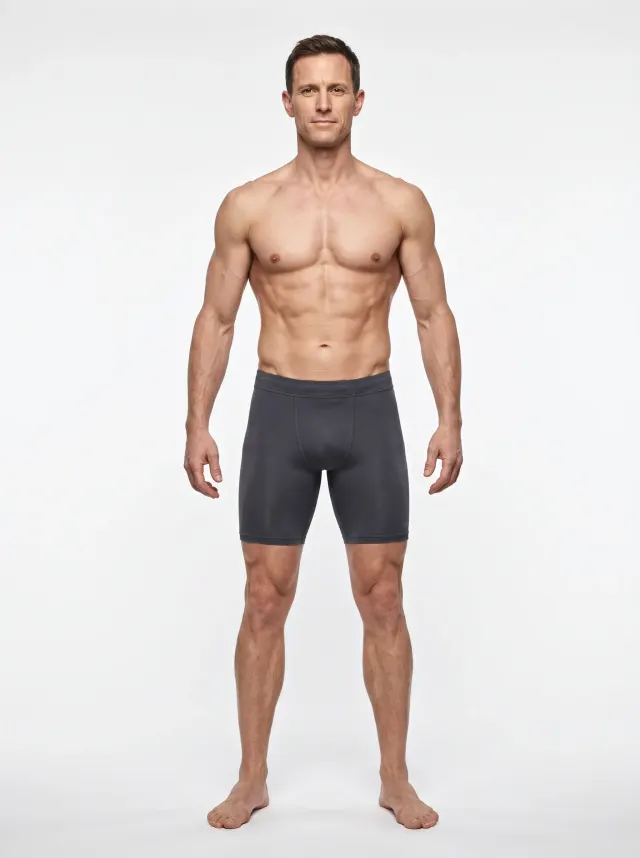
The same frame at ~13%: squarely inside most team-sport ranges, and a level a trained person can actually live at.
Why do women's athlete ranges sit higher?
Essential fat. The minimum body fat compatible with normal physiological function is commonly cited around 3% for men versus around 12% for women — a baseline difference that shifts every female athletic range up by roughly 6–10 points. This is the same offset that runs through our body fat percentage chart, where women's athletic range is commonly given as 14–20% against men's 6–13%.
Read the table with that offset in mind and the rows align: a female distance runner around 15% occupies the same competitive tier as a male teammate around 8%. Same relative leanness, different absolute number.
The offset also carries a warning that sports medicine commonly emphasizes: pushing female athletes toward male-coded numbers is associated with hormonal disruption and health consequences. The higher range is the correct range, and comparing across it is a category error.
What do athlete numbers mean for your target?
Usually nothing, and that's the most useful sentence on this page. Athlete body fat is an instrument tuned for a sport you probably don't compete in, often measured at a seasonal peak, in a population selected for outlier genetics. Adopting a marathoner's 7% as a personal goal imports the costs — chronic hunger, training volume, recovery debt — without importing the reason.
For looking athletic while living a normal life, commonly cited ranges around 10–15% for men and 18–24% for women deliver most of the visual payoff sustainably — the full argument is in our aesthetic physique guide. And if the goal is a certain amount of muscle rather than a certain absence of fat, FFMI percentiles is the better scoreboard anyway.
Whatever number you pick, the useful part is watching your own trend rather than someone else's table. GainFrame estimates body fat percentage from progress photos — estimates, from photos, with the honesty that implies — and tracks the trend week over week, which turns "how do I compare to a lineman" into the better question of "which direction am I moving." A one-off reading with no download is available in the free browser body fat estimator.
Frequently asked questions
What is the average body fat percentage for athletes?
There is no single athlete average — commonly reported ranges run from roughly 6–13% for male distance runners to 18–25% or more for football linemen, with most male team-sport athletes somewhere between 8% and 15%. Women's ranges sit roughly 6–10 points higher across every sport because of essential fat requirements.
What body fat percentage are bodybuilders?
Commonly cited stage-condition figures run around 3–8% for men — held for days, reached through an extreme peaking process of dieting and water manipulation. Off-season, the same competitors commonly sit in the 10–15% range or higher. Stage leanness is a transient event, and treating it as a year-round condition misreads how the sport works.
Are athletes always leaner than regular gym-goers?
It depends on the sport. Powerlifters, linemen, and throwers commonly carry body fat levels above a fit recreational lifter, because their performance rewards mass and leverage over leanness. Many team-sport ranges overlap heavily with an ordinary fit person at 12–15%. Elite performance and visible abs are separate achievements that only sometimes coincide.
Why do female athletes have higher body fat percentages?
Essential fat — the minimum required for hormonal and physiological function — is commonly cited around 3% for men versus 12% for women. That baseline shifts every women's athletic range upward by roughly 6–10 points. A female distance runner around 15% is comparably lean, in athletic terms, to a male teammate around 8%.
Should I aim for athlete body fat levels?
Usually there is no reason to. Athlete numbers serve sport performance, are often seasonal peaks rather than living conditions, and come with costs in hunger, training volume, and recovery that most people cannot sustain. Commonly cited aesthetic ranges of roughly 10–15% for men look athletic, hold year-round, and demand none of those trade-offs.
Track your number, skip the comparison
GainFrame estimates body fat percentage and physique scores from your progress photos and tracks the trend over time — your own row in the table, updated weekly. Free to start on iOS.
Download GainFrame Free