

Quick answer: Essential fat floors sit around 2–5% for men and 10–13% for women — survival minimums. The leanest most people sustain year-round without hormonal or performance costs is commonly discussed in coaching practice as roughly 10–12% for men and 18–20% for women. Anything leaner is usually a peak, held briefly.
You dieted from 17% down to 10% over four months. For about two weeks you had the physique you'd been chasing — veins on the shoulders, abs in bad lighting. Then sleep started fragmenting at 3 a.m., every workout felt like week eight of a cut because it was, and by month six you'd drifted back to 15% wondering what you did wrong.
Probably nothing. You found a peak and tried to live on it. This is the mirror image of the natty limit question — that post covers the ceiling on how much muscle you can build naturally; this one covers the floor on how lean you can get and, more importantly, stay. The two numbers are different, and the gap between them is where most post-cut rebounds are born.
How lean can the human body actually get?
There's a hard physiological floor: essential fat. Figures commonly cited put it around 2–5% of body weight for men and 10–13% for women — the fat wrapped around organs, padding nerves, and built into cell membranes. The body needs that fat to run.
Nobody lives at essential fat. Bodybuilders in stage condition approach it for a weekend, in a state commonly described as depleted, flat, cold, and miserable. The higher floor for women reflects reproductive physiology, which is also why the costs of pushing too low tend to show up earlier and louder for women — more on that below.
For context on where these numbers sit against the full spectrum, our body fat percentage chart maps every range with photos. The short version for men: athletic is commonly cited as 6–13%, fitness 14–17%. For women: 14–20% and 21–24%. The natural leanness question lives almost entirely inside those first bands.
What's the difference between a peak and a level you can live at?
Coaching practice commonly draws a line between two very different numbers that get mixed together online:
| Peak condition | Sustainable floor | |
|---|---|---|
| Men (commonly discussed) | ~5–8% | ~10–12% |
| Women (commonly discussed) | ~12–16% | ~18–20% |
| How long it holds | A day to a few weeks | Indefinitely, for most |
| Typical cost | High — hunger, flatness, fatigue | Low, if it's at or above your floor |
Peak condition is what physique athletes present on stage and what shredded transformation photos capture. It's real, it's achievable naturally, and it's temporary by design — competitors commonly regain 5–10 pounds within days of a show, on purpose. The sustainable floor is the leanest level you can hold through normal life — work stress, social meals, full training — without the wheels coming off.
Here's the visual gap between those two numbers on the same body. These are standardized, photorealistic AI renders from our body fat visualizer — same build, pose, and lighting, so only body fat changes between images.

8% — peak condition. This is a day: a photoshoot, a stage, a beach vacation you planned a cut around.
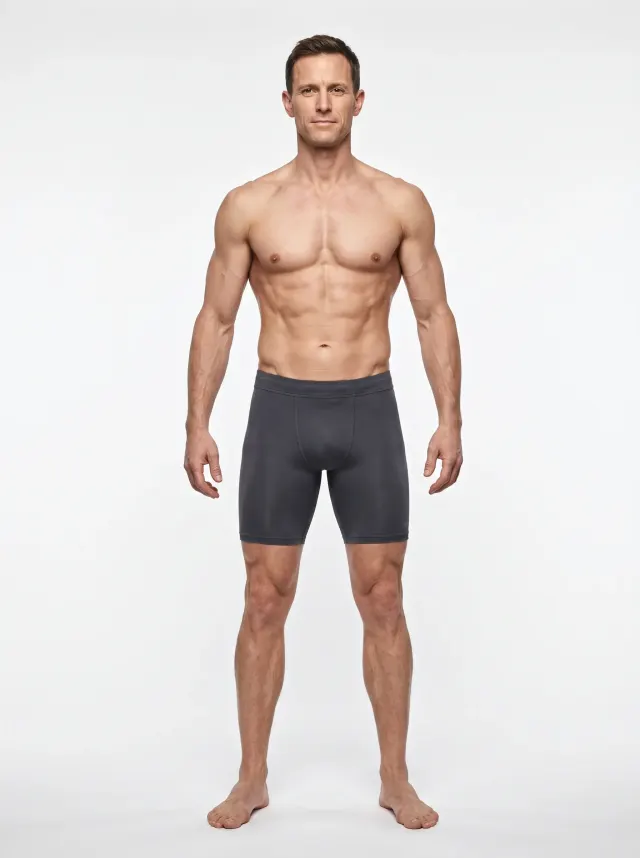
13% — still clearly lean, visible upper abs in decent lighting. This is a life: a level many people can actually hold.
The difference on screen is smaller than most people expect. The difference in what each level demands day to day is enormous — and that asymmetry is the entire argument for aiming at the second number. If your goal is looking good rather than competing, the aesthetic physique breakdown makes the case that 10–15% is where most men photograph best anyway.
What does staying very lean usually cost?
The research and coaching literature on chronically low body fat describes a consistent cluster of costs. Every item below is commonly reported rather than guaranteed — individuals vary a lot — but the pattern repeats enough to take seriously.
Hormones. Prolonged low energy availability is commonly associated with suppressed testosterone in men and menstrual cycle disruption in women. Case studies of natural bodybuilders during contest prep commonly document significant hormonal declines that take months to recover after the diet ends.
Sleep. Very lean plus hungry commonly produces fragmented sleep and early waking. Poor sleep then degrades recovery and appetite regulation, which makes holding the level even harder — the loop feeds itself.
Mood and food focus. Persistent preoccupation with food, irritability, and social withdrawal around eating are commonly reported at the extremes. When maintaining a look starts organizing your entire day, that's data.
Training output. Strength commonly stalls or slides at very low body fat. If your lifts have been drifting down for a month and your weight hasn't, your body is spending less on performance to defend its energy budget.
Getting lean is fine. Parking at the extreme is what carries the bill. Short, deliberate pushes like a mini cut exist precisely so you can visit lower levels without moving in. And to be clear on the serious end: persistent symptoms — lost cycles, mood changes that scare you, strength that keeps falling — are a reason to talk to a physician or registered dietitian, and nothing in this post overrides that.
Why is your floor different from someone else's?
One idea commonly discussed in nutrition and coaching circles is the personal fat threshold — the notion that each body defends its own comfort zone of fat mass, and the level where symptoms start varies widely between people. It's a working concept rather than settled science, but it matches what coaches commonly observe: one client cruises at 11% while another falls apart at 14%.
Genetics, fat distribution, stress load, sleep quality, and training history all appear to move the line. This is why copying someone else's maintenance body fat is a coin flip. The shredded guy on your feed telling you 9% is easy may simply have drawn a different floor than you did — or may be describing his two best weeks a year.
The practical consequence: the question "how lean can you get naturally?" has a population answer (the commonly discussed ranges above) and a personal answer. Only the personal one is actionable, and you find it by testing rather than by searching.
How do you find your own sustainable floor?
The test is boring and it works: hold a level for 8+ weeks and watch your biofeedback. Cut to a target — sensibly, per the first cut guide — then stop cutting and eat at maintenance there for two months of normal life.
- Pick a candidate level — for most men something in the 10–14% range, for most women 18–22%.
- Transition to maintenance calories and hold your weight within a couple of pounds.
- Track five signals weekly: sleep quality, morning energy, libido, training performance, and how much of your day food occupies.
- At 8 weeks, read the verdict. All five stable or improving means the level is at or above your floor — you can live here, or even test lower. Two or more degrading means you're below it; move up 2–3 points and retest.
The trap in this protocol is that mirror-based judgment drifts — you normalize to your own reflection within weeks. Photos under consistent conditions don't. GainFrame estimates body fat percentage from progress photos and tracks the trend, so you can confirm you're actually holding the level rather than slowly sliding off it in either direction. They're estimates from photos rather than clinical measurements, but week-to-week consistency is exactly what an 8-week hold needs. For a one-off reading today, the free browser body fat estimator does a single scan a day, no download.
Whatever your test returns, that number is the honest answer to this post's title — for you. It's usually a few points higher than the number you wanted, and life at it is dramatically better than life below it.
Frequently asked questions
How lean can you get naturally?
Essential fat — commonly cited around 2–5% for men and 10–13% for women — is the physiological floor, and even stage competitors only approach it for days. For most people, the leanest level that holds year-round without hormonal or performance costs is commonly discussed in coaching practice as roughly 10–12% for men and 18–20% for women.
How lean is too lean?
There's no universal cutoff, but a practical signal is biofeedback. If holding a level costs you sleep quality, mood, libido, training output, or a normal relationship with food for weeks at a time, that level is commonly treated as below your personal floor. Persistent symptoms — especially cycle disruption in women — are worth taking to a physician.
Can you stay at 10% body fat year-round?
Some men can — usually those with favorable genetics, low stress, and years of training behind them. Many others report degraded sleep, low energy, and constant food focus when they try. The honest test is holding it for eight-plus weeks and watching biofeedback. If life at 10% feels like a permanent diet, your sustainable floor likely sits a few points higher.
Is 8% body fat sustainable naturally?
For a small minority, possibly — but 8% sits near the bottom of the athletic range, and most men who reach it describe it as a peak rather than a home. Coaching practice commonly treats 8% as photoshoot or stage territory: achievable for a day or a week, with sleep, hormones, and training output commonly degrading if it's held for months.
Why do some people feel fine lean while others feel terrible?
One idea commonly discussed in nutrition circles is the personal fat threshold — the notion that each body defends a different comfort zone of fat mass. Genetics, fat distribution, training history, and stress all seem to shift it. Two people at 12% can have completely different experiences: one thrives, one fights constant hunger. Your floor is found by testing, and comparison to others mostly misleads.
Find your floor with photos, then hold it
GainFrame estimates body fat percentage and physique scores from your progress photos — so an 8-week hold test runs on consistent weekly data instead of mirror guesswork. Free to start on iOS.
Download GainFrame Free