
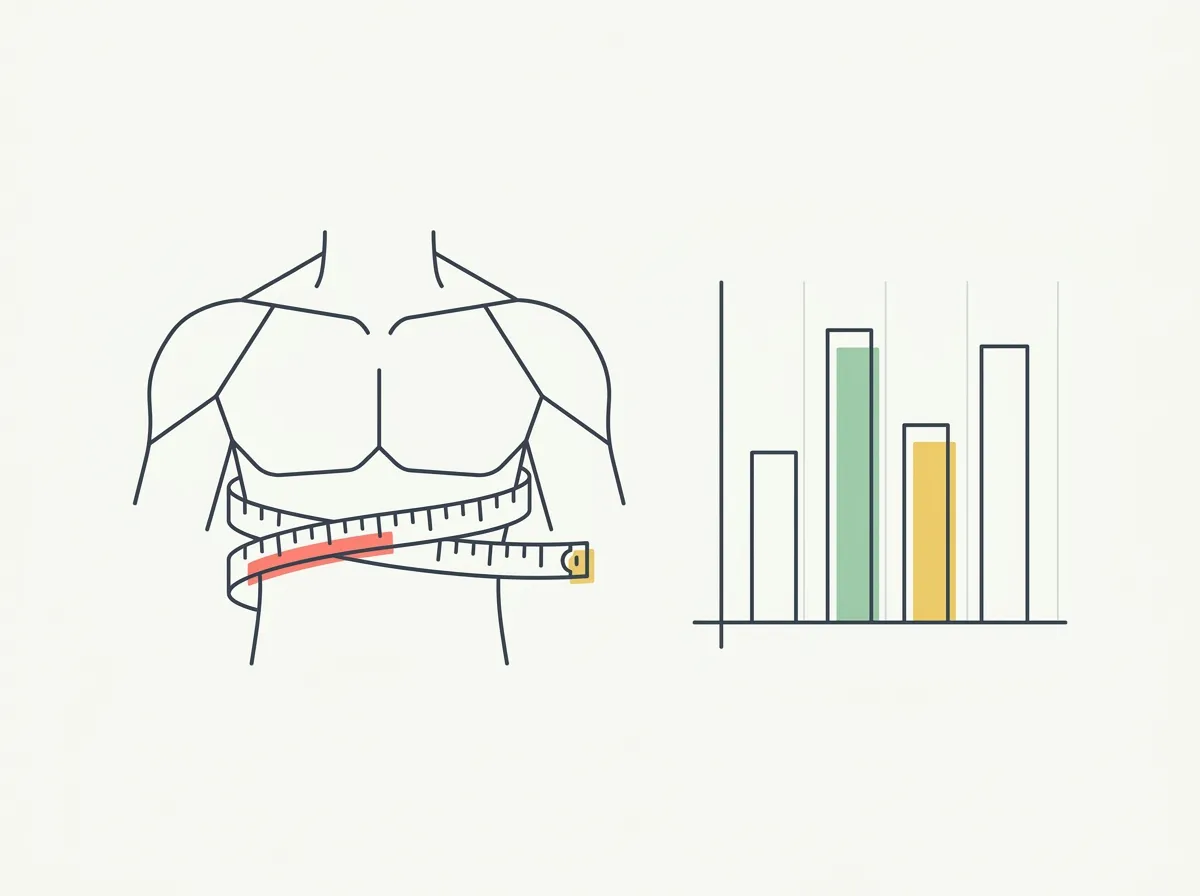
Quick answer: Commonly cited measurement data puts the average adult male chest around 40 to 42 inches, measured relaxed at the widest point. Consistent lifters typically tape 42 to 46 inches; a lean chest over 46 is genuinely big. Most of any reading is ribcage and back - the pecs are a smaller slice than the tape implies.
You measure your chest for the first time: 41 inches. Is that good? A T-shirt size chart says it's a Large. A bodybuilding forum says a "real" chest starts at 46. Neither of those is a useful reference point, and one of them is calibrated to enhanced physiques standing in a pump.
Here's what the measurement data actually says about the average man, what changes with training, and the part nobody mentions: the tape around your chest is mostly measuring things that aren't your chest.
What is the average chest size for men?
Commonly cited measurement data puts the average adult American man's chest at roughly 40-42 inches, taped relaxed around the widest point. Like every population average, it includes men at every body fat level, and that inflates it - chest circumference climbs with body weight whether the added weight is muscle or fat.
An untrained man at a healthy weight typically tapes somewhere around 37-40 inches depending on frame. Everything above that is training, body fat, or a big ribcage - and the tape alone can't tell you which. A photo can: the free browser body fat estimator reads body fat from a single picture - one scan a day, no signup - which settles half of that question immediately.
The uncomfortable truth about the chest measurement specifically: it wraps around your back, lats, ribcage, and the fat over all of it. Your pecs contribute a couple of inches at most. A man with a deep ribcage and wide back can tape 44 inches with completely flat pecs. That's why chest circumference is the least visual of the common measurements - and why the same number looks so different on different bodies.
What counts as a big chest? Chest size by height and training level
Height and frame set your starting circumference - a 6'3" ribcage simply has more bone and lung to wrap around than a 5'6" one. Shoulder breadth also changes how the same chest measurement reads, so compare it with the average male shoulder-width benchmarks for fuller frame context. The chart below reflects ballparks commonly observed in lifting communities for natural lifters at moderate body fat. Treat it as orientation, not gospel.
| Height | Untrained (typical) | 1-2 years training | Advanced natural, lean |
|---|---|---|---|
| 5'6" | ~36-39 in | ~39-42 in | ~42-45 in |
| 5'9" | ~37-40 in | ~40-43 in | ~43-46 in |
| 6'0" | ~38-41 in | ~41-44 in | ~44-47 in |
| 6'3" | ~39-42 in | ~42-45 in | ~45-48 in |
A few honest readings. The untrained-to-trained jump of roughly two to three inches is mostly upper back and lats, not pecs - pressing builds the chest you see, but rowing builds the circumference you tape. The advanced column assumes leanness; add ten points of body fat and every number inflates by an inch or two without any new muscle. And a lean 47-inch chest on a natural frame is rare enough to notice across a room - that territory is mapped in our natty limit guide.
Is a 40-inch chest big?
Against the general population: it's average, almost exactly. Against T-shirt sizing: it's a standard Large. Against a lean frame: it can look legitimately trained.
That last one deserves the explanation. A 40-inch chest at 14% body fat on a 5'9" frame means visible pec outline, a chest-to-waist taper, and shirts that fit the shoulders before the stomach. The same 40 inches at 28% body fat is a larger waist eating the taper, and the reading mostly reflects torso thickness. Identical tape, opposite impressions.
So the answer scales the same way it does for arms: the number means little until you know the body fat behind it. Circumference is the raw material; leanness is what makes it visible.
Why does the tape say your chest grew when your pecs didn't?
Because the tape counts everything in the loop equally: spine, lats, ribcage expansion from breath, subcutaneous fat, and - last and least - pec thickness.
That produces misleading movement in both directions. Bulk for six months and the tape climbs two inches while maybe half an inch is pec; the rest is back thickness and fat. Cut hard and the tape drops while your pecs are fully intact - the fat sleeve over the chest and back commonly accounts for an inch or more. Anyone who has panicked mid-cut about "losing their chest" has met this exact illusion; the signs you're actually building muscle are mostly visual, not circumferential.
There's also a cheap parlor trick worth knowing so you don't fool yourself: a big breath and a slight lat spread add one to two inches instantly. If your measurement protocol isn't identical every time, your "progress" may be posture.
How do you measure your chest correctly?
Sloppy chest measurement swings readings by two inches - more than most lifters gain in a year. The protocol:
- Relaxed, arms down. No flex, no lat spread, no deep breath. Exhale normally and let the tape settle.
- Tape at the widest point - across the nipple line, under the armpits, around the fullest part of the back.
- Parallel to the floor. A tape that dips in the back reads long. Check in a mirror or have someone hold it level.
- Cold, not pumped. A chest and back pump commonly adds an inch that's gone by evening. Measure before training or on a rest day.
- Monthly, not weekly. Chest circumference moves too slowly for weekly readings to show anything but breath and water.
Write the conditions down with the number. "41.5, relaxed, cold, morning" is a data point you can compare in three months. "About 41" is a memory.
How do you know your chest gains are actually muscle?
The tape hands you one number for a region that's really four - pecs, back, ribcage, and the fat over all of them. Separating pec growth from the rest takes a second signal, and the practical one is visual.
GainFrame approaches it from a photo: its AI rates 12 muscle groups individually - upper chest and mid/lower chest among them - alongside estimated body fat percentage and FFMI, so you can see whether the tape trend is pec-shaped or just torso-shaped. Estimates come from photos rather than clinical measurement, but the per-muscle breakdown answers exactly the question the chest tape can't.
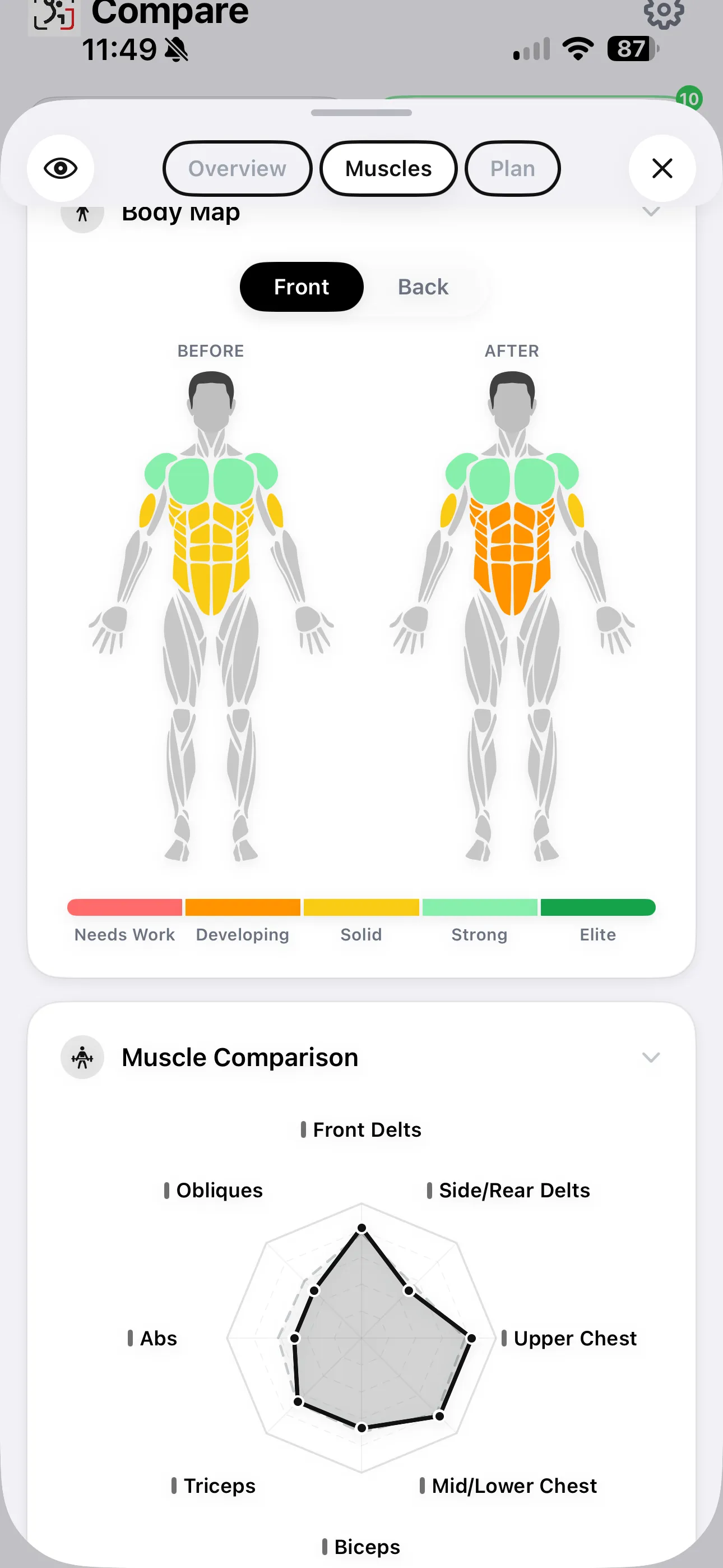
Per-muscle ratings over time: if the chest scores climb while body fat holds, the tape gain was muscle.
Pair the photo signal with the tape and your pressing log and you have the full picture - circumference, composition, and performance. Our guide to tracking muscle gain progress covers running all three without turning tracking into a part-time job.
Frequently asked questions
Is a 40 inch chest big?
No - 40 inches is right around the commonly cited adult male average. What changes the picture is composition: a lean 40-inch chest with developed pecs looks athletic, while a soft 40 mostly reads as an ordinary torso. Trained lifters at moderate leanness typically tape 42-46 inches.
What is the average chest size for a man?
Commonly cited measurement data puts the average adult male chest around 40-42 inches, measured relaxed at the widest point. That average includes every body fat level - chest circumference rises with body weight whether the weight is muscle or fat. Consistent lifters typically land in the 42-46 inch range at moderate leanness.
Is a 38 inch chest small?
Slightly below the commonly cited 40-42 inch average, but frame matters enormously. At 5'6", 38 inches is close to typical; at 6'2" it suggests a light frame with room to grow. On a lean, shorter man with developed pecs, a 38-inch chest can look distinctly trained.
Should I measure my chest flexed or relaxed?
Relaxed, arms at your sides, tape at the widest point across the chest and under the armpits. Flexing, spreading your lats, or puffing the ribcage adds an inch or more of unrepeatable noise. Measure cold, before training, and keep the tape parallel to the floor - same conditions every time.
How fast does chest size grow?
Slowly. A dedicated beginner commonly adds around one to two inches of chest circumference in the first year of training, and the rate drops sharply after that. Fast jumps on the tape usually mean body fat or measurement inconsistency - the pecs themselves add circumference in fractions of an inch.
Know if the tape gain is pecs
GainFrame rates your upper and lower chest - and 10 other muscle groups - from a photo, next to estimated body fat and FFMI. See whether your chest is growing or your torso is just getting thicker. Free to start on iOS.
Download GainFrame Free