
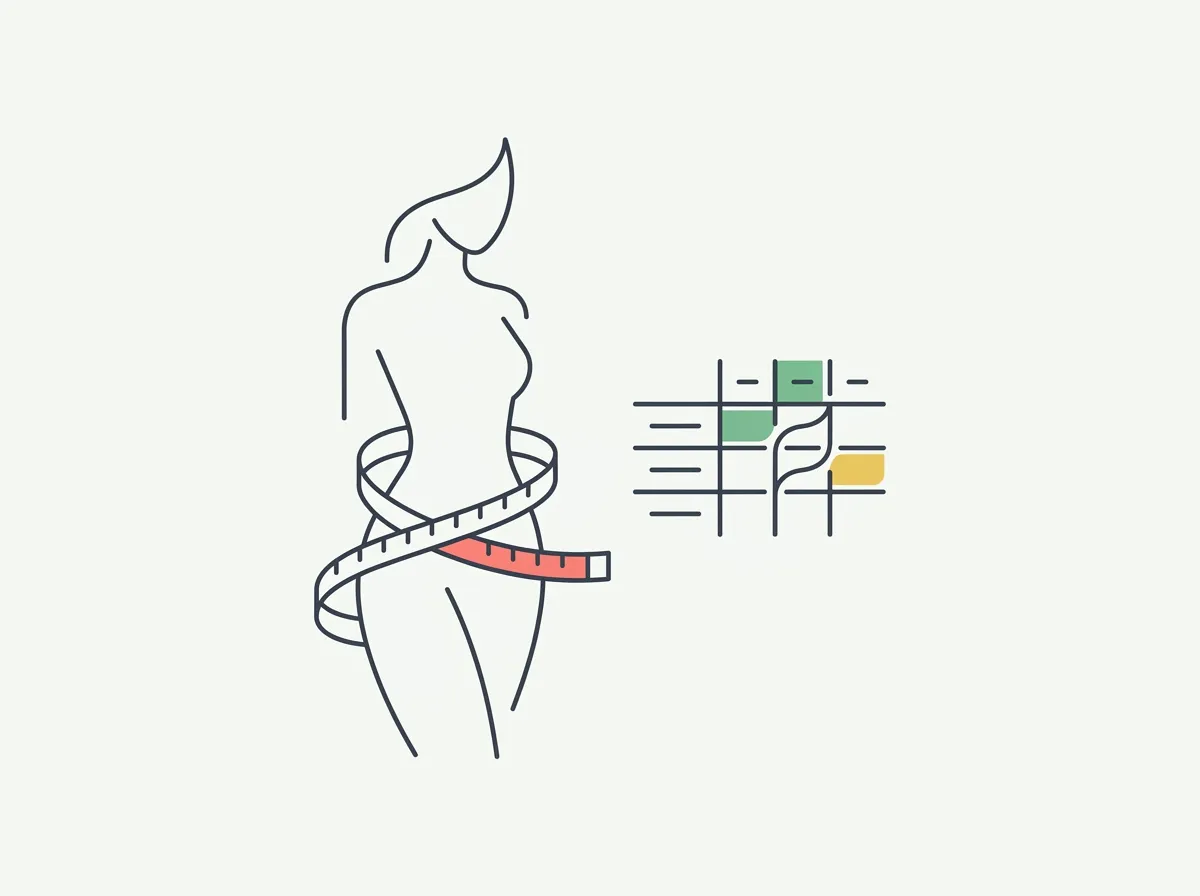
Quick answer: Commonly cited US survey data puts the average American woman's hip measurement around 40 to 42 inches, taken at the widest point of the buttocks with feet together. Hip size alone says little about health, the waist-to-hip ratio, which compares the two, is the number clinicians actually watch.
You put the tape where your hips obviously are, that bony ridge at the top of your pelvis, right where your hands rest, and get 34 inches. Then a size chart claims your hips are 41, and nothing adds up.
Both numbers are real. They're measurements of two different places, and every size chart, survey, and health formula means the lower one: the widest point of the buttocks, several inches below the bones. This page covers the averages, the measuring method that ends the confusion, the dress-size mapping, and why hip inches are the most misunderstood good news on your tape.
What is the average hip size for women?
Commonly cited figures from US survey and apparel-industry data put the average adult woman's hip measurement around 40 to 42 inches. As with any population number, treat it as orientation rather than precision, different surveys measure slightly different landmarks, and hip circumference varies more with genetics, pelvic structure, and where your body prefers to store fat than almost any other measurement.
A rough sense of how hips relate to the rest of the tape, using commonly cited averages:
| Measurement | Commonly cited US female average |
|---|---|
| Waist (navel) | ~38-39 in |
| Hips (widest point) | ~40-42 in |
| Difference | ~2-4 in |
The gap between those two rows matters more than either number alone, that's the waist-to-hip relationship this page comes back to at the end. If the waist row surprises you, our average waist size for women guide covers why the survey number is so much higher than anything clothing labels imply.
How do you measure your hips correctly?
This is the number one source of confusion, so let's kill it first: your hip measurement is taken at the widest point of your buttocks. The hip bones everyone instinctively reaches for are the wrong landmark entirely.
The iliac crest, the bony ridge you feel at your beltline, sits several inches above the point every size chart and health formula means. Measure there and you'll read 4 to 7 inches low, wonder why no size chart matches your body, and compute a waist-to-hip ratio that's meaningless.
The correct protocol:
- Stand with feet together, weight even. Feet apart spreads the hips and inflates the reading.
- Find the widest point from the side. Use a mirror or a phone photo in profile, the maximum is usually at the fullest part of the buttocks, well below the waistband of most jeans.
- Wrap the tape parallel to the floor all the way around. A tape that rides up at the back is the most common error after the wrong landmark.
- Slide the tape up and down an inch at a time and take the largest number you find. Hips are a maximum, so hunting for it is the method.
- Snug against the body without compressing. Measure over bare skin or thin underwear, jeans add an inch or more.
Once you've found the spot, it's easy to find again. Measure monthly under the same conditions and the trend is stable enough to trust.
What hip size is what dress size?
Loosely, and with a caveat big enough to deserve its own paragraph, US brand size charts commonly map like this:
| US size | Typical hip range (chart) |
|---|---|
| 2 | ~35-36 in |
| 4 | ~36-37 in |
| 6 | ~37-38 in |
| 8 | ~38-39 in |
| 10 | ~39-40 in |
| 12 | ~41-42 in |
| 14 | ~43-44 in |
| 16 | ~45-46 in |
Now the caveat. A women's size is an index into one brand's chart, and every brand draws its chart differently, then vanity sizing drags the labels downward over time, because shoppers buy the smaller number. Two size-8 garments from two stores can differ by a couple of inches of actual fabric. Notice, too, that the commonly cited average hip measurement (40-42 inches) lands around a chart size 10-12, while the most commonly discussed "average dress size" tends to sit higher, the charts and the real distribution of bodies drifted apart long ago.
The practical rule: your measured hips in inches are data; the size on the label is marketing. When a store publishes a size chart, shop by the inches.
For a broader lower-body reference, compare your hip reading with average thigh and calf measurements. Measure each area at its specified landmark so the numbers are comparable.
Why do hips matter beyond fitting jeans?
Here's the part almost nobody tells you: on a tape measure, hip inches and waist inches are opposite signals.
Research generally associates fat stored at the hips and thighs, the "pear" pattern, with lower metabolic risk than the same amount of fat stored at the abdomen, the "apple" pattern. Lower-body fat is subcutaneous and appears relatively inert; abdominal fat includes visceral fat packed around the organs, which is the metabolically active, risk-carrying kind. The full mechanism is covered in our visceral vs subcutaneous fat guide.
This is why a bigger hip measurement, by itself, is nothing to fix. A 42-inch hip reading over a 29-inch waist describes a distribution pattern that health research generally treats as favorable. The same 42 inches under a 40-inch waist describes a different body and a different risk profile, even if the hip number is identical.
Which is exactly why hip size only becomes meaningful next to the waist.
What does your waist-to-hip ratio say?
Divide your navel waist by your hips at the widest point. That single division, the waist-to-hip ratio, is what turns two tape readings into a health signal, and it's the context every hip measurement deserves.
Commonly used clinical cutoffs flag ratios above roughly 0.85 in women as elevated risk. A 29-inch waist over 41-inch hips is about 0.71, comfortably favorable; a 36-inch waist over the same hips is 0.88, on the wrong side of the commonly cited line with identical hips. The ratio moves almost entirely with the waist, which is also the half you can change, the full thresholds, charts for both sexes, and the improvement levers are in our waist-to-hip ratio guide.
Here's what a body fat swing does to that geometry. These are standardized, photorealistic AI renders from our body fat visualizer, same build, pose, and lighting, so only body fat changes between images.
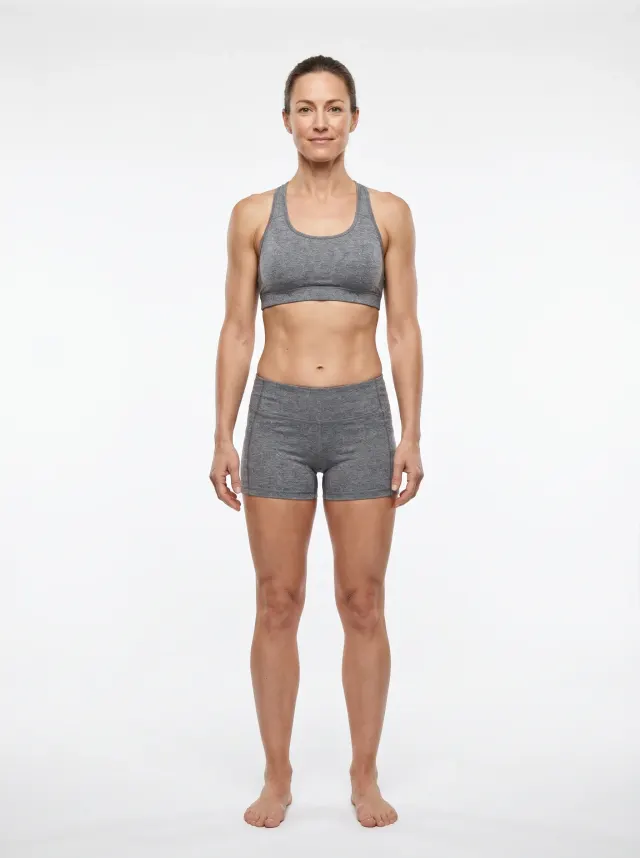
22% body fat, the waist sits well inside the hip line, and the waist-to-hip curve is the defining feature of the silhouette.
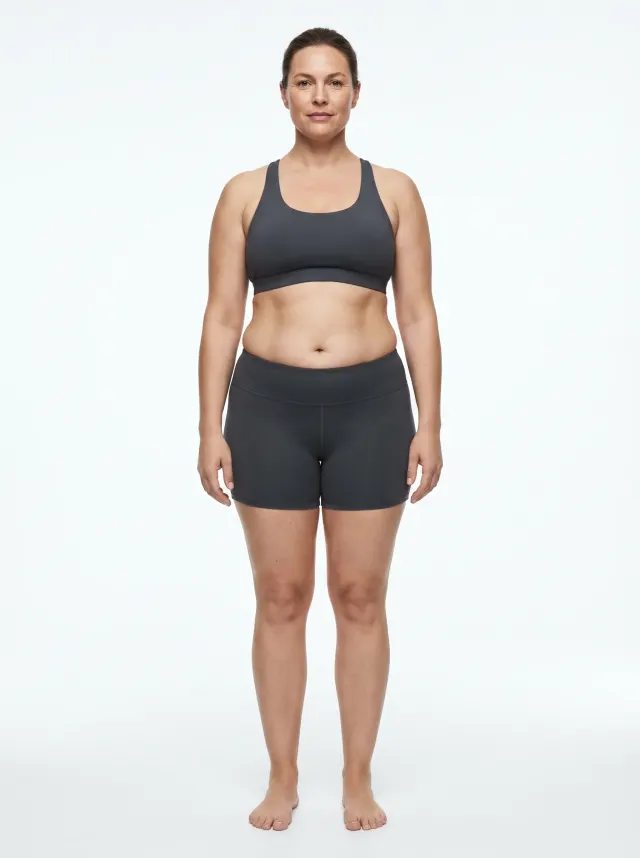
The same frame at 32%, the hips grew a little, the waist grew a lot, and the ratio between them moved far more than either number alone.
Both measurements increased, but nowhere near equally, the waist absorbs most of a body fat change while the hips move slowly. That's the pattern to remember: your hips are mostly structure, your waist is mostly signal.
The tape gives you the two numbers; photos show you the shape they add up to. GainFrame estimates body fat percentage and physique scores from progress photos, so the silhouette change and the measurements live in one timeline, estimates from photos rather than clinical readings, but consistent week to week, which is what a trend needs. If you're actively reshaping the ratio, our body recomposition for women guide covers the training and diet side.
Frequently asked questions
What is the average hip size for a woman?
Commonly cited US survey figures put the average adult woman's hip measurement around 40 to 42 inches, taken at the widest point of the buttocks. Different surveys and protocols land on slightly different numbers, so treat it as orientation. Hip size also varies more with build and genetics than most other measurements.
Where exactly do you measure hips?
At the widest point of your buttocks, viewed from the side, usually several inches below the hip bones most people instinctively reach for. Stand with feet together, wrap the tape parallel to the floor, and slide it up and down until you find the largest reading. That maximum is your hip measurement.
What hip measurement is a size 8?
Rough brand size charts commonly map a US size 8 to hips around 38 to 39 inches, but the spread across brands is huge and vanity sizing keeps shifting labels. Two size-8 garments can differ by two inches of actual fabric. Measure your hips directly and shop by inches whenever a chart is available.
Is it bad to carry fat on your hips?
Research generally associates fat stored at the hips and thighs with lower metabolic risk than the same fat stored at the abdomen. Subcutaneous lower-body fat appears relatively inert compared with visceral fat around the organs. So a larger hip measurement paired with a smaller waist is commonly read as a favorable distribution pattern.
What is a good waist-to-hip ratio for women?
Commonly used clinical cutoffs flag ratios above roughly 0.85 as elevated risk in women, so anything comfortably below that band is generally considered favorable. Divide your navel waist by your hip measurement at the widest point. A 29-inch waist over 41-inch hips is about 0.71, well inside the favorable range.
See your shape change, measurement by measurement
GainFrame estimates body fat percentage and physique scores from your progress photos, so the waist-to-hip change you're working on shows up as visible, tracked progress. Free to start on iOS.
Download GainFrame Free