
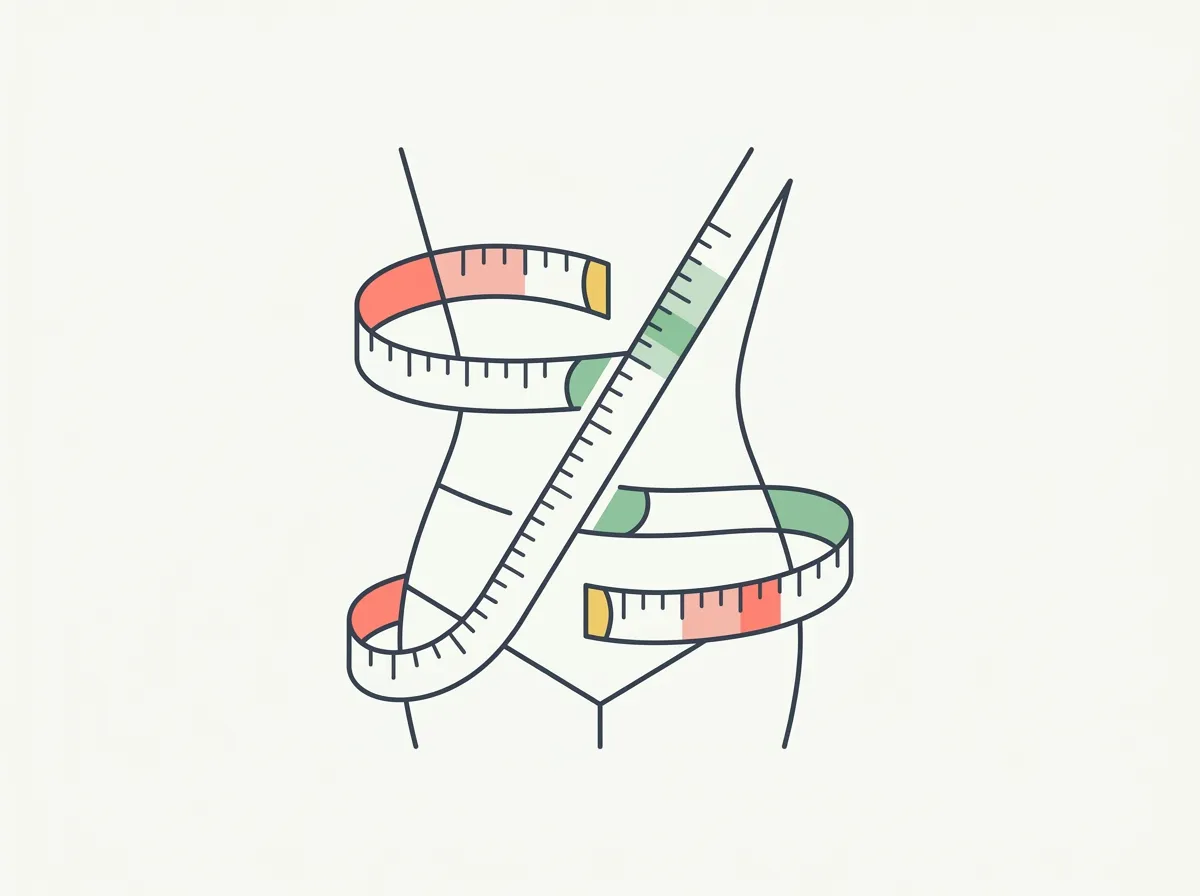
Quick answer: Divide your waist (at the navel) by your hips (widest point of the buttocks). Commonly used clinical cutoffs flag ratios above roughly 0.90 in men and 0.85 in women as elevated risk. Below those bands, your fat distribution pattern is unlikely to be a health concern on its own.
Calculate your waist-to-hip ratio
For adults. Waist-to-hip ratio is a screening tool, not a diagnosis. The cutoffs are commonly used population-level thresholds; different bodies of guidance draw the lines slightly differently.
Two people can weigh the same, stand the same height, and even carry the same body fat percentage — and one of them is at meaningfully higher metabolic risk than the other. The difference is where the fat sits, and the cheapest instrument ever devised for detecting it is a tape measure used twice and one division.
That's the waist-to-hip ratio. This page gives you the chart for both sexes, the commonly used cutoffs, the measuring protocol that makes the number trustworthy, and an honest answer on how much of it you can change.
One distinction before anything else, because the two get merged constantly: this is a different number from the waist-to-height ratio. Waist-to-height screens how much central fat you carry for your frame — waist under half your height. Waist-to-hip describes the pattern: whether your body parks its fat at the abdomen or at the hips. Height tells you how much; hips tell you where.
What is the waist-to-hip ratio?
Waist circumference at the navel, divided by hip circumference at the widest point of the buttocks. That's the entire formula.
A 32-inch waist over 40-inch hips is 0.80. A 38-inch waist over the same 40-inch hips is 0.95. Same hips, six inches of waist — and the ratio has moved from comfortably favorable to past every commonly cited cutoff for both sexes.
Why does this crude division predict anything? Because the two measurements sample two very different fat depots. The waist wraps around abdominal fat, including the visceral fat packed around the organs — the metabolically active, risk-carrying kind. The hips wrap around subcutaneous fat and gluteal muscle, a store research generally treats as far more benign. Divide one by the other and you get a rough index of how your total fat splits between the risky depot and the neutral one.
What is a healthy waist-to-hip ratio?
Commonly used clinical cutoffs — the WHO-style bands most screening guidance is built on — look like this:
| Band | Men | Women |
|---|---|---|
| Generally favorable | under ~0.90 | under ~0.80 |
| Borderline / moderate | ~0.90–0.99 | ~0.80–0.85 |
| Commonly flagged as elevated risk | ~1.0+ | ~0.85+ |
Read these as commonly used screening thresholds rather than medical advice. They come from population-level research, different bodies of guidance draw the lines slightly differently, and a ratio near a boundary is a prompt to look closer rather than a verdict. Someone with a ratio just past the line but a small waist and a waist-to-height ratio under 0.5 is in a very different position than someone over on every measure.
The reason women's cutoffs sit lower is the same reason the ratio exists at all: female fat distribution is typically hip-dominant, so a female ratio approaching 0.85 signals more of a shift toward abdominal storage than the same number would in a man.
Are you an apple or a pear?
Those bands describe the two classic distribution patterns.
Apple — fat concentrates at the abdomen, the ratio runs high. This pattern carries more visceral fat, and research generally associates it with higher metabolic risk. It's more common in men and becomes more common in women after menopause, when fat storage tends to shift toward the midsection.
Pear — fat concentrates at the hips and thighs, the ratio runs low. This fat is subcutaneous, appears relatively inert, and research generally associates the pattern with lower metabolic risk at the same total body fat. The mechanism is covered in our visceral vs subcutaneous fat guide, and the hip side of the tape gets its own treatment in the average hip size post.
The ratio also has a life outside the clinic: older attractiveness research commonly cited a ratio around 0.7 as the most-preferred female figure across several studies — a finding about aesthetic preference that sits well below, and entirely apart from, the 0.85 health line. For men, the aesthetic ratio that dominates is a different one entirely — shoulders over waist, covered in our shoulder-to-waist ratio guide.
How do you measure both numbers correctly?
The ratio is only as good as its two inputs, and each input has a classic error. For the waist, it's measuring where your pants sit instead of the navel. For the hips, it's measuring the hip bones instead of the widest point below them.
- Waist: tape at navel level, parallel to the floor, standing relaxed. Exhale normally and read at the end of the breath — no sucking in.
- Hips: feet together, tape around the widest point of the buttocks. Find it from the side in a mirror, then slide the tape up and down and keep the largest reading.
- Snug on both, compressing on neither. A tape that dents the skin reads low.
- Same conditions every time — morning, before food. Waists swing an inch or more through a day; hips barely move, so a sloppy waist reading distorts the whole ratio.
- Divide waist by hips. Track it monthly — the ratio moves slowly, and chasing it weekly just measures noise.
If your waist number surprises you, that's normal — commonly cited survey averages run around 40 inches for US men and 38–39 for US women, well above what clothing labels imply.
What does the ratio look like on a body?
Here's the same man at two body fat levels — standardized, photorealistic AI renders from our body fat visualizer — same build, pose, and lighting, so only body fat changes between images. Watch what happens to the waist relative to the hips.
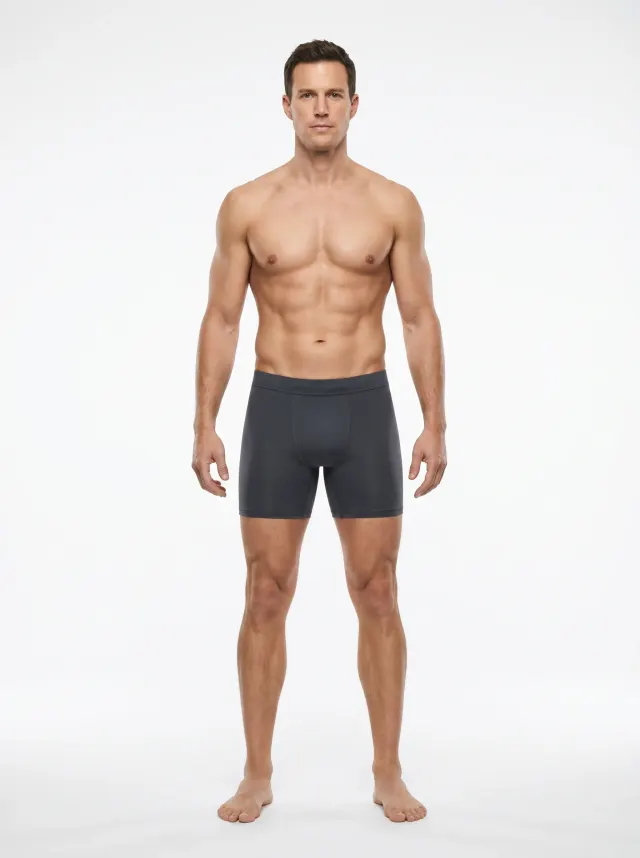
18% body fat — the waist sits inside the hip line, the pattern a waist-to-hip ratio comfortably under 0.90 describes.
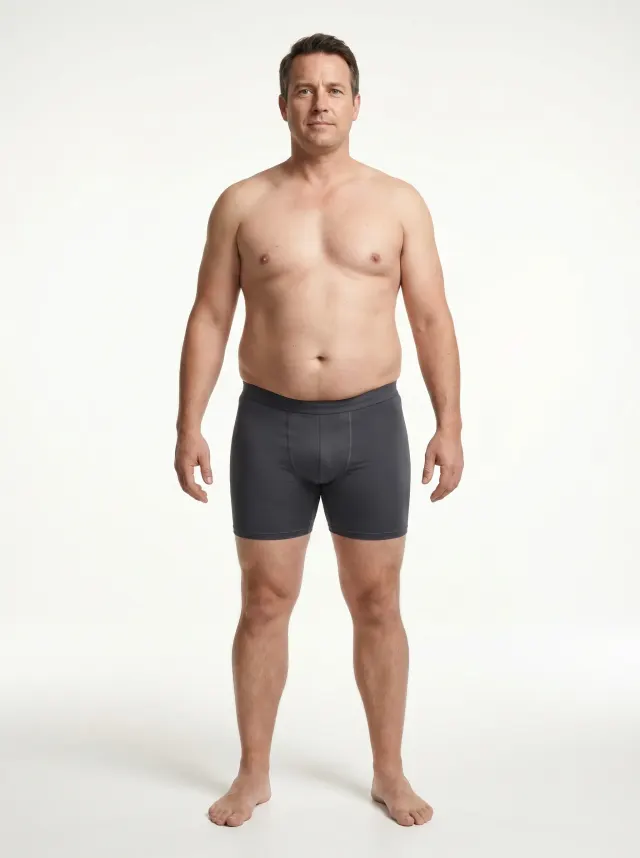
The same frame at 28% — the added fat went overwhelmingly to the waist, pushing it out to meet the hip line. This is the ratio climbing.
The hips changed modestly; the waist absorbed most of the gain. That asymmetry is the whole story of the ratio — and it's also the good news, because it works in reverse.
How do you improve your waist-to-hip ratio?
There are exactly two honest levers, and one of them barely counts.
Lever one: lose body fat. The denominator is mostly structure — pelvis, glutes, slow-moving subcutaneous fat. The numerator is mostly signal. When you drop body fat, the waist typically shrinks several times faster than the hips, so the ratio falls almost as fast as the waist does. For most people the entire project reduces to "get the waist down": a modest, sustained deficit, covered in our first cut guide, or a slower recomposition if you're also building muscle. Spot reduction, for completeness, doesn't work — crunches don't pull fat from the abdomen preferentially.
Lever two: build the glutes. Hip circumference includes muscle, so serious lower-body training can add real inches to the denominator. It's the slower lever by far, and it can't rescue a large waist — but combined with fat loss it moves the ratio from both ends.
What you can't change is the pattern itself. Where your body prefers to store fat is largely set by genetics and hormones — an apple losing 20 pounds is a leaner apple, storing fat in the same places in smaller amounts. That's fine, because the risk research tracks how much fat sits at the waist, and that amount is fully in your control even if the storage order isn't.
Progress on the ratio is slow enough that memory can't track it, which is where photos beat the tape. GainFrame estimates body fat percentage and physique scores from progress photos, so the silhouette change and the numbers sit in one timeline — estimates from photos rather than clinical measurement, but consistent week to week, which is exactly what a slow-moving ratio needs.
Frequently asked questions
What is a healthy waist-to-hip ratio?
Commonly used clinical cutoffs flag ratios above roughly 0.90 in men and 0.85 in women as elevated risk. Ratios comfortably below those bands are generally read as favorable fat distribution. These are screening thresholds from population data rather than diagnoses — a ratio near the line is a prompt to look closer, together with waist size and height.
How do I calculate my waist-to-hip ratio?
Measure your waist at the navel, standing relaxed, at the end of a normal exhale. Measure your hips at the widest point of the buttocks. Divide waist by hips. A 34-inch waist over 40-inch hips gives 0.85. Use the same conditions each time — morning, before food, is the least noisy.
What is the difference between waist-to-hip and waist-to-height ratio?
Waist-to-height screens how much central fat you carry relative to your frame — the common target is a waist under half your height. Waist-to-hip describes where your fat sits: abdomen versus hips. The two answer different questions, and clinicians commonly look at both. If you only track one number, waist-to-height is the simpler starting point.
Can you change your waist-to-hip ratio?
Yes, mostly through the numerator. Losing body fat tends to shrink the waist faster than the hips, because abdominal fat is often the first store to respond to a deficit. Where your body prefers to keep fat is largely set by genetics and hormones, so the realistic lever is carrying less fat overall rather than relocating it.
Why is 0.7 considered ideal for women?
Older attractiveness research commonly cited a ratio around 0.7 as the most-preferred figure for women across several studies, which is why the number circulates so widely. That's a finding about aesthetic preference in study conditions, separate from the health cutoffs — the commonly used clinical line for women sits at about 0.85, well above it.
Watch the ratio change, photo by photo
GainFrame estimates body fat percentage and physique scores from your progress photos — so a shrinking waist shows up as visible, tracked change against the hips that stay put. Free to start on iOS.
Download GainFrame Free