
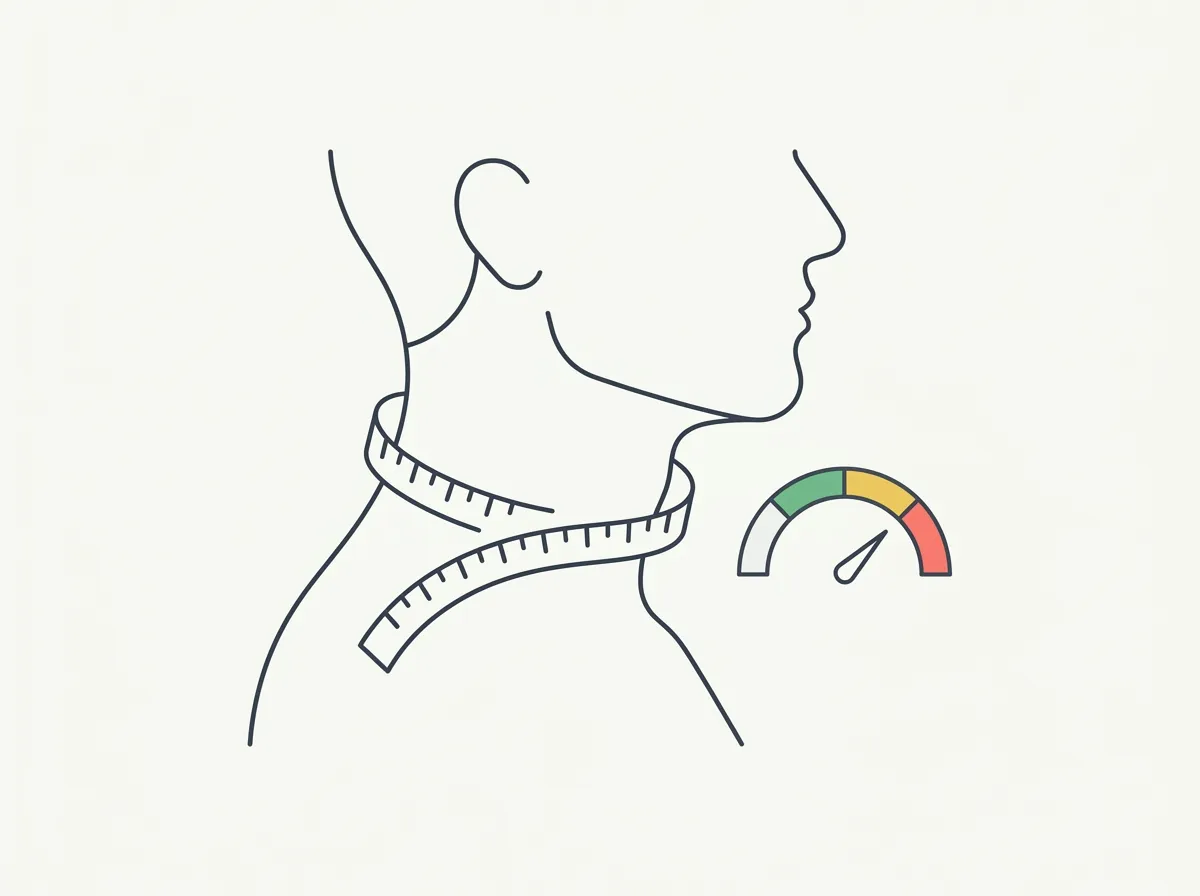
Quick answer: Commonly cited measurement data puts the average adult male neck around 15 to 16 inches, measured just below the Adam's apple. Research commonly flags 17-plus inches as a health marker on untrained frames, while the same number on a lean lifter is simply a trained neck. Body composition decides which story your number tells.
Your dress shirt says 15.5. The sleep apnea questionnaire at the doctor's office asks whether your collar is over 17. The old-school lifting forums treat 18 as a badge of honor.
Same measurement, three completely different meanings — and the difference between "trained" and "health flag" isn't the number on the tape. It's what the rest of your body composition says about where that circumference came from.
What is the average neck size for men?
Commonly cited measurement data and a century of dress-shirt sizing agree: the average adult male neck runs around 15–16 inches, taped just below the Adam's apple. Most off-the-rack collar ranges center on 15.5 for a reason.
Two things move the average, and both are worth knowing before you compare. First, body weight: the neck carries a real layer of subcutaneous fat, so circumference climbs as overall body fat climbs — commonly a quarter to half an inch per ten pounds gained. Second, age drifts the number up through midlife for exactly the same reason, then muscle loss pulls it back down past 60.
The honest baseline: an untrained man at a healthy weight typically tapes somewhere around 14.5–15.5 inches. Readings meaningfully above that are either training, fat, or a thick frame — and the tape alone can't say which.
Is a 17-inch neck big?
Yes — an inch-plus over the commonly cited average puts you noticeably above most men. Whether that's good news depends entirely on context.
On a lean, trained body, a 17-inch neck reads as athletic: necks respond to heavy compound lifting, direct work, and contact sports, and a thick neck on a defined frame is one of the strongest "this person trains" signals there is. Rugby players and wrestlers routinely carry 18-plus lean.
On an untrained frame, the same 17 inches usually arrived with body fat — and that's where health research starts paying attention. Studies commonly flag neck circumference above roughly 17 inches in men (16 in women) as a marker associated with higher risk of obstructive sleep apnea and cardiometabolic issues, because neck circumference tracks upper-body fat specifically. It's a screening correlation, not a diagnosis — but it's the reason the sleep clinic asks about your collar size and not your bicep.
Same tape reading, opposite interpretations. The deciding variable is body fat, and if you don't know yours, the free browser body fat estimator reads it from a single photo — one scan a day, no signup.
Why does the Navy body fat formula use your neck?
The Navy tape method — still one of the most-used field estimates of body fat — needs exactly two circumference numbers for men: waist and neck. That pairing isn't arbitrary, and understanding it explains most of what neck size means.
Your waist circumference rises steeply with body fat: the abdomen is where men preferentially store it. Your neck rises much more slowly with fat but carries proportionally more lean tissue. So the gap between waist and neck isolates a fat signal: a big waist over a small neck estimates high body fat, while a modest waist under a thick neck estimates low. It's why two men with identical waists can get very different Navy numbers, and why neck training technically lowers your estimated body fat without changing your actual composition — a known quirk of the formula.
The method's weakness is the same as every tape method: it infers composition from two points on a three-dimensional body. Photo-based AI estimation attacks the same problem with more information per check-in; our guide to every way to measure body fat compares the accuracy trade-offs honestly, method by method.
Can you train your neck bigger?
Yes — the neck is one of the more responsive muscle groups when you actually train it, which almost nobody does.
Indirect work moves it first: heavy deadlifts, rows, shrugs, and farmer carries load the traps and the stabilizing musculature enough that most lifters gain some neck in their first serious year. Direct work — neck curls and extensions, done light and controlled — is what separates the 17-inch necks from the 15.5s; commonly a half inch to an inch of growth in a year of consistent direct training. Go gradually: the neck recovers well but punishes ego loading.
Shrinking a soft neck works the same way as everywhere else. There is no spot reduction; neck circumference falls with overall fat loss, and it falls early — the neck is commonly one of the first places visible leaning shows. Track it monthly during a cut and it doubles as a cheap progress marker.
How do you measure your neck correctly?
- Tape just below the Adam's apple, at the narrowest visible point of the neck.
- Look straight ahead, shoulders relaxed. Tilting your chin down adds material; shrugging pulls the traps into the loop.
- Snug, not compressing. The tape should sit flat on the skin all the way around, no dimpling.
- Cold and consistent — same time of day, since water and a training pump both nudge the reading.
- Monthly. Pair it with your waist number; the two together say more than either alone.
If you're tracking a cut or a recomp, that waist-plus-neck pair is exactly what the Navy formula reads — and the trend in the gap matters more than either absolute number.
How do you know what your neck size actually means?
One tape number can't separate trained thickness from stored fat. The rest of your composition can.
GainFrame reads that context from a photo: estimated body fat percentage, FFMI, and 12 individual muscle group ratings per check-in, so a 17-inch neck lands next to the numbers that interpret it — lean and trained, or a flag worth acting on. Estimates from photos, not clinical measurement, but consistent check-in to check-in, which is what a trend needs.
Frequently asked questions
What is the average neck size for a man?
Commonly cited measurement data and dress-shirt sizing both center the average adult male neck around 15 to 16 inches, measured just below the Adam's apple. The number climbs with body weight — neck circumference tracks upper-body fat closely — and with age through midlife for the same reason.
Is a 17 inch neck big?
Yes — roughly an inch or more above the commonly cited average. What it means depends on the body attached to it. On a lean, trained man it reads as athletic thickness. On an untrained frame with a soft midsection, research commonly treats 17-plus inches as a marker worth checking, since neck circumference correlates with sleep apnea and cardiometabolic risk.
Does neck size matter for health?
Research suggests it does as a rough screening marker. Neck circumference correlates with upper-body fat, and studies commonly flag values above roughly 17 inches in men (16 in women) as associated with higher risk of obstructive sleep apnea and cardiometabolic issues. It is a correlation and a screening signal, not a diagnosis — context and body composition matter.
Why does the Navy body fat formula use neck size?
The Navy tape method estimates body fat from the contrast between waist and neck circumference. The waist grows mainly with fat, while the neck carries proportionally more lean tissue — so subtracting neck from waist isolates a fat signal. It is why a thick neck lowers your Navy estimate and a soft waist raises it.
Can you make your neck bigger or smaller?
Both, within limits. Direct neck training and heavy compound work commonly add half an inch to an inch over a year or two — wrestlers and rugby players prove the ceiling is higher. Shrinking works the same way as everywhere else: neck circumference drops with overall fat loss, commonly about a quarter to half inch per 10 pounds lost.
Put your neck number in context
GainFrame estimates body fat, FFMI, and 12 muscle group ratings from a photo — the context that decides whether your neck size is trained thickness or a flag. Free to start on iOS.
Download GainFrame Free