
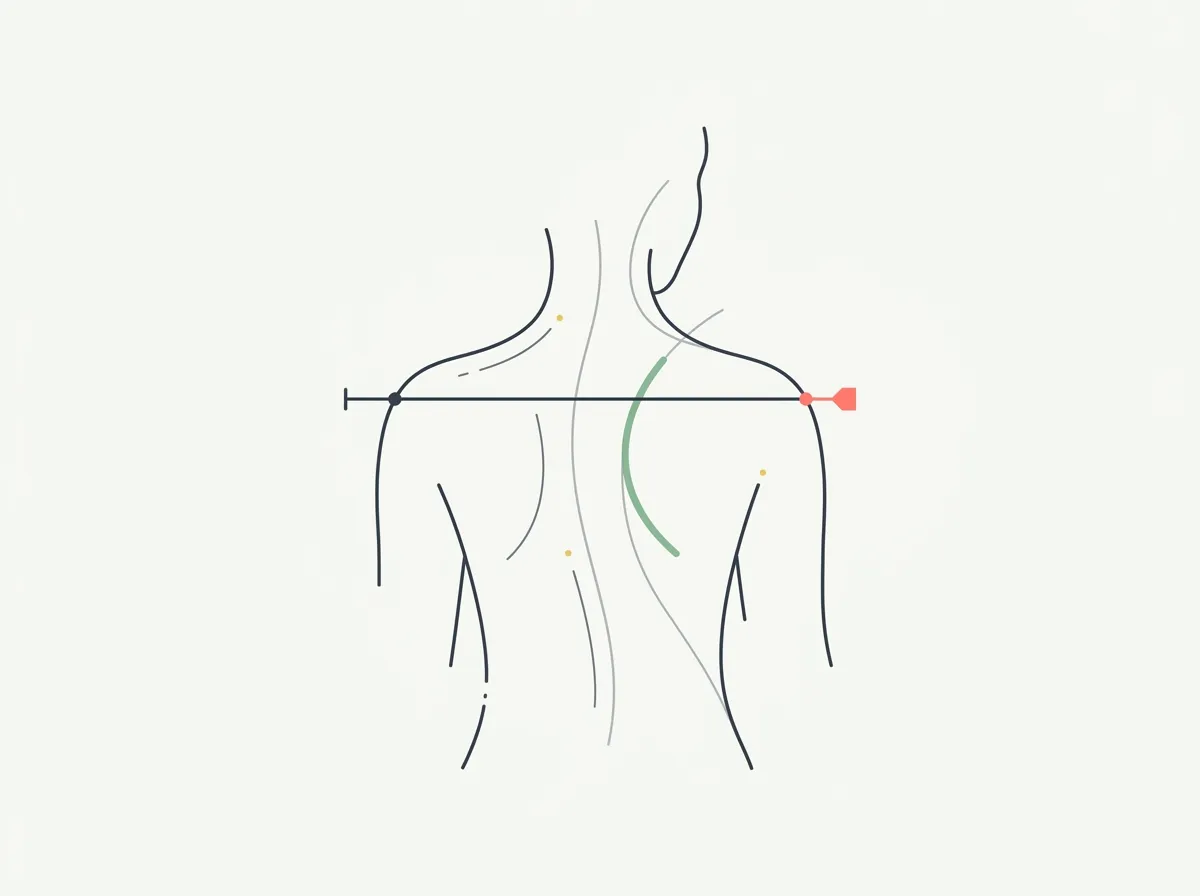
Quick answer: Commonly cited measurement data puts the average adult woman's biacromial width — bone to bone across the shoulder tips — around 14 to 15 inches. Shoulder circumference, taped around the delts, is a different, much larger number. Bone width is fixed after growth; what reads as broad is usually posture and proportion, and delt training adds shape, never accidental bulk.
Search "average shoulder width women" and you'll hit the same trap the men's version of this question has: one site says 14 inches, another says 39, and neither tells you they're measuring different things. Then there's the reason many women search this at all — the quiet worry that their shoulders are too broad, usually formed in a fitting room or a group photo rather than with a tape measure.
Both deserve straight answers. We covered the male numbers in our average shoulder width guide; this page is the female version — the real measurements, what "broad" actually consists of, and what training does and doesn't change.
What is the average shoulder width for women?
There are three different numbers that all get called "shoulder width," and most of the confusion in this topic is people comparing one against another.
Biacromial width — the straight-line, bone-to-bone distance between the bony points at the top of each shoulder — is the skeletal measurement. Commonly cited survey data puts the adult female average around 14 to 15 inches, with most women falling within roughly an inch and a half of that band. This is the number your frame was dealt. It's set when growth plates close, and no exercise, diet, or posture drill moves it.
Shoulder circumference — a tape wrapped horizontally around the widest point of the shoulders and delts — is the trainable measurement. It runs far larger than biacromial width because it travels the full loop of delts, chest thickness, and upper back, and it varies widely with height, muscle, and body fat. Two women with identical skeletons can tape several inches apart here.
Garment shoulder width — the seam-to-seam measurement on a size chart — is a third number, larger than biacromial breadth because it spans the outside of the deltoids plus ease. A jacket chart saying "shoulder: 16.5 inches" says almost nothing about your bones.
Before you compare yourself to any chart, confirm which of the three it's using. An "average" that mixes them is noise.
Are your shoulders actually broad?
Here's the part worth slowing down for, because the anxiety version of this question rarely survives contact with a tape measure.
Bone-to-bone, "broad" means measurably above the commonly cited average — roughly an inch or more past the 14–15 inch band. That describes a minority of women, and if you're in it, that's a skeletal trait as neutral as height. Swimmers, throwers, and gymnasts are disproportionately built on exactly that frame, and half of fashion's most photographed silhouettes depend on it.
But most women who feel broad-shouldered are reading proportion and posture rather than bone. A few things inflate the read:
- Shoulder-to-hip contrast. Shoulders at a dead-average 14.5 inches look wide over narrow hips and unremarkable over wider ones. The judgment your eye makes is a ratio, and the denominator is doing half the work.
- Posture. Shoulders held square and back present their full line; the same skeleton rounded forward can appear an inch or more narrower — which is why "broad" often arrives with good carriage, and why slouching to hide it trades a neutral trait for a worse one.
- Garment comparison. Clothing is cut for a middling frame. Sleeves that pull across average-plus shoulders create a "too broad" feeling that's really a sizing mismatch.
If the concern is live for you, measure before you conclude. A number within the average band relocates the whole question from your skeleton to your styling.
Will training make your shoulders bigger or bulky?
Accidentally — no, and this deserves the same directness we gave it in our women's recomposition guide. Women naturally produce a fraction of the testosterone men do, which makes rapid, unintended muscle gain essentially impossible. Visible delt development takes most women months to years of deliberate, progressive work. Nobody stumbles into capped shoulders from two dumbbell sessions a week.
What balanced delt training actually produces is shape: a defined line at the top of the arm, a squared-off look that carries clothes well, and — the underrated part — a waist that reads smaller by contrast. For women who feel their shoulders are already prominent, skipping delt work entirely tends to backfire; a soft, untrained shoulder over a broad frame reads larger than a defined one, and balanced lower-body training (glutes, hips) adjusts the proportion from the other end. Our women's proportions guide covers that shoulder-hip balance in full.
One neutral note on shape vocabulary: roughly equal shoulder and hip lines get called hourglass or X-frame, wider shoulders get called inverted triangle, wider hips pear. These are descriptions of skeletons, with no ranking attached — every one of them shows up on healthy, strong, athletic women. Training shifts the soft tissue on either end of the ratio; the hip side has its own numbers, and so do arms.
How do you measure your shoulder width correctly?
For circumference — the number that responds to training:
- Stand relaxed, arms at your sides. No shrug, no flare, no breath-hold.
- Wrap the tape around the widest point of both delts, level with the top of your armpits.
- Keep the tape parallel to the floor all the way around — check in a mirror; a drooping tape reads long.
- Snug, not compressing, and cold rather than post-workout — a pump commonly adds an inch that's gone by morning.
- Monthly, alongside waist and hips. The proportions between the numbers say more than any of them alone.
For biacromial width, you need a second person and a rigid ruler: feel for the bony point at the top of each shoulder (the acromion) and measure the straight line between them. Measure it once for context — it will never change again.
How do you know what's changing on your frame?
The tape wraps delts, back thickness, and the fat over all of it into one number. Whether a shoulder trend is muscle, water, or weight takes a second signal — and posture, which shapes half the visual, never shows up on a tape at all.
Photos catch what the tape misses. GainFrame reads progress photos and rates 12 muscle groups individually — front delts and side/rear delts among them — alongside an estimated body fat percentage, so you can see whether the shoulder line is developing, the frame is leaning out, or both. Estimates from photos rather than clinical measurement, but for tracking your own trend against your own baseline, consistent photos settle the question the mirror keeps reopening.
Frequently asked questions
What is the average shoulder width for a woman?
Measured bone-to-bone across the acromion processes, commonly cited survey data puts the average adult woman around 14 to 15 inches, with most women within roughly an inch and a half of that. Shoulder circumference — a tape wrapped around the delts — is a separate, much larger number that varies with muscle and body fat, so check which one your source means.
What counts as broad shoulders for a woman?
Bone-to-bone, roughly an inch or more above the commonly cited 14–15 inch average reads as genuinely broad-framed. But most "broad" judgments are visual, driven by shoulder-to-hip proportion, posture, and garment fit rather than the skeletal number. Many women who feel broad-shouldered measure close to average and simply have narrower hips or an upright carriage.
Can a woman make her shoulders narrower?
The bone width can't shrink — biacromial breadth is set once growth ends. What can change is the read: losing body fat slims the tissue over the shoulder line, building glutes and hips shifts the shoulder-to-hip proportion, and posture work changes how squared-off the line appears. The frame itself is permanent, and plenty of athletes build their look on exactly that frame.
Will lifting weights give a woman broad shoulders?
Accidentally, no. Women's naturally lower testosterone makes rapid, unintended muscle gain essentially impossible — visible delt development takes most women months to years of deliberate training. What a few sets of lateral raises and presses per week actually produces is shape: a defined shoulder line that makes waists look smaller. Bulk at the scale competitors show is built on purpose, over years.
How do you measure shoulder width correctly?
For skeletal breadth, have someone measure the straight line between the bony points at the top of each shoulder with a rigid ruler. For circumference, stand relaxed with arms down and wrap a tape horizontally around the widest point of both delts, parallel to the floor, snug without compressing. Record which measurement you took — the two aren't comparable.
See your shoulder line change
GainFrame rates your delts — and 9 other muscle groups — from a progress photo, next to estimated body fat, so you can watch shape develop on your frame over weeks. Free to start on iOS.
Download GainFrame Free