
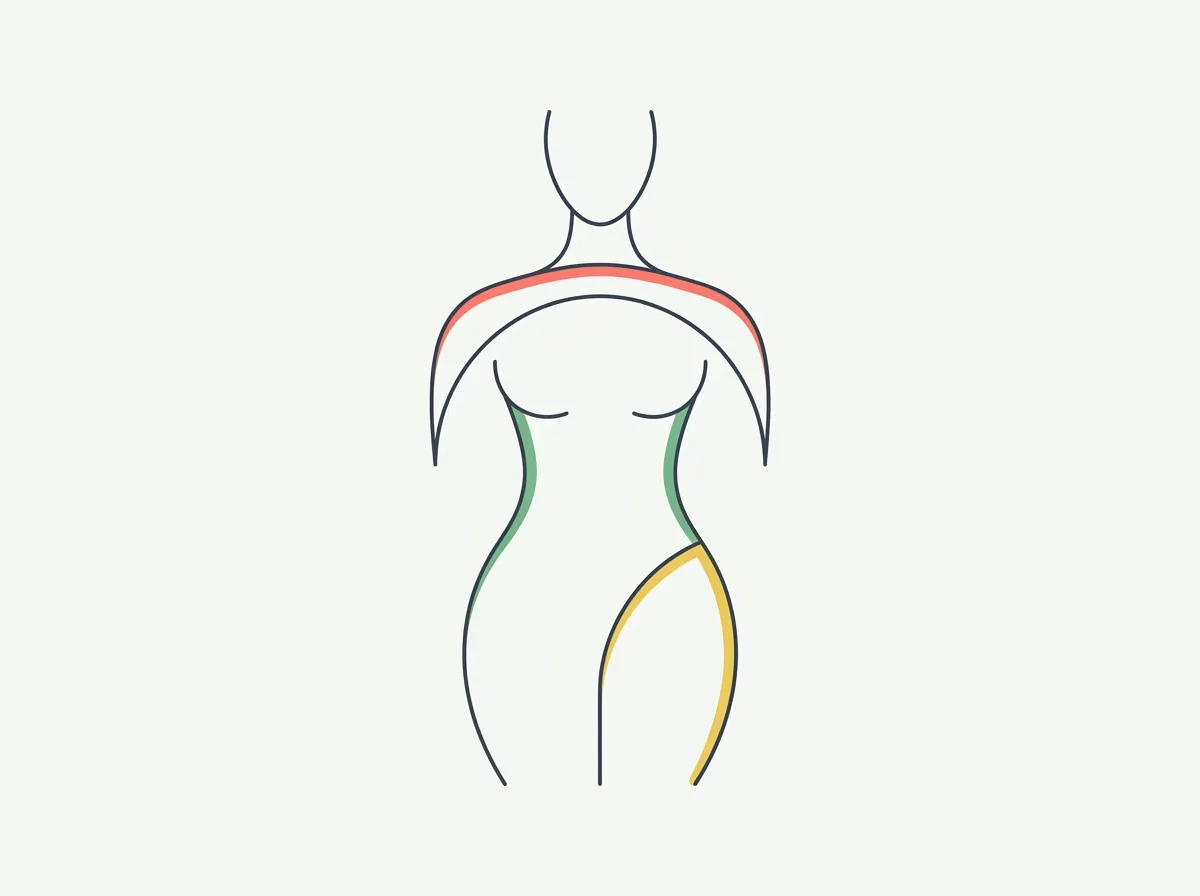
Quick answer: There is no single set of ideal body measurements for women. The classic 36-24-36 is a dated cliché, and the 0.7 waist-to-hip figure comes from older attractiveness research. The framings that hold up are relative to your own frame: waist under half your height, waist-to-hip ratio in a healthy band, and shoulder-hip balance.
Type "ideal body measurements women" into a search bar and the top results still serve numbers coined when your grandmother was buying records: 36-24-36, celebrity charts, calculators that grade you against a 1950s pageant stage. Measure yourself against them and the most likely outcome is feeling wrong about a body that's completely fine.
So this page does something different. It names the old conventions for what they are, gives you the two or three ratio framings that actually survive scrutiny, and gets specific about which proportions training can move and which ones your skeleton decided years ago.
Is there such a thing as ideal body measurements for women?
As a fixed set of numbers — no. A 24-inch waist means completely different things on a 5'1" frame and a 5'10" frame. Bust and hip measurements are dominated by skeletal width and genetically-set fat distribution, which vary enormously between perfectly healthy women. Any chart that hands every reader the same three numbers is describing one body type and grading everyone else against it.
What does exist is a handful of proportion relationships — ratios between your own measurements — that carry real information. Waist relative to height tracks health risk. Waist relative to hips describes fat distribution, which matters clinically. Shoulder relative to hip describes shape, with no health content at all. Those are worth knowing. A stranger's tape measurements are not.
That's the frame for everything below: your measurements compared to your measurements. The averages — and we have full pages on the average waist, average hips, and average arms for women — are context, never targets.
What are the average body measurements for women?
Averages are a different question from ideals, and they are worth knowing because they anchor everything else. US health survey data measures a population that is heavier than the pageant-era charts assume:
| Measurement | Commonly cited US average | How it's measured |
|---|---|---|
| Height | ~5'3.5" | Standing, no shoes |
| Waist | ~38.7 inches | At the iliac crest (NHANES 2015–2018) |
| Hips | ~40–42 inches | Widest point of the buttocks, feet together |
Notice the gap: the "ideal" 36-24-36 waist is nearly 15 inches smaller than the measured average. That gap is the whole argument of this page — a chart number that almost nobody measures near is a prescription without a patient. The deeper dives on each number live in the average waist size for women and average hip size for women pages.
Averages describe what is, and health thresholds describe what matters: guidance commonly flags waists over 35 inches in women as elevated metabolic risk regardless of build, and a waist under half your height is the more personal version of the same check.
Where did 36-24-36 and the 0.7 ratio come from?
The 36-24-36 figure is a mid-twentieth-century artifact — pageant measurements, pin-up copy, and Hollywood studio publicity, repeated until it hardened into a default. It describes a specific hourglass frame at one era's media preference. It was never a health standard, never a population average, and survey data suggests the average American woman's actual measurements sit well away from it — closer to a 38–39 inch waist and 40–42 inch hips. As a target, it's a dated cliché; treat it as trivia.
The waist-to-hip ratio around 0.7 has slightly better paperwork: older attractiveness research commonly cited it as an average of rated preferences across studies — though an average of preferences is a description of raters, never a prescription for bodies. Clinically, the waist-to-hip number that matters is different and much more forgiving: guidance commonly flags ratios above roughly 0.85 in women as elevated risk. Our waist-to-hip ratio guide covers the measurement and thresholds properly.
Notice what both conventions share: they were built by other people looking at women, and neither one tells you anything about your health, strength, or trajectory.
Which proportions actually mean something?
Three relationships do real work, in descending order of stakes.
Waist-to-height — the health one. Keep your navel waist under half your height. That's roughly 31 inches at 5'2", 32 at 5'4", 33 at 5'6", 34 at 5'8". It scales to your frame automatically, and it's the strongest simple signal on this page because waist circumference proxies abdominal fat — the kind that matters metabolically. The waist-to-height guide has the full chart. Guidance also commonly flags waists over 35 inches in women as elevated risk regardless of height.
Waist-to-hip — the distribution one. Below the ~0.85 clinical band, this ratio is mostly a shape descriptor. Fat stored at the hips and thighs carries less metabolic risk than fat stored at the waist, so two women at the same body fat percentage can have meaningfully different ratios purely from genetics — and both can be fine.
Shoulder-to-hip — the shape one, zero health content. Roughly equal shoulder and hip lines read as the classic hourglass or athletic X-frame; wider hips read pear; wider shoulders read inverted triangle. Every one of those is a skeleton doing its job. It's worth understanding only because it's the proportion training can visibly shift — more on that below, and our women's shoulder width guide covers the top half of the equation.
What can training change and what is skeletal?
Your rib cage, pelvis width, hip bone structure, and shoulder bone width are fixed once growth ends. No workout narrows a pelvis; no diet shrinks a rib cage. If your hips are wide because your iliac crests are wide, that is permanent — and it's also the foundation of the waist-to-hip ratio charts flatter.
Everything layered on top is trainable. Glute work adds to the hip line and lifts it. Delt and upper-back work adds to the shoulder line, which balances a wider-hipped frame if that's the shape you want. And fat loss shrinks the waist faster than any other lever moves anything — which improves both meaningful ratios at once. Muscle changes where inches sit; body fat changes how many there are.
Here's what that composition lever looks like with the skeleton held perfectly constant. These are standardized, photorealistic AI renders from our body fat visualizer — same build, pose, and lighting, so only body fat changes between images.
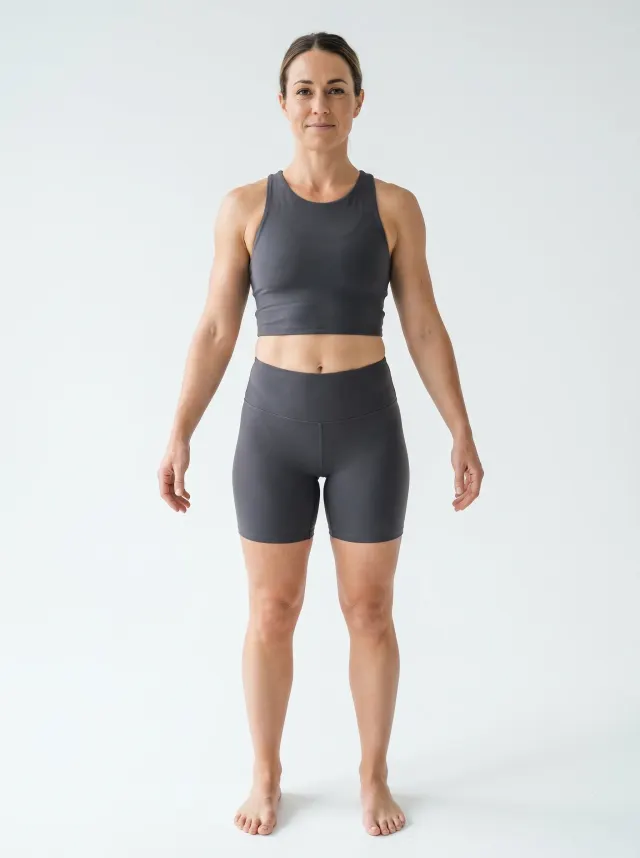
Around 27% body fat — squarely in the healthy average range for women. The waist-hip difference is present; the tape just reads it with a wider waist number.
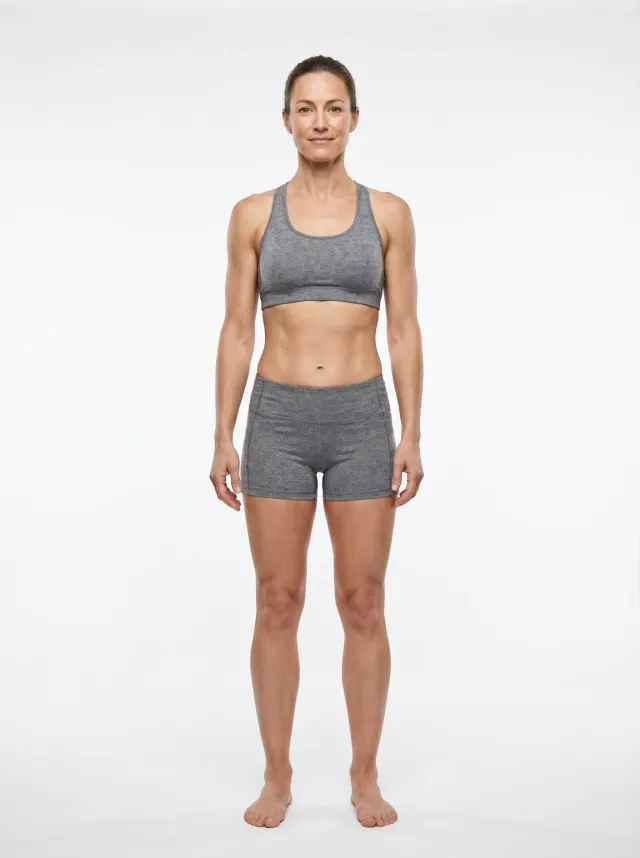
The same skeleton at 22% — the fitness range. Nothing about her frame changed. The waist came in, both ratios improved, and the shape the old charts were chasing showed up on her proportions, at her numbers.
The pelvis, rib cage, and shoulders in those two images are identical. That's the honest summary of this entire topic: the proportions people chase are mostly a body composition outcome expressed on whatever frame you have. If that's the project you want, body recomposition is the strategy built for it.
How should you track proportions without the chart nonsense?
Tape your waist at the navel and your hips at the widest point, monthly, same conditions. Two numbers, two ratios, trend over time — that's the whole quantitative program, and it beats any celebrity chart ever printed.
The part the tape misses is shape — where the inches moved, whether shoulders and glutes are coming up, whether the change is composition or just size. GainFrame reads that from progress photos: estimated body fat percentage, ratings across 12 muscle groups including glutes and delts, and aligned side-by-side comparisons, so the proportion trend is visible instead of imagined. Estimates from photos rather than clinical measurement — but consistent week to week, which is what a trend needs.
Frequently asked questions
What are the ideal body measurements for a woman?
There is no single set. The 36-24-36 figure is a mid-century pageant and pin-up cliché that describes a specific frame at a specific era's preference — most healthy, fit women have never had those numbers. The framings that hold up are frame-relative: waist under half your height, waist-to-hip ratio in a healthy band, and balance between shoulders and hips.
What is the ideal waist-to-hip ratio for women?
Older attractiveness research commonly cited a waist-to-hip ratio around 0.7 as a preference average — an average across many raters, never a requirement. The number with real stakes is clinical: guidance commonly flags ratios above roughly 0.85 in women as elevated health risk. Below that band, your ratio is a shape descriptor rather than a problem.
What are hourglass measurements?
Hourglass conventionally describes bust and hips within an inch or two of each other with a waist substantially smaller — commonly cited as roughly 9 or more inches of difference. It's one of several common shape patterns, driven mostly by skeletal structure and genetically-set fat distribution. Surveys of actual body scan data commonly find it's far from the most common female shape.
Can you change your body proportions with training?
The soft tissue, yes — the skeleton, no. Rib cage, pelvis width, and shoulder bone width are fixed after growth ends. Training builds glutes, delts, and back, which visibly shifts shoulder-hip-waist balance, and fat loss shrinks the waist faster than any other lever. Most visible proportion change in adults comes from those two inputs.
What is a healthy waist size for a woman?
The most useful rule is frame-relative: keep your navel waist under half your height — roughly 32 inches at 5'4", 33 at 5'6". Guidance also commonly flags waists over 35 inches in women as elevated risk regardless of height. Both thresholds are health markers, and neither requires anything close to a 24-inch waist.
Track your proportions, skip the pageant chart
GainFrame estimates body fat and rates 12 muscle groups from your progress photos — so waist, shoulders, and glutes get tracked as a trend on your frame, against your own baseline. Free to start on iOS.
Download GainFrame Free