
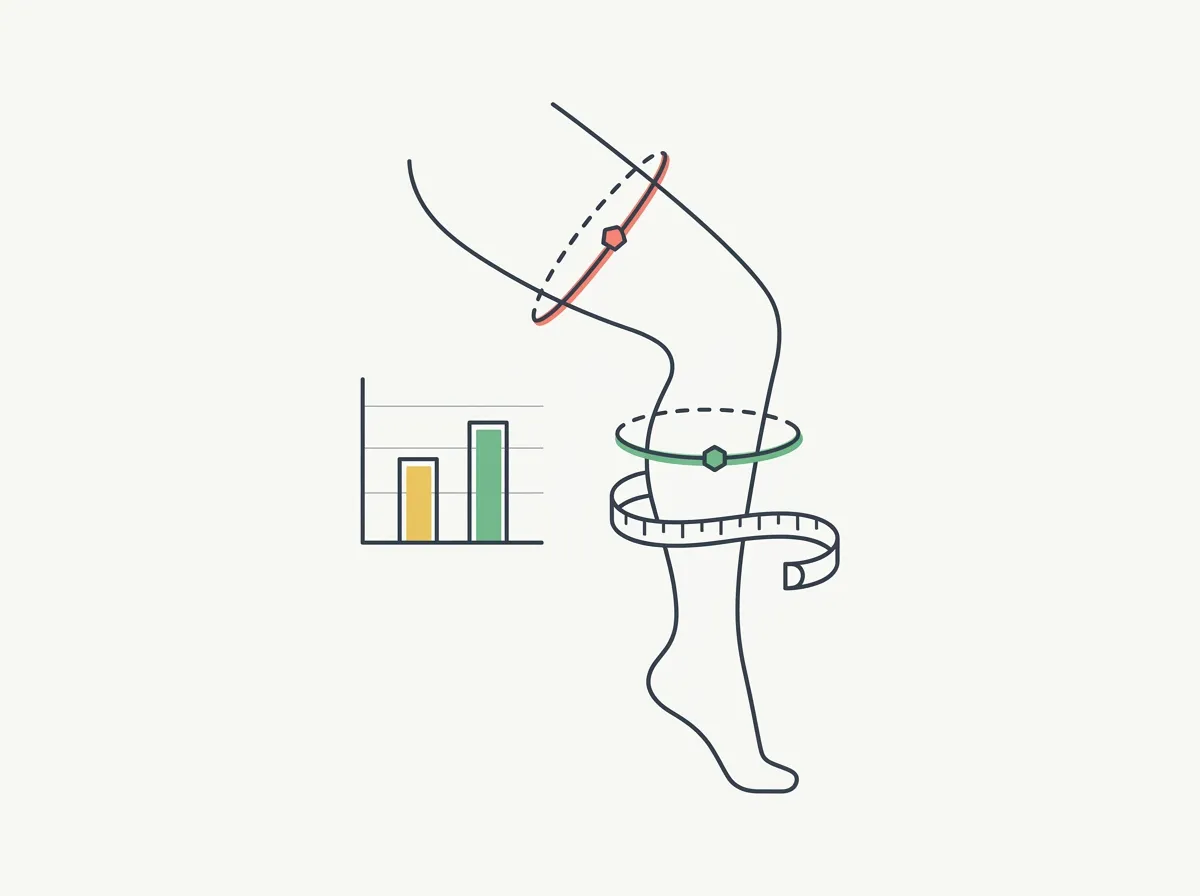
Quick answer: Commonly cited measurement data puts the average adult male thigh around 21 to 23 inches and the average female thigh around 20 to 22, measured at the widest point below the glute fold. Average calves run roughly 14 to 15 inches. Interestingly, larger thighs are commonly associated with favorable metabolic markers in research.
You tape your thigh for the first time and read 22.5 inches. Then you stare at the number, because you genuinely have no reference for it. A 40-inch waist means something to you. A 15-inch arm means something. A 22.5-inch thigh could be muscular, could be average, could be a warning sign — you have no idea.
That blind spot exists because thighs get measured far less than waists and arms, and the charts that do circulate rarely say how or where the tape went on. Here's what's average for men and women, how to measure so your number means something, what trained legs actually tape, and the genuinely surprising thing research commonly reports about big thighs.
What is the average thigh size for men and women?
Figures commonly cited from measurement surveys put the average adult thigh at roughly:
| Group | Commonly cited average thigh (widest point) |
|---|---|
| Adult men | ~21–23 in |
| Adult women | ~20–22 in |
Treat those ranges as orientation, not precision. Anthropometric surveys differ in where they place the tape — mid-thigh versus widest point can differ by an inch or more on the same leg — and averages drift with the body weight of the population being measured. Different surveys genuinely produce different numbers, which is why every serious chart hedges.
Two things are worth noticing in that table. First, the male-female gap is small — much smaller than for arms or shoulders — because women commonly carry proportionally more of their body fat in the thighs and hips. Second, the thigh is a big cylinder of muscle and fat, and the tape counts both. A heavier untrained person can out-tape a lean lifter without a single squat. Circumference alone can't tell you which one you are, though a photo can get you close: the free browser body fat estimator reads body fat percentage from a single picture, no signup.
How do you measure your thighs correctly?
Thigh measurements are notoriously noisy because the leg changes diameter fast along its length — move the tape two inches and the reading changes by one. The protocol:
- Stand relaxed, feet shoulder-width, weight even on both legs. No flexing, no shifting your weight onto the other leg.
- Find the widest point of the upper thigh, just below the glute fold. That's the standard most charts assume.
- Wrap the tape parallel to the floor, all the way around. Check in a mirror — a tape that dips at the back reads long.
- Snug, not compressing. Thigh tissue is soft; it's easy to shave half an inch by pulling tight.
- Same leg, same conditions, every time. Cold, before training — leg workouts commonly pump the reading up noticeably — and morning is least noisy.
Write down the conditions with the number. "23.1, right leg, below glute fold, morning" is a data point you can compare next month. "About 23" is a memory.
What do trained vs untrained thighs measure?
Height and body fat both move these numbers, so treat the table as ballparks commonly observed among lifters at moderate leanness rather than a standard to hit:
| Training level | Men (typical) | Women (typical) |
|---|---|---|
| Untrained, healthy weight | ~20–22 in | ~19–21 in |
| 1–2 years of lifting | ~22–24 in | ~21–23 in |
| Advanced, lean | ~24–27 in | ~23–25 in |
The honest readings: the untrained-to-trained jump is modest on the tape — a couple of inches — even though the visual change is large, because trained legs usually get leaner while they get bigger and the two effects partially cancel. And the advanced column assumes leanness; add ten points of body fat and those numbers inflate by an inch or two with no extra muscle underneath.
If proportions are what you care about, thigh size only means something relative to the rest of you — the classic aesthetic templates set thigh targets as ratios against the waist and calves, which our ideal body measurements guide walks through with the actual numbers.
Are big thighs actually good for you?
Here's the part almost nobody expects: for waists, smaller is better, and most people assume every circumference works the same way. Thighs commonly run the opposite direction.
Studies commonly report that larger thigh circumference is associated with more favorable metabolic markers — better blood sugar handling, lower cardiometabolic risk — particularly when comparing people with similar waists. The commonly offered explanation is about what the thigh is made of. Thigh circumference mostly reflects muscle plus subcutaneous fat, and leg muscle is a major site of glucose disposal, while fat stored on the thighs appears metabolically far more benign than the visceral fat that accumulates behind a growing waistline.
Hedge it properly: this is an association in observational research, and an association is a pattern rather than a promise. Nobody's metabolic panel improves because they taped a bigger leg. But the practical takeaway is real — the waist-to-thigh contrast matters more than either number alone, and a training program that builds legs while holding the waist is pushing both in the commonly favorable direction.
Do squats automatically give you big legs?
No — and this myth cuts both ways, disappointing lifters and needlessly scaring everyone else.
Squats are a stimulus, and muscle responds to stimulus slowly. Dedicated beginners commonly add an inch or two of thigh circumference in their first year of consistent leg training with adequate food — and the rate drops sharply after that, the same decay curve arms follow. Nobody stumbles into tree-trunk quads from three sets of squats twice a week; the huge legs you're picturing took years of heavy progressive work, eating to grow, and usually favorable genetics.
The flip side: if your thighs are growing fast on the tape without hard leg training, the tape is most likely measuring fat. Legs tape muscle and fat identically, and only a second signal separates them. GainFrame reads that second signal from progress photos — its AI analysis rates 12 muscle groups individually, legs included, alongside an estimated body fat percentage, so you can see whether the thigh trend is muscle-shaped or fat-shaped. Estimates from photos rather than clinical measurement, but consistent week to week, which is what a trend needs.
What is the average calf size?
Commonly cited figures put the average adult calf around 14 to 15 inches at the widest point — and unlike most measurements on this page, that average barely separates trained from untrained people.
Calves are widely considered the most genetics-bound muscle on the body. How big your calves can get is heavily set by muscle-belly length and where the Achilles tendon inserts — a long muscle belly fills the lower leg, a short one leaves an inch of tendon that no training fills in. Calf size also tracks body weight closely, since calves carry you around all day; heavier people commonly have larger, stronger calves without any training at all.
What training can do: calves respond to volume and full range of motion like any muscle, just modestly — an inch of growth is commonly a multi-year project, and plenty of dedicated lifters get less. Measure at the widest point of the calf, standing, weight even, and apply the same rule as everywhere else: track your own trend and ignore anyone else's genetics. The same is true one joint down at the forearms, the calf's upper-body twin in both stubbornness and genetic lottery, and at the biceps, where the averages surprise people in the opposite direction.
Frequently asked questions
What is the average thigh size for a man?
Commonly cited measurement data puts the average adult male thigh around 21 to 23 inches, measured at the widest point of the upper thigh just below the glute fold. The average includes every body fat level, so heavier men tape larger without carrying more muscle. Consistent lifters at moderate leanness commonly tape 22 to 24 inches.
What is the average thigh size for a woman?
Commonly cited figures put the average adult female thigh around 20 to 22 inches at the widest point. Women commonly carry proportionally more of their body fat in the thighs and hips than men do, so the tape number tracks body weight closely — and it says very little on its own about muscle or fitness.
Are 25 inch thighs big?
For most people, yes. Twenty-five inches sits above the commonly cited 21–23 inch male average, and for a lean lifter it usually means seriously developed quads. The caveat is body fat: thighs tape muscle and fat together, so a 25-inch thigh reads very differently at 15% body fat than at 30%.
Are big thighs healthy?
Often, yes — studies commonly report that larger thigh circumference is associated with more favorable metabolic markers, likely because thighs store muscle and subcutaneous fat rather than the visceral fat that accumulates at the waist. It's an association rather than a guarantee, and it holds best when the waist is under control.
What is the average calf size?
Commonly cited figures put the average adult calf around 14 to 15 inches at the widest point, similar for men and women once body weight is accounted for. Calves are widely considered the most genetics-bound muscle: muscle-belly length and tendon insertion are set early, and training commonly adds only modest circumference.
Know if your leg gains are muscle
GainFrame rates your legs — and 11 other muscle groups — from a progress photo, next to estimated body fat and FFMI. See whether the tape gain is quad or padding. Free to start on iOS.
Download GainFrame Free