
Quick answer: The best fitness app for women depends on which job it's doing. Hevy or Ladder for lifting, GainFrame for tracking visible change, MacroFactor for nutrition, Wild.AI or Flo for cycle-aware planning, Oura for recovery, Nike Training Club or Down Dog at home. Most women need two or three of these.
Search the women's fitness category and you get 28-day challenges, pastel step counters, and a great deal of copy about slimming down. Very little of it is built around the thing that actually produces the look most women describe wanting: muscle, plus moderate leanness.
So this list is sorted by goal, and the goals assume you're training rather than shrinking. Each entry says what the app is genuinely good at and where it falls short. If you want the underlying strategy first, our body recomposition guide for women covers the training and nutrition side that these apps only measure.
Which app should you pick for your goal?
Ratings and rating counts below are from the US App Store at the time of writing and move around.
| Goal | App | iOS rating | Price |
|---|---|---|---|
| Log your own lifting | Hevy | 4.9 (81K+) | Free / Pro |
| Follow a coached program | Ladder | 4.9 (168K+) | Subscription |
| Track visible change | GainFrame | 4.9 (39) | Free / $5.99 mo |
| Nutrition | MacroFactor | 4.8 (19K+) | ~$12/mo |
| Cycle-aware training | Wild.AI | 4.4 (396) | Free / paid tier |
| Cycle tracking | Flo | 4.7 (1.9M+) | Free / Premium |
| Recovery & sleep | Oura | 4.9 (271K+) | Ring + membership |
| Free home workouts | Nike Training Club | 4.8 (279K+) | Free |
| Yoga & mobility | Down Dog | 4.9 (326K+) | Free / subscription |
| Classes & cardio at home | Peloton | 4.9 (813K+) | App subscription |
Goal 1: Strength training
1. Hevy — Best log for running your own program
Platform: iOS & Android · Price: Free tier; Pro optional · iOS: 4.9 stars, 81,000+ ratings
Hevy is a plain, fast workout log, and that's the whole appeal. Build a routine, log sets between rest periods, and watch per-exercise charts show whether your hip thrust is actually progressing or just feels heavy. The free tier is fully usable long-term.
It has no women's programming and no coaching, which is a feature if you already know what you're doing or you're following a written program from elsewhere. The interface asks nothing of you beyond tapping numbers. Strong is the closest rival, compared in Hevy vs Strong.
Best for: progressive overload you can verify week to week. Limitations: brings no program of its own; you need a plan before it's useful.
2. Ladder — Best coached strength programs
Platform: iOS & Android · Price: subscription · iOS: 4.9 stars, 168,000+ ratings
If the blocker is "I don't know what to do in the weight room," Ladder solves the actual problem. You join a coach-led team, get a structured multi-week strength program with video demos, and log against it. Several of the strength and hybrid programs are run by women coaches, and the programming is real lifting — barbells, dumbbells, progression — rather than light-weight circuits marketed as toning.
The rating volume is high enough that it isn't a niche bet. The cost is the obvious tradeoff, and the team format works better for some people than others.
Best for: wanting an actual program written by a coach instead of assembling one. Limitations: subscription pricing sits well above a plain logging app; the social team element is not for everyone.
On the bulky question, once: women produce a fraction of the testosterone men do — commonly cited figures put it around 10–20 times lower — which makes rapid accidental muscle gain essentially impossible. "Toning" and "building muscle" are the same physiological process; there is no separate tone tissue. Lifting heavy is how the shape arrives. More in how to get toned arms.
Goal 2: See whether it's showing up
3. GainFrame — Best for tracking visible physique change
Platform: iOS App Store · Price: Free (25 photos lifetime) with Pro at $5.99/mo or $39.99/yr · iOS: 4.9 stars, 39 ratings
Recomposition is the case where every other number lies to you. You're losing fat and adding muscle at roughly the same rate, so the scale sits still for months while your body changes underneath it. GainFrame reads a progress photo and returns an estimated body fat percentage, FFMI, a 1–100 score, and ratings across 12 muscle groups, so the flat scale stops being the only feedback you get.
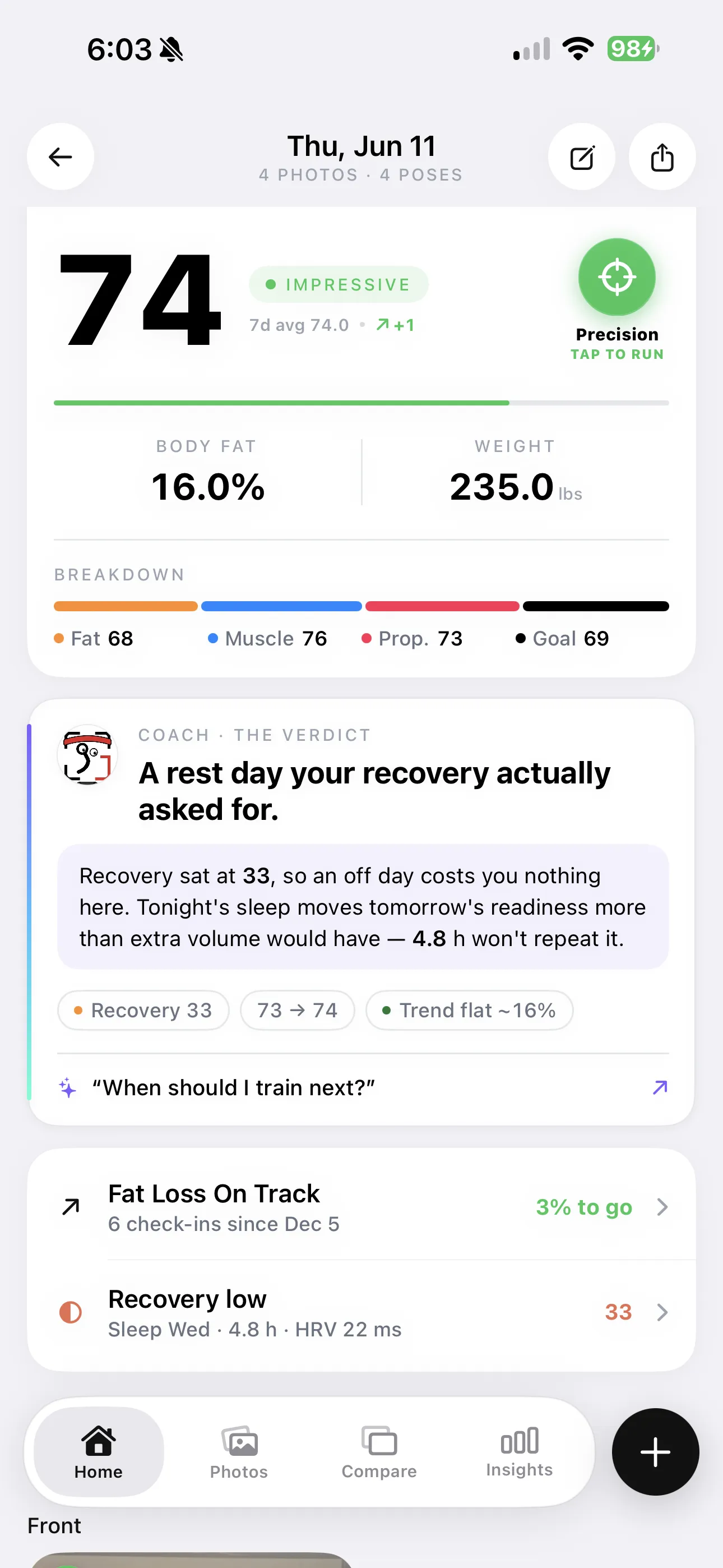
The composition estimate from a single photo — the metric that moves during recomp while body weight doesn't.
The side-by-side comparison is the part worth the install. Two photos eight weeks apart, aligned, with the estimates next to each other, catches change your eyes have adapted to seeing daily.
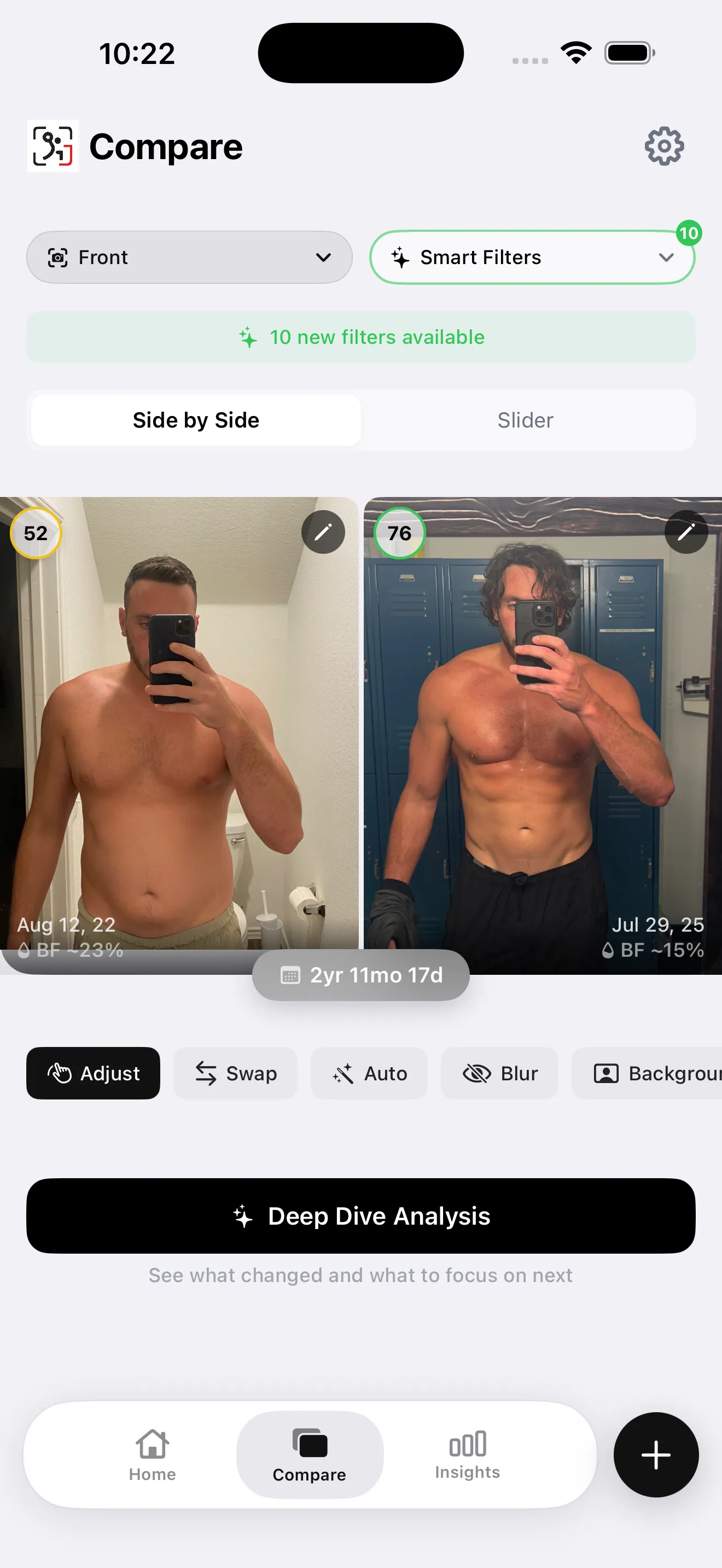
Same pose, weeks apart, aligned automatically. Change the mirror hides because you see it every day.
Best for: recomp, where the scale reports nothing useful. Limitations: iOS only, with no Android version; these are AI estimates from photos rather than clinical measurement, and the rating count is small because the app is new. Photos are analyzed without an account and are not stored on a server.
Goal 3: Nutrition
4. MacroFactor — Best nutrition tracker
Platform: iOS & Android · Price: around $12/mo, cheaper annually · iOS: 4.8 stars, 19,000+ ratings
Protein is the lever that decides whether recomp works, and most women eat well under the commonly cited 0.7–1 gram per pound of body weight guidance without tracking it at least for a while. MacroFactor's advantage is its adaptive expenditure model: it reads your weight trend against logged intake and adjusts your calorie target on its own, so a plateau produces a new number instead of a guessing session.
It's also one of the few trackers with no ad layer, no streak guilt, and no shaming design patterns — it reports numbers and moves on. Our MacroFactor review has the full breakdown.
Best for: hitting protein without a spreadsheet. Limitations: subscription-only; daily food logging is a real habit cost, and it's a poor fit for anyone with a history of disordered eating.
Goal 4: Cycle-aware training and tracking
5. Wild.AI — Best attempt at cycle-based programming
Platform: iOS & Android · Price: free tier with a paid level · iOS: 4.4 stars, 396 ratings
Wild.AI takes your cycle phase (or hormonal contraception, or perimenopause status) and adjusts training, nutrition, and recovery guidance around it. The category is genuinely interesting and genuinely young — the underlying research on whether phase-based programming outperforms consistent training is limited, mixed, and complicated by huge individual variation.
Treat the recommendations as a structured starting hypothesis you test on yourself, rather than settled physiology. The lower rating and small review base reflect an early product, and it's worth knowing that going in.
Best for: systematically noticing how your cycle affects your training. Limitations: the science it's built on is unsettled; smallest user base on this list.
6. Flo — Best plain cycle tracker
Platform: iOS & Android · Price: free tier with Premium · iOS: 4.7 stars, 1.9M+ ratings
If you want the cycle data without the training prescriptions, Flo is the default by a wide margin. Predictions, symptom logging, and a clean history you can hold up against your own training log to see whether your strong weeks cluster anywhere.
Worth checking the privacy settings and what you're comfortable storing, as with any health app handling reproductive data.
Best for: the raw cycle data, used however you want. Limitations: offers no training guidance; heavy content and Premium prompting.
Goal 5: Recovery
7. Oura — Best recovery and sleep tracking
Platform: device + app · Price: ring purchase plus monthly membership · iOS: 4.9 stars, 271,000+ ratings
A ring is easier to sleep in than a watch, the battery runs for days, and the sleep staging is what most users rate highest. Oura also reports cycle-phase insights from temperature data, which is a reasonable use of the sensor.
Two honest caveats. Readiness scores are directional signals rather than instructions — a low score on a day you feel fine is information, not a rest day order. And it's the most expensive item here once you count the hardware and the membership together, so it's a later purchase rather than a first one.
Best for: sleep data and long-run recovery trends with minimal friction. Limitations: meaningful upfront cost plus subscription; readiness scoring is imprecise and easy to over-read.
Goal 6: Training at home
8. Nike Training Club — Best free home workouts
Platform: iOS & Android · Price: free · iOS: 4.8 stars, 279,000+ ratings
The whole library is free: guided strength, mobility, and conditioning sessions with video, plus structured multi-week programs. For starting out, travel weeks, or filling gaps between gym sessions, nothing else at this quality costs nothing.
The ceiling is the equipment. Bodyweight and light dumbbells will build strength for a while and then stop, because you run out of ways to add load. Use it to hold the habit, and add a barbell when muscle becomes the priority.
Best for: free, well-produced sessions with no equipment. Limitations: limited loading caps the hypertrophy ceiling; no progression tracking worth the name.
9. Down Dog — Best yoga and mobility
Platform: iOS & Android · Price: free level with a subscription · iOS: 4.9 stars, 326,000+ ratings
Down Dog generates a new sequence every session rather than replaying the same recorded class, with control over length, pace, focus, and difficulty. The same studio produces barre, HIIT, and meditation versions.
This is a supplement rather than a strength program — yoga builds mobility and some endurance, and won't drive the muscle side of recomp. Paired with two lifting days it's an excellent third and fourth session.
Best for: mobility and recovery days you'll actually do. Limitations: not a strength stimulus; the free level is limited compared to the subscription.
10. Peloton — Best class experience without the bike
Platform: iOS & Android · Price: app subscription tiers · iOS: 4.9 stars, 813,000+ ratings
The app-only tiers give you the instructor-led classes — strength, running, cycling, yoga — without owning any hardware, and the instruction quality is the reason people stay. If a voice and a schedule are what get you moving, this is the strongest version of that on the market.
The strength classes are follow-along, which means the load progression is on you to manage. Log the weights somewhere else if you want to know whether you're getting stronger.
Best for: motivation from real instruction and structure. Limitations: subscription; follow-along format makes progressive overload hard to track.
So which two or three should you actually install?
Every app is a daily habit you're signing up for, and habits fail at a predictable rate. Pick for the next three months, not for a complete collection.
- New to lifting: Ladder or Nike Training Club, alone, until training three times a week is automatic.
- Recomping: a training log, a nutrition tracker, and weekly photos. That combination covers input, fuel, and output.
- Already lifting consistently: Hevy plus MacroFactor. Add photo tracking when the scale stops telling you anything.
- Curious about your cycle: add a tracker and read it against your training log for three cycles before changing your programming.
The women who see real change are usually running two apps they open without thinking, for a year. For what that change actually looks like on the body rather than on a chart, see our average body fat percentages for women.
Frequently asked questions
What is the best fitness app for women in 2026?
It depends on the goal. For strength training, Hevy for logging your own program or Ladder for a coached one. For nutrition, MacroFactor. For tracking visible change, a photo-analysis app like GainFrame. For home workouts, Nike Training Club is free and good. Two apps that fit your actual routine beat ten that don't.
Do women need a fitness app designed specifically for women?
Only for the parts that are genuinely different — cycle tracking, pregnancy and postpartum programming, and pelvic floor work. Barbell training, progressive overload, and protein targets work the same way regardless of sex. A general app with a good training log will serve you better than a women's app whose main differentiator is the color scheme.
Should you train differently around your menstrual cycle?
Possibly, though the evidence is genuinely mixed and individual variation is large. Some women report feeling strongest in the follicular phase and flatter in the late luteal phase; controlled research on whether phase-based programming outperforms consistent training is limited and inconsistent. Tracking your own energy and lifts for a few cycles tells you more than any general rule.
What is the best free workout app for women?
Nike Training Club gives away its whole library — guided strength, mobility, and conditioning sessions plus multi-week programs, at no cost. Hevy's free tier covers routine building and progression logging indefinitely if you train in a gym. Down Dog's yoga and barre generators have a free level too. None of these require a subscription to be worth installing.
How do you track progress when the scale isn't moving?
That's the normal case during recomposition, and it's why photos and measurements exist. Weekly progress photos in consistent lighting, waist and hip measurements, and your strength numbers will all show change the scale flattens. Menstrual-cycle water retention adds several pounds of noise on top, which makes week-to-week weigh-ins close to useless.
See the change the scale won't show
GainFrame turns weekly photos into a body composition trend — estimated body fat, FFMI, and 12 muscle-group ratings, with aligned before-and-after comparisons. Free to start on iOS.
Download GainFrame Free