
Quick answer: Toned arms come from two things — some visible muscle and less fat over it. Train arms and shoulders 2–3 times a week with gradually heavier weights, eat enough protein, and run a modest calorie deficit for the fat layer. Expect visible change in roughly 3–6 months. Accidental bulk is essentially impossible naturally.
You've probably done the 20-rep tricep kickbacks with the 3-pound dumbbells. Maybe for months. And the arms in the mirror look like they did in January — which is exactly what that workout was ever going to deliver, because the advice behind it gets the definition of "toned" wrong.
Toned is a body composition outcome: some muscle, with a thin enough fat layer that you can see it. Two variables. Every piece of arm advice that works targets one of them, and most of what's marketed at women targets neither. Here's the honest version of both halves.
What does "toned arms" actually mean?
There is no tone tissue. A muscle is either bigger or smaller, and the fat over it is either thicker or thinner — "toned" is the look those two produce at a particular combination: visible shoulder shape, a line down the upper arm, firmness where there was softness. Our body recomposition guide for women covers this reframe in depth, because it changes everything about the plan.
It means the goal has exactly two levers. Build some arm and shoulder muscle. Reduce the fat layer over it. Any exercise, program, or product you're evaluating should answer a simple question — which lever does this move? If the answer is neither, it's decoration.
The good news buried in that: both levers respond to boring, well-understood work. Nothing about toned arms requires secrets. It requires the two right inputs held for a few months.
Can you exercise arm fat away?
This is the kindest place to be direct: no exercise removes the fat on your arms specifically. Spot reduction — the idea that working a muscle burns the fat over it — has been tested repeatedly, and the research commonly fails to find it. The "arm fat exercises" genre is selling a mechanism that doesn't exist.
And there's a second truth worth hearing plainly: where your body stores fat, and the order it releases it, is largely genetic. For many women the upper arms are stubborn — commonly among the last places to lean out, well after the face and waist have changed. If your arms have resisted every diet you've run, that's not a personal failing or a broken metabolism. It's storage order, and it's normal.
What reduces the fat layer is an overall calorie deficit, held modestly and patiently — the arms take their turn on your body's schedule, not yours. The deficit doesn't need to be aggressive; it needs to be sustained.
Do light weights and high reps tone better?
This is probably the most persistent myth in women's fitness, so it deserves a direct answer: as far as the evidence goes, no. Muscle doesn't have a sculpting mode and a bulking mode. It grows when it's challenged near its capacity and maintains when it isn't — light weights lifted far from effort mostly deliver neither.
The mechanism that produces the toned look is the same one that produces all muscle: progressive overload. Weights that feel genuinely hard in the last few reps, made gradually harder over weeks. That's it. High reps can work when the set is taken close to failure, but a 3-pound weight for 20 easy reps signals almost nothing.
The fear underneath the light-weight advice — accidental bulk — doesn't survive contact with physiology. Women naturally produce a fraction of the testosterone men do, and building even a few visible pounds of muscle typically takes months of deliberate training and eating. Nobody stumbles into bulky arms; the physiques that read that way are built on purpose, over years. You cannot accidentally become something it takes other people a decade to achieve.
What is the actual toned-arms playbook?
Four pieces. None of them are exotic, and the combination is the point.
Train arms and shoulders 2–3 times a week, progressively. Rows, presses, curls, and tricep extensions cover everything. Pick weights that make the last 2–3 reps of each set genuinely hard, and when a weight becomes comfortable, add a little. Shoulders matter as much as arms here — a bit of deltoid shape is most of what reads as "toned" in a tank top.
Eat protein. Common evidence-based guidance lands around 0.7–1 gram per pound of body weight daily — roughly 105–150 grams for a 150-pound woman, which is more than most women eat by default. Under-eating protein is among the most common reasons arm training produces nothing visible.
Run a modest deficit — or recomp. If you have noticeable arm fat to lose, a small calorie deficit shrinks the layer while the training builds underneath. If you're already fairly lean, eating at maintenance while lifting — classic recomposition — is often the better play. Either way, aggressive crash-dieting undercuts the muscle half of the equation.
Give it 3–6 months. First changes — a firmer feel, a shoulder line in certain light — commonly show at 8–12 weeks. The arms you're picturing typically take 3–6 months, sometimes longer if the fat layer is thicker at the start. Anyone promising toned arms in 21 days is selling the calendar, not the result.
What does the difference actually look like?
Here's the honest visual — the same woman at two body fat levels, as standardized, photorealistic AI renders from our body fat visualizer — same build, pose, and lighting, so only body fat changes between images. This five-point difference is roughly what the playbook above produces over several months.
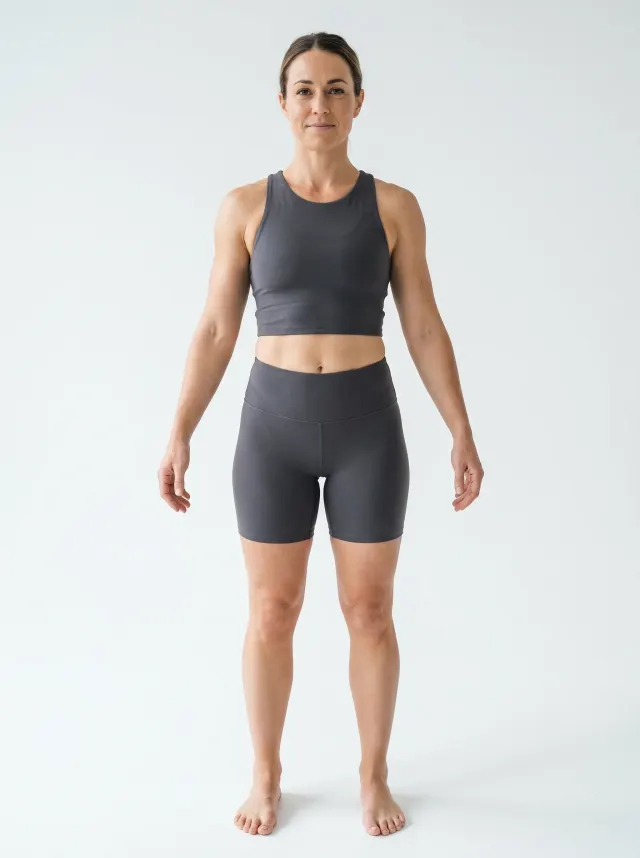
Around 27% body fat — squarely in the healthy average range for women. The arm muscle is there; the layer over it keeps it from showing.
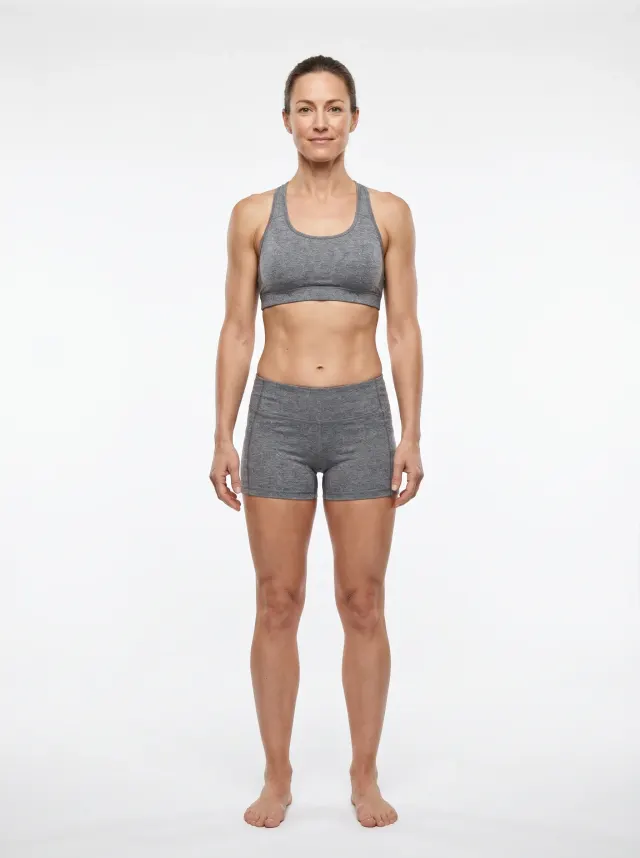
The same frame at 22% — shoulder shape and an upper-arm line are visible. This is the range where "toned" typically lives.
Worth noticing: the second image isn't dramatically smaller, and it isn't bulky. The arms changed shape more than size — which is what the toned look is, and why the scale is a poor judge of whether you're getting there. For women's reference points across the full range, our average body fat percentage for women guide has the charts.
How do you know it's working?
Arm progress is slow and local, which makes it easy to miss — and easy to quit on at week six, right before it shows. Three signals beat the mirror's day-to-day judgment:
- Strength numbers. If your curls and presses are climbing, muscle is coming. This is the earliest reliable signal, weeks ahead of anything visual.
- A relaxed-arm measurement. Monthly, same spot, same conditions. Interpreting it needs context — muscle gain and fat loss can cancel out on the tape — so pair it with the next one.
- Photos. Same pose, same light, every week or two. Arm definition changes gradually enough that only a side-by-side across months makes it obvious.
The consistency problem with photos is the part GainFrame was built for — weekly check-ins with an estimated body fat percentage per photo, per-muscle-group ratings including arms and shoulders, and aligned before/after comparisons. The AI numbers are estimates from photos, not clinical scans, but for confirming a slow trend is real they beat squinting at the mirror.
Frequently asked questions
How long does it take to get toned arms?
Most women see the first visible change — a line in the shoulder, a firmer upper arm — within roughly 8–12 weeks of consistent training. The full toned look commonly takes 3–6 months, longer if there's a meaningful fat layer to work through first. Beginners generally progress fastest, because untrained muscle responds quickest to new lifting.
Will lifting weights make my arms bulky?
For the overwhelming majority of women, no. Women naturally produce far less testosterone than men, so muscle growth is gradual — visible arm muscle takes months of deliberate training and eating, and it arrives in millimeters, not inches. The lean, defined arms most women want are built with the same heavy, progressive lifting people fear will bulk them.
Why won't my arm fat go away?
Fat-loss order is largely genetic, and for many women the upper arms are among the last places to lean out — commonly after the face, chest, and waist have already changed. That's frustrating and completely normal. It doesn't mean the deficit isn't working; it means the arms are late in your sequence. Photos usually catch the change before the mirror does.
Can you tone your arms without weights?
You can start — push-ups, chair dips, and resistance bands all build muscle when they're hard enough. The catch is progression: once bodyweight movements become easy, they stop signaling growth, and arm change stalls. Anything that lets you keep adding difficulty over time works; dumbbells just make that progression easiest to measure.
Do arm exercises get rid of flabby arms?
Not by themselves. Exercises build the muscle underneath, which improves shape and firmness, but the fat layer over the muscle only shrinks through an overall calorie deficit — spot reduction doesn't hold up in research. The combination is what works: train the arms so there's something to see, and lose fat overall so you can see it.
See the definition arriving
GainFrame tracks arm and shoulder change from weekly photos — estimated body fat, per-muscle ratings, and aligned before/after comparisons that catch progress months before the mirror admits it. Free to start on iOS.
Download GainFrame Free