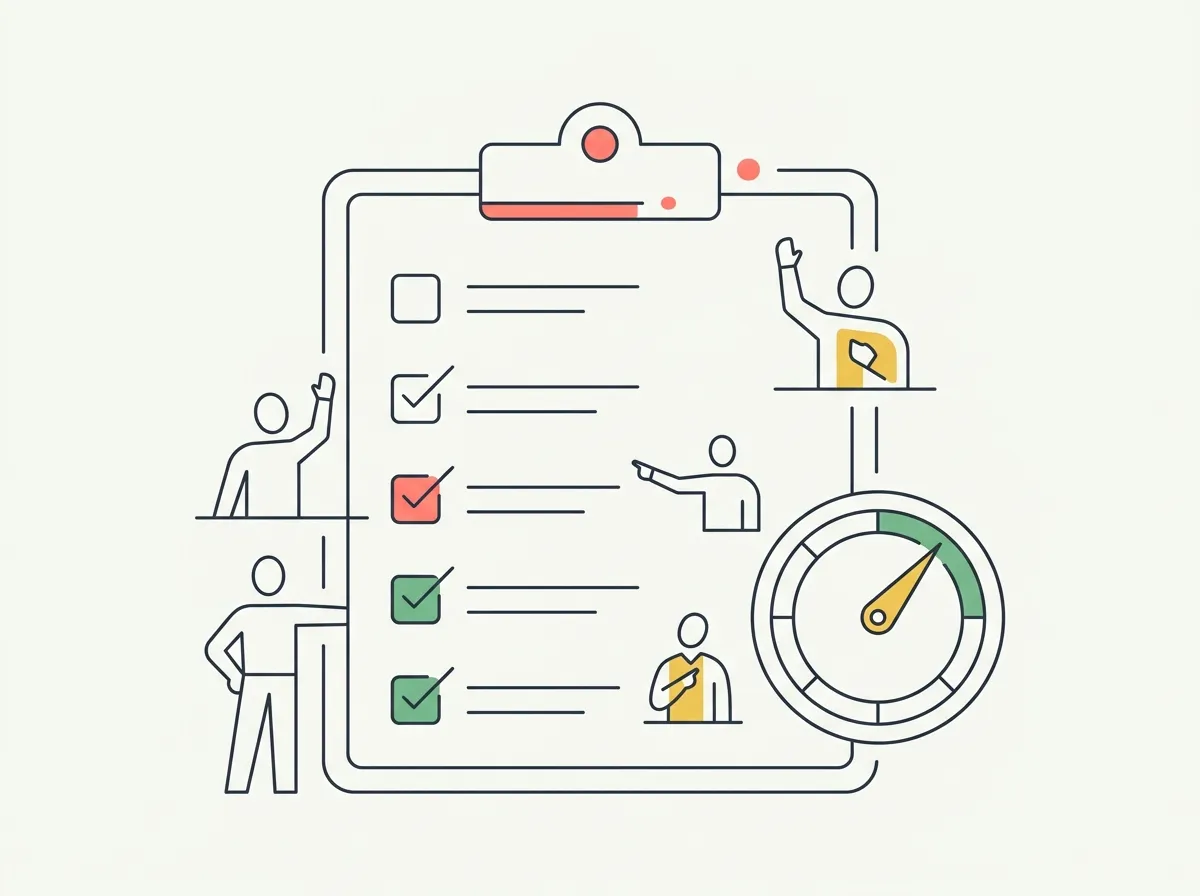
Quick answer: Answer seven yes/no checks — ab visibility, jawline, waist-to-height, navel pinch, vascularity, shoulder separation — then count your points in the scoring table below for a bracket estimate. Expect a margin of roughly ±4–5 points: a visual quiz places you in a range, and a photo-based estimate can tighten it from there.
Ask someone to guess their body fat percentage and the answers cluster in two places: lifters guess 15% while carrying 22%, and everyone else guesses 30% while carrying 24%. Self-perception runs a reliable 5–8 points optimistic or pessimistic depending on which direction your insecurities lean.
The checks below bypass the guessing. Each one is an observable fact — either you can see your abs relaxed or you can't, either the pinch at your navel clears an inch or it doesn't — and each fact only occurs within a certain body fat range. Stack seven of them and the ranges intersect at a bracket. No tape, no scale, no photo; two minutes in front of a mirror.
What are the seven checks?
Answer honestly, in normal indoor lighting, relaxed unless the question says otherwise. Count as you go.
- Are your abs visible while fully relaxed? Not braced, not exhaled hard, not under a skylight. Relaxed, resting abs are one of the strictest checks on the list — for men this generally means the athletic range, for women the low end of it.
- Flexed and in good light, can you see ab outlines? The forgiving version of check 1. A yes here with a no above is one of the most common patterns in the fitness ranges.
- Is your jawline clearly defined? Face fat tracks body fat surprisingly well. A sharp jaw and visible cheek structure generally rule out the upper brackets; a soft, rounded jawline generally rules out the lower ones.
- Can you pinch more than an inch of fat beside your navel? Thumb and forefinger, vertical pinch, an inch or two to the side of the navel. This is the caliper site without the caliper — and the only check where a yes points to higher body fat.
- Is your waist under half your height? The one check that borrows a number: navel waist versus height. If you've never measured, a string cut to half your height wrapped at the navel settles it in ten seconds.
- Do you have visible veins on your forearms or biceps? Standing relaxed, arms warm, no pump. Vascularity needs thin subcutaneous fat, so visible arm veins generally indicate the leaner half of the table.
- Can you see separation between your shoulders and arms? A visible line where the deltoid meets the bicep, or a cap on the shoulder that reads as a distinct shape. Muscle separation requires both muscle and leanness, which is what makes it informative.
How do you score it?
One point for each yes on checks 1–3 and 5–7. Check 4 is reversed: one point for a no. Total your points out of seven and find your row:
| Points | Men (estimated body fat) | Women (estimated body fat) |
|---|---|---|
| 7 | ~8–12% | ~15–19% |
| 5–6 | ~13–17% | ~20–24% |
| 3–4 | ~18–24% | ~25–31% |
| 1–2 | ~25–30% | ~32–38% |
| 0 | ~30%+ | ~38%+ |
The brackets line up with the standard classification bands — men's athletic 6–13% / fitness 14–17% / average 18–24% / elevated 25%+, and women's 14–20% / 21–24% / 25–31% / 32%+.
Two honest caveats before you take the number anywhere. First, the margin is real: genetics move individual checks by a lot — some people show abs at 17%, some hide them at 12%, and jawlines vary by bone structure — so treat the bracket as ±4–5 points, not a reading. Second, checks 6 and 7 run strict for women: vascularity and hard muscle separation typically appear only at the very lean end of the female range, so a woman scoring 5 without them is still solidly in the fitness bracket. When a check feels ambiguous, score it a no — the quiz fails more gracefully in that direction.
What does a mid-range score actually look like?
Calibration helps more than description. The two references below are standardized, photorealistic AI renders from our body fat visualizer — same build, pose, and lighting across every level, so you're comparing body fat and nothing else.
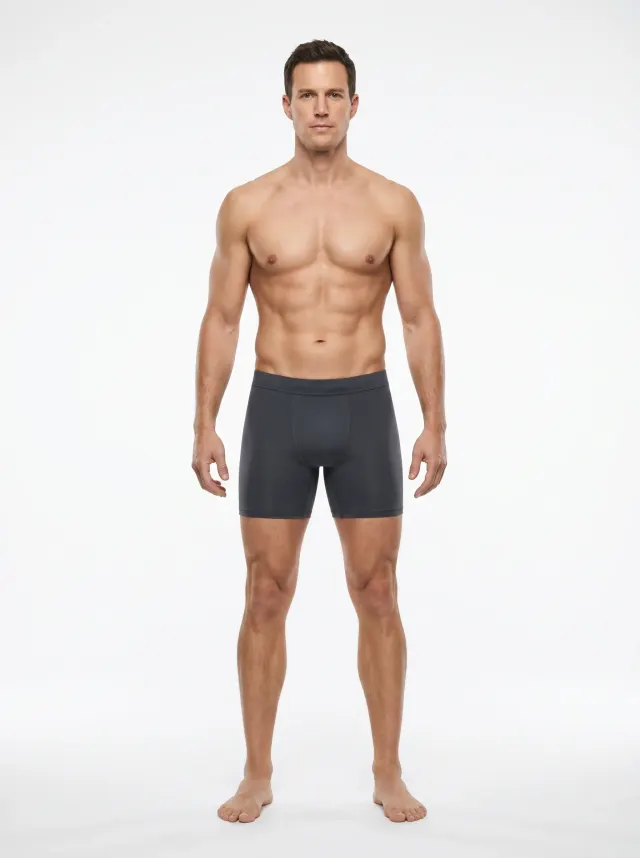
A man at ~18%: typically scores 3–4 — no relaxed abs, maybe a faint flexed outline, decent jawline, pinch near an inch, waist under half height, no vascularity.
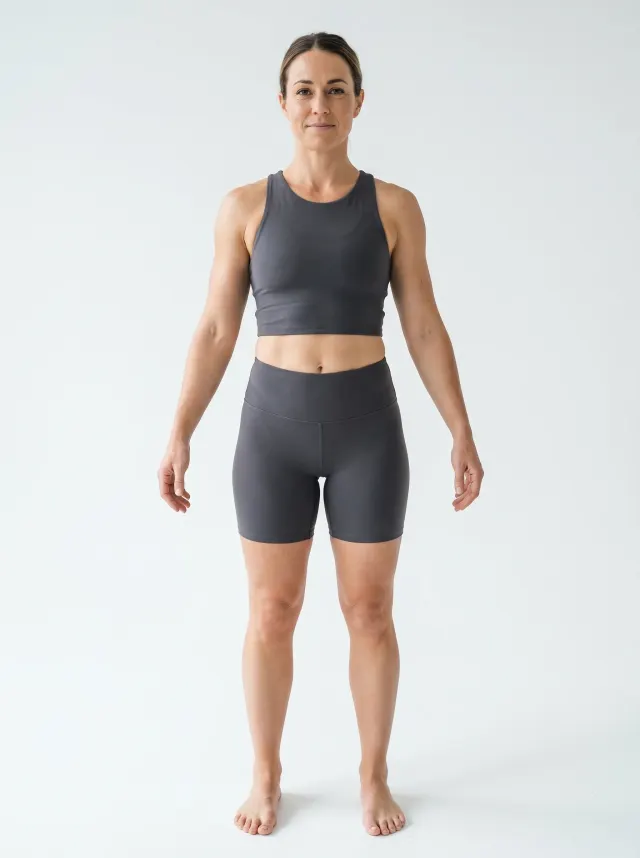
A woman at ~27%: typically scores 2–3 — no ab visibility either way, softened jawline, pinch over an inch, waist near the half-height line.
If your mirror check reads noticeably leaner or heavier than the render at your bracket, trust the render and re-answer the ambiguous checks — the standardized image is the more objective referee.
How do you tighten the estimate?
Three steps, each cutting the margin further. First, match yourself against the full level-by-level renders — the men's and full chart covers 8% to 33% and the women's chart covers 18% to 42% — which usually narrows a bracket to a level or two. Second, if you own a tape, the Navy tape method converts two or three circumferences into a formula-based estimate.
Third, let software read the photo. The free AI body fat estimator analyzes an actual photo of you in the browser and returns a percentage in under a minute — no signup, one scan a day. It reads the same cues this quiz asks about, but from your real body instead of your self-report, which is exactly why it's tighter. If you want the number tracked over time rather than taken once, GainFrame scores every progress photo with a body fat estimate, 12 muscle ratings, and a 1–100 physique score — estimates rather than clinical measurement, iOS only, free tier covers 25 photos.
Frequently asked questions
How accurate is a body fat percentage quiz?
A visual self-check places most people within roughly ±4–5 percentage points — enough to tell 15% from 25%, and enough to pick between cutting and recomping. It can't distinguish 17% from 19%; nothing that skips measurement can. Treat the result as a bracket, refine it against reference photos, and use a consistent method afterward to track direction.
Can you estimate body fat without measuring anything?
Yes, roughly. Body fat leaves observable markers — ab visibility, jawline sharpness, vascularity, muscle separation, and how much you can pinch at the navel — and each maps to an approximate range. Seven such checks together produce a usable bracket without a tape, scale, or caliper. For a tighter estimate you eventually want at least one real measurement or a photo-based analysis.
What body fat percentage are abs visible at?
Abs typically become visible around 12% body fat for men and 18% for women, assuming average genetics and some ab muscle to reveal. In good lighting with a flex, faint outlines commonly show a few points higher — around 15–17% for men and 20–22% for women. That gap is why two of the seven checks ask about abs separately.
Why is the navel pinch a good body fat check?
The pinch at the navel is a crude version of what skinfold calipers formalize: subcutaneous fat depth at a site that tracks total body fat reasonably well for most people. More than an inch between your fingers generally indicates the average range or above. It's the most direct of the seven checks because it touches the fat itself rather than reading a visual proxy.
What should you do after getting your bracket?
Compare yourself against reference photos at your bracket's levels — our chart pages show the same person at each percentage, which makes matching much easier than guessing from random photos. Then pick one consistent method to track the trend: tape, photos, or an AI photo estimate. The bracket gets you oriented; the trend tells you if anything is changing.
Turn a two-minute guess into a tracked number
GainFrame estimates body fat percentage from your progress photos and scores every shot — so the bracket you just found becomes a trend line you can actually watch move. Free to start on iOS.
Download GainFrame Free