
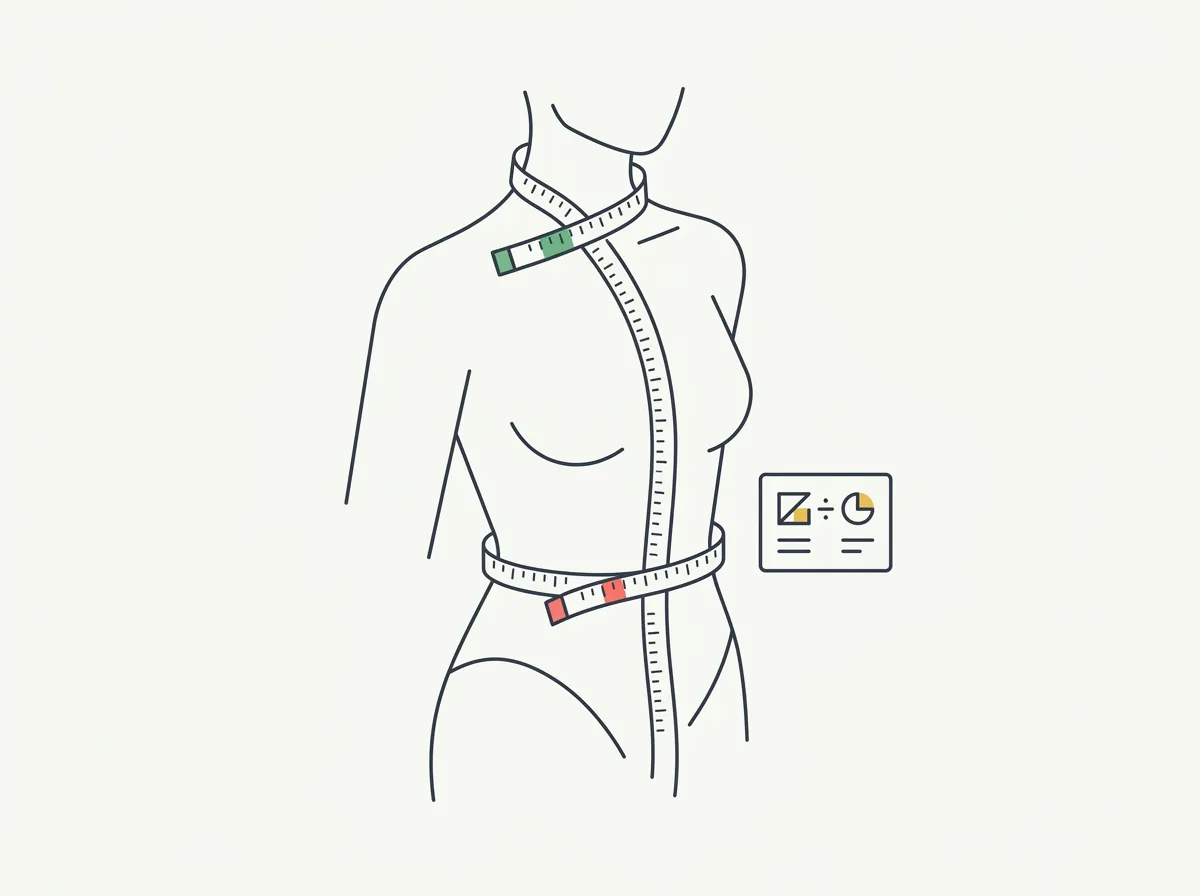
Quick answer: The US Navy circumference method estimates body fat from a tape measure: men measure neck and waist, women measure neck, waist, and hips, then plug the numbers into a logarithmic formula with height. Done with good technique, it's commonly cited as accurate within roughly 3-4 percentage points of DEXA - free, repeatable, and fast.
Your gym's smart scale says 24%. The handheld device at the front desk says 19%. A DEXA scan costs $150 and lives across town. Meanwhile there's a soft tape measure in your kitchen drawer that - fed into a formula the US military has used for decades - can estimate your body fat within a few points of that DEXA, for free, in two minutes.
This page is the full how-to for that method. If you want the entire measurement landscape compared - DEXA, calipers, Bod Pod, smart scales, photo AI - our guide to every way to measure body fat covers the field. This one goes deep on the tape.
What is the Navy body fat method?
The US Navy circumference method is a body fat estimation formula built on a simple observation: where your body stores fat changes the geometry of specific circumferences in predictable ways. The waist grows with fat gain; the neck barely does. Compare the two against your height, and the gap predicts body fat percentage well enough that the US military has used versions of this test for body composition standards for decades.
The appeal is the input list. No electrodes, no water tank, no appointment:
- Men: neck circumference, waist circumference, height.
- Women: neck circumference, waist circumference, hip circumference, height.
That's the entire test. The trade-off is that a formula reading two or three circumferences is blind to everything else about you - which is where the accuracy caveats later in this page come from.
What are the Navy body fat formulas?
The commonly published formulas, using measurements in inches and base-10 logarithms:
| Sex | Formula |
|---|---|
| Men | 86.010 × log10(waist − neck) − 70.041 × log10(height) + 36.76 |
| Women | 163.205 × log10(waist + hip − neck) − 97.684 × log10(height) − 78.387 |
A few notes before you reach for a calculator. The log10 function is on every scientific calculator and in every spreadsheet (=LOG10() in Excel or Google Sheets). Metric versions of these formulas exist with different constants, so do not mix inch measurements into a centimeter formula. Published sources also vary slightly in constants and rounding, so treat the output as an estimate with a tolerance, never a lab value. If you would rather skip the spreadsheet, enter the same measurements in our free U.S. Navy body fat calculator.
How do you take the measurements correctly?
The formula is only as good as the tape work - this method's accuracy lives and dies here. Use a flexible cloth or fiberglass tape, and measure cold: morning, before food, no pump.
- Neck: tape just below the larynx (the Adam's apple point), sloping slightly downward to the front. Look straight ahead, shoulders relaxed - no shrugging, no chin-tucking. Snug without denting the skin. Our average neck size guide covers this site in detail.
- Waist (men): at the navel, tape parallel to the floor all the way around. Exhale normally and read at the end of the breath - no sucking in, no pushing out. The full protocol is in our average waist size guide.
- Waist (women): at the narrowest visible point of the abdomen, typically above the navel. Same rules: parallel, relaxed, end of a normal exhale.
- Hips (women only): at the widest point of the buttocks, feet together, tape parallel to the floor.
- Height: no shoes, heels against a wall. Use your real measured height - the height on your license is doing your body fat estimate no favors.
- Take each measurement twice and use the average. If two attempts differ by more than half an inch, your tape placement is drifting - redo it.
Consistency outranks perfection. A tape that's placed identically every time gives you a clean trend even if your placement is a quarter-inch off the textbook site.
What does a worked example look like?
A man, 6'0" (72 inches), waist 36 at the navel, neck 15.5:
- Waist minus neck: 36 − 15.5 = 20.5 → log10(20.5) ≈ 1.312 → × 86.010 ≈ 112.8
- Height: log10(72) ≈ 1.857 → × 70.041 ≈ 130.1
- Estimate: 112.8 − 130.1 + 36.76 ≈ 19.5% body fat
That lands him at the lean edge of the average male range (18-24%), which squares with a 36-inch waist at six feet - right at the waist-to-height line.
A woman, 5'6" (66 inches), waist 30, hips 40, neck 13:
- Waist plus hips minus neck: 30 + 40 − 13 = 57 → log10(57) ≈ 1.756 → × 163.205 ≈ 286.6
- Height: log10(66) ≈ 1.820 → × 97.684 ≈ 177.7
- Estimate: 286.6 − 177.7 − 78.387 ≈ 30.4% body fat
Squarely in the average female range (25-31%). Run your own numbers the same way, then sanity-check the result against the body fat percentage chart - if the formula's output and the mirror disagree wildly, suspect the tape work first.
How accurate is the tape test, honestly?
Commonly cited comparisons put the Navy method within roughly 3-4 percentage points of DEXA for most people under good technique. That's a real tolerance - a "17%" result means something like 14-20% - but it's competitive with consumer smart scales and dramatically better than guessing. Our body fat calculator accuracy comparison shows how that range stacks up against BMI formulas, calipers, photo estimates, and smart scales. Three failure modes are worth knowing:
Technique sensitivity. This is the big one. A half-inch of tape drift at the waist can move the output a full point or more, and sucking in or shrugging moves it further. The formula can't tell careful from careless; the trend can - a jagged, jumping trend line usually means inconsistent tape work rather than volatile body fat.
Unusual fat distribution. The formula assumes your waist-to-neck geometry follows population-typical patterns. Carry your fat disproportionately in the legs and hips (or almost entirely viscerally), and the estimate drifts. The waist-to-hip ratio page covers why distribution varies so much person to person.
Muscular outliers. A thick, trained neck widens the neck measurement, which the formula reads as leanness - so very muscular lifters commonly get estimates that flatter them by a few points. The reverse geometry (thin neck, blocky midsection from ab and oblique mass) can penalize. If you're well into trained territory, treat the absolute number skeptically and lean on the trend.
When does the tape beat an app - and when doesn't it?
The tape's case is strong: it's nearly free, works in any lighting, needs no battery, and measures actual circumferences - so even if the body fat estimate is off, the raw waist trend is ground truth about your body. For a single number tracked carefully over months, the Navy method is arguably the best zero-cost tool there is.
What it can't do is see. The tape reports one slice of geometry and nothing about where change is happening, how you actually look, or whether the loss is fat or muscle. Photo-based estimation reads the whole physique: GainFrame estimates body fat percentage from progress photos and pairs it with ratings across 12 muscle groups, so the number arrives with the visual context the tape leaves out - estimates in both cases, just built from different evidence. If you want to try the photo route before downloading anything, the free browser body fat estimator runs one scan a day with no tape, no signup.
The honest play for most people: run both. Tape every few weeks for the circumference ground truth, photos for the visual trend - when two independent estimates move the same direction, you can actually trust the direction.
Frequently asked questions
How accurate is the Navy body fat method?
With clean technique, the Navy circumference method is commonly cited as landing within roughly 3 to 4 percentage points of DEXA for most body types. Sloppy tape placement widens that fast - a half-inch of tape drift can move the estimate a full point or more. It's most reliable as a trend tool: same spots, same conditions, tracked over weeks.
Where do you measure for the Navy body fat test?
Men take two sites: neck just below the larynx, and waist at the navel. Women take three: neck below the larynx, waist at the narrowest point of the abdomen, and hips at the widest point. Height completes the inputs. The tape stays parallel to the floor, snug against the skin without compressing it.
Can you calculate body fat with just a tape measure?
Yes. The commonly published US Navy formulas need only circumference measurements and height. For men: 86.010 × log10(waist − neck) − 70.041 × log10(height) + 36.76, in inches. For women: 163.205 × log10(waist + hip − neck) − 97.684 × log10(height) − 78.387. Any scientific calculator or spreadsheet handles the log10 function.
Why does the Navy method disagree with my smart scale?
They estimate from different signals. The Navy method reads circumference geometry; smart scales pass a current through your body and infer fat from electrical resistance, which swings with hydration, food, and time of day. Both are estimates, and disagreements of several points are common. Pick one method, keep conditions identical, and trust its trend rather than reconciling the two numbers.
How often should you measure body fat with a tape?
Every two to four weeks is the useful cadence. Circumferences move slowly, and measuring more often mostly captures water and food noise rather than fat change. Always measure under the same conditions - morning, before eating, cold - and log the raw measurements alongside the calculated percentage so you can spot a technique glitch when one number jumps.
Pair the tape with a second signal
GainFrame estimates body fat from progress photos and rates 12 muscle groups - a visual trend to run alongside your tape numbers, so you know the change is fat and can see where it's happening. Free to start on iOS.
Download GainFrame Free