
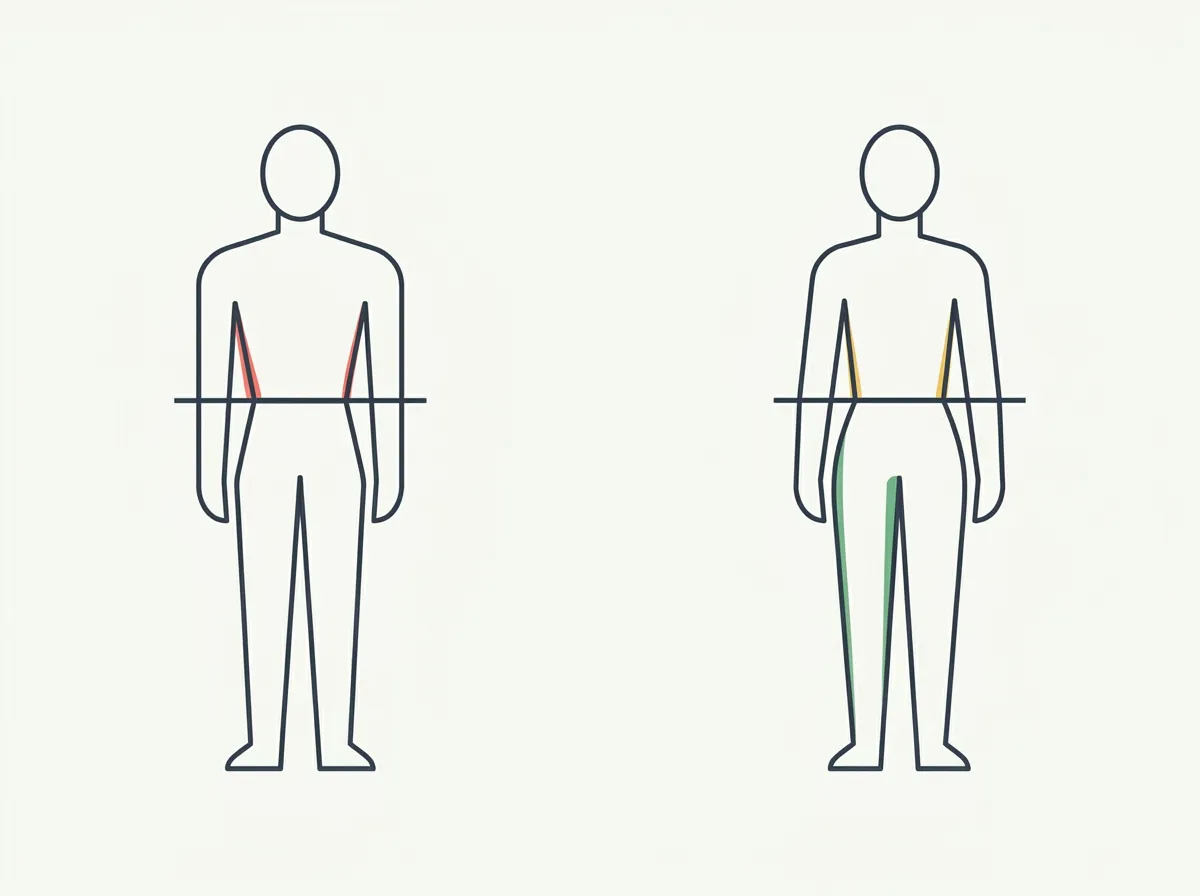
Quick answer: Compare your sitting height to your standing height: sit on a hard, flat surface, measure crown to seat, and divide by your full height. Commonly cited averages put that ratio around 52%. Meaningfully above suggests a long torso; below, long legs. It's skeletal proportion — it changes fit and looks, and limits no body composition goal.
Two people, both 5'9", walk into the same store. One buys a 30-inch inseam, the other needs a 33 — and the one with the 30 also can't find a shirt long enough to stay tucked. Same height on paper, and almost nothing else about how clothes, mirrors, or barbells treat them is the same.
That's torso-to-leg ratio, and hardly anyone ever measures theirs. The test takes a minute with a wall and a tape, and the number explains a surprising amount: where your waist sits, why your weight distributes the way it does, why certain lifts feel awkward. Here's how to run it and what to do with the result.
How do you actually tell if you have a long torso or short legs?
Eyeballing the mirror fails here, because clothing waistbands and camera angles distort where your midpoint appears to be. The method commonly used in anthropometry is the sitting height comparison — your seated height captures head plus torso, and the remainder of your standing height is effectively leg.
- Measure standing height first. Barefoot, heels against a wall, book flat on your head, mark and measure. Morning is best — spines commonly compress a bit through the day.
- Sit on a hard, flat surface against the same wall. A bench, a sturdy box, or the floor against the wall all work; a soft couch reads low. Back straight, sitting tall without stretching.
- Measure from the seat surface to the crown of your head. Same book-on-head trick. This is your sitting height.
- Divide sitting height by standing height. A 36-inch sitting height at 68 inches standing is 36 ÷ 68 = 0.529, or about 53%.
That percentage — sometimes called the sitting height ratio — is your answer. It removes the guesswork that plagues the "where does my waist look like it is" approach, and it's repeatable enough to trust.
What does your sitting height ratio mean?
Survey data generally puts adult sitting height around 50–54% of standing height, with a commonly cited average near 52%. Women tend to land slightly higher in the range than men on average, and ancestry shifts the distribution too — so treat these bands as orientation rather than diagnosis:
| Sitting height ÷ standing height | Reads as |
|---|---|
| Below ~51% | Relatively long legs, shorter torso |
| ~51–53% | Typical proportions |
| Above ~53–54% | Relatively long torso, shorter legs |
A point either side of average is ordinary variation you'd never spot without a tape. It takes a couple of points before the proportion becomes visible in how clothes fit and how your silhouette reads — which is exactly the situation that probably brought you to this page.
Worth saying plainly: this ratio is bone. It was set when you stopped growing, it carries no health verdict by itself, and it sits in the same category as body frame size — measurement context that helps you interpret other numbers, never a grade on your body.
Why does your torso-to-leg ratio actually matter?
Because two bodies at identical height and identical weight can look and fit remarkably different, and the ratio is a big part of why.
Where your waist sits visually. A long torso puts more vertical real estate between chest and hips, so the natural waist sits lower relative to total height and the midsection reads longer — belts and high-waisted cuts land differently. A short torso stacks chest, waist, and hips close together, so even a small amount of midsection fat has nowhere to hide. Neither is worse; they're different canvases.
The same weight distributes differently. Torso length means more or less room for the mass you carry, which is one reason scale weight and appearance diverge so often — a theme our why you weigh more than you look guide covers from the density side. It's also why proportion charts like the ideal measurements for men and for women are built on ratios rather than absolute inches.
Clothing fit. This one you already know from experience. Long torso: shirts untuck, one-piece swimsuits and jumpsuits pull, standard rises sit oddly high. Long legs: every pant is too short, shirts billow with spare fabric. Knowing your ratio turns years of "clothes just fit me weird" into a solvable shopping filter — inseam numbers, rise measurements, "tall" sizing tops.
Does your ratio change how you should lift?
It changes geometry, and lifters commonly discuss it — especially femur length and the squat. Longer femurs relative to torso tend to push the hips further back and the chest further forward at depth, so long-legged lifters often need a wider stance, more forward lean, or elevated heels to squat comfortably, while long-torso lifters commonly fold less and sit more upright. The same leverages flip for pulls: proportions that make squatting awkward are often described as favorable for deadlifting. None of this is a strength ceiling — it's a fit problem, solved with stance and bar-position adjustments rather than a different body, and a good coach or a few filmed sets will find your version faster than any chart.
What does your torso-to-leg ratio NOT limit?
The list is long, and it's the part worth actually internalizing: body composition goals are proportion-independent. Losing fat, building muscle, dropping body fat percentage, getting visibly lean — every one of those works identically at 50% and at 54%, because they happen in tissue, and the ratio lives in bone.
The trap is blaming the skeleton for what's actually composition. "My torso is long so my stomach always looks soft" conflates two separate variables — the length is fixed, the softness is body fat, and only one of them responds to training. People routinely transform how their proportions read without moving the ratio a millimeter, because leanness and muscle change the silhouette far more than an inch of bone ever did.
That's also the measurable part. GainFrame estimates body fat percentage and muscle-group ratings from progress photos, so you can watch the variable you control actually move against the frame you can't — estimates from photos rather than clinical scans, but consistent week to week, which is what a trend needs. Your skeleton sets the stage; composition writes the play.
Frequently asked questions
How do I know if I have a long torso?
Compare sitting height to standing height. Sit on a hard, flat surface with your back straight and measure from the seat to the crown of your head, then divide by your standing height. Commonly cited averages sit around 52%. If your ratio lands meaningfully above that — roughly 54% or more — you likely have a relatively long torso.
What is a normal torso-to-leg ratio?
Survey data generally puts sitting height around 50–54% of standing height for most adults, with the commonly cited average near 52%. Women tend to sit slightly higher in that range than men, and ancestry shifts it as well. Treat the cutoffs as orientation — a point in either direction is ordinary variation, and none of it is a health signal.
Are long legs bad for squatting?
Harder to learn, according to common coaching discussion — long femurs tend to force more forward lean and make comfortable depth trickier to find, so stance width and heel elevation usually need adjusting. That's a technique fit issue rather than a strength ceiling. The same leverages that complicate squats are often described as favorable for deadlifts.
Can you change your torso-to-leg ratio?
No. The ratio is set by bone length, which is fixed once growth ends. What you can change is everything layered on top of the skeleton — body fat, muscle, posture, and clothing choices — and those change how the proportion reads far more than most people expect. A leaner waist on a long torso looks dramatically different from a soft one.
Is a long torso good or bad?
Neither. A long torso usually means a longer-looking midsection and a lower-sitting waistband, with legs that read shorter; long legs mean the reverse trade. Each version fits some clothes and some lifts more easily than the other. Every body composition goal — losing fat, building muscle, getting visibly lean — is fully available at any ratio.
Track the part you can change
Your ratio is fixed; your composition isn't. GainFrame estimates body fat percentage and physique scores from weekly progress photos, so the variable you control gets measured on the frame you were given. Free to start on iOS.
Download GainFrame Free