Quick answer: If one arm looks bigger than the other, first retake the photo with both shoulders square to the camera. Measure each relaxed upper arm at its own midpoint, then compare reps on one familiar exercise. These checks answer different questions. Seek urgent medical advice for new, unexplained swelling, especially if the arm is painful, red or warm.
You take two pictures before leaving the gym. In the mirror selfie, your phone-side biceps looks bigger. In the timer shot, you can barely see a difference. The easiest thing to change between those pictures was the angle of your elbow.
When does a difference in arm size need medical attention?
If an arm has become swollen for no clear reason, seek prompt medical advice, especially if the swelling is sudden or painful, or the area feels hot or looks red. Skip the gym comparison. With chest pain or trouble breathing, call emergency services immediately (911 in the US). NHS guidance on swollen arms · CDC guidance on blood clot symptoms
Sudden weakness or numbness on one side also warrants an emergency call, even if the arm looks the same or the symptoms go away. Facial drooping and speech changes are other stroke warning signs. CDC stroke signs
Why does one arm look bigger than the other in a photo?
In the front view below, you can see daylight between the dumbbells. Look at the same phase from the side and the weights overlap. The near arm hides part of the far arm. Even on a gridded background, which outline would you use to measure the far arm?
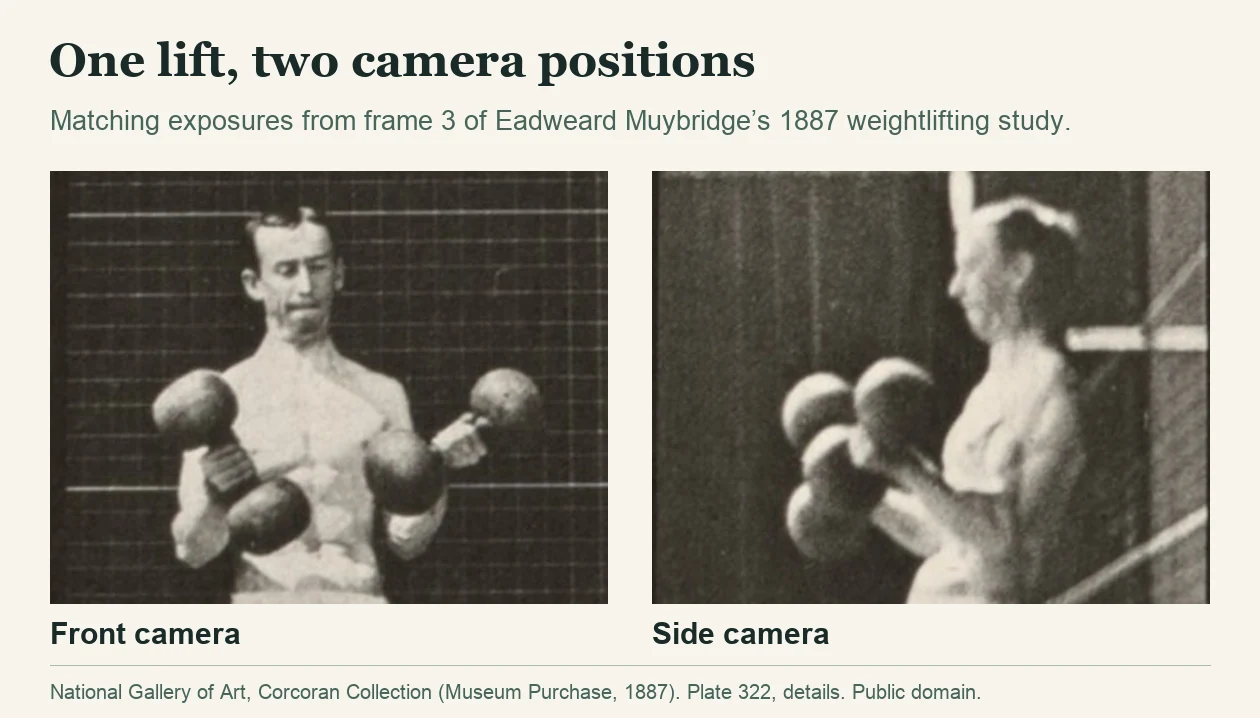
Both crops are frame 3, top and bottom rows of Eadweard Muybridge's Plate 322 (1887). National Gallery of Art, Corcoran Collection (Museum Purchase, 1887), accession 2014.79.347. Public domain. See the original photographic plate.
Muybridge used cameras in different positions to record the lift. The pair lets you inspect one movement from two viewpoints. It gives you no tape reading or strength test for the lifter. University of Pennsylvania's account of the camera setup
Try a two-shot version at home before your workout. Prop the phone at chest height, turn on the timer and face a window. Keep both arms relaxed and take a photo facing the lens squarely. Without moving the phone, take another with one shoulder turned slightly toward it. Compare the two photos side by side and check whether the difference follows the turn.
For tracking across dates, save the square-on version. If you also want a flexed view, take a separate picture with both elbows at the same height and both hands turned the same way. Label your physical left and right if your front camera mirrors the image. Our progress-photo pose guide shows how to repeat a pose.
How do you measure your left and right arms in the same place?
Use a flexible, nonstretch tape and, if possible, the same helper on both sides. Before lifting, mark the midpoint of each upper arm. The NHANES survey measures the right arm. For this home comparison, you repeat its landmark and relaxed posture separately on the left. CDC anthropometry manual, sections 3.4.6 and 3.4.7
- Bend the elbow about 90 degrees. Have your helper find the bony tip of the shoulder and the tip at the back of the elbow. Measure between them along the back of the arm and mark halfway. Find each arm's own midpoint.
- Let the arm hang loosely. Wrap the tape around the mark at a right angle to the arm. Keep it flat against the skin, with enough contact to stay in place and no visible dent.
- Record the reading and unit, remove the tape, and wrap again. Repeat on the other side. Keep both readings. If your two attempts on the same arm differ as much as the left/right gap, recheck the mark and tape tension before interpreting it.
A tape includes everything inside the loop, including triceps, biceps, fat and bone. If you also track peak flexed size, give that measurement its own line. The bicep-size reference describes a flexed method with a different measurement site.
Does the bigger arm have to be stronger?
Handedness can matter when one arm does years of sport-specific work. An MRI study of professional tennis players found larger volumes in several muscles of the racket arm. That sample tells us about repeated, one-sided loading in tennis. It cannot tell you how many centimeters apart your arms should measure. Professional tennis player study
In a separate experiment, researchers tested elbow flexion and extension in 55 healthy, physically active adults. The side that did better depended on the muscle action and the performance measure. Someone's better side on one task could differ on another. Original upper-limb strength study
For a familiar, pain-free exercise such as a seated dumbbell curl, log one set per side with the same weight, range, controlled pace and stopping rule. For example, stop when you would have to swing your trunk to finish the next rep. Write down which side went first and how long you rested. Repeat the setup on another training day.
How do you read the photo, the tape and the rep count together?
Download the left/right arm log (fillable PDF). It has room for two dates, two tape readings per arm and a matched set for each side. Use the notes field for the photo pose and whether you measured before training.
| Illustrative entry | Left | Right |
|---|---|---|
| Relaxed midpoint, first and second wrap | 31.2 and 31.3 cm | 32.0 and 32.1 cm |
| Seated curl with the same 7 kg dumbbell | 10 clean reps | 10 clean reps |
Here the right arm tapes about 0.8 cm larger while both sides complete the same set. That's enough to record a circumference difference and equal reps on this exercise today. It gives you no reason on its own to add extra sets on the left. If a performance gap keeps turning up, bring your log and a video of the movement to a qualified coach to review technique. New pain or loss of function belongs with a clinician.
What else should you know?
How much difference between arms is normal?
A single home tape reading cannot give you a personal cutoff. The landmark, whether the arm is relaxed, and how tightly the tape sits all influence what you record. Repeat the readings in the same conditions. Seek medical advice promptly for new or unexplained swelling, regardless of the number.
Why does my non-dominant arm look bigger?
A camera held on one side moves that shoulder, changes the arm angle and can cover part of your torso. Try a timed front photo with both hands empty. If the difference persists on a relaxed tape check, record it. Your writing hand alone cannot predict the larger arm.
Should I measure my biceps flexed or relaxed?
For the comparison in this guide, mark each upper arm's midpoint and measure with both arms relaxed at your sides. Someone tracking a flexed pose can keep that record too. Label the site and the pose each time so that you compare the same method on later dates.
Should I do more curls on the arm that looks smaller?
Start by checking whether the smaller-looking side also performs differently on a familiar curl. Use the same load, range of motion and stopping rule. A persistent difference across sessions gives you something specific to review with a coach. A camera angle on its own is a poor basis for adding sets.
Can a progress photo measure the difference in centimeters?
An ordinary progress photo shows a two-dimensional outline. Camera distance, rotation and the direction of your arm change what is visible in the frame. Use matched photos for appearance, and use a tape around each marked midpoint to record circumference. Keep both results under the same visit date.
Compare your two camera angles
Place your square-on and turned photos side by side to see which outlines shift.
Open Progress Photo Compare