
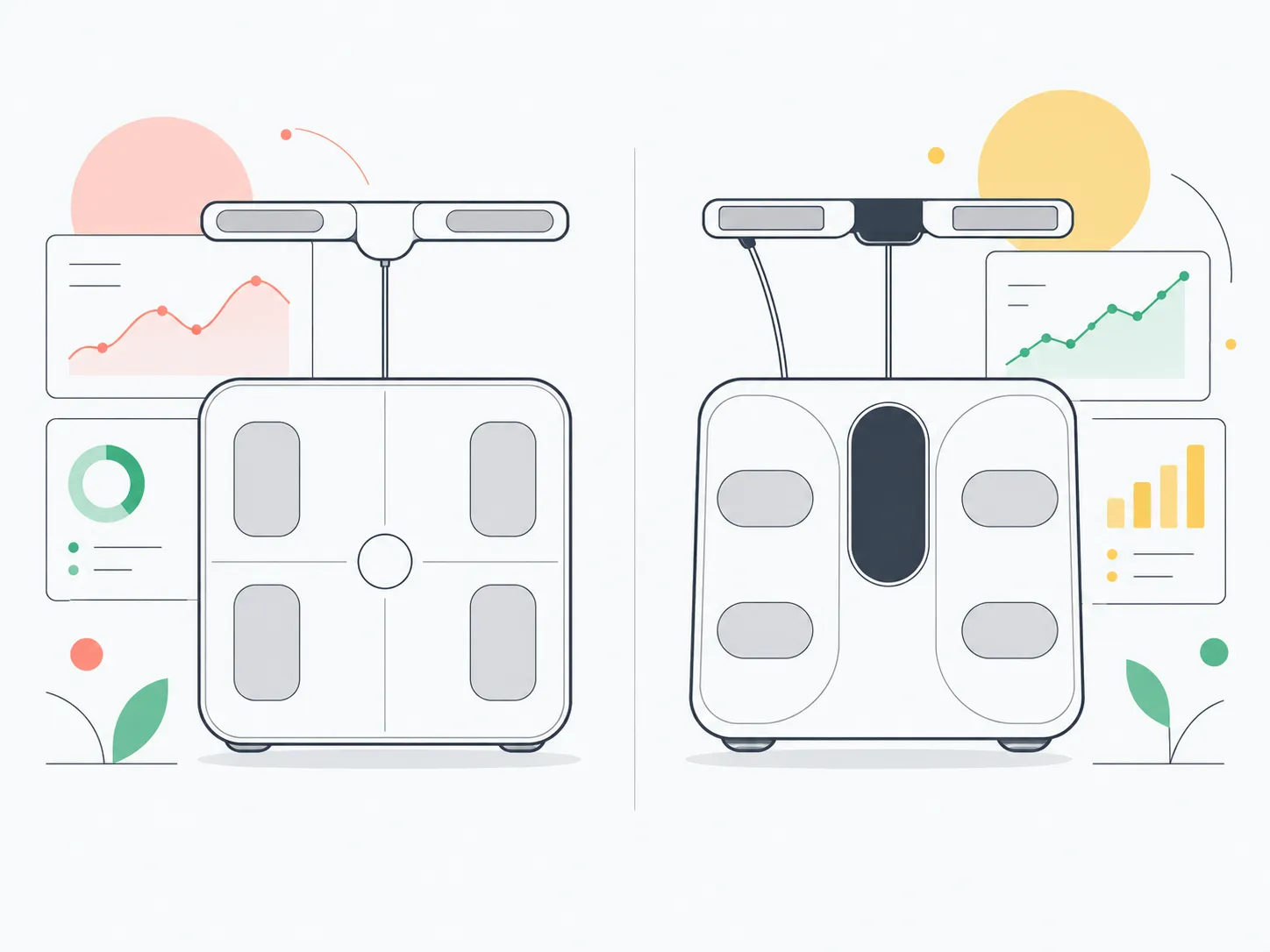
Quick answer: Choose Oxiline Scale MD Pro for its handle display and advertised PDF/CSV exports, or Hume Body Pod for its app experience and optional coaching. Both estimate composition through hand-and-foot impedance. Neither product page establishes an accuracy winner for you. Compare the exact model, included app features and final purchase terms.
If you are comparing Oxiline vs Hume, first check the model name. Oxiline sells several scales, and the Scale MD Pro is the handle-equipped model that belongs opposite the original Hume Body Pod. A cheaper foot-only Oxiline and a newer Hume Pod 2.0 would be different comparisons.
This is a comparison of published specifications and buying considerations, checked September 29, 2026. We have not performed a controlled head-to-head test of these two scales. The aim is to help you choose a useful home workflow without treating a marketing accuracy percentage as your expected personal error.
Which should you choose in an Oxiline vs Hume comparison?
Choose the Oxiline Scale MD Pro if a handle display, downloadable records and the current purchase price fit your needs. Choose the Hume Body Pod if you prefer its app experience and want the option of paid reports and coaching. Confirm the included features before comparing totals.
Both let you build a home body-composition history. The decision becomes easier when you name the output you will actually use: weekly weight, body-fat trend, segmental estimates, an export for a coach, or a report you will read. A longer list of metrics does not automatically improve that workflow.
For a wider comparison across measurement methods, start with our body-scanning and measurement guide.
What does the Oxiline Scale MD Pro offer?
Oxiline's MD Pro product page lists eight electrodes, a retractable handle with an OLED display, rechargeable power and Bluetooth connectivity. Its app supports history, PDF/CSV exports and Apple Health integration. These are manufacturer specifications, not results from our own hardware testing.
The practical strength is being able to see readings while holding the handle and keep a record outside the app. If you share trends with a coach or maintain a spreadsheet, inspect a sample export before buying. Check that it contains the fields and dates you need.
The site advertises 31 metrics. Several are related calculations derived from the same inputs. A separate label for fat mass, body-fat percentage or BMI does not represent a separate laboratory measurement. Our Oxiline scale review covers the wider model range.
What does the Hume Body Pod offer?
The original Hume Body Pod also combines a standing scale with a hand sensor. Its main appeal is the Hume Health app's presentation of composition trends and the surrounding coaching service. Make sure the listing says which generation you are ordering: the store now also links to Pod 2.0.
Hume's FAQ says you can view basic weigh-ins and body measurements without a Premium subscription. Weekly reports and personalized guidance are among the paid extras. That gives you a choice between using the hardware for records and paying for interpretation.
Decide whether you want those extras before accepting a trial. A bundled subscription or extended warranty changes the first-year cost even when the advertised hardware offer looks attractive. See our Hume Body Pod review for the standalone product evaluation.
How do the features compare side by side?
| Buying question | Oxiline Scale MD Pro | Original Hume Body Pod |
|---|---|---|
| Composition method | Hand-and-foot bioelectrical impedance estimates | Hand-and-foot bioelectrical impedance estimates |
| Hand sensor | Retractable handle with display | Retractable hand sensor |
| Where you review trends | Oxiline app | Hume Health app |
| Basic app access | Free app advertised | Basic measurements available without Premium |
| Export | PDF and CSV advertised | Confirm the export format you need before purchase |
| Apple Health | Integration advertised; verify individual fields | Integration advertised; verify individual fields |
| Paid interpretation | Check current included app features | Optional Premium reports and guidance |
| Purchase-price check | $179 promotional price shown September 29 | Offer, bundle and generation affect the displayed total |
| Best reason to choose it | Handle display and an export-focused workflow | App-led tracking with optional coaching |
The table describes the linked products. It does not establish that either scale produces more accurate body-fat estimates. Promotional prices can change; compare the final hardware, subscription and warranty total in your currency.
Does either scale prove better body-fat accuracy?
We cannot call an accuracy winner from these product pages. Hand electrodes change the electrical paths sampled, but both devices still estimate composition through an algorithm. The number on the screen depends on the device, its model assumptions and measurement conditions.
Oxiline uses medical-accuracy language. Hume publishes claims comparing its readings with DEXA. Those claims need the underlying protocol, population and error distribution to become useful buying evidence. “Within a percentage” can refer to relative error, percentage points, an average, or a selected measurement; those are different statements.
Independent experiences also differ. Tom's Guide's MD Pro review raised concerns about inconsistent information. That is a reason to examine the app and return terms, not proof that every unit or every person's estimate behaves the same way.
Before paying extra for accuracy, ask for a study of the exact model. Look for agreement with the reference method, individual limits of agreement and who participated. A correlation coefficient alone cannot tell you how far your reading might be from the reference. Our smart-scale accuracy guide explains the distinction.
How should you check Apple Health compatibility?
Treat the connection as two steps: the scale sends a reading to its own app, then that app writes authorized categories into Apple Health. The words “Apple Health compatible” do not promise that every proprietary score or regional estimate leaves the manufacturer's app.
On your iPhone, open Health, select your profile, and review the scale app under Apps or Apps and Services. Inspect the write permissions for the fields you care about. After a test weigh-in, open each category's data list and verify its timestamp and source.
Ask support about any essential field before ordering. This matters most if your intended workflow depends on lean body mass, rather than weight alone. A dashboard containing a number is not enough to establish that it is exported.
Which routine makes either purchase more useful?
Use the same scale, location and measurement conditions for your trend. Follow the manufacturer's preparation instructions and keep a note when you change devices or app settings. Compare several observations before changing a training or nutrition plan in response to a body-composition estimate.
Pair the record with your lifting performance, a waist measurement and consistent progress photos. Our free photo body-fat estimator offers another rough perspective, with its own lighting and framing limitations. It cannot validate a scale reading or replace a clinical assessment.
What are the limits of this comparison?
This is a sourced buying guide, without a new laboratory validation or a hands-on comparison. App capabilities, offers and model generations can change. Follow each device's safety instructions, particularly around implanted electronic devices or pregnancy, and use a clinician for medical interpretation.
Our recommendation is to choose the recordkeeping experience you can maintain. Prefer Oxiline when its display and exports solve your problem. Prefer Hume when you have reviewed its app and value the optional guidance enough to pay for it.
What else should you know?
Is Oxiline more accurate than Hume?
This comparison does not establish an accuracy winner. Both use hand-and-foot impedance and an algorithm to estimate body composition. To compare accuracy, look for a study of the exact models that reports individual agreement with a reference method. Marketing percentages and additional metric labels cannot establish your expected error.
Which Oxiline scale should be compared with Hume Body Pod?
The Scale MD Pro is the relevant Oxiline model here because it includes hand electrodes and a retractable handle. Oxiline sells other scales with different hardware. Also check the Hume generation: this article covers the original Body Pod, so specifications should not be silently carried over to Pod 2.0.
Does Hume Body Pod require a subscription?
Hume says a Premium subscription is not required for basic weigh-ins and body measurements in its app. Paid reports and personalized guidance are separate features. Before accepting a bundle or trial, check the included services, renewal price and cancellation terms on the offer you are actually buying.
Do Oxiline and Hume work with Apple Health?
Both advertise Apple Health integration through their companion apps. That does not mean every score or segmental estimate is exported. Review the app permissions and verify a fresh entry in each Health category you need. Ask support about an essential field before choosing hardware for a particular app workflow.
Is the scale with more body metrics automatically better?
No. Several metrics can be calculations from the same measured inputs, so the count is not a count of independent tests. Start with the fields you will use and whether they can be reviewed or exported reliably. A clear weight and composition history may be more useful than additional scores.
Can I compare readings from both scales in one trend?
Keep separate histories when you compare devices. Different hardware, algorithms and measurement conditions can create a persistent gap even when your body has not changed. If you switch scales, mark that date and establish a new baseline. Avoid treating the first reading on the new device as a training result.
Which sources support this comparison?
Keep the trend beside your photos
GainFrame is our iPhone app for organizing progress photos and reviewing estimated body-composition trends. Read about the app and its creator, or start your own photo history.
Get GainFrame for iPhone