
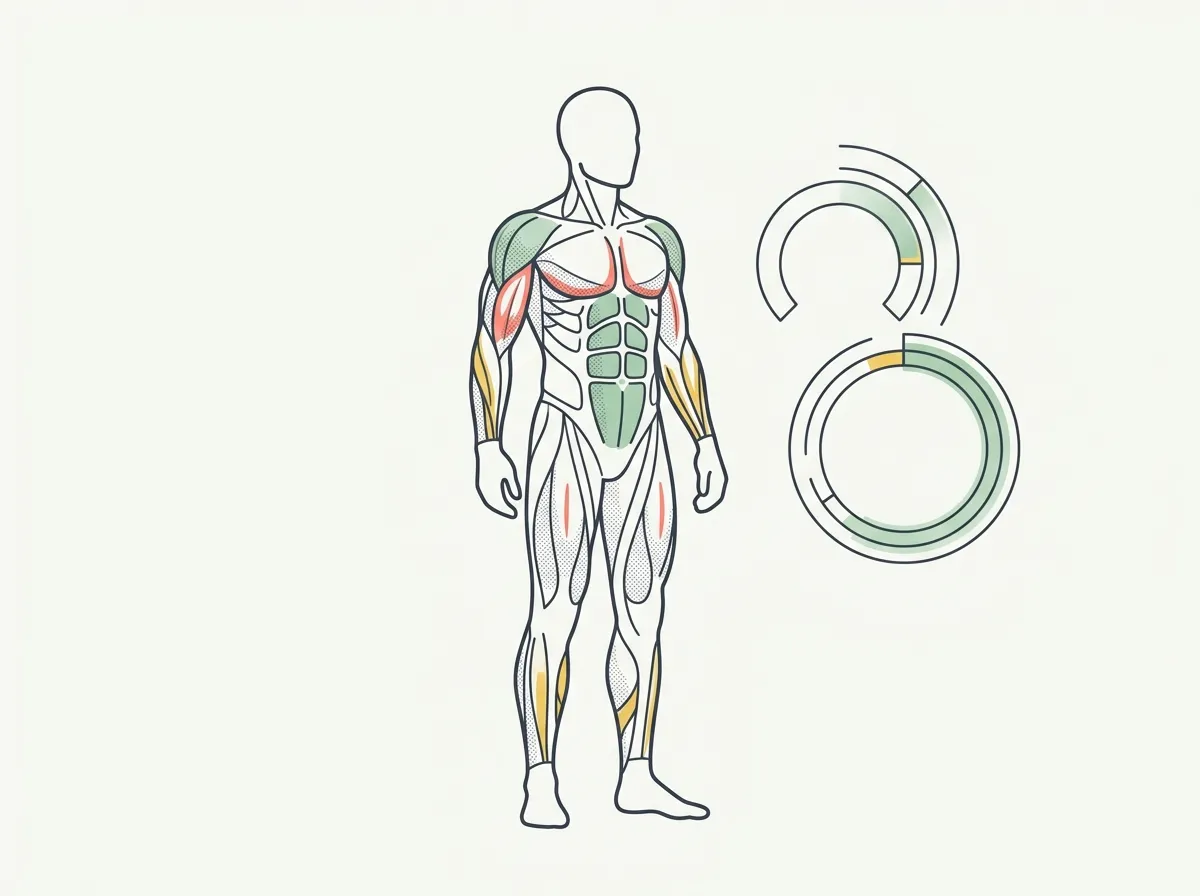
Quick answer: Skeletal muscle mass percentage is the share of body weight that is contractile muscle — a subset of lean body mass, always a smaller number. Figures commonly cited on BIA-device documentation put healthy young men around 40–44% and women around 30–35%, declining with age. The number moves with your body fat, and BIA estimates it with hydration caveats.
You step off an InBody machine or a smart scale and it hands you a skeletal muscle mass percentage — say, 38%. And then it just sits there, a number with no context. Is 38 good? Should it be higher? Is it the same as the lean body mass figure two rows up that says 62%?
That confusion is the whole problem. The screen reports several body-composition numbers that sound alike and mean different things, and skeletal muscle mass is the one people most often misread. This page covers what it actually measures, how it differs from lean body mass, the commonly cited reference bands by sex and age, where the number comes from, why it falls as you get older, and the unglamorous way to move it up.
What is skeletal muscle mass — and how is it different from lean body mass?
Here's the distinction the InBody screen doesn't explain. Lean body mass (also called fat-free mass) is everything in your body that isn't stored fat: muscle, bone, water, organs, and connective tissue all lumped together. Skeletal muscle mass is just the contractile muscle — the tissue that attaches to bone, moves you around, and grows with training. It's a subset of lean mass, which is why your SMM number is always smaller than your lean body mass number on the same printout.
That gap matters. Lean body mass includes several pounds of water and glycogen that swing day to day, plus organ and bone weight that never responds to your training. Skeletal muscle mass tries to isolate the part you can actually change in the gym. If the two get confused — and devices and apps confuse them constantly — you'll draw the wrong conclusion from a normal daily fluctuation. Our full lean mass vs muscle mass guide owns that distinction in depth; it's the companion read to this page.
What is a good skeletal muscle mass percentage by sex and age?
First, the honest caveat: there is no official, universally agreed reference standard for skeletal muscle mass percentage the way there is for, say, blood pressure. The bands below are commonly cited on BIA-device documentation and consumer-scale literature, and they vary between sources and devices. Read them as directional orientation, not diagnosis.
| Group | Commonly cited SMM% (directional) |
|---|---|
| Men, young adult (20s–30s) | ~40–44% |
| Men, middle age (40s–50s) | ~37–40% |
| Men, older (60+) | declining below ~37% |
| Women, young adult (20s–30s) | ~30–35% |
| Women, middle age (40s–50s) | ~28–32% |
| Women, older (60+) | declining below ~28% |
Two things drive the pattern. Men carry a higher share of muscle than women at essentially every age — a difference in body composition, not effort. And the percentage drifts down with age in both sexes as muscle is gradually lost.
There's also a subtlety that trips people up: the percentage depends on your body fat. Two men with identical muscle in pounds will show different SMM percentages if one is leaner — because the leaner man's muscle is a bigger slice of a smaller total. So a rising SMM% during a cut can mean you lost fat, not that you built muscle. That's exactly why a single percentage, read in isolation, is a weak signal.
Where does the skeletal muscle mass number come from?
Almost always from bioelectrical impedance analysis (BIA) — the technology inside InBody machines and consumer smart scales alike. The device sends a small, safe electrical current through your body and estimates how much of you is muscle, water, and fat by measuring how the signal travels: water and muscle conduct well, fat resists.
The catch is that BIA estimates, it doesn't measure. Hydration status, meal timing, a recent workout, and time of day commonly move the reading, because the method is fundamentally reading water content and inferring the rest. InBody machines are more sophisticated than a $40 scale — multiple frequencies, segmental electrodes — but they run on the same physics and the same hydration sensitivity. If you want the number, get it under identical conditions each time and watch the trend over weeks.
For the fuller picture on what these devices get right and wrong, and cheaper or more accurate ways to track composition, see our best InBody alternatives and best Renpho alternatives guides.
The practical rule: one SMM reading tells you almost nothing. A month of readings taken the same way each morning tells you the direction, which is the only part that's actionable.
Why does skeletal muscle mass fall with age?
The gradual, age-related loss of skeletal muscle has a name: sarcopenia. Research generally reports muscle mass beginning to decline from around the 30s and accelerating in later decades, driven by a mix of reduced physical activity, hormonal changes, and the body becoming less efficient at turning dietary protein into muscle.
The important nuance is that sarcopenia is slowed, not caused, by aging alone — a large share of the decline blamed on "getting older" is really the compounding effect of decades of less training and less protein. Regular resistance training and adequate protein won't stop the clock, though they bend the curve substantially. This is why staying trained matters more with age, not less: you're defending a shrinking baseline.
The midlife hormonal angle is especially pronounced for women. Menopause brings changes that accelerate both muscle loss and a shift of fat toward the abdomen, often while the scale barely moves — our menopause and body composition guide covers what actually changes and what to track through it.
How do you increase skeletal muscle mass percentage?
The boring truth, because it's the only truth that works: resistance training, adequate protein, and time. The percentage rises when either side of the ratio improves — more muscle, or less fat — so the program is the same one you already know.
- Lift progressively, two to four times a week. Skeletal muscle grows in response to being loaded harder over time. This is the only lever that directly adds the muscle in "skeletal muscle mass."
- Eat enough protein. Adequate daily protein is the raw material; without it, training breaks muscle down faster than it rebuilds. Especially critical for defending muscle with age.
- Manage body fat with a modest deficit if needed. Because SMM is a percentage, trimming fat raises it even at constant muscle — but don't cut so hard you lose muscle alongside the fat.
- Give it real time. Muscle accrues slowly — on the order of a pound or two a month at best, and less as you get more trained. Our how much muscle can you gain in a month guide sets honest expectations.
There's no supplement, machine, or hack that replaces this. Anything promising a fast jump in muscle mass is selling either water weight or wishful thinking.
Is there a better way to track muscle than a percentage?
Given how much a single BIA percentage bounces with hydration, many lifters track the visible result instead — and one useful proxy is FFMI (Fat-Free Mass Index), which normalizes lean mass to your height so you can compare against population percentiles rather than a device's opaque reference. Our FFMI percentiles guide shows where different training levels land and why ~25 is the commonly cited natural ceiling.
Photos catch what a percentage can't: where the muscle is and which groups are lagging. GainFrame reads body fat, FFMI, and individual scores for 12 muscle groups from progress photos, so you can see the composition shift directly rather than trusting a hydration-swayed number. Estimates from photos, not clinical measurement — but consistent week to week, which is what a trend needs.
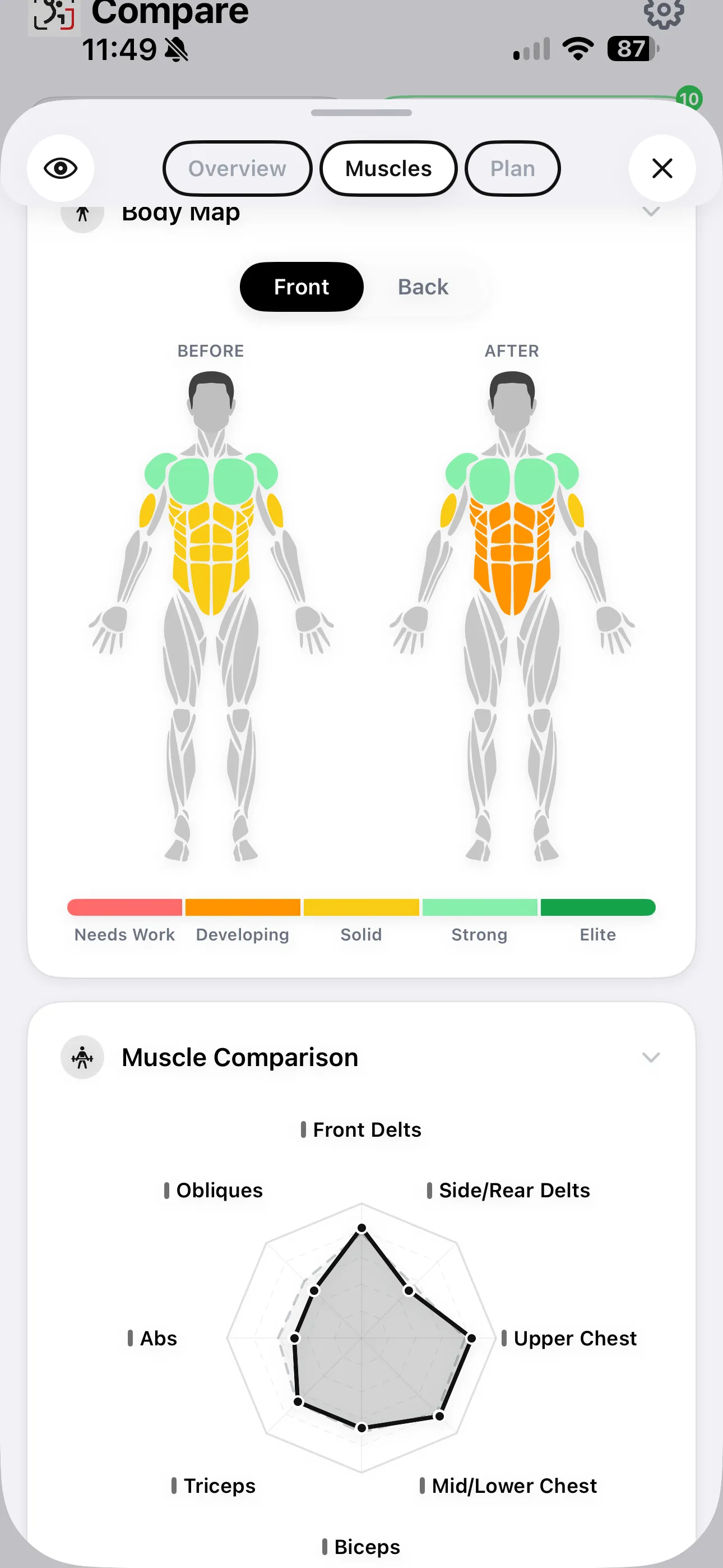
Where the muscle is, not just how much — per-group scores catch the lagging areas a single SMM percentage can't.
Frequently asked questions
What is a good skeletal muscle mass percentage?
There's no official standard, but figures commonly cited on BIA-device documentation put healthy young adult men roughly around 40–44% skeletal muscle mass and women around 30–35%, both declining with age. Treat these as directional, not precise — the number depends heavily on your body fat, since a leaner body is a higher muscle percentage at the same muscle weight.
Is skeletal muscle mass the same as lean body mass?
No. Lean body mass is everything that isn't fat — muscle plus bone, water, organs, and connective tissue. Skeletal muscle mass is only the contractile muscle, a subset of lean mass. That's why your SMM number is always smaller than your lean body mass number on the same InBody or scale printout, and the two should never be read as interchangeable.
How is skeletal muscle mass percentage measured?
Consumer BIA scales and InBody machines estimate it by passing a small electrical current through the body and modeling how it travels through different tissues. It's an estimate, not a direct measurement, and hydration, meal timing, and time of day commonly move the reading. Weigh under consistent conditions and trust the multi-week trend, not any single number.
Why does skeletal muscle mass decrease with age?
The gradual age-related loss of muscle is called sarcopenia. Research generally reports muscle mass beginning to decline from around the 30s and accelerating later in life, driven by reduced activity, hormonal shifts, and lower protein efficiency. It's substantially slowed — not fully stopped — by regular resistance training and adequate protein, which is why staying trained matters more with age, not less.
How can I increase my skeletal muscle mass percentage?
Two levers, both boring: build muscle and lose fat, since the percentage rises when either side of the ratio improves. Progressive resistance training two to four times a week plus adequate protein builds the muscle; a modest deficit trims the fat. There's no shortcut — muscle accrues slowly, on the order of a pound or two a month at best. Time and consistency do the work.
Track the muscle you can see, not a hydration-swayed number
GainFrame reads body fat, FFMI, and 12 muscle-group scores from your progress photos — so you can watch composition shift without a scale's daily noise. Free to start on iOS.
Download GainFrame Free