
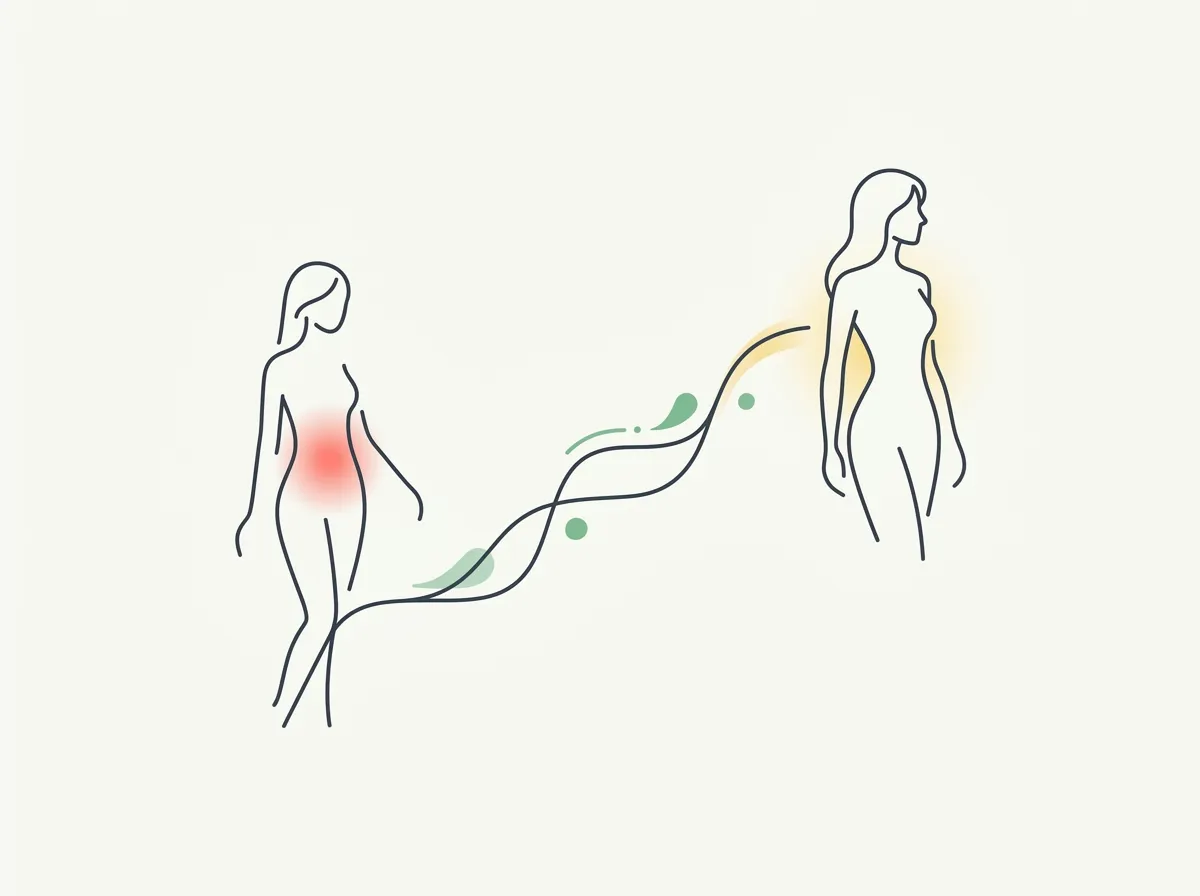
Quick answer: Skinny fat means a normal scale weight with relatively low muscle and enough body fat to look soft — commonly the result of years of dieting and cardio without resistance training. The way out for women is recomposition: progressive lifting, roughly 0.7–1 g protein per pound, and patience. More cardio and harder deficits deepen the pattern.
You've done everything the standard advice asked. The deficits, the step goals, the spin classes — maybe a decade of them. Your weight is fine, your BMI is fine, your doctor is fine with all of it. And the body in the mirror is still soft in the places you expected all that discipline to firm up.
That outcome has a name, and it isn't a willpower problem. Our general skinny-fat guide covers the diagnosis in depth and the recomp playbook covers the full fix — this page is the version for women specifically, because both the causes and the presentation run differently, and the standard advice aimed at women is most of how the pattern got built.
What does "skinny fat" actually mean for a woman?
Skinny fat describes a body composition, never a body weight: relatively low muscle mass plus enough body fat to read as soft, all at a scale weight the charts call normal. The scale and BMI both miss it completely, because they count total mass and have no idea how it splits between muscle and fat.
The numbers make it concrete. Using the reference ranges from our women's charts, the average range runs roughly 25–31% body fat — and a woman at, say, 28% with very little trained muscle can sit at a textbook-normal BMI while carrying the classic skinny-fat look. If you want to check where you land, the 60-second self-check and the women's body fat charts are the fastest routes.
One thing worth hearing before the mechanics: this pattern is extremely common, it's largely the predictable output of the advice women are handed, and it's fixable. Nothing below is a verdict on you.
Why is the skinny-fat pattern so common in women?
Because the mainstream playbook marketed to women for decades — eat less, do cardio, stay away from the weight room — is almost a recipe for it.
Chronic dieting without resistance training. Every deficit removes a mix of fat and muscle, and without lifting to signal "keep the muscle," the mix gets worse. Run that cycle a few times — lose 15, regain 10, repeat — and each pass commonly ends with a little less muscle and a little more relative fat at the same weight. Years of dieting can leave a woman lighter and softer simultaneously.
A cardio-only history. Cardio is genuinely good for you, and it burns calories. What it generally doesn't do is build appreciable muscle — so a training history that's all running, cycling, and classes leaves the muscle side of the equation untouched no matter how consistent it was.
The "toned without lifting" myth. Women have been sold toning workouts — tiny dumbbells, high reps, endless variations — that are marketed as sculpting and are too easy to build much of anything. The look those workouts promise is muscle with less fat over it, and the workouts themselves commonly deliver neither. If you spent years on them and got nowhere, the method failed you, and that's the whole story.
Why does skinny fat look different on women?
The male version of skinny fat is famously thin arms plus a belly. The female version commonly presents as an overall softness that concentrates where women preferentially store fat — the midsection, hips, and thighs — while staying invisible to every standard health metric.
That distribution matters for why it goes unnoticed so long. A soft midsection at a normal BMI doesn't trip any alarm; clothes still fit; the scale keeps saying fine. Women also start with less muscle mass than men on average and carry more essential fat by design — 10–13% versus 2–5% is the commonly cited gap — so the margin between "healthy average" and "soft with little muscle" is narrower and easier to drift across, especially through years of dieting.
What does the way out actually look like?
Here's the honest visual — the same woman at two body fat levels, as standardized, photorealistic AI renders from our body fat visualizer — same build, pose, and lighting, so only body fat changes between images. This five-point drop, with muscle built underneath, is roughly what a year of the plan below produces.
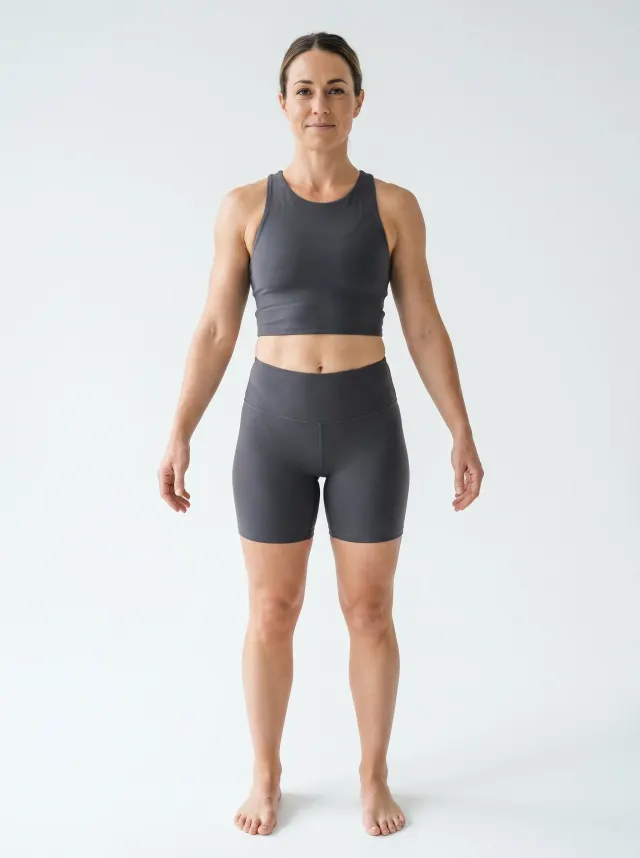
Around 27% body fat — squarely in the healthy average range, and where the skinny-fat pattern commonly lives. Normal weight, soft midsection, little visible muscle shape.
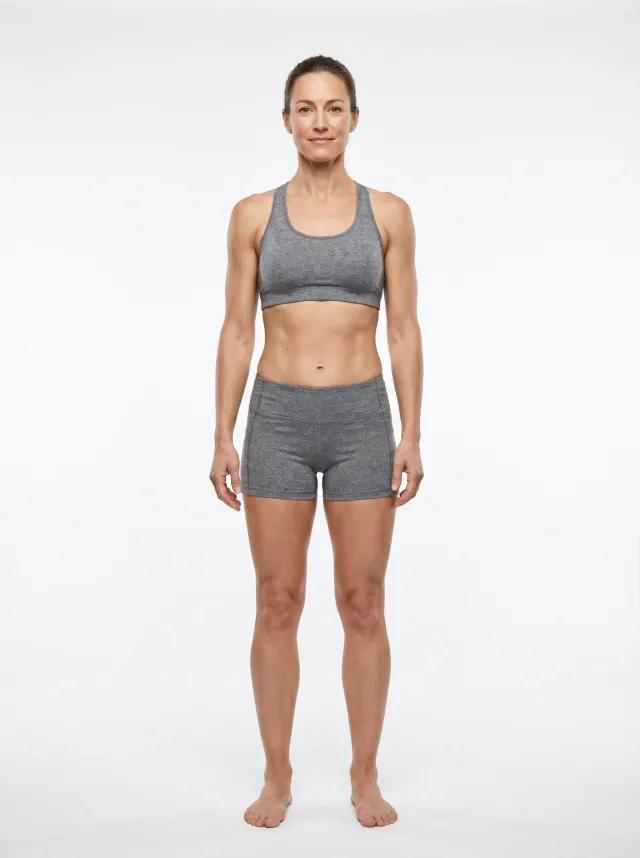
The same frame at 22% — the fitness range. Firmer midsection, shoulder and arm shape, curves intact. The scale might report almost none of this change.
Notice the size of the change versus the size of the weight difference. On the scale this transformation might total single-digit pounds, because fat left while muscle arrived — which is precisely why every previous scale-watching diet failed to produce it.
How do you actually fix skinny fat as a woman?
The fix is female recomposition, and our body recomposition guide for women is the complete plan — protein targets, training structure, tracking. The short version has three moving parts.
Lift, progressively, 2–4 times a week. Compound movements — squats, hinges, rows, presses — with weights that make the last few reps genuinely hard, made gradually harder over months. This is the input that was missing from every previous attempt, and it's the one that builds the shape dieting kept promising.
Eat protein like it's the point, because it is. Common evidence-based guidance lands around 0.7–1 gram per pound of body weight daily — roughly 105–150 grams for a 150-pound woman, far more than most women eat by default. Calories sit at maintenance or a slight deficit; recomp is a rebuild rather than another starvation round.
Retire the instinct to add more cardio and cut deeper. That instinct built the pattern. A harder deficit without lifting produces a smaller, softer version of the same body — the outcome you already have receipts for. Keep cardio you enjoy for health; stop asking it to change your shape.
And the fear that guards the weight room: lifting will not make you bulky. Women produce a fraction of the testosterone men do — commonly cited figures put it 10–20 times lower — and visible muscle arrives in millimeters over months, with plenty of time to steer. The physiques women point to as "too much" were built on purpose, over years, with training and eating most people never approach.
How do you know the fix is working?
The scale is nearly useless here — recomp trades fat for muscle at similar weight, and menstrual-cycle water swings of several pounds sit on top of the flat trend. Judge it with tools that see composition: strength numbers climbing, a waist measurement drifting down, and photos in consistent conditions every week or two.
Photos are the metric that matches the goal, and consistency is where they usually fall apart. GainFrame handles that part — weekly photo check-ins with an estimated body fat percentage per photo, per-muscle-group ratings, and aligned before/after comparisons that make a slow recomp visible months before the mirror admits it. The AI numbers are estimates from photos rather than clinical scans, but for confirming a trend is real, consistent photos beat the bathroom scale decisively.
Frequently asked questions
Can a woman be skinny fat at a normal weight?
Yes — that's the defining feature. Skinny fat means a normal scale weight and BMI with relatively low muscle mass and enough body fat to look soft, commonly around the midsection and hips. BMI only counts total mass, so it can't see the pattern. Body fat percentage and photos catch what the scale calls fine.
How do I know if I'm skinny fat as a woman?
Common signs: a normal BMI with a soft midsection, little visible muscle shape in the arms or shoulders, strength that hasn't changed in years, and a body fat estimate in the upper 20s or beyond despite a normal weight. If several of those land, our skinny-fat guide and 60-second self-check walk the full diagnosis.
Should a skinny fat woman cut or lift?
Lift. Another deficit on its own produces a smaller version of the same softness, because dieting removes fat and muscle alike and builds nothing. Most skinny-fat women do best with recomposition — progressive lifting and high protein at roughly maintenance calories — which trades fat for muscle at a similar scale weight.
Will lifting weights make a skinny fat woman bulky?
For the overwhelming majority of women, no. Women naturally produce far less testosterone than men, so muscle arrives gradually — months of deliberate training for visible change, years for anything dramatic. The lean, shaped look most women are actually after is built with exactly the progressive lifting the bulk fear warns against.
How long does it take to fix skinny fat for a woman?
First visible changes — a firmer midsection, some shoulder shape — commonly show around 8–12 weeks of consistent lifting with adequate protein. A change you'd notice across a room typically takes 6–12 months. Newer lifters progress fastest, which works in most skinny-fat women's favor, since the pattern usually comes from never having trained for muscle.
See the recomp the scale can't
GainFrame turns weekly photos into a body composition trend — estimated body fat, muscle-group scores, and aligned before/after comparisons that catch the fat-for-muscle trade while the scale reads flat. Free to start on iOS.
Download GainFrame Free